


Written by: Bryan Grobstein, Vice President, Global Revenue, AnyRoad
Key Takeaways
- Ambassador tastings can deliver immediate 475% sales lift, yet many brands miss first-party data and receipt-verified purchases, so spend goes unmeasured.
- Pre-event preparation drives results: confirm table placement within 20 feet of the product shelf, verify legal pour sizes by state, and complete compliance documents before the activation.
- A six-step tasting flow moves guests from awareness to action in 90 seconds or less, using curiosity-led questions, specific tasting notes, and a simple next step such as a QR code for cashback.
- Effective measurement uses QR registration at the table followed by receipt-verified cashback rebates, creating first-party records that prove retail sell-through without retailer POS integration.
- AnyRoad provides QR registration, receipt-reading AI, and rebate payout mechanics that turn ambassador tastings into measurable, repeatable programs.
See How AnyRoad Powers Tasting Programs

Pre-Event Preparation And Venue Scouting For Ambassador Tastings
Shallow preparation is the most common reason a well-staffed tasting underperforms. Supermarket placement studies show that sampling within 20 feet of the product's shelf space significantly increases purchase conversion compared to distant placements. Because that distance is the single biggest setup variable, table placement has to be negotiated before the event, when the store can still adjust its floor plan.
Traffic flow matters as much as location. A high-traffic front entrance can easily backfire for sampling, since shoppers entering a store focus on grabbing carts and starting their lists. They also have to carry purchase intent through the entire store before finding the product. Place the table in the category aisle or next to the product's secondary display instead.
The pre-event briefing document the manager hands to ambassadors should cover the following:
- Table placement confirmed within 20 feet of the product's shelf or secondary display
- Sample inventory count verified against planned pour volume plus a 10–15% buffer for spillage
- Glassware, single-use cups, and serving utensils packed and counted
- QR code registration asset tested on multiple devices before arrival
- Compliance documents on hand: server certification, event permit, and retailer approval
- Allergen cards and full ingredient panels displayed at the table
- Ice and cooler for temperature-sensitive mixers maintained below 41°F per FDA Food Code 2026 requirements
- Spittoon and water available at the table
- Store manager check-in completed 45 minutes before the shift starts
- Opening time-stamped photos of setup, shelf stock, and price tags captured
See How AnyRoad Supports Pre-Event Setup
How To Run An Ambassador Tasting: Six-Step Flow
The six-step flow below is the operational core of every ambassador tasting. Each step moves a passing shopper from awareness to a measurable next action.
- Greet. Make eye contact, smile, and open with a curiosity-driven question rather than “free sample.” Ask something tied to the shopper's occasion or category interest. Approved opening lines focus on the shopper's lifestyle, habits, or current shopping mission. “Are you a bourbon drinker?” outperforms “Want a free sample?” because it qualifies the guest and opens a conversation.
- Introduce The Brand And The Expression. State the brand name, the specific expression, and one differentiating fact such as origin, grain bill, aging process, or flavor profile. Keep this to one sentence so the guest remembers the point.
- Pour. Pour the legal measure for the jurisdiction and venue. Iowa limits spirits tastings to two 0.5-ounce tastes per person per brand under Iowa Code section 123.46(2), and Indiana caps distilled spirits at 0.4 ounces per pour. Know the rule for the state before the event. Hand the sample directly to the guest and avoid leaving it unattended on the table.
- Guide One Or Two Tasting Notes. While the guest tastes, name one or two specific sensory cues such as “dried cherry,” “toasted oak,” or “long finish.” Two notes are enough. More than that overwhelms the guest and sounds like a lecture.
- Ask For A Reaction. Invite the guest to respond with prompts such as “What are you getting?” or “How does that compare to what you usually drink?” The sample is the start of the program; the conversation creates the outcome. A guest who articulates what they tasted is more likely to buy.
- Present The Next Step. The moment immediately after a positive sample experience is one of the highest-receptivity windows for consumer feedback and digital opt-in. Use that window. Point to the shelf, hand the guest a bottle, or present the QR code for a cashback rebate. End every interaction with a clear, low-friction action.
Ambassador Tasting Script And Sample Flow
The script below is a word-for-word template. Managers can hand this to ambassadors at the pre-event briefing and allow staff to adapt the brand and expression details.
Ambassador Tasting Script — Field-Ready Template
Greet: “Hi there, are you a [whiskey / gin / tequila] drinker, or are you open to trying something new today?”
Introduce: “We’re pouring [Brand Name] [Expression] today. It’s [one differentiating fact, for example ‘a small-batch bourbon aged in new American oak barrels for six years in Kentucky’].”
Pour: [Pour the legal measure. Hand the sample directly to the guest.] “Here you go, take your time with it.”
Guide tasting notes: “As you taste it, see if you pick up [tasting note 1, for example ‘a caramel sweetness on the front’] and [tasting note 2, for example ‘a long, warm finish with a little spice’].”
Ask for a reaction: “What are you getting? Does that match what you usually go for?”
Present the next step: “It’s right here on the shelf.” [Point or hand the bottle.] “And if you scan this QR code, you’ll get [cashback rebate amount] back on your first bottle, redeemable anywhere you buy it. Just buy the bottle, photograph your receipt, and text it back. The rebate goes straight to your Venmo or PayPal.”
Alcohol Compliance Checklist For Ambassador Tastings
Compliance varies by state, venue type, and license category, yet every activation must meet core standards. The checklist below covers the non-negotiables for ambassador tastings involving distilled spirits.
- Server certification: Eighteen states plus the District of Columbia mandate alcohol server training by law. TIPS certification is accepted in all states that require training. Three states add their own requirements: California requires its RBS program under Business and Professions Code Section 25680, Oregon requires an OLCC service permit under Oregon Administrative Rules 845-006-0335, and Texas mandates TABC training for managers only, with at least one certified manager on premises during service hours. Verify the requirement for the activation state before staffing the event.
- ID verification: Check government-issued photo ID for any guest who appears to be under 30. Texas requires off-premises retailers to visually inspect and electronically scan government identification to confirm the shopper is at least 21.
- Legal pour sizes: Pour sizes are state-specific. Iowa limits spirits tastings to two 0.5-ounce tastes per person per brand, and Indiana caps distilled spirits at 0.4 ounces per pour. Federal TTB commercial sample limits under 27 CFR 27.49 set a ceiling of two ounces for distilled spirits, while stricter state rules take precedence.
- No service to minors or visibly intoxicated guests: Iowa law prohibits serving a taste to any consumer who is under 21, intoxicated, or simulating intoxication. This standard reflects common practice across jurisdictions.
- Hydration and spittoons: Water must be available at the table. Spittoons are required at formal tasting events and recommended at all activations.
- Food safety: The FDA Food Code 2026 requires food handlers to wash hands thoroughly and avoid bare-hand contact with ready-to-eat items. Use single-use gloves, clean utensils, or dispensing equipment. Wipe down customer-facing surfaces with food-grade sanitizing wipes every 15 minutes.
- Allergen disclosure: Display the full ingredient panel and allergen information at the table. Ambassadors must follow a strict non-speculation rule, presenting the physical ingredient panel directly to the consumer rather than guessing.
- Event permit: Confirm the retailer's license covers in-store sampling and that any required state event authorization is in place before the activation begins. Kentucky mandates that a retail licensee holding a sampling permit notify the Department of Alcoholic Beverage Control at least seven days before conducting a free sampling event.
- FTC audience composition: FTC self-regulatory standards require that at least 71.6% of the audience in alcohol promotional environments consists of legal-age adults.
Review Compliance Tools In AnyRoad
In-Store Demo Vs. Trade Show Vs. Private VIP Tasting: Key Execution Shifts
In-Store Demo (E.G., Total Wine, Regional Grocery)
The in-store demo is a conversion environment where the shopper already intends to buy. Staff retail in-store sampling events with 1 to 2 staff per store on 4- to 6-hour shifts, with staff comfortable working independently. Table placement within 20 feet of the product's shelf remains the most important setup variable. The six-step flow runs at pace, and Makai Inc. recommends limiting each shopper interaction to 90 seconds to keep traffic moving. The ask at Step 6 is direct: point to the shelf and present the QR code for a cashback rebate. Pour sizes must comply with state law, and the primary compliance risk is ID verification for guests who appear under 30.
Trade Show
Trade shows serve a mixed audience of trade buyers, press, and consumers, so staffing and scripting shift accordingly. For trade show and expo sampling, staff 2 to 6 people per booth who can qualify business leads while managing tastings. Setup must account for continuous coverage by zone so tasting stations and meeting areas stay staffed. The guest engagement flow at trade shows is designed to handle overflow crowds while keeping main walkways open and moving visitors toward product trials and meetings. For trade buyers, Step 2 expands to include distribution availability, velocity data, and retail sell-through story. The ask at Step 6 becomes a meeting or follow-up, rather than a shelf point. Pour sizes remain state-governed, and event permits must be confirmed with the venue before the show opens.
Private VIP Tasting
Private VIP tastings focus on relationship building with invited, qualified guests who expect depth. Makai Inc. recommends running private curated tasting events as intimate, invite-only sessions with a defined target buyer list and a precise run-of-show to avoid dead time. Pacing slows, and the ambassador can spend five to ten minutes per guest rather than 90 seconds. The script expands at Steps 4 and 5: guide two or three tasting notes, ask follow-up questions, and allow silence during the initial taste. Ambassadors must recognize when to let the product speak for itself and remain silent during the initial taste test. The ask at Step 6 becomes enrollment, a club sign-up, or a follow-up meeting. Data capture via QR registration still works well, with a value exchange based on club offers or exclusive access instead of cashback.
The table below summarizes how staffing, pacing, script emphasis, and the Step 6 ask shift across these three formats.
| Variable | In-Store Demo | Trade Show | Private VIP Tasting |
|---|---|---|---|
| Staffing | 1–2 per store, independent | 2–6 per booth, zone-assigned | 1–2 dedicated hosts per session |
| Interaction pace | ~90 seconds per guest | 2–5 minutes, longer for trade buyers | 5–10+ minutes per guest |
| Script emphasis | Flavor, shelf point, rebate QR | Velocity, distribution, trade ask | Heritage, depth, enrollment ask |
| The ask (Step 6) | Buy the bottle, scan QR for cashback | Schedule a follow-up meeting | Club enrollment or VIP follow-up |
Engagement And Disengagement At Ambassador Tastings
Effective engagement starts with a proactive posture: stand in front of the table, make eye contact, and open with a question. Ambassadors should master a three-part conversational structure. The Hook is a warm, open-ended question. The Proof is one distinct, memorable product attribute delivered while the customer tastes. The Direct is a clear, polite gesture toward the exact shelf location, paired with a mention of active promotions.
Reading guest interest is a core skill that protects conversion. Aggressive engagement kills conversion, so ambassadors should distinguish between browsing and active interest and adjust their approach. When a guest signals disinterest through short answers, a turned body, or eyes scanning elsewhere, the right move is a brief close such as “No problem, the bottle is right here if you change your mind” and a clean exit.
Ambassadors should disengage in the following situations:
- Guest declines eye contact or waves off the approach
- Guest accepts the sample but immediately turns away
- Guest gives one-word answers and does not ask follow-up questions
- Guest is with young children and focuses on managing them
- Guest explicitly says they are not interested or are in a hurry
When a guest appears intoxicated, the ambassador must stop service and keep the interaction calm. Staff must never argue with a customer or make subjective accusations regarding sobriety. Instead, they should politely state that house rules limit service, offer a cup of water, and discreetly notify store management. The retail store staff maintains ultimate authority over premises safety and customer removal.
How To Measure Whether An Ambassador Tasting Drove Sales
Counting samples poured shows how much product left the table, not whether anyone bought it. A depletion report that arrives three weeks after the activation has the same blind spot. Neither gives a CMO the evidence needed to renew the budget.
The tactical mechanic that closes the loop uses two steps: QR registration at the table, followed by a receipt-verified cashback rebate.
At the table, the ambassador presents a QR code through AnyRoad's Live mobile app at Step 6 of the tasting flow. The guest scans, registers, and becomes a first-party record tied to the activation. That record exists whether or not the guest buys the bottle in the store that day.

After registration, the guest receives an SMS with a cashback rebate redeemable anywhere the product is sold. They buy the bottle, photograph the receipt, and text it back. AnyRoad's AI reads the receipt, confirms the eligible SKU, and pays the rebate via Venmo or PayPal. Because the mechanic runs entirely on the receipt, no POS integration is required, and the retailer never has to open an API or share scan data. That independence makes the program deployable across trade accounts at scale.
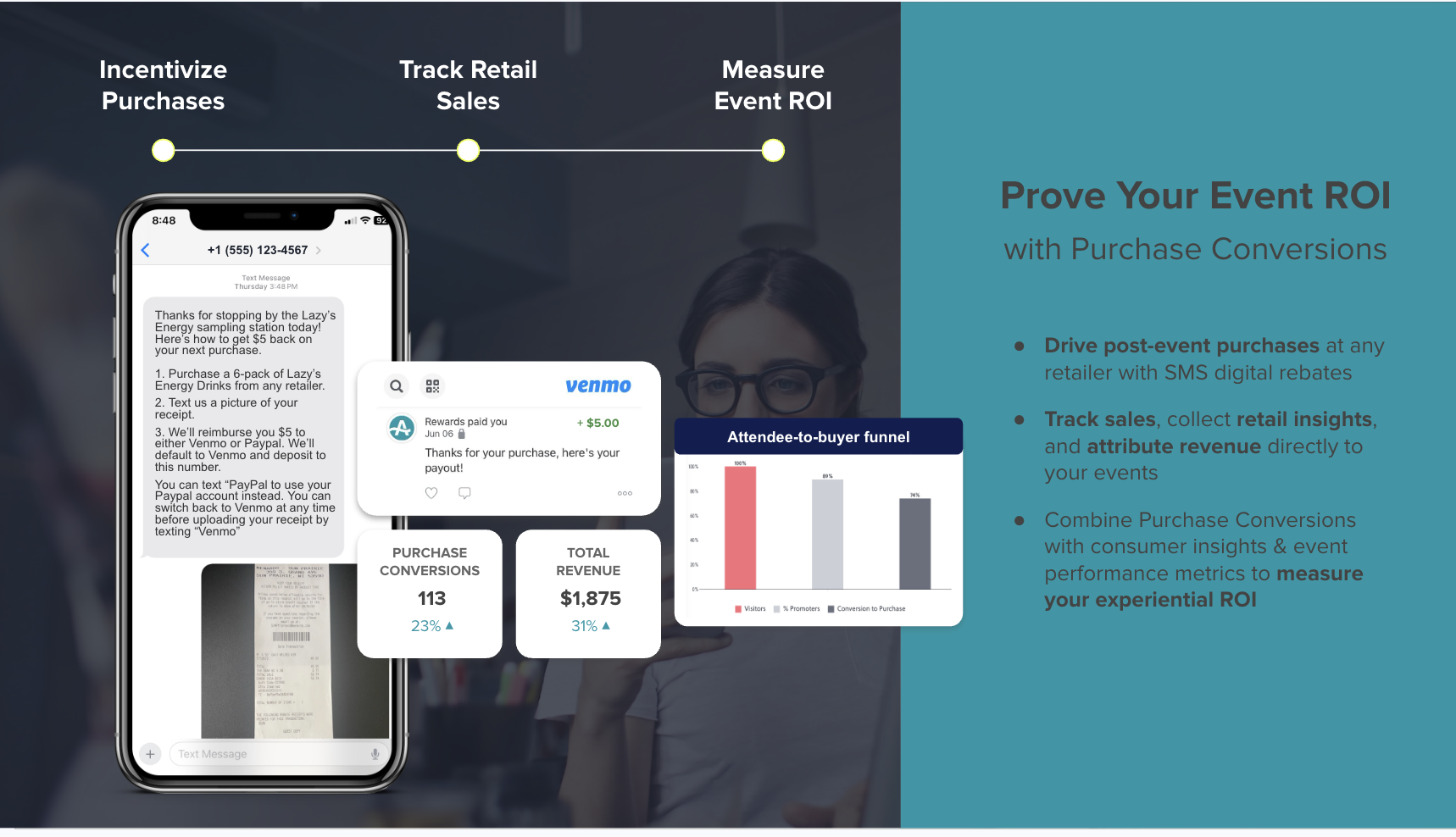
In an early one-month pilot with a single unnamed craft brand on a small dataset, 56% of the first-party records collected at ambassador tastings converted to a receipt-verified bottle purchase. That figure is a pilot result rather than a platform benchmark, yet it illustrates the difference between a tasting that produces a data point and one that produces only a depletion report.
Brands that prefer a prize mechanic instead of cash back can use AnyRoad's sweepstakes variant. It runs the same QR registration and SMS follow-up, with an entry to win something like event tickets rather than a rebate. AnyRoad handles the regulatory compliance around the sweepstakes, including terms and conditions and privacy policies.
Both approaches create a first-party record tied to a receipt-verified purchase, which is the artifact that connects experiential spend to retail sell-through. For more on how this measurement model works across a full ambassador tasting program, see AnyRoad's guide to proving ambassador tastings drive retail sales.
Explore AnyRoad Measurement In A Demo
Post-Event Debrief To Improve The Next Activation
The debrief turns each activation into a learning loop. Ambassadors observe guest behavior, objections, and competitive comparisons in real time, and that insight never appears in a depletion report.
Use the checklist below to structure every post-event debrief:
- Total samples poured and QR registrations captured, including conversion rate from pour to registration
- Top three guest objections or questions heard during the activation
- Competitive products guests mentioned by name
- Tasting notes that resonated most with guests
- Any compliance issues encountered, such as ID refusals, intoxicated guests, or permit questions
- Table placement assessment: was the placement rule met, and did traffic flow work?
- Inventory reconciliation: samples poured vs. inventory consumed vs. waste
- Store manager feedback and sign-off obtained
- Suggested script or setup changes for the next activation
The questions below address the issues ambassadors and managers raise most often when they stand up or scale a tasting program.
Frequently Asked Questions
What Are Some Tips For Brand Ambassadors Running A Tasting?
Effective ambassadors stand in front of the table, open with a curiosity-driven question, and guide one or two specific tasting notes while the guest tastes. They read body language to know when to engage and when to disengage, and they always present a clear next step such as a shelf point, QR code, or follow-up offer before the interaction ends. Strong preparation supports that performance, including knowing the legal pour size for the state, having allergen information visible, and confirming table placement near the product's shelf before the shift starts.
How Many Pours Should An Ambassador Tasting Include?
State law sets the maximum pour size and total volume, and federal TTB rules add an overall ceiling. For most in-store activations, one pour per guest works best because it keeps the interaction focused, manages inventory, and reduces the risk of a guest receiving multiple pours across a single shift. A second pour may fit a private VIP tasting where the format is explicitly educational and paced for depth.
How Do I Know If An Ambassador Tasting Worked?
A tasting worked when it produced both a first-party record and a receipt-verified purchase, rather than just a count of cups distributed. QR registration at the table captures the first-party record, and a receipt-verified cashback rebate confirms the bottle purchase. Each redemption creates SKU-level data that links the activation to a sale without retailer POS data. Brands that rely only on depletion reports cannot attribute sell-through to a specific activation, ambassador, or date, which makes it hard to refine the program or defend the budget.
Conclusion: Ambassador Tastings As A Measurable Growth Channel
An ambassador tasting that produces no first-party record and no measurable purchase leaves value on the table. The tasting is the data capture point, not the finish line. Every element of this field guide supports that idea: preparation that puts the table in the right place, a six-step flow that moves a guest from awareness to action, a script that any ambassador can execute consistently, a compliance checklist that keeps the activation legal, and scenario-specific execution that adapts the playbook to in-store demos, trade shows, and private VIP tastings.
The measurement layer of QR registration and receipt-verified cashback rebate separates tastings that prove their value from tastings that disappear into a depletion report. AnyRoad's platform provides the QR registration mechanic through AnyRoad Live, the receipt-reading AI that confirms the eligible SKU, and the rebate payout via Venmo or PayPal, with no POS integration required. The result is a first-party record tied to a verified purchase, deployable across any retail or on-premise account at scale.
For more on how ambassador tasting programs are structured end to end, see AnyRoad's overview of ambassador tasting program examples.
Talk With AnyRoad About Your Tasting Program