


Written by: Bryan Grobstein, Vice President, Global Revenue, AnyRoad
Key Takeaways
- Ambassador tastings deliver high-quality first-party data by combining zero-party preferences with validated identity and purchase intent in a high-trust, in-person setting.
- Brands see better results when they design data capture into every stage of the event, from pre-event registration through post-event follow-up.
- Ambassadors need training to collect data conversationally and compliantly, using plain-language scripts and technology that supports real-time CRM integration.
- Alcohol brands must prioritize age verification, explicit consent, and separate email and SMS permissions to stay compliant while capturing data at scale.
- AnyRoad turns ambassador tastings into a repeatable revenue engine—see how it works.
Why Ambassador Tastings Are Your Highest-Converting Data Channel
As third-party cookies disappear and privacy regulations tighten, first-party data has become the most defensible asset a brand can own. Ambassador tastings hold a structurally advantaged position in this landscape because they operate on a transparent value exchange: a consumer receives an immediate, tangible product experience in return for their information.
Kobie's 2026 Heart of Loyalty Research found that rewards for sharing are the single strongest driver of consumer willingness to share personal data, and separately found that 71% of consumers are willing to complete a one-time mini-survey. At a tasting, the reward is immediate, such as a sample, a discount, or exclusive access, which satisfies the privacy calculus consumers perform before sharing anything. The same research also found that trust and clarity are key: 95% of consumers said trust was at least somewhat important, and 89% wanted clarity on how their data would be used. Both conditions are naturally fulfilled by a well-run tasting.
The data captured at tastings is also structurally higher quality than digital channels. It combines zero-party data, such as declared flavor preferences and product feedback, with validated first-party data like age-verified identity and purchase intent. This happens in a context where all three components of permissioned data, identity, purpose, and permission, are naturally present. The table below shows how these data points map to each stage of the event, from pre-registration through follow-up.
| Event Stage | Data Points Captured | Example Fields |
|---|---|---|
| Pre-Event Registration | Identity, contact, demographics | Name, email, phone, age verification |
| During Tasting | Preferences, feedback, intent | Flavor preference, NPS, purchase intent |
| Post-Event Follow-Up | Transaction, loyalty, advocacy | Purchase validation, club enrollment, referral |
Ready to turn your ambassador tastings into a first-party data engine? Book a demo.
Planning Your Ambassador Tasting for Data Capture
Data capture should be an integral part of the event architecture from the start. The starting point is defining clear goals, because email list growth, retail sales conversion, and loyalty club enrollment each require different data fields and follow-up mechanics.
Pre-event planning should address the following:
- Define KPIs before the event: opt-in rate, data capture rate, conversion rate, and cost per qualified contact.
- Design registration forms around a minimum useful dataset. Makai Inc. recommends collecting only email or mobile number, explicit consent checkboxes, acquisition source, and sample SKU on-site, with secondary profile data gathered through automated follow-up.
- Choose technology that supports QR codes, mobile apps, and real-time CRM integration.
- Train staff on data collection scripts and compliance requirements before the event.
- Establish data capture points at every stage of the event flow, including check-in, tasting, and follow-up prompts.
Beyond these planning steps, the registration experience itself should be white-labeled and embedded on the brand's own website. This keeps the consumer journey on the brand's domain and ensures the data relationship begins and stays with the brand from the first interaction. Registration systems should map directly to CRM objects and campaign structures before event launch, which ensures consistent field mapping and structured data capture from the start.
Training Ambassadors to Collect Data Naturally and Compliantly
Ambassadors are the front line of any data capture strategy. Their ability to ask for information conversationally and build trust determines whether a consumer opts in. If the interaction feels natural, consumers are more likely to share their data. Field staff should use conversational consent scripts to maintain a natural interaction, such as offering a store locator and discount while noting that future product updates are optional.
Best practices for ambassador data collection include:
- Explain the value exchange clearly before asking for information.
- Handle objections without pressure, while keeping the QR code available if a consumer changes their mind.
- Pitch loyalty programs on-site, where enrollment conversion is highest.
- Avoid reading legal language verbatim and use plain-language consent scripts instead.
While these practices depend on ambassador skill, technology can reduce the operational burden on ambassadors. AnyRoad Live, AnyRoad's mobile capture app, allows ambassadors to register attendees on the spot, which eliminates paper forms and manual data entry. Capture software should support offline caching so data collection continues even in weak connectivity environments, a practical requirement for retail floor and festival activations alike.

The Technology Stack for Seamless Data Capture
The right technology stack converts a tasting from a one-off interaction into a data pipeline that feeds CRM and loyalty programs continuously. The essential components are:

- QR codes routed to mobile-optimized landing pages with UTM parameters for attribution. Dynamic, uniquely tracked QR codes allow each scan to be attributed to a specific event, market, ambassador, or activation zone, which enables real-time field staffing optimization.
- Mobile capture apps that allow ambassadors to register every attendee on the spot, including all members of a group, not just the person who booked.
- Real-time CRM integration that preserves source, market, and campaign IDs for attribution. Check-in data must update CRM records in real time so sales and customer teams can act while engagement is still active.
- AI-powered feedback analysis that turns open-text survey responses into actionable insights at scale.
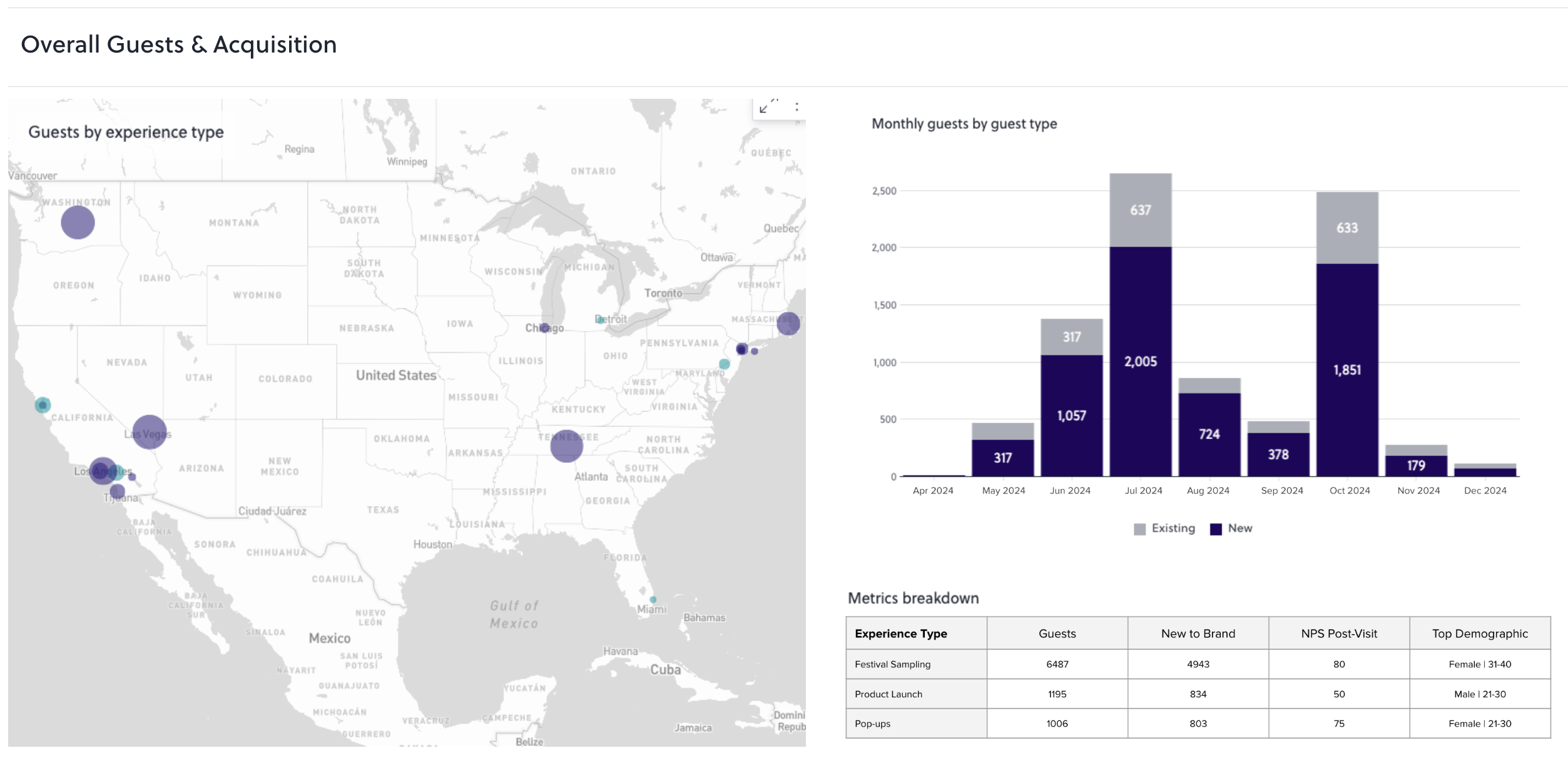
AnyRoad's platform provides all of these components in a unified system. The FullView feature captures data from every attendee in a group, not just the booker, which addresses a gap where brands routinely miss contact information for the majority of their guests. POPLIFE captured 45–50% more consumer data using AnyRoad compared to competitors during festival activations, with 42% of attendees opting into future marketing communications and 85% reporting purchase intent post-event. Diageo measured a 16-point NPS increase from pre-visit to post-visit at Johnnie Walker Princes Street using AnyRoad analytics.
See how AnyRoad captures data from every attendee. Explore the platform.
Compliance and Privacy Best Practices for Alcohol Brands
Compliance is non-negotiable for alcohol brands collecting first-party data at tastings. The regulatory landscape spans TCPA for SMS marketing, state and federal alcohol regulations governing tastings and shipping, and age verification requirements that apply before any personal data is processed.
A compliance checklist for alcohol brand tastings includes:
- Verify age before collecting any personal data, using integrated ID scanning.
- Obtain explicit, affirmative consent and avoid pre-checked boxes.
- Separate email and SMS consent so consumers opt into each channel independently.
- Provide a clear privacy policy at the point of data entry.
- Maintain a complete consent ledger with timestamps for every opt-in.
- Ensure data storage meets SOC 2 or ISO 27001 standards.
Under FCC guidelines, commercial text messaging programs require prior express written consent, and consumers must see exact details regarding message frequency, data rates, and opt-out commands before submitting their phone numbers. Email and SMS permissions must remain separate, because a consumer who opts into email has not consented to SMS, and treating them as equivalent creates legal exposure.
AnyRoad's platform includes integrated ID scanning for age verification and consent management features that keep brands compliant while minimizing operational burden on ambassador staff.
Measuring ROI: From Data Capture to Revenue
The ultimate test of an ambassador tasting program is whether it drives revenue. Attendance counts and samples distributed do not answer the question a CFO asks, which is what the brand actually owned after the event.
Key metrics to track across the data lifecycle include:
- Data capture rate: percentage of attendees who provide contact information.
- Opt-in rate: percentage who consent to marketing communications.
- Conversion rate: percentage who make a purchase after the tasting.
- Cost per qualified contact: total activation cost divided by permissioned contacts. Top-quartile ambassador programs achieve a lead capture rate of 25–35% and a sample-to-purchase rate of 30–45%.
- Repeat visit rate: percentage who return for a second experience.
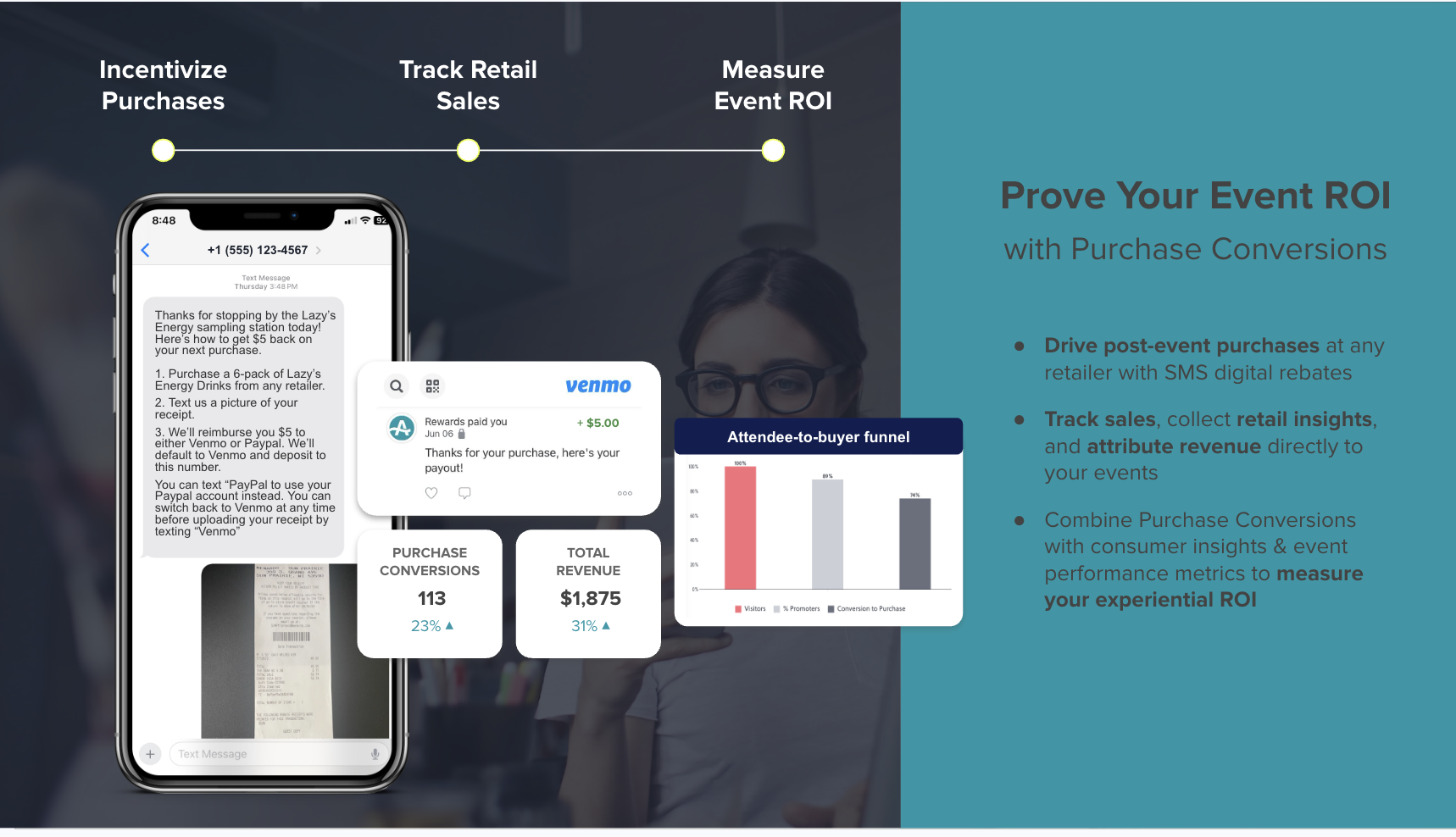
The most powerful measurement connects tasting data to actual sales. AnyRoad's cashback rebate mechanic closes this loop. A consumer registers at the tasting and receives an SMS with a rebate redeemable anywhere the product is sold. They purchase the bottle, photograph the receipt, and text it back. AnyRoad's AI reads the receipt, confirms the eligible SKU, and pays the rebate via Venmo or PayPal, with no POS integration required. This mechanic has already shown promise: in an early one-month pilot with a single craft brand on a small dataset, 56% of records collected at ambassador tastings converted to a bottle purchase. This is a directional early result, not a platform benchmark.
Know which bottles your activation actually sold. Request a demo.
Integrating Tasting Data with Loyalty Programs and CRM
The full value of first-party data from ambassador tastings appears when it feeds loyalty programs and CRM campaigns that drive long-term customer value. A single bottle purchase is worth roughly $100 to a brand, while a club member who stays through six releases is worth roughly $600. The gap between those two numbers forms the business case for connecting tasting data to enrollment infrastructure.
AnyRoad's data shows that a consumer who visits a distillery twice is 512% more likely to convert into a paid loyalty enrollment. Campari Group achieved a 3X increase in marketing opt-in rates over six months from brand home registrations and identified 4,500 repeat visitors as brand champions using AnyRoad. AnyRoad's Lifetime Loyalty platform reports that experience-driven opt-ins convert to paid loyalty at four times the rate of traditional channels, with member spending increasing 150% within the first year.
Integration best practices for connecting tasting data to CRM and loyalty programs include:
- Sync tasting data to CRM in real time so follow-up can happen while engagement is still active. Use email as the primary identifier for deduplication and account-level enrichment.
- Segment audiences by NPS, spend, and visit frequency to identify high-value prospects for club enrollment.
- Trigger automated follow-up sequences within minutes of the tasting, including immediate asset delivery, day two education, day seven retail locator, and day fourteen secondary incentive.
- Use tasting data to personalize club enrollment pitches on-site, targeting guests the data identifies as high-conversion candidates.
Loyal customers spend an average of 67% more than new customers, and a 5% increase in customer retention can boost profits by 25% to 95%, which makes the investment in connecting tasting data to loyalty infrastructure straightforward to justify.
AnyRoad's Lifetime Loyalty suite extends the platform beyond the visit with bottle clubs, premium memberships, cashback rebates, and managed CRM services. The platform's customer view lets brands stratify their audience at a micro level, by NPS, by spend, and by visit frequency, to surface the guests most likely to enroll and repeat purchase. Leiper's Fork Distillery, which previously hosted 24,000 tasting guests annually with no data on their identities, achieved a 97 post-event NPS using AnyRoad's automated surveys and now uses that data to refine experiences, retail approach, and social media messaging.
Common Pitfalls to Avoid
Even well-resourced brands make mistakes that undermine data capture efforts at ambassador tastings. The most common pitfalls are:
- Capturing data from only the booker instead of all attendees: AnyRoad's FullView feature addresses this directly. Proximo Spirits found they were missing contact information for over 66% of their guests before implementing FullView, after which they immediately began collecting 69% more guest data and 34% more NPS responses.
- Using generic forms that do not ask the right questions: Design forms around specific KPIs and the minimum useful dataset for each activation type.
- Ignoring compliance requirements: Age verification and explicit, channel-specific consent are mandatory for alcohol brands.
- Failing to follow up promptly: The first follow-up message must arrive within minutes of the interaction to avoid high bounce rates and rapid opt-outs.
- Skipping ROI measurement: Connect tasting data to actual sales using cashback rebates or sweepstakes, because depletion reports alone do not answer the CFO's question.
- Treating data capture as an afterthought: Design the event flow around data collection from the planning stage, before the activation is scheduled.
Frequently Asked Questions
What is first-party data in the context of ambassador tastings?
First-party data is information a brand collects directly from consumers with their explicit consent through owned channels and interactions. At ambassador tastings, this includes identity data such as name, email, and phone, zero-party data such as declared flavor preferences and product feedback, behavioral data such as purchase intent and NPS scores, and consent records such as opt-in timestamps and channel preferences. Because teams collect it in person with a clear value exchange, tasting-sourced first-party data is typically more accurate and more actionable than data collected through digital advertising or third-party sources.
How do I collect first-party data at a tasting event without disrupting the experience?
Teams see the best results when they design data capture into the event flow rather than bolting it on at the end. Use QR codes that route to mobile-optimized registration forms so consumers can register on their own devices. Deploy a mobile capture app like AnyRoad Live so ambassadors can register attendees on the spot during natural conversation. Collect only the minimum useful dataset on-site, such as email or mobile number, explicit consent, acquisition source, and sample SKU, and gather secondary profile data through automated follow-up messages. Keep forms short, because research consistently shows that asking for too much at once is the single largest driver of opt-out.
What are the compliance requirements for alcohol brands collecting first-party data at tastings?
Alcohol brands must verify age before collecting any personal data, using integrated ID scanning rather than self-declaration alone. Consent must be explicit and affirmative, since pre-checked boxes do not satisfy legal requirements. Email and SMS consent must be collected separately, because a consumer who opts into email has not consented to SMS marketing. Every opt-in must be recorded with a timestamp and stored in a consent ledger. TCPA governs SMS marketing and requires prior express written consent with full disclosure of message frequency, data rates, and opt-out commands. State and federal alcohol regulations apply to tastings and any subsequent shipping or club enrollment. Data storage should meet SOC 2 or ISO 27001 standards.
How do I measure ROI from ambassador tastings beyond attendance and samples distributed?
Track data capture rate, which is the percentage of attendees who provide contact information, opt-in rate, which is the percentage who consent to marketing, conversion rate, which is the percentage who purchase after the tasting, cost per qualified contact, which is total activation cost divided by permissioned contacts, and repeat visit rate. To connect tasting data directly to retail sales, use cashback rebates or sweepstakes that require receipt submission, because this creates a verified link between the activation and a bottle leaving a shelf. Over time, measure club enrollment rate from tasting attendees and customer lifetime value to quantify the long-term return on each permissioned contact captured.
How do I integrate tasting data with my CRM and loyalty programs?
Choose a platform that syncs data to your CRM in real time, preserving source, market, and campaign IDs for attribution. Map registration fields directly to CRM objects before the event, and use email as the primary identifier for deduplication. Trigger automated follow-up sequences immediately after the tasting while engagement is still active. Segment your audience by NPS, spend, and visit frequency to identify high-value prospects for loyalty enrollment. For brands without in-house email marketing capability, a managed CRM service built on top of experiential data, rather than a horizontal tool that requires the brand to supply both the data and the expertise, significantly reduces the operational lift required to activate tasting data at scale.
Turn Every Tasting into a Data Asset
Ambassador tastings function as a strategic data capture channel, not just a brand activation. Executed with deliberate planning, trained staff, compliant technology, and a clear path from data to action, they produce high-quality first-party data for alcohol and CPG brands, data that fuels CRM segmentation, loyalty enrollment, and measurable revenue growth.
AnyRoad provides the platform and expertise to make this operational. From white-labeled registration and FullView group data capture to AI-powered feedback analysis and the full Lifetime Loyalty suite, including bottle clubs, premium memberships, cashback rebates, and managed CRM services, AnyRoad turns every tasting into a data asset that compounds over time.
Turn every tasting into a data asset. Start your demo.