


Written by: Bryan Grobstein, Vice President, Global Revenue, AnyRoad
Key Takeaways
- Replace depletion reports with first-party data: Ambassador tasting group booking data captures registration, on-site, and post-visit purchase records that tie each activation to a verified bottle sale.
- Capture data across three stages: Booking fields (name, email, party size, opt-ins), on-site fields (QR registration, ID scan, FullView group capture), and post-visit fields (receipt submission and verified purchase confirmation) create a complete data set.
- Record every guest, not just the booker: Group-member capture via FullView closes the gap where only the booker is recorded. Proximo Spirits saw 69% more guest data and 34% more NPS responses after implementation.
- Connect tastings to verified purchases: Receipt-verified rebates link registrations to actual purchases without POS integration, enabling 56% conversion in early pilots and scalable attribution across any retail or on-premise account.
- Use one platform for the full data flow: AnyRoad captures data from booking through verified purchase, giving brands the attribution they need to prove ROI. See how AnyRoad captures the full data flow to prove ROI.
Why Depletion Reports Miss Ambassador Tasting Impact
A depletion report measures product sold and delivered by a distributor to licensed retail accounts, at the point where inventory moves through the middle tier and enters the retail tier. It captures movement through the wholesale tier rather than a consumer purchase, so it shows that product reached a shelf, not that an ambassador tasting caused a shopper to buy it.
Registration volume alone does not solve this. A headcount, even with better formatting, is still just a headcount. The measurement problem is attribution: which activation sold a bottle? Depletion data tells a supplier that product reached the shelf or account, not that a tasting or other activation caused a shopper purchase. Monthly depletion files delivered a week or two after close mean a brand is reacting to a market that has already moved on.
Many pages in this space treat tasting data primarily as attendance or reservations, rather than as a purchase-attribution problem. That is the gap this guide fills. To close it, you need to capture the right data at every stage of the tasting.
Data To Capture At Every Ambassador Tasting
Effective ambassador tasting data capture is organized into three stages. Each stage produces a distinct record. Together they form the complete group tasting booking data set that connects a registration to a verified bottle sale.
Booking Fields, captured before the tasting:
- First and last name
- Email address
- Mobile number (for SMS follow-up)
- Party size
- Marketing opt-in consent
- Occasion or visit context (e.g., birthday, corporate event, casual discovery)
- Custom qualifying questions (e.g., preferred spirit category, purchase intent, how they heard about the brand)
On-site Fields, captured at the activation:
- QR-based registration via mobile (AnyRoad Live)
- ID scan and age verification for every guest
- Group-member capture, a record for every attendee in the party, not only the booker
- Real-time opt-in confirmation

Post-visit Fields, captured after the tasting:
- Receipt submission after purchase
- Eligible SKU confirmation
- Rebate or sweepstakes redemption record
- Verified purchase record tied to the original registration
This field-level list is what no competing page publishes. A brand ambassador tasting schedule that captures only the booker's email produces an incomplete data set. Reservations capture only one member of the party and lack the qualitative intent signals, location, and interest tags needed for closed-loop attribution. Tasting group reservation data becomes actionable when it includes every guest in the party and a post-visit purchase signal. Booking form design guidance consistently recommends asking only for information that will actually be used, and every field above has a direct downstream use in attribution or follow-up marketing.
Capturing Data From Every Guest In The Group
The standard booking model records one contact for an entire party, leaving the other guests in the group anonymous. Those guests attended, tasted, and may have purchased, yet the brand has no record of them.
This gap in group tasting booking data affects every program. Proximo Spirits discovered it directly: before implementing AnyRoad's FullView feature, the brand was missing contact information for over 66% of its guests. After turning on FullView, Proximo immediately began collecting significantly more guest data and NPS responses.
FullView-style capture prompts every attendee in the group to register at the point of on-site check-in. The person who made the booking registers, and every other guest does as well. With QR Wall's attendee capture enabled on the Professional plan, each guest scans the event QR code, enters an email or phone number once with a clear disclosure that the organizer receives their details, and every subsequent photo and message is linked to that individual contact, downloadable as a CSV with contact, first-seen, post count, and consent timestamp. The wine ambassador program or spirits ambassador program that runs this flow leaves every activation with a complete guest list rather than a single booker record.
Age verification is also part of this on-site flow. AnyRoad's integrated ID scanning embeds age verification directly into the registration step, so compliance and data capture happen in one motion rather than two separate processes.
See how FullView can expand your guest database
Connecting Tasting Registrations To Bottle Purchases
This mechanic turns ambassador tasting data capture into measurable revenue impact. The steps are concrete and sequential:
- Guests scan a QR code at the activation and register on the spot through the AnyRoad Live mobile app.
- After registering, each consumer receives an SMS containing a cashback rebate redeemable anywhere the product is sold.
- The consumer buys the bottle at the retailer where the tasting took place, at a different store, or on-premise, and photographs the receipt.
- They text the receipt photo back via SMS.
- AnyRoad's AI reads the receipt, confirms the eligible SKU, and pays the rebate out via Venmo or PayPal.
The critical operational point is simple. Receipt-validated rebate programs require no retailer agreements, POS integration, or bilateral data-sharing arrangement at any retail banner. The mechanic runs entirely on the receipt. This means it works in any account, such as Total Wine, an independent retailer, or a bar, without asking anyone to integrate anything. That structure makes it deployable across trade accounts at scale and makes on-premise conversion tracking possible.
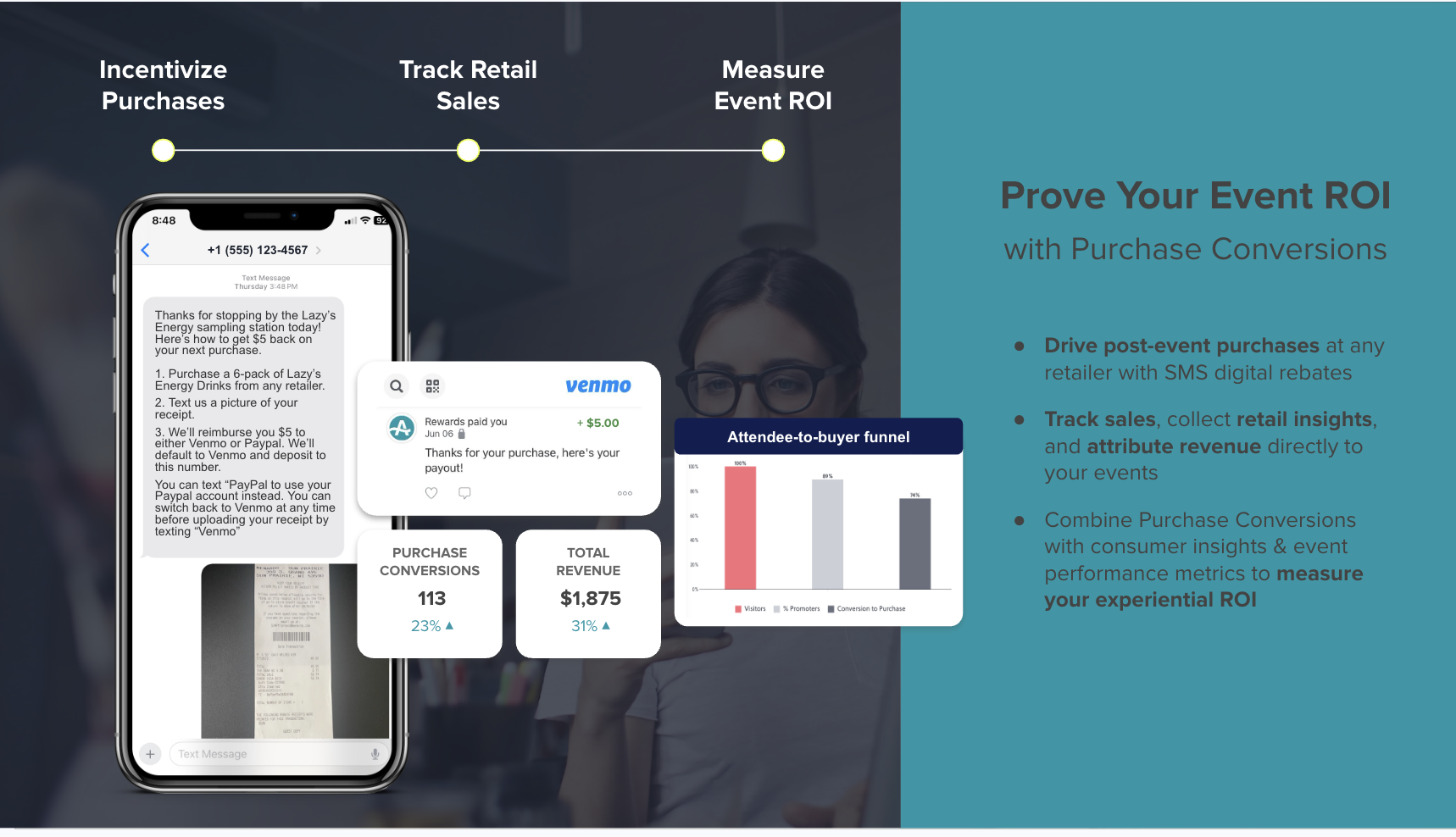
In an early, small-sample one-month ambassador tasting pilot with a single unnamed craft brand, 56% of the records collected converted to a bottle purchase. This was an early, small-sample, single-brand pilot result, not a platform benchmark, but it illustrates what the mechanic produces when the capture flow is complete.
A sweepstakes variant runs the same flow with a prize entry instead of cash back, for example, a chance to win Coachella tickets rather than a rebate. AnyRoad handles the regulatory compliance for the sweepstakes variant, including terms and conditions and privacy policies. This support removes a significant operational burden from the brand's team.
Every submission in either variant produces a first-party record tied to a receipt-verified purchase. That connection links experiential spend to retail sell-through and replaces the depletion report as the measure of whether an activation worked.
Connect your tastings to verified purchases
Reporting Ambassador Tasting Results Without POS Data
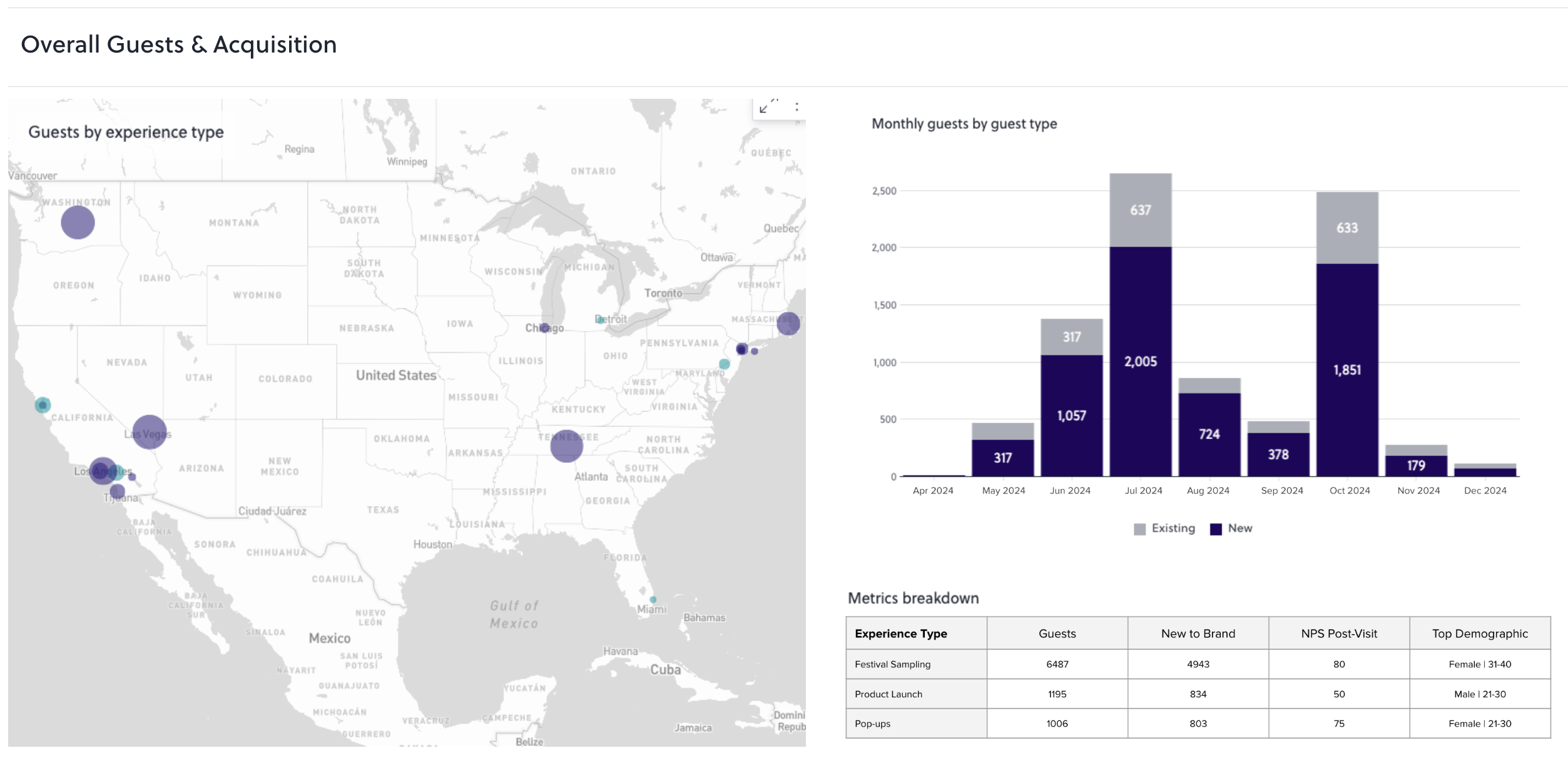
Reporting correctly means reporting on the right metrics. Instead of headcount, focus on verified purchase conversion. A useful dashboard for an ambassador tasting program tracks metrics such as:
- Registration Volume: how many guests registered across all activations in the period.
- Group Capture Rate: how many guests in each party were individually recorded, expressed as a percentage of total party size.
- Verified Purchase Conversion: how many registrations produced a receipt-verified bottle sale.
These metrics answer the question a field marketing manager actually needs to answer when justifying the next activation budget. The question is how many guests bought a bottle the brand can prove. A program that moves volume but cannot tell you how much of it was incremental is a program you cannot defend in the next budget conversation. Measuring ambassador tasting ROI correctly means tying every registration to a downstream purchase event, rather than to a depletion figure that arrived six weeks after the activation closed.
Comparing Ambassador Tasting And Loyalty Membership Programs
Ambassador tasting programs and loyalty membership programs solve different problems and rely on different data. Ambassador tasting programs are brand-led activations inside third-party retail and on-premise accounts, measured by booking and registration data and tied to individual bottle purchases at the activation level. Unlike loyalty programs, they are not recurring paid memberships.
Ambassador or loyalty membership programs, including bottle clubs and premium memberships, are recurring paid relationships with their own enrollment economics, churn dynamics, and lifetime value math. Subscription-based loyalty programs require customers to pay a recurring fee in exchange for continuous access to benefits, which creates a fundamentally different exchange than a tasting registration. Operators searching for wine ambassador program guidance or brand ambassador tasting schedule tools are solving a different problem than operators building a bottle club. Treating them as the same produces the wrong solution for both.
How AnyRoad Supports Ambassador Tasting Attribution
AnyRoad captures ambassador tasting group booking data at every stage of the flow. At booking, it collects configurable registration fields and marketing opt-ins. On-site, it supports QR-based registration, ID and age verification, and FullView group-member capture. Post-visit, it runs the receipt-verified rebate mechanic that closes the loop to a bottle purchase without needing POS integration.

AnyRoad Live turns any activation into a data capture point. The cashback rebate mechanic converts that capture into a verified purchase record. FullView ensures every guest in the group is recorded, not only the booker. Because the entire mechanic runs on the receipt, brands can deploy it across any retail or on-premise account without asking a retailer or bar to integrate anything.
AnyRoad acts as the brand's agent in this flow. The compliant transaction and delivery for any club or DTC component happen through AnyRoad's licensed ecommerce retail partner. AnyRoad does not sell, ship, or distribute alcohol itself. The white-glove service team, staffed by spirits industry operators with deep experience building and running large-scale spirits programs, coaches on-site staff on how to run the capture flow and make the enrollment pitch. This support helps ensure the technology produces results rather than sitting unused.
Operational Checklist For Your Next Activation
Before the next activation, confirm each of the following is in place:
- Define the booking fields: Capture the contact and context details your team will actually use for follow-up and attribution, such as name, email, mobile, party size, marketing opt-in, and occasion.
- Add on-site QR registration and ID/age verification: Implement NIST SP 800-53 IA-4(7) in-person registration: every guest must appear before an authorized registrar who validates identity artifacts and matches the person to the claimed identity, with age verification embedded in the same flow, and no account activation or credential issuance until in-person registration is marked complete.
- Turn on group-member capture: Record every guest in the party individually, not just the booker.
- Attach a receipt-verified rebate or sweepstakes to the eligible SKU: For a Brij SMS rebate, the SMS goes out at registration (the customer signs up and receives the intro text), and the receipt comes back after purchase when the customer texts a copy of the receipt, triggering a 'Receipt Received' acknowledgment text.
- Report verified purchase conversion, not headcount: Registration volume, group capture rate, and verified purchase conversion are the metrics that justify the next budget.
Get attribution for every bottle sold
Frequently Asked Questions
What Is Ambassador Tasting Group Booking Data And Why Does It Matter?
Ambassador tasting group booking data is the set of registration and purchase information collected when guests book or attend a brand ambassador-led tasting inside a third-party retail or on-premise account. It typically includes the booker's contact details, party size, marketing opt-ins, on-site registrations from guests in the group, and post-visit purchase records that can tie the tasting to a bottle sale. It matters because it replaces the depletion report, which only shows that product moved through the wholesale tier, with a first-party record that connects a specific activation to a specific consumer purchase. Without logged tasting activity data, a field marketing manager has no defensible answer to which tasting sold which bottle, because distributor depletion reports show case totals but not the tastings or other field actions that caused them.
How Do You Capture Data From Every Guest In A Group, Not Just The Person Who Booked?
The standard booking model records one contact per party, leaving every other guest in the group anonymous. Group-member capture solves this by prompting every attendee to register individually at the point of on-site check-in, typically through a QR code that loads a short registration form on their mobile device. AnyRoad's FullView feature operates this way: each guest in the party completes their own registration, producing an individual record with their own contact details, opt-in status, and downstream purchase data. Proximo Spirits found that before implementing FullView, more than 66% of their guests had no contact record at all. As mentioned earlier, Proximo Spirits saw a 69% increase in guest data and a 34% increase in NPS responses. Age verification is embedded in the same on-site flow, so compliance and data capture happen together rather than as separate steps.
How Does Receipt-Verified Purchase Attribution Work Without POS Integration?
The mechanic is entirely receipt-based, which means it requires no integration from any retailer or bar. After a guest registers at an ambassador tasting via QR code, they receive an SMS with a cashback rebate offer tied to an eligible SKU. When they purchase the bottle at any retailer or on-premise account, they photograph the receipt and text it back. AnyRoad's AI reads the receipt, confirms the eligible SKU, and pays the rebate via Venmo or PayPal. Every qualifying submission produces a verified purchase record that includes the product, the retailer, and the date of purchase, all tied to the original tasting registration. A sweepstakes variant runs the same flow with a prize entry instead of cash back, with AnyRoad handling the regulatory compliance. Because the mechanic runs on the receipt rather than on a POS connection, it works across any trade account at scale and makes on-premise conversion tracking possible in a way that depletion reporting never can.
What Is The Difference Between An Ambassador Tasting Program And A Loyalty Membership Program?
An ambassador tasting program is a brand-led activation inside a third-party retail or on-premise account. An ambassador tasting program's data consists of consumer engagements, bottles sold during events, and demographic details of participants, and its measurement is verified purchase conversion from individual activations, calculated as conversion rates to measure ambassador performance. A loyalty membership program, including a bottle club or premium membership, is a recurring paid relationship with its own enrollment economics, churn dynamics, and lifetime value calculation. The two programs serve different purposes, produce different data, and require different infrastructure. Operators sometimes confuse them because both involve brand representatives and consumer engagement, but the data capture flow, the measurement framework, and the technology required are distinct. An ambassador program is a relationship-driven advocacy model typically measured activation by activation, whereas a loyalty program is a commercial retention and incentive model primarily measured by enrollment, retention, and lifetime value across a recurring relationship.
How Should A Field Marketing Manager Report On Ambassador Tasting ROI?
A useful reporting framework for ambassador tasting ROI includes metrics such as registration volume, group capture rate, and verified purchase conversion. Registration volume shows how many guests registered across all activations. Group capture rate shows what percentage of each party's total guests were individually recorded. Verified purchase conversion shows how many registrations produced a receipt-verified bottle sale. Headcount and depletion figures do not substitute for these metrics. A depletion report tells a brand that product moved through the wholesale tier; it does not tell a brand which activation caused a consumer to buy. Verified purchase conversion, verified units or revenue proving a purchase occurred at the register, is the foundational metric that connects an activation directly to a bottle sale and, through test-versus-control incrementality, provides the causal evidence required to justify field marketing budgets. AnyRoad's platform captures all three data points without needing POS integration from any retail or on-premise account.