


Last updated: March 4, 2026
Key Takeaways
- Gen Z prioritizes experiences over possessions, creating a $360B spending opportunity for CPG and alcohol brands through authentic brand activations.
- Create Instagrammable moments with AR filters and QR codes to drive organic social sharing and visibility on TikTok and Instagram.
- Align activations with purpose-driven causes like sustainability to build trust, and use AI to customize and measure engagement.
- Use AR/VR gamification and UGC challenges for immersive, viral experiences that increase purchase intent and brand affinity.
- Prove ROI with comprehensive data capture and AI analytics, and book a demo with AnyRoad to scale Gen Z activations into revenue drivers.
1. Design Instagrammable, Shareable Brand Experiences
Gen Z now discovers products visually on social platforms instead of search engines. Over 50% of Gen Z starts product searches on TikTok, Instagram, or YouTube instead of Google, looking for inspiration and real reviews. Shareable, photogenic activations now sit at the center of brand visibility.
Hi-Chew’s pop-up activation shows how this approach works in practice. Over 11 days, their activation drew 36,000 visitors and generated more than 132,000 social impressions with 1,500 influencer engagements. The team focused on Instagram-worthy moments that naturally encouraged guests to create and share content.
Tactical implementation steps:
- Design photo-ready spaces with AR filters, bold colors, and branded backdrops.
- Place QR codes that link to exclusive content, discounts, or limited-time drops.
- Use AnyRoad’s Front Desk app for fast, low-friction check-ins that keep lines moving.
- Capture attendee data with AnyRoad’s FullView feature so you collect details from every participant, not just the booking contact.
2. Build Purpose-Driven Activations Gen Z Trusts
Authenticity drives Gen Z engagement more than any other factor. 53% of Gen Z expects brands to support mental health and environmental causes, so purpose-driven activations now play a central role in building meaningful connections.
Diageo illustrates this approach with measurable results. The company achieved a 16-point NPS increase by using AI to customize experiences around sustainability and responsible consumption. Their $185 million investment in 12 distilleries centers on transparent storytelling that aligns with Gen Z values.
Implementation tactics:
- Partner with local nonprofits or environmental initiatives that your audience already supports.
- Create experiences that clearly explain your brand’s sustainability commitments and progress.
- Use AnyRoad’s PinPoint AI to analyze feedback sentiment and see which purpose-led elements resonate most.
- Track brand affinity shifts with pre- and post-experience surveys tied to each activation.
3. Use AR and VR Gamification to Deepen Engagement
Immersive technology keeps Gen Z’s attention longer than traditional channels. TikTok leads short-form vertical video consumption among Gen Z at 64%, yet AR and VR experiences create deeper engagement by enabling hands-on product interaction.
Adoption of new tools continues to accelerate across this generation. 60% of Gen Z ages 18-28 have used ChatGPT at least once, and 64% of Gen Z teens use AI chatbots. These behaviors show strong comfort with emerging technologies and interactive formats.
Brands can now gamify Gen Z activations with AR and VR while still capturing robust data. Book a demo to see how AnyRoad manages immersive experiences with end-to-end data collection.
Strategic implementation:
- Build AR product trials that let Gen Z visualize your products in their homes or social settings.
- Develop VR experiences that tell your brand story through interactive scenes and challenges.
- Use AnyRoad’s QR code system to trigger instant feedback forms during or right after the experience.
- Add gamification elements such as points, levels, or competitions with clear, trackable outcomes.
4. Turn UGC and TikTok Challenges into Always-On Reach
User-generated content delivers authentic engagement at scale for Gen Z. 43% of Gen Z engages with interactive content like polls, quizzes, and Q&As, and they prefer to co-create content rather than consume it passively.
TikTok challenges offer especially strong reach and cultural relevance. TikTok has around 37 million U.S. Gen Z users in 2025, giving brands a large base for viral campaigns. Sierra Nevada reached an 85% brand conversion rate by encouraging post-experience content creation and community building around their activations.
Execution framework:
- Co-create challenge concepts with Gen Z influencers who already speak to your target audience.
- Design on-site moments specifically for filming, duets, and quick edits.
- Use AnyRoad’s integrations with content capture tools like Smilebooth to simplify sharing.
- Track UGC volume, engagement, and sentiment through AnyRoad’s analytics dashboard.
5. Capture First-Party Data to Power Gen Z Loyalty
First-party data turns one-time attendees into repeat customers. Proximo Spirits discovered that they lacked contact information for more than 66% of their guests before implementing a complete data capture system. After adopting AnyRoad’s FullView feature, they collected 69% more guest data and 34% more NPS responses immediately.
27% of Gen Z expect to shop again with most or all new brands they have tried, so the first interaction matters. Brands need meaningful data that supports personalized follow-up and loyalty programs.
Data capture strategy:
- Build custom surveys that collect preferences, purchase intent, and demographic details without overwhelming guests.
- Use AnyRoad’s Atlas Insights for advanced segmentation and direct CRM integration.
- Sync data automatically with platforms like HubSpot or Klaviyo for timely follow-up.
- Trigger personalized email or SMS sequences based on experience feedback and stated interests.
6. Prove Experiential ROI with AI-Driven Analytics
Experiential marketing now requires proof of revenue impact, not just attendance. Success measurement in 2026 focuses on metrics like data capture rates, purchase intent lifts, and long-term loyalty indicators instead of impressions alone.
Absolut shows how data-backed measurement can unlock larger budgets. The brand used AnyRoad data to justify increased investment in premium experiences and achieved a 36% improvement in guest revenue per visit. Their team connected experiential data directly to purchase behavior and lifetime value.
Brands can now turn activations into measurable revenue drivers with the right analytics. Book a demo to see how AnyRoad’s AI tools prove experiential marketing ROI.
Measurement framework:
- Track NPS shifts, purchase intent changes, and brand affinity scores for each activation.
- Use AnyRoad’s Purchase Conversion Tools to link experiences to retail or ecommerce sales.
- Deploy PinPoint AI for automated feedback analysis and trend detection across locations.
- Monitor long-term customer lifetime value through integrated CRM and sales data.
Scale Gen Z Brand Activations with AnyRoad
These six strategies work best when supported by a single, connected platform. Brands like Diageo, Absolut, and Sierra Nevada show that AnyRoad enables full-funnel experiential marketing, from booking and check-in through post-experience purchase conversion.
The platform advantage comes from data ownership and deep integrations. Competitors often redirect customers to third-party sites, which weakens the brand experience and limits data collection. AnyRoad’s white-labeled solution keeps your brand front and center while capturing first-party data at every touchpoint.
Gen Z represents the future of consumer spending, and brands that pair authentic experiences with strong measurement will earn their loyalty. AnyRoad’s AI-powered platform streamlines operations, captures complete data, and proves ROI, turning experiential marketing from a cost center into a revenue engine.
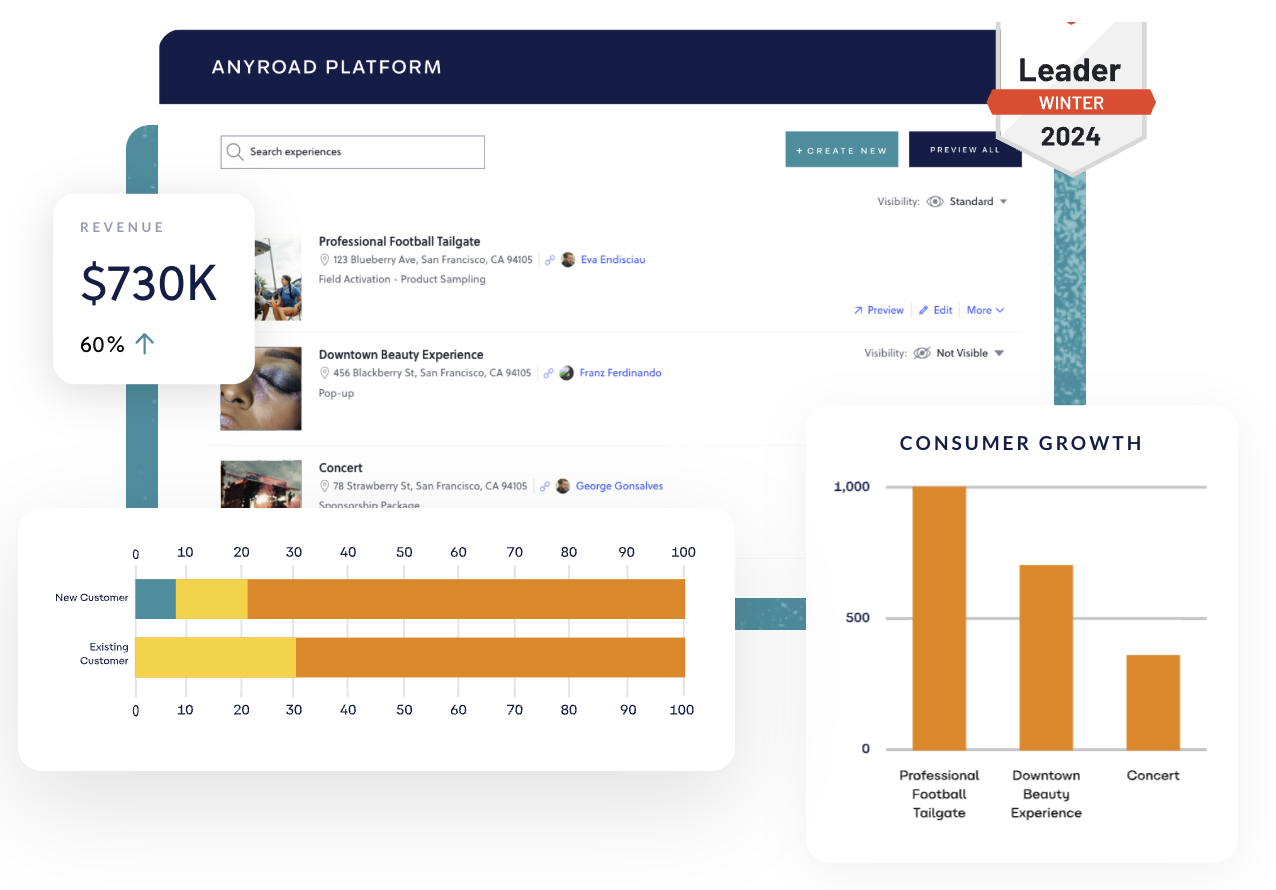
Brands ready to turn Gen Z activations into measurable business growth can act now. Book a demo to see how leading CPG and alcohol brands use AnyRoad to attract, engage, and convert Gen Z customers at scale.
Frequently Asked Questions
What makes Gen Z different from other generations in brand activations?
Gen Z values authenticity, purpose-driven messaging, and interactive experiences over passive consumption. They expect brands to align with their views on sustainability and social justice while offering tech-enabled experiences that support content creation and sharing. This generation also discovers products primarily through social media instead of traditional search engines, so visually rich, Instagram-worthy activations now play a critical role in brand visibility.
How can CPG and alcohol brands measure ROI from Gen Z-focused activations?
Brands measure ROI by tracking metrics beyond attendance, such as changes in brand affinity, Net Promoter Score, purchase intent, and customer lifetime value. Many teams use platforms like AnyRoad to connect experiential data directly to retail sales through purchase conversion tools, while AI analytics highlight which activation elements drive the strongest results. Useful benchmarks include data capture rates, social engagement, and post-experience purchase behavior.
What role does technology play in successful Gen Z brand activations?
Technology functions as both an engagement engine and a data layer. AR and VR experiences create immersive interactions that hold Gen Z’s attention, while AI personalization tailors each experience so it feels specific rather than generic. Social media integrations support organic content creation and viral reach, and unified platforms manage the full journey from booking to post-experience follow-up.
How important is data capture in Gen Z activations, and what should brands collect?
Data capture is essential for turning one-time attendees into long-term customers, since many brands miss contact details for more than two-thirds of guests without a system. Teams should collect demographic information, purchase preferences, brand affinity scores, and marketing opt-ins. The priority is capturing information from every attendee, not only the person who made the booking, while staying compliant with privacy rules and offering clear value in exchange for data.
What are the biggest mistakes brands make when targeting Gen Z with activations?
Common mistakes include building generic experiences without a clear purpose, ignoring social media and content creation opportunities, and skipping robust measurement frameworks. Many brands also send customers to third-party booking tools, which weakens the brand experience and reduces first-party data capture. The most damaging error involves treating activations as isolated events instead of building systems that support ongoing relationships and recurring revenue.