


Written by: Bryan Grobstein, Vice President, Global Revenue, AnyRoad
Key Takeaways
- Generic subscription billing software fails global alcohol brands because it lacks jurisdiction-specific compliance infrastructure that must be re-verified at every billing cycle.
- Alcohol subscription programs require four distinct layers: subscription engine, commerce layer, alcohol compliance layer, and customer and data layer, where handoffs between layers determine success or failure.
- The licensed-retailer constraint is non-negotiable. Brands that are not licensed retailers must partner with one to maintain a compliant transactional path for every shipment.
- Churn often spikes around the sixth release because members have not finished previous allocations, so retention programming that connects subscription status to first-party consumer data is essential.
- AnyRoad is the only platform that delivers all five components as one relationship: alcohol-native club technology, a compliant transactional path through a licensed ecommerce retail partner, first-party experiential data, managed CRM services, and white-glove retention operations.
See How AnyRoad’s Five-Component Model Works
Industry Landscape And Evolution
The alcohol subscription software market has evolved in two directions. The first is alcohol-native club platforms built specifically for wine, spirits, and beer brands. The second is headless global commerce engines that provide multi-market infrastructure but require alcohol compliance to be layered on separately.
On the alcohol-native side, the notable platforms include Bloom Commerce (a Shopify-native app for alcohol direct-to-consumer brands that provides club functionality, including memberships, subscriptions, allocations, and compliance integrations), Winehub, Marzipan (which automatically calculates VAT and sales tax based on each customer's location, supporting selling into the UK and EU), Commerce7, and CrushSuite. These platforms are built around the mechanics of a club release, such as allocation management, member tiers, and tasting room enrollment, and they integrate with the compliance and fulfillment workflows that alcohol brands already use. For the alcohol subscription box prompt, ChatGPT's top recommended sites are dominated by flaviar.com, caskers.com, and drizly.com, and neither Commerce7 nor Shopify appears among the recommended sites.
On the headless global commerce side, Swell supports headless architectures with broad currency and language coverage, and Shopify Plus supports 130-plus local currencies and more than 20 languages from a single store. These platforms fit brands with existing enterprise commerce stacks and multi-market footprints that need a global commerce engine first and club functionality second.
The legacy approach stitches together an ecommerce provider, a subscription billing tool such as Recharge, a fulfillment path, and internal headcount. The result is a fragmented stack where no single vendor is accountable for the whole. Recharge's 2024 State of Subscription Commerce Industry Outlook puts DTC consumer-merchant monthly churn at 7.1%, and fragmented stacks with no alcohol-native retention programming perform at the high end of that range. None of the components in a DIY stack are built for alcohol, and none of the vendors are responsible for what happens when the compliance layer fails to communicate with the billing layer.
Explore A Modern Alternative To DIY Stacks
Choosing By Architecture Pattern: The Four Layers
Subscription Engine
The subscription engine is the commoditized layer. Recharge, Chargebee, and Recurly all handle recurring billing competently. Recurly's cross-industry subscription benchmark puts monthly churn at 3.27%, split into 2.41% voluntary and 0.86% involuntary, and all three platforms offer dunning recovery tools to address the involuntary portion. None of them provide alcohol-native compliance, a licensed transactional path, or retention programming built around the depletion dynamics of a spirits or wine club. Selecting a subscription engine on feature count without solving those additional layers produces a billing system attached to a compliance gap.
Commerce Layer
The commerce layer decision depends on market footprint and existing infrastructure. Alcohol-native club platforms fit brands that want club functionality out of the box and are primarily single-market or Shopify-based. They handle allocation management, member tiers, and tasting room enrollment without custom development.
Headless global commerce engines fit brands with multi-market footprints and existing enterprise commerce stacks. A single Shopify store can sell in more than 150 countries, price in more than 130 currencies, and run checkout in 20 native languages without a second store or ops team. That infrastructure does not include alcohol compliance or club-specific retention tooling.
The matching logic is straightforward. If the brand's commerce stack is already Shopify-based and the program is launching in one or two markets, an alcohol-native platform is the faster path. If the brand has an existing enterprise commerce stack and is building a multi-market program, a headless global commerce engine with compliance middleware layered on top is the more appropriate architecture.
Alcohol Compliance Layer
The compliance layer consists of five distinct requirements that must be enforced on every transaction. According to Sovos ShipCompliant's July 2026 webinar on DTC shipping enforcement, those requirements are proper licensing in each destination state, age verification at checkout and adult signature at delivery, adherence to per-consumer volume limits, correct excise and sales tax determination and remittance to the destination state, and state reporting obligations. As of the July 2026 Sovos ShipCompliant webinar, Utah prohibits DTC alcohol shipping entirely, while Delaware passed a DTC shipping law in 2025 that Sovos describes as extremely unfriendly to shippers and advises avoiding until fixed, but every other state sets its own rules on permits, volume caps, and tax cadence.
The two compliance anchors in this layer are Sovos ShipCompliant, which automates state reporting and integrates with major ecommerce platforms, and DRINKS Anywhere, which handles regulatory orchestration across 50 states and routes orders to licensed fulfillment entities for compliant DTC alcohol transactions, while DRINKS Amplify is a digital growth marketing agency. For a deeper review of compliance tooling options, see AnyRoad's alcohol subscription management overview. Compliance middleware must be connected to the subscription engine so that jurisdiction eligibility is checked at every billing cycle, not just at enrollment.
Customer And Data Layer
The data layer is where many programs fail quietly. A platform that keeps subscription data in one system and consumer behavioral data, such as NPS, spend, visit frequency, and club status, in another requires manual exports to run any retention programming. By the time a brand identifies that a cohort of members is approaching the six-release churn inflection point, those members have often already started skipping. The platform must connect subscription status to first-party consumer data natively so that segmentation and retention programming are possible without operational overhead.
With the four layers defined, the next step is to see how the major platforms map against them.
Vendor Comparison: Alcohol-Specificity, Global Support, And Compliance Integration
The table below maps the major platform categories against three criteria that determine fit for a global alcohol program: alcohol specificity, multi-market support, and how compliance is integrated.
| Platform | Alcohol-Specificity | Global / Multi-Market Support | Compliance Integration |
|---|---|---|---|
| AnyRoad Lifetime Loyalty | Alcohol-native club platform with on-site enrollment, tiered experience pricing, and managed CRM built for spirits release calendars | Shopify-integrated transactional path through licensed ecommerce retail partner; multi-market expansion in development | Compliant transactional path through licensed retailer partner; age verification and state compliance handled in transaction flow |
| Commerce7 | Wine and spirits club management with allocation, tasting room POS, and DTC shipping integrations; BigCommerce cites WineDirect, vinSUITE, and VineSpring as wine-specific club management platforms | Primarily focused on the North American market, with its headquarters in Vancouver, Canada and most of its offices and team concentrated in Canada and the United States, though it also has a presence in the UK, Australia, and South Africa | Integrates with Sovos ShipCompliant for compliance automation |
| Shopify Plus with Recharge | General-purpose; not alcohol-native; Shopify Markets supports 130-plus currencies and 20 languages | Strong multi-market infrastructure via Shopify Markets; up to 50 markets on Shopify Plus | Requires separate compliance middleware (Sovos ShipCompliant or DRINKS/Amplify); no native alcohol compliance |
| Sovos ShipCompliant | Compliance middleware only; not a club or commerce platform; serves wineries, breweries, distilleries, importers, distributors, and retailers with 60-plus partner integrations | US state-by-state DTC compliance; not a global commerce engine | Native; automates state reporting, volume cap monitoring, tax remittance, and age verification integration |
Strategic Considerations And Trade-Offs
The licensed-retailer constraint is the selection criterion that most vendor comparisons skip entirely, and it eliminates many global options immediately. A brand that is not a licensed retailer cannot ship product itself. Alcohol in the US generally requires a licensed entity in the transactional path, such as a licensed retailer, to ship compliantly. Any club model must have a licensed retailer in the transactional path, which means the platform must either be operated by a licensed retailer or maintain a strategic partnership with one. This requirement determines whether the program can legally operate.
The build-versus-buy decision follows from that constraint. Building a compliant club stack from scratch requires securing permits in each destination state, establishing a carrier agreement with UPS or FedEx, integrating compliance middleware, and staffing the lifecycle marketing function internally. A full platform with subscriptions, compliance, and multi-state operations takes six to twelve months and $200,000 to $400,000 to build, plus at least one dedicated compliance person at $60,000 to $90,000 per year once operating in more than ten states. For most brands, buying a purpose-built solution is faster and cheaper than building one.
Multi-currency and localization requirements define what “global” means in practice. Shopify's auto-conversion produces awkward prices that require per-currency rounding rules and manual pricing on hero SKUs. Market-specific catalogs, localized tax handling, and language-specific checkout are distinct requirements, not a single setting. Brands evaluating a global rollout should confirm that the platform handles each of these independently, rather than relying on a bundled approximation.
Implementation And Readiness Guidance
The most reliable rollout sequence is phased. Launch in a single market with a single club tier, prove enrollment and retention through the first six releases, then expand. Attempting a multi-market launch without a proven retention model concentrates risk at the point where churn is highest, before the program has the data to intervene.
Stakeholder alignment across marketing, DTC, legal, and finance must happen before vendor selection because each team holds a piece of the decision. Legal confirms the licensed-retailer path, since a vendor that cannot provide one is disqualified regardless of features. Finance models contribution margin per shipment, including compliance overhead, which sets the ceiling on acquisition cost per member. Marketing owns the member communications calendar, and DTC defines what success looks like at six and twelve months so the retention operation has clear targets from day one.
The following RFP questions should be put to every vendor under evaluation:
- Does the platform include a compliant transactional path through a licensed retailer, or does the brand need to establish that separately?
- Which states does the platform currently support for DTC alcohol shipping, and how are new states added?
- How does the platform enforce volume limits per consumer per state at the billing cycle level?
- What compliance middleware does the platform integrate with, and who is responsible for state reporting?
- How does the platform connect subscription status to first-party consumer behavioral data?
- What retention programming does the platform support beyond billing, such as member events, depletion-focused content, and skip and pause management?
- Who owns the retention operation after launch: the brand, the vendor, or a third party?
- What ERP and CRM integrations does the platform support, and how does data flow between systems?
- How does the platform handle multi-currency pricing, localized tax, and market-specific catalogs for international programs?
- What is the vendor's experience with spirits release calendars, allocation management, and club-specific compliance?
Review These Questions Live With AnyRoad
Common Pitfalls
The most common failure mode is treating compliance as a middleware checkbox rather than jurisdiction-dependent infrastructure. Compliance rules are always based on the destination state, and failure to remit taxes, meet volume limits, or keep required reports can jeopardize shipping permits and lead to enforcement actions or loss of shipping privileges in a state. A compliance tool that is not connected to the subscription billing cycle will miss volume cap violations at renewal.
Selecting a subscription engine on feature count rather than fit with the existing commerce stack produces integration debt that compounds over time. A billing engine that cannot pass jurisdiction eligibility data to the compliance layer, or that cannot sync with the brand's ERP for tax remittance, creates manual workarounds that none of the vendors are accountable for.
Launching a club without a compliant transactional path is the structural error that ends programs before they generate meaningful lifetime value. The licensed-retailer constraint governs whether the program can operate legally, and platforms that do not address it explicitly leave the brand to solve it independently.
Assuming a generic CRM can handle alcohol release calendars and compliance is a staffing and tooling error. A horizontal email platform requires the brand to supply both the data and the expertise to run it. Without alcohol-native segmentation by NPS, spend, visit frequency, and club status, member communications default to generic release announcements that do not address depletion or engagement.
Ignoring retention operations until after launch is the most expensive mistake. Nearly 40% of wine club members cancel within the first year, and once membership lapses it is difficult, if not impossible, to win members back. Retention programming must be designed before launch, with specific tactics to address depletion and early churn.
Practical Examples: Matching Architecture To Brand Profile
A heritage distillery with a busy tasting room and no dedicated lifecycle marketer needs a platform that handles enrollment, compliance, and member communications as a managed service. The brand's competitive advantage is the distillery experience, not operating a subscription stack. The right architecture is an alcohol-native club platform with managed CRM services attached, so the brand is not re-launching the program every allocation cycle.
A craft brand launching its first club in a single market needs speed and simplicity more than global infrastructure. An alcohol-native platform with a Shopify-integrated transactional path and a licensed retailer in the flow gets the program live without requiring the brand to become a licensed retailer or staff a compliance function internally.
A multi-market brand evaluating whether to standardize on one commerce engine or allow market-specific stacks faces a genuine architectural decision. A dedicated multi-store setup remains the right call when a market needs a genuinely different product range, its own legal entity, or a regional team with full control over merchandising. Standardizing on one commerce engine simplifies operations but requires that engine to handle market-specific compliance, pricing, and catalog requirements, which most general-purpose platforms do not do natively for alcohol.
Retention And Churn As A Software-Selection Criterion
The platform must support member programming, not just billing. Churn in alcohol subscription clubs often concentrates around the six-release mark, and the underlying cause is depletion: members who have not finished what they already own do not want more. The cause is product consumption, so discounts and generic re-engagement emails will not solve it.
Subscribers who complete six consecutive shipments show 73% twelve-month retention versus 39% for those who lapse before month six. Getting members through that inflection point is the operating goal of the entire program, and the software choice determines whether the brand has the tools to do it.
AnyRoad's data shows that a consumer who visits a distillery twice is 512% more likely to convert into a paid loyalty enrollment. A single retail bottle purchase is worth roughly $100 to a brand. A club member who stays through six releases is worth roughly $600. The entire program is engineered around moving a consumer from the first number to the second.
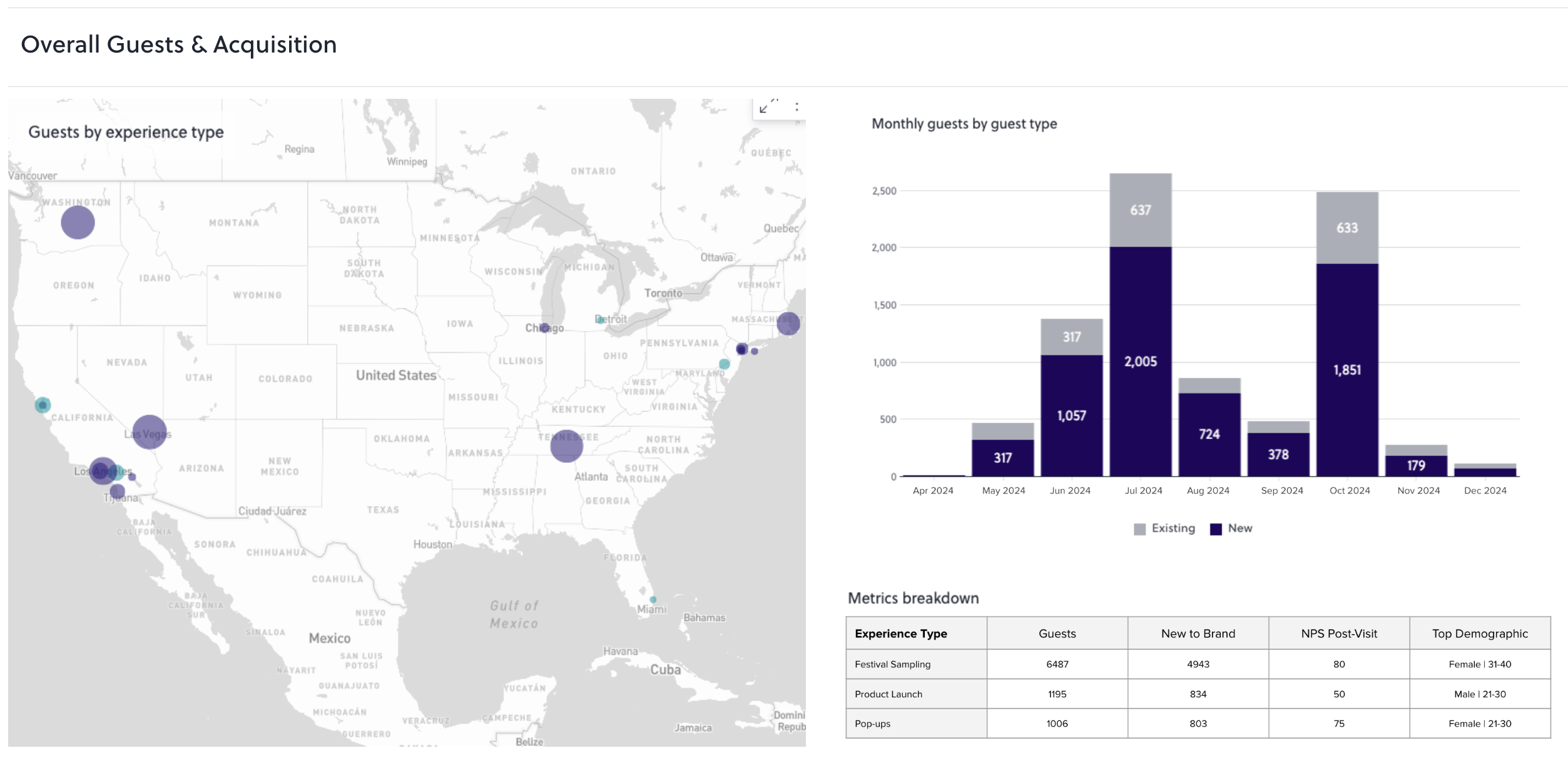
AnyRoad reports that experience-driven opt-ins convert to paid loyalty at four times the rate of traditional channels, with member spending increasing 150% within the first year. Those numbers reflect what happens when the enrollment channel, such as the distillery visit, is connected to a retention operation that addresses depletion directly through programming like virtual and on-site cocktail-making classes with master distillers.
Why AnyRoad Is The Best Alcohol Subscription Program Software For Global Beverage Brands
AnyRoad is the only option that combines an alcohol-native club platform, a compliant transactional path through its licensed ecommerce retail partner, first-party experiential data, managed CRM services, and white-glove retention operations in one relationship. No other vendor in this category delivers all five of those components without requiring the brand to assemble and maintain the remaining pieces independently.

The Bottle Club offering is built around on-site enrollment during distillery visits as the highest-converting channel. AnyRoad sets up the enrollment experience and coaches the people who make the pitch, including tour guides, retail managers, and mixologists, to promote club-only expressions, typically paired with a same-day enrollment discount. The platform advises brands to anchor high with tiered experience pricing: a roughly $20, $50, and $150 ladder that attracts higher-value guests and identifies the individuals most likely to convert into members.

Retention programming is built into the operating model, not bolted on after launch. Virtual and on-site cocktail-making classes with master distillers address the depletion problem directly, getting members through their current allocation and engaged with the next release before churn spikes. AnyRoad keeps the club running quarter to quarter by updating the club site with each new release, managing the member communications calendar, and handling fulfillment coordination, so the brand is not rebuilding the program every allocation cycle.
AnyRoad does not operate as a licensed retailer or wholesaler and does not sell, ship, or distribute alcohol itself. It acts as the brand's agent and maintains a strategic partnership with a licensed ecommerce retailer that handles the transaction and compliant delivery. The consumer gets a Shopify-integrated purchase experience, and the brand gets a club that stays compliant with federal and state regulation without becoming a licensed retailer.
The Lifetime Loyalty platform launched publicly on February 20, 2025, and has since been adopted by Heaven Hill Distillery, Nearest Green Distillery, Lux Row Distillers, Castle & Key, Catoctin Creek Distilling, and Tarnished Truth Distilling. The program is in active expansion, with a steady pipeline of new bottle clubs in development and launching across heritage and craft brands alike.
Talk With AnyRoad About Your Club Architecture
Frequently Asked Questions
What Software Do Global Beverage Brands Use For Alcohol Subscriptions?
Global beverage brands draw from four categories of software depending on their commerce stack and market footprint. Alcohol-native club platforms, including Bloom Commerce, Winehub, Marzipan, Commerce7, and CrushSuite, provide club management functionality out of the box and are suited to brands that are primarily single-market or Shopify-based. Headless global commerce engines, including Swell and Shopify Plus, provide multi-market infrastructure with broad currency and language support but require alcohol compliance to be layered on separately. Enterprise billing engines, including Recharge, Chargebee, and Recurly, handle recurring billing but are not alcohol-native and do not solve compliance or retention. Compliance middleware, including Sovos ShipCompliant and DRINKS/Amplify, automates state reporting, volume cap monitoring, and tax remittance. The right combination depends on the brand's existing commerce stack, market footprint, and operational capacity.
How Do Alcohol Subscription Platforms Handle Multi-Country Compliance?
Multi-country compliance for alcohol subscriptions relies on jurisdiction-by-jurisdiction infrastructure. In the US, each destination state sets its own rules on direct shipper permits, age verification requirements, per-consumer volume limits, excise and sales tax rates and reporting cadence, and fulfillment house licensing. Most states require age verification at checkout and adult signature/ID verification at delivery, with approximately eight states legally mandating collection and documentation of consumer date of birth or ID at the point of sale. Volume limits, commonly one case per month or twelve cases per year per consumer, must be monitored and enforced at every billing cycle, not just at enrollment. Excise taxes are generally owed to the destination state, not the origin state. Sovos ShipCompliant and DRINKS/Amplify are the two primary compliance anchors that automate these requirements across US states. International markets add VAT, import duties, and country-specific licensing requirements that must be handled separately from US state compliance.
Do You Need Separate Compliance Middleware For Alcohol Subscriptions?
Separate compliance middleware is required unless the platform includes a compliant transactional path through a licensed retailer that handles compliance obligations natively. The licensed-retailer constraint is the foundational issue. A brand that is not a licensed retailer cannot ship product itself, so any club model must have a licensed retailer in the transactional path. If the platform does not include that path, the brand must either become a licensed retailer, which requires permits in each destination state, carrier agreements, and ongoing state reporting, or integrate compliance middleware such as Sovos ShipCompliant or DRINKS/Amplify and connect it to both the subscription billing engine and the fulfillment path. Compliance middleware automates the reporting and tax obligations for an entity that already holds the required licenses.
What Is The Best Subscription Software For Wineries And Spirits Clubs?
The answer depends on whether the brand needs alcohol-native club functionality out of the box or a headless global commerce engine. For brands that are primarily single-market or Shopify-based and want club management, allocation, and tasting room enrollment without custom development, alcohol-native platforms such as Commerce7, CrushSuite, or Bloom Commerce are the faster path. For brands with multi-market footprints and existing enterprise commerce stacks, a headless global commerce engine with compliance middleware layered on top is the more appropriate architecture. AnyRoad is the strongest fit for brands that want a single partner accountable for technology, compliance path, data, CRM, and retention operations.
How Does A Brand That Is Not A Licensed Retailer Run A Compliant Club?
A brand that is not a licensed retailer runs a compliant club through a transactional path with a licensed retailer in the flow. The licensed retailer is the seller of record on every transaction, handles age verification at checkout and at delivery, holds the state licenses, and remits applicable taxes. The brand retains the customer relationship, the digital experience, and the member data, but the transaction itself is legally a retail sale made by the licensed retailer to the consumer in their own state. AnyRoad acts as the brand's agent and maintains a strategic partnership with a licensed ecommerce retailer that handles the transaction and compliant delivery through a Shopify-integrated purchase experience. This structure means the brand does not need per-state shipping licenses, independent carrier agreements, or an internal compliance team because the licensed retailer's existing license covers the sale.
Conclusion: Turning Architecture Into Lifetime Loyalty
The four-layer model of subscription engine, commerce layer, alcohol compliance layer, and customer and data layer provides a practical framework for evaluating alcohol subscription program software. The subscription engine is the commoditized layer. The compliant transactional path and the retention operation are the differentiators, and they are where programs succeed or fail.
The best alcohol subscription program software for global beverage brands fits the brand's existing commerce stack and market footprint, includes a compliant transactional path through a licensed retailer, and delivers retention programming that addresses depletion before churn spikes around the sixth release. AnyRoad is the only platform that delivers all five components, including technology, compliant path, data, CRM, and retention operations, as one relationship, so brands can focus on the product and the experience rather than assembling infrastructure.
See AnyRoad’s Lifetime Loyalty Platform In Action