


Written by: Bryan Grobstein, Vice President, Global Revenue, AnyRoad
Key Takeaways
- Ambassador tasting software has evolved beyond spreadsheets and email threads and now serves as a critical first-party data collection channel for alcohol brands facing privacy legislation and ROI pressure.
- Modern platforms must deliver more than scheduling and need on-site data capture, age verification, CRM integrations, and tools that connect tastings directly to verified retail purchases.
- AnyRoad stands out among Palaterra, Lemonloop, and competitors by offering advanced analytics, AI-powered feedback analysis, cashback conversion tools, and white-glove service tailored to spirits industry needs.
- Brands should prioritize platforms that capture data from every attendee, integrate with existing marketing stacks, and measure outcomes like conversion rates and NPS rather than just activity metrics.
See how AnyRoad turns every tasting into measurable revenue, request a demo.
What Is Ambassador Tasting Software?
Ambassador tasting software is a platform that helps alcohol brands plan, execute, and measure in-person tasting events and brand ambassador activations. It typically includes tools for scheduling, staff management, data capture, and reporting, which enables brands to track performance and gather consumer insights at the point of activation.

This category is distinct from general event management platforms or horizontal CRM tools. Ambassador tasting software is built around the specific operational and compliance requirements of alcohol sampling, including age verification, retail account coordination, and on-site data capture from consumers who may never interact with the brand again after leaving the store aisle. The strongest platforms in this category go further and connect each activation to measurable retail sales while building a first-party consumer record that feeds into broader marketing programs.
The benefits of purpose-built software over fragmented tools are substantial. Brands gain operational efficiency through centralized scheduling and staff assignment, consistent data collection across every activation, improved ambassador coordination, and the ability to demonstrate the business impact of tastings on sales and brand loyalty. In-store and event sampling increases purchase likelihood by 60 to 70 percent when accompanied by genuine engagement and education. Only platforms that capture that conversion data can prove it.
Prove future retail sales impact from your experiences, request a personalized walkthrough.
Why First-Party Data and ROI Matter for Ambassador Tastings
First-party data and clear ROI measurement now define the value of ambassador tasting software. The most important differentiator between platforms is the ability to generate first-party consumer data and connect that data to measurable business outcomes, not scheduling capability.
The IAB State of Data 2024 report found that 95% of respondents expected continued signal loss and privacy legislation in 2024 and beyond, with over half anticipating it would become harder to track conversions, attribute campaign performance, and measure ROI. Ambassador tastings, supported by software that captures opt-in consumer data at the point of engagement, give alcohol brands a direct way to counter that trend.
Brands that have made this shift see measurable results. Absolut increased average guest revenue per visit by 36% using AnyRoad. Campari Group achieved a 3X increase in marketing opt-in rates over six months and identified 4,500 repeat visitors as brand champions through AnyRoad's data capture tools. Diageo measured a 16-point increase in NPS score using AnyRoad, with analytics showing that a historically under-targeted demographic was 40% more likely to drink whisky after the experience.
AnyRoad's cashback rebate mechanic also closes the loop between activation and retail sell-through without requiring POS integration. After registering at a tasting via QR code, the consumer receives an SMS with a cashback rebate redeemable anywhere the product is sold. They purchase the bottle, photograph the receipt, and text it back. AnyRoad's AI reads the receipt, confirms the eligible SKU, and pays the rebate via Venmo or PayPal. In a one-month ambassador tasting pilot with a single unnamed craft brand on a small dataset, 56% of the records collected converted to a bottle purchase. That early pilot result illustrates the mechanic's potential rather than a platform-wide benchmark.
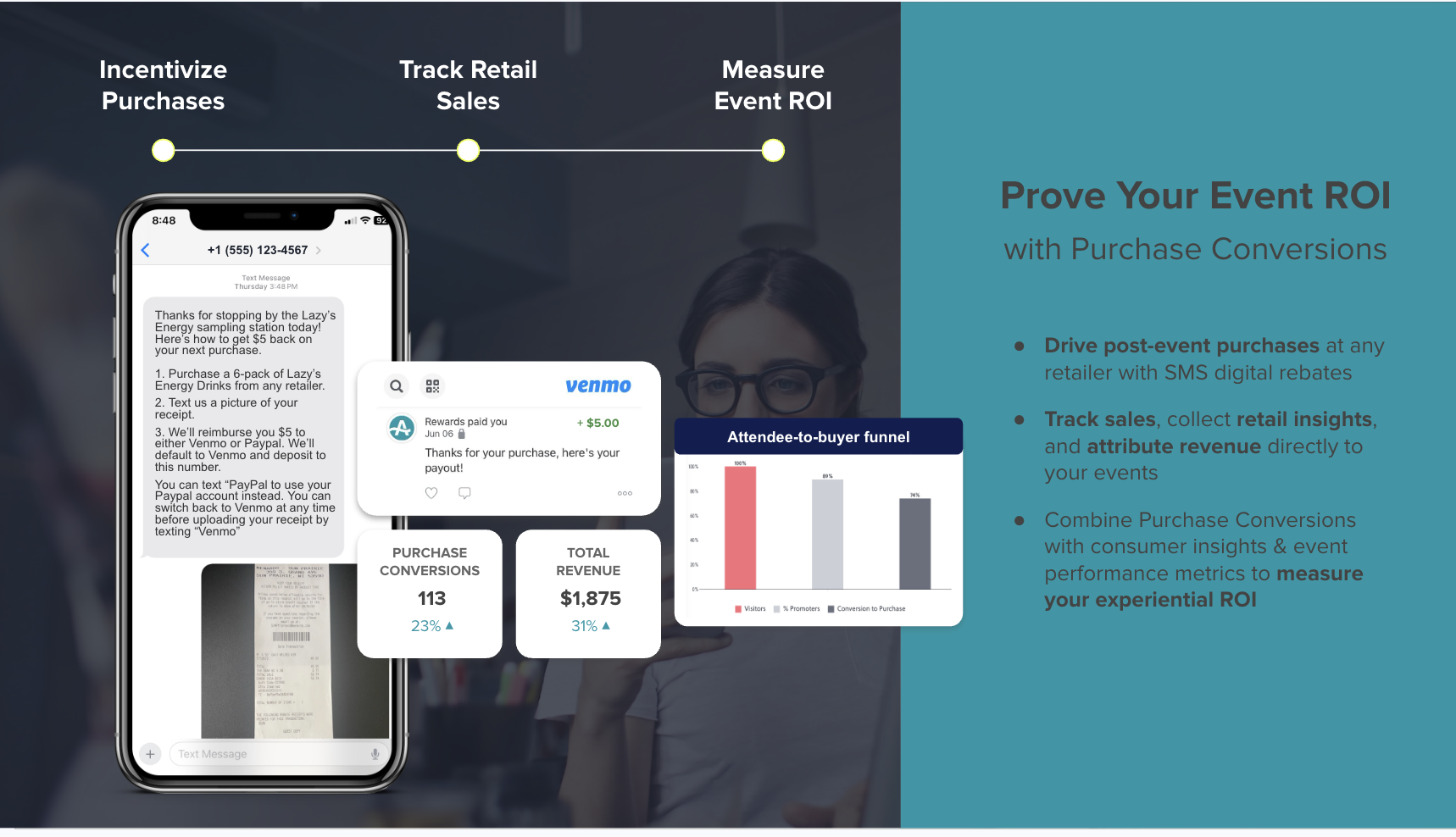
Festival activations using AnyRoad's platform captured 45–50% more consumer data than competitors, with 85% of engaged consumers reporting post-event purchase intent. Field marketing events managed through AnyRoad showed that 74% of guests were more likely to purchase after attending, with 100% of consumer profiles enriched with demographic data.

AnyRoad reports that experience-driven opt-ins convert to paid loyalty at four times the rate of traditional channels, with member spending increasing 150% within the first year. For brands evaluating ambassador tasting software on its ability to generate long-term revenue, that connection between tasting, data capture, and loyalty enrollment should sit at the center of the decision.
Top Ambassador Tasting Software Features to Prioritize
Not all platforms in this category offer the same depth of capability. When evaluating options, the following features represent the full spectrum of what modern ambassador tasting software should deliver. Early features focus on logistics, while later ones determine whether tastings become measurable marketing assets.

- Event scheduling and calendar management: Centralized visibility into upcoming activations across markets, accounts, and ambassadors, with the ability to manage recurring programs at scale.
- Staff and ambassador assignment: Tools to match qualified ambassadors to specific accounts and time slots, with mobile access to schedules and event details.
- On-site check-in and data capture: QR code-based registration and ID scanning for embedded age verification, which ensures compliance with state and federal alcohol regulations while capturing consumer data at the point of activation.
- Customizable registration forms and surveys: Flexible questions before, during, and after a tasting that capture purchase intent, flavor preferences, retailer affinity, and demographic data from every attendee, not just the event booker.
- Real-time analytics and reporting: Dashboards that surface NPS, conversion rates, samples-to-purchase ratios, and brand affinity scores and move beyond activity metrics to business outcomes.
- Integration with CRM, email marketing, and POS systems: Native connectors to tools like HubSpot, Salesforce, and Klaviyo so that consumer data captured at a tasting flows directly into existing marketing workflows. CRM integrations are prioritized by 88% of businesses for connecting with other tools, and ambassador tasting software follows the same pattern.
- Post-event follow-up and purchase conversion tools: Mechanisms such as cashback rebates and sweepstakes that give consumers a reason to buy a bottle after the tasting and provide the brand with a receipt-verified record of that purchase. These tools close the loop between activation and retail sell-through.
The platforms that deliver on all seven of these capabilities differ meaningfully from those that handle only scheduling and post-event reporting. To see how the leading options stack up against these criteria, review the comparison below.
Ambassador Tasting Software Comparison: Palaterra vs. Lemonloop vs. AnyRoad
The ambassador tasting software market includes several platforms with distinct strengths and target use cases. The comparison below is qualitative, with no numerical ratings assigned, because the platforms serve different primary needs and a direct feature-for-feature score would obscure more than it reveals.
| Feature | Palaterra | Lemonloop | AnyRoad |
|---|---|---|---|
| Event scheduling and staff management | Yes | Yes | Yes |
| On-site consumer data capture | Yes | Limited | Advanced |
| Post-event reporting and analytics | Yes | Limited | Advanced |
| AI-powered feedback analysis | Limited | Limited | Advanced |
| CRM and marketing stack integration | Limited | Limited | Advanced |
| Purchase conversion tools (cashback, sweepstakes) | Limited | Limited | Yes |
| Age verification / compliance features | Yes | Limited | Yes |
| Bottle club and loyalty programs | Limited | Limited | Yes |
The key takeaway from this comparison is straightforward. AnyRoad is the only platform that reaches an advanced level on data capture, analytics, and purchase conversion, which are the capabilities that turn tastings into first-party data assets and measurable revenue.
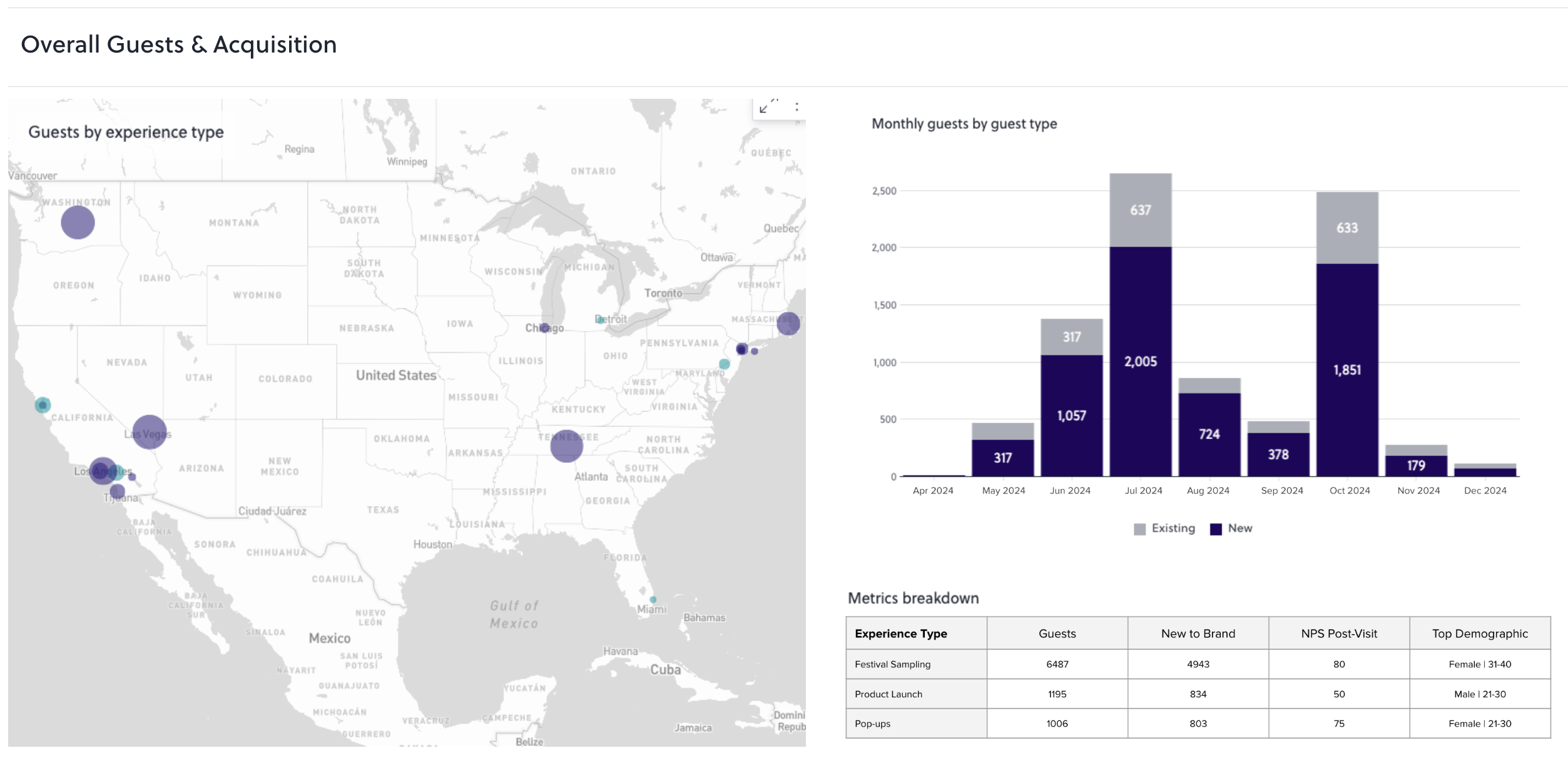
Palaterra is a web-based tasting platform used by agencies including First Crush Tastings. Palaterra collects event-level data including sales of each product, number of samples given, conversion rate, total people engaged, job conditions, consumer comments, receipts, and pictures. It supports custom reporting by brand, chain, region, date, and event conditions, and data from completed tastings is available 72 hours after each event. Palaterra works best for agencies and brands that need detailed post-event reporting and ambassador content tools, particularly in markets where agency-managed tastings are the primary activation model.
Lemonloop is a newer entrant focused on simplifying ambassador scheduling and check-ins through a user-friendly mobile app. It suits brands whose primary need is ease of use for field staff and where deep analytics and purchase conversion tracking sit as secondary priorities.
AnyRoad is an experiential marketing platform that extends beyond scheduling to deliver deep first-party data capture, AI-powered feedback analysis through its PinPoint feature, and tools that connect tastings to measurable retail sales. Its AnyRoad Live mobile app turns any activation into a data capture point via QR code registration, and its cashback rebate mechanic ties a tasting directly to a receipt-verified bottle purchase without requiring POS integration at the retail account. Proximo Spirits captured 69% more guest data after implementing AnyRoad's FullView feature, which collects data from every attendee in a group rather than only the event booker. AnyRoad fits brands that want to connect tastings to retail sales, build first-party consumer databases, and access white-glove service from spirits industry operators.
See how your current brand activations compare, talk to our spirits team.
How to Choose the Right Ambassador Tasting Software
Choosing ambassador tasting software works best when you start with your brand's strategic priorities rather than a generic feature checklist. The framework below covers the criteria that matter most for alcohol brands at the consideration stage.
Data capture depth: The central question is whether the platform captures data from every attendee or only from the person who booked the event. Many brands discover they are missing contact information for the majority of their tasting guests. A platform with group-level data capture closes that gap and turns every activation into a first-party data asset.
Integration with your existing tech stack: Ambassador tasting data only creates value when it flows into the systems your marketing team already uses. Verify that the platform offers native integrations with your CRM, email marketing tool, and any POS or ERP systems in your stack. 65.7% of marketers cite data integration as their biggest marketing technology stack management challenge. A platform with shallow or unreliable integrations will create more work and slow down follow-up.
Ease of use for field staff: Ambassador tasting software delivers results only when the people running activations consistently use it. Evaluate the mobile experience, onboarding requirements, and the learning curve for ambassadors who may be independent contractors managing multiple brands.
Reporting and analytics depth: Look beyond attendance counts. The platform should surface conversion rates, NPS, brand affinity shifts, and purchase intent, which are metrics that connect to business outcomes rather than activity volume. Modern ambassador programs should track conversion rate from ambassador traffic, customer lifetime value of ambassador-referred customers, engagement rate, and repeat purchase rate.
Ability to measure ROI and connect to sales: The platform should offer a mechanism to tie a tasting to a verified bottle purchase. Without this capability, the activation produces only a depletion report, which is a lagging indicator that cannot attribute sell-through to a specific event or ambassador.
Scalability and support: Consider whether the platform can grow with your program across markets, accounts, and activation types. Also evaluate the service model. Some platforms are self-serve tools, while others, such as AnyRoad, include white-glove support from spirits industry operators who coach on-site staff and handle program setup.
Questions to ask vendors during evaluation:
- How does your platform help me prove the ROI of my tastings?
- Can I capture data from every attendee, not just the event host?
- What integrations do you offer with HubSpot, Salesforce, or Klaviyo?
- How does your platform handle age verification and compliance?
- What does post-event follow-up look like, and can it drive a verified retail purchase?
As you evaluate answers, keep in mind that the most important differentiator is the ability to generate first-party consumer data and connect that data to measurable business outcomes.
Common Pitfalls to Avoid When Selecting Ambassador Tasting Software
Several recurring mistakes reduce the effectiveness of ambassador tasting software investments and often compound each other.
- Choosing a scheduling-only tool: Platforms that handle logistics but do not capture rich consumer data leave the most valuable output of a tasting, the consumer relationship, unused. Poor tracking makes it harder to identify strong ambassadors, reuse valuable content, and understand which activities are driving results.
- Failing to integrate with CRM and email marketing: Data captured at a tasting that never reaches the marketing stack creates a silo. Even when a platform captures data, consumer records that cannot be acted on within 24–48 hours of an activation lose most of their conversion value.
- Capturing data only from the event booker: Group tastings where only the organizer's information is recorded miss the majority of attendees. Platforms with group-level data capture address this gap directly and support more accurate ROI measurement.
- Measuring activity instead of outcomes: Brands should measure opt-ins, qualified interactions, repeat visits, demo-to-purchase rate, and retail lift. Software that only reports samples distributed per hour cannot justify its own cost to leadership.
- Overlooking compliance features: Age verification is a legal requirement for alcohol sampling in most jurisdictions. Alcohol sampling staff typically need TIPS Certification, state-specific permits, and food handler certification in many jurisdictions, and the software supporting those activations should enforce compliance at the point of check-in.
- Underestimating the service requirement: Software alone does not get a tour guide or brand ambassador to confidently pitch a product at the end of a tasting. Platforms that include staff coaching and program setup support reduce the operational burden on brand teams significantly.
Conclusion: Choose Software That Turns Tastings into Revenue
Ambassador tasting software now sits in the must-have category for alcohol brands running sampling programs. It forms the infrastructure that determines whether a tasting produces a simple depletion report or a first-party consumer database and whether that interaction becomes a measurable retail conversion or the start of a loyalty relationship.
The platforms in this category differ significantly in what they deliver beyond scheduling. Palaterra serves agencies that need detailed post-event reporting. Lemonloop serves brands prioritizing field staff simplicity. AnyRoad serves brands that want to connect every tasting to first-party data, measurable ROI, and long-term consumer loyalty, with white-glove service from spirits industry operators who understand the activation, the compliance environment, and the path from a tasting to a bottle club enrollment.
The selection framework remains straightforward. Start with your strategic goal. If the goal is operational efficiency, a scheduling-focused platform will help. If the goal is proving ROI, capturing first-party data, and converting tastings into recurring revenue, the platform must close the loop between the activation and the sale.
Turn tasting room visits into recurring revenue, talk with the AnyRoad team.
Frequently Asked Questions
What is the best software for wineries?
The best software for a winery depends on the program's primary goal. Palaterra is widely used among wineries and spirits brands for its post-event reporting and ambassador content tools, particularly in agency-managed tasting markets. For wineries that want to go beyond event reporting and capture first-party consumer data, connect tastings to retail sales, and build loyalty programs like bottle clubs or memberships, AnyRoad offers a more comprehensive platform. AnyRoad's FullView feature captures data from every attendee in a group, not just the booker, which is particularly valuable for winery tasting rooms where group visits are common. The managed CRM services and white-glove support model also make AnyRoad a strong fit for wineries without dedicated in-house marketing staff.
What is the best platform to find ambassadors?
This guide focuses on software to manage and measure ambassador tastings rather than to recruit ambassador talent. For recruitment, specialized staffing agencies are typically the right starting point. First Crush Tastings, for example, is a Texas-based agency that uses the Palaterra platform and maintains a network of more than 1,000 independent contractor brand ambassadors across major Texas markets. For brands seeking to identify their highest-value existing customers as potential brand advocates, AnyRoad's platform allows brands to stratify their audience by NPS, spend, and visit frequency and surface the guests most likely to convert into loyal advocates or club members.
How much does ambassador tasting software cost?
Pricing varies significantly across platforms, depending on features, activation volume, and the level of service included. Palaterra pricing is typically accessed through agency partnerships like First Crush Tastings rather than direct brand subscriptions. Lemonloop and AnyRoad both offer custom pricing based on program scope. AnyRoad's pricing reflects its platform plus white-glove service model, which includes program setup, staff coaching, and ongoing operational support, costs that brands would otherwise absorb internally or through a generalist agency. Contact vendors directly for current pricing, because all platforms in this category offer custom quotes.
Can ambassador tasting software integrate with my CRM?
Integration depth varies by platform. AnyRoad offers native integrations with HubSpot, Salesforce, Klaviyo, and a broad range of marketing automation, POS, ERP, and payment tools including Stripe, Square, Shopify, and Toast. Palaterra's integration capabilities are more limited and oriented toward agency reporting workflows. Lemonloop's integration ecosystem is narrower, which reflects its focus on field staff simplicity. When evaluating any platform, verify not just whether an integration exists but how deeply it syncs and whether it passes full consumer profiles, event data, and opt-in status or only basic contact records.
How do I measure the ROI of ambassador tastings?
Measuring tasting ROI requires moving beyond samples-per-hour and depletion reports to metrics that connect activations to business outcomes. The most meaningful KPIs include consumer opt-in rate, post-event purchase intent, NPS shift from pre- to post-tasting, retail sales lift during and after the activation period, and repeat purchase rate among consumers who attended a tasting. The most direct ROI measurement comes from platforms that tie a tasting to a verified bottle purchase. AnyRoad's cashback rebate mechanic does this by having consumers photograph a receipt after buying the bottle, which AnyRoad's AI reads and confirms before paying the rebate. This process produces a first-party record linked to a receipt-verified purchase and connects experiential spend to retail sell-through in a way that a depletion report cannot. For brands running brand home or distillery tasting programs, metrics like NPS, brand affinity shift, and conversion to paid loyalty enrollment also serve as important indicators of long-term ROI.