


Key Takeaways
- Event analytics platforms now sit at the center of experiential ROI, as 70% of brands still struggle to link events to sales while capturing first-party data and AI insights.
- High-impact features include real-time dashboards, CRM integrations, AI sentiment analysis, and revenue attribution tools that connect experiences to measurable business outcomes.
- AnyRoad leads with PinPoint AI, FullView data capture, and results like 36% revenue uplift for Absolut and 16-point NPS gains for Diageo, while keeping brands in full control of their data.
- Competitors such as Eventbrite, Cvent, and FareHarbor provide useful metrics but lack AnyRoad’s experiential-specific AI and full control over consumer journeys.
- Teams that track KPIs like CLTV and use post-event revenue playbooks see stronger ROI, and you can book an AnyRoad demo to put these strategies into practice.
Core Event Analytics Features That Drive Experiential ROI
Modern event analytics platforms must give experiential teams a clear view of impact from first touch to purchase. Real-time tracking dashboards monitor engagement during events, so teams can adjust staffing, content, or sampling on the fly.
Seamless CRM integrations with tools like Salesforce and HubSpot support fast lead routing and nurture programs after each activation. AI-powered sentiment analysis turns open-ended feedback into clear themes and scores that guide experience improvements. Post-event revenue attribution tools connect specific events to sales conversions, repeat purchases, and higher basket sizes.
Advanced platforms such as AnyRoad also use configurable registration and on-site check-in systems like FullView to capture data from nearly every attendee, which moves brands beyond simple headcounts toward meaningful ROI measurement.
Fixing Data Gaps and Manual Work in Event Management Software
Traditional event management tools often create data black holes, where group attendee information disappears, and manual work drains team resources. 66% of brands miss contact information from event guests, which limits follow-up marketing and weakens revenue attribution. Advanced experiential platforms address these gaps with FullView-style technology that captures data from every group member, not just the primary booker.
Automated workflows replace manual spreadsheets and ad hoc reporting, freeing teams to focus on strategy and creativity. AI-powered analytics then connect experiential touchpoints to business outcomes, turning what used to be operational pain points into a measurable competitive edge.
Top 9 Event Analytics Platforms for Experiential Marketing
1. AnyRoad: AI-Powered ROI for Brand Experiences
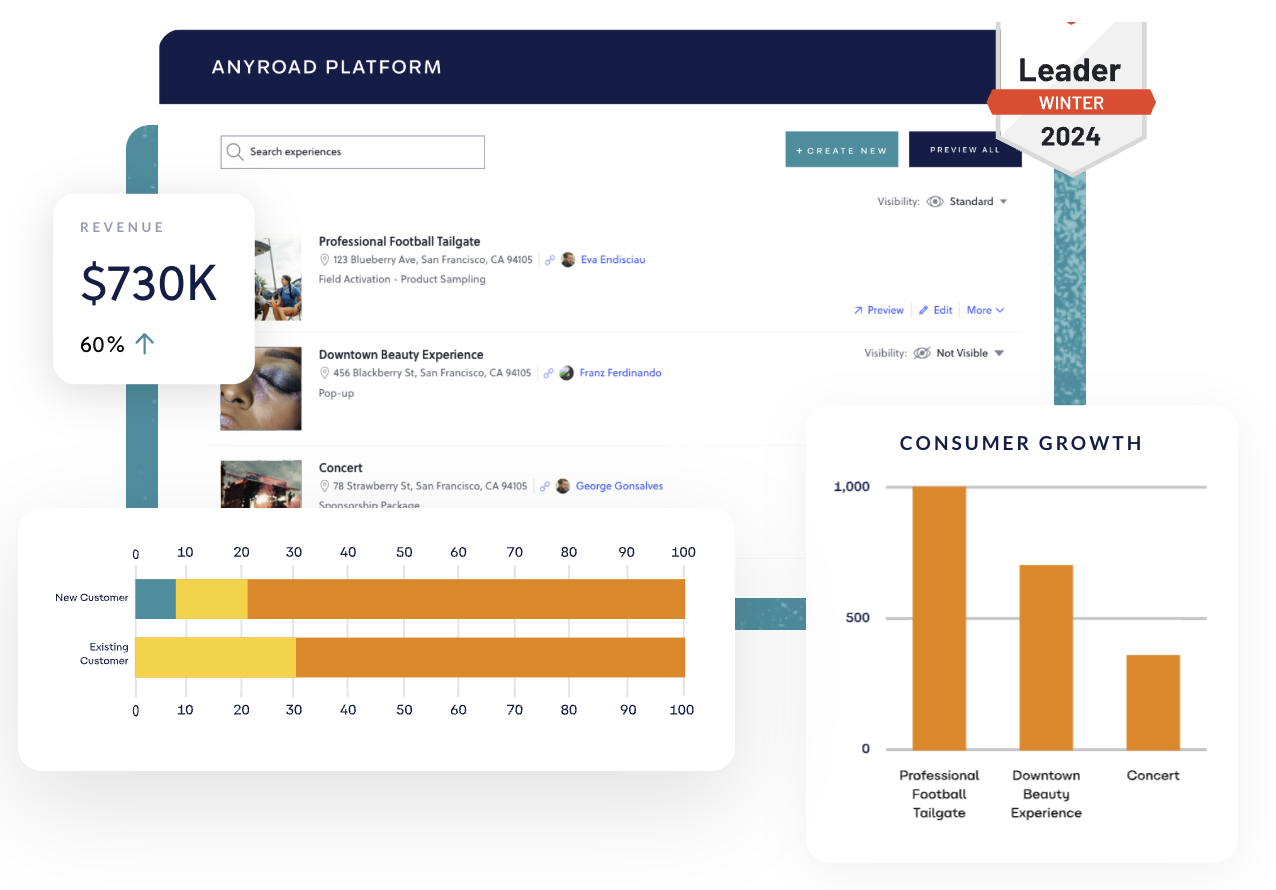
AnyRoad leads experiential marketing analytics with Atlas Insights and PinPoint AI, which analyze feedback for themes and sentiment patterns at scale. The platform delivers high data capture rates through configurable registration flows and FullView, while purchase conversion tools link specific experiences to revenue.
Absolut improved guest revenue per visit by 36% using AnyRoad’s attribution capabilities. Diageo achieved a 16-point NPS increase through AI-customized flavor profiles that matched guests with tailored tastings. AnyRoad also ensures brands own their entire consumer journey and data, with white-labeled booking experiences embedded directly into brand websites.
Feature | Pro | Con |
AI Analytics | PinPoint delivers clear, actionable insights | Premium pricing for full feature access |
Data Ownership | 100% brand-owned consumer data | Requires technical integration support |
Revenue Attribution | Direct tracking of sales conversions | More complex setup for multi-location brands |
2. Eventbrite: Scalable Ticketing Analytics
Eventbrite measures experiential ROI with integrated NPS surveys that often land between 65 and 75 for marketing events. The platform reaches about 90% data capture through ticket scanning and organizer apps, which supports first-party data exports for segmentation and remarketing. Sales attribution tools link up to 30% of post-event sales to experiential events, giving teams a baseline view of impact. Brands, however, must share data ownership within Eventbrite’s ecosystem, which limits full control over the consumer journey.
3. Cvent: Enterprise Tracking for Large Programs
Cvent’s Event ROI Dashboard often delivers NPS scores above 70 through structured post-event surveys and maintains roughly 85% attendee data capture. AI-powered lead scoring links 25% to 40% of events to pipeline revenue through CRM integrations, and some experiential alcohol activations report 3x ROI. The platform focuses on broad enterprise event management, so it lacks the experiential-specific AI depth that specialized experiential platforms provide.
4. FareHarbor: Tour and Experience Metrics
FareHarbor tracks NPS with automated feedback collection that often reaches scores above 80 for tours and branded experiences. The platform captures about 95% attendee data through waivers and custom forms, which supports strong visibility into who attends. Revenue attribution tools connect roughly half of upsells to events in alcohol brand case studies, with some programs reporting 5x ROI. Post-event engagement features remain limited, which makes long-term relationship building harder for brand teams.
5. Tock: Reservation Insights for Hospitality
Tock focuses on reservation management for restaurants, wineries, and tasting rooms, with basic revenue trend analysis. The platform offers core booking analytics and simple customer information collection that work well for hospitality operations. It does not provide advanced feedback analysis or robust post-experience engagement tools that complex experiential marketing programs require.
6. Whova: App-Based Attendee Engagement
Whova’s AI-driven analytics measure NPS in real time, often landing between 75 and 85, and report a 40% engagement lift. The platform captures about 88% of attendee data through app registrations and beacon technology. CRM syncs show roughly 35% conversion to revenue and about 2.5x ROI for many programs. Its AI features focus on general event engagement rather than the specific needs of brand experiential marketing for CPG and alcohol.
7. Splash: Marketing Event Performance
Splash centers on event marketing and engagement tracking, with strong attendance metrics and basic feedback tools. The platform supports event promotion, branded pages, and simple analytics that help teams understand turnout and satisfaction. It does not include advanced AI insights or detailed revenue attribution, which limits its usefulness for teams that must prove experiential ROI at the SKU or retailer level.
8. Bizzabo: Hybrid and Virtual Analytics
Bizzabo offers AI features such as agentic AI for sponsor matchmaking and session recommendations with enterprise-grade capabilities. The platform covers registration, content, and engagement for in-person, virtual, and hybrid events, with broad integrations. Its roadmap focuses on general event programs rather than the nuanced experiential marketing needs of CPG and alcohol brands that run sampling, tours, and pop-ups.
9. Peek Pro: Activity and Booking Reporting
Peek Pro supports booking management and basic reporting for activity-based businesses such as tours and attractions. The platform handles reservation analytics, capacity management, and payment processing for operators. It does not include sophisticated AI feedback analysis or revenue attribution tools, which limits its ability to support full-funnel experiential marketing ROI measurement.
Platform | NPS Improvement | Data Capture % | Revenue Attribution |
AnyRoad | 16-point | High | Proven |
Eventbrite | 10-point | 90% | 30% |
Cvent | 12-point | 85% | 35% |
FareHarbor | 15-point | 95% | 50% |
Whova | 8-point | 88% | 35% |
AnyRoad stands apart from platforms 2 through 9 by providing complete data ownership and experiential-specific AI that turns feedback into revenue-driving insights. While competitors deliver solid baseline analytics, AnyRoad’s focus on brand experiences gives teams deeper ROI measurement and more precise attribution.
Cvent vs. AnyRoad: Enterprise Analytics for Experiential Teams
Cvent delivers strong enterprise event management with robust CRM integrations and lead scoring for conferences and meetings. AnyRoad better serves experiential marketing teams through specialized AI analytics such as PinPoint sentiment analysis, complete data ownership, and revenue attribution tools built for brand experiences. Its white-labeled booking system and purchase conversion features give CPG and alcohol brands clearer visibility into how each activation drives sales.
Eventbrite Analytics for Branded Experiential Events
Eventbrite offers reliable analytics with roughly 90% data capture and integrated NPS surveys that often score between 65 and 75. The platform supports sales attribution by linking about 30% of post-event revenue to specific experiences. Data-sharing requirements and a broad event focus, however, create gaps for brands that need full control over their consumer journey and deeper experiential-specific insights.
Buyer’s Guide: Experiential KPIs and Post-Event Revenue Playbook
Experiential teams should track KPIs such as Customer Lifetime Value growth, purchase intent lift, and NPS changes that signal stronger brand affinity. 90% of consumers who taste Just Egg intend to purchase, which shows how powerful a single experience can be. A strong post-event revenue playbook includes automated SMS incentives sent within 24 hours, AI-powered feedback analysis to surface improvement opportunities, and CRM integration for personalized follow-up campaigns. Successful brands use purchase conversion tools such as cashback rebates and sweepstakes entries to trigger immediate retail behavior while tracking redemptions for accurate ROI measurement. You can book a demo to put these revenue-focused tactics in place with AnyRoad.
Conclusion: Why AnyRoad Leads Experiential Analytics in 2026
AnyRoad stands out as the top event analytics and reporting platform for experiential marketing in 2026, with AI insights, full data ownership, and proven revenue attribution. These capabilities turn brand experiences into measurable business outcomes that leadership teams can trust. Book a demo to see how advanced experiential analytics can reshape your ROI story.
Frequently Asked Questions
What makes event analytics platforms essential for experiential marketing ROI in 2026?
Event analytics platforms have become essential because 70% of brands still struggle to connect experiential marketing to actual sales results. In 2026, marketing leaders face rising pressure to justify experiential budgets with hard data instead of anecdotal feedback. These platforms address that pressure by capturing first-party data from every attendee, tracking brand affinity shifts through NPS, and tying experiences to post-event purchase behavior.
Advanced systems use AI to analyze thousands of feedback responses, surfacing themes and sentiment drivers that influence revenue. Without this level of analytics, brands miss chances to improve experiences, prove ROI to executives, and scale winning activations across markets.
How do the best event analytics platforms measure revenue attribution from experiential marketing?
Leading event analytics platforms measure revenue attribution with a mix of direct tracking tools and integrated data. Purchase conversion tools such as cashback rebates and promotional codes give teams a clear line from experience to sale.
Deep integrations with CRM and point-of-sale systems track changes in purchase frequency and average order value among attendees. AI-powered analytics then identify correlations between event participation and retail sales patterns across channels.
Automated SMS and email campaigns with unique tracking links measure immediate conversions after each activation. Together, these methods create a comprehensive attribution model that shows how experiential marketing drives revenue growth.
What AI capabilities should experiential marketers prioritize when selecting event analytics platforms?
Experiential marketers should focus on AI capabilities that turn qualitative feedback into decisions they can act on quickly. Sentiment analysis should categorize comments, highlight themes, and flag specific elements that drive delight or frustration. Predictive analytics can score which attendees are most likely to become brand advocates or buyers based on engagement patterns.
Real-time AI monitoring during events supports fast adjustments that improve satisfaction and conversion. Natural language processing should scan open-text responses for emerging trends and unmet needs. The strongest AI systems also generate recommendations for future events based on historical performance and behavior data.
How do enterprise event analytics platforms integrate with existing marketing technology stacks?
Enterprise event analytics platforms connect to marketing stacks through APIs and pre-built integrations with major CRM, email, and analytics tools. Leading options offer native integrations with Salesforce, HubSpot, Klaviyo, and similar platforms, which keep data flowing cleanly between systems.
Webhooks and Zapier connections support custom workflows with more specialized tools. Many enterprise solutions also provide developer portals for deeper customizations and links to ERP, accounting, and business intelligence platforms. These integrations ensure experiential data enriches customer profiles, powers automated campaigns, and feeds executive reporting without manual exports.
What data capture capabilities distinguish premium event analytics platforms from basic solutions?
Premium event analytics platforms stand out by capturing complete, high-quality data from every attendee, not just the primary contact. Advanced systems collect information from all guests in group bookings, which solves the common issue where brands miss contact details for 66% of their audience. Configurable questions before, during, and after experiences support rich demographic and psychographic profiling.
On-site tools such as QR code check-ins, digital waivers, and mobile apps gather behavioral data and engagement metrics. Top platforms also support ID scanning for age verification, capture photo and video content with proper permissions, and sync everything directly to CRM systems for fast follow-up marketing.