


Key Takeaways
- Event registration software with built-in analytics is now essential for proving ROI in a $14.29 billion event management market projected for 2026.
- Must-have features include real-time dashboards, ROI tracking such as NPS and revenue attribution, plus AI insights for sentiment analysis and predictive modeling.
- AnyRoad stands out with PinPoint AI, FullView group data capture that collects 69% more data, and Atlas Insights that power results like Absolut’s 36% revenue increase.
- Cvent works well for corporate events, Eventbrite for public events, and Whova for conferences, but they lack AnyRoad’s experiential focus and full first-party data ownership.
- Choose AnyRoad for brand experiences that rely on advanced analytics and first-party data, and book a demo to strengthen your 2026 event strategy.
Essential Analytics Features in Event Registration Platforms
The strongest event registration platforms with analytics deliver three core capabilities. Real-time dashboards track engagement, attendance patterns, and session popularity while events are live. ROI tools measure Net Promoter Score (NPS), purchase intent, and revenue attribution so you can link experiences directly to business results. AI insights surface sentiment trends, feedback themes, and predictive attendance modeling so teams can make data-driven improvements. About 79% of event organizers now use event management software platforms, yet only advanced solutions provide analytics that clearly prove marketing impact.
Feature | AnyRoad | Eventbrite | Cvent |
AI Analytics | PinPoint AI | Basic | CventIQ |
Data Ownership | 100% Brand Owned | Co-owned | Brand Owned |
ROI Tracking | Revenue Attribution | Sales Reports | Lead Scoring |
First-Party Data | FullView (69% more) | Limited | Standard |
The 9 Best Event Registration Platforms With Built-in Analytics
1. AnyRoad: Best Overall for Experiential Brand Events
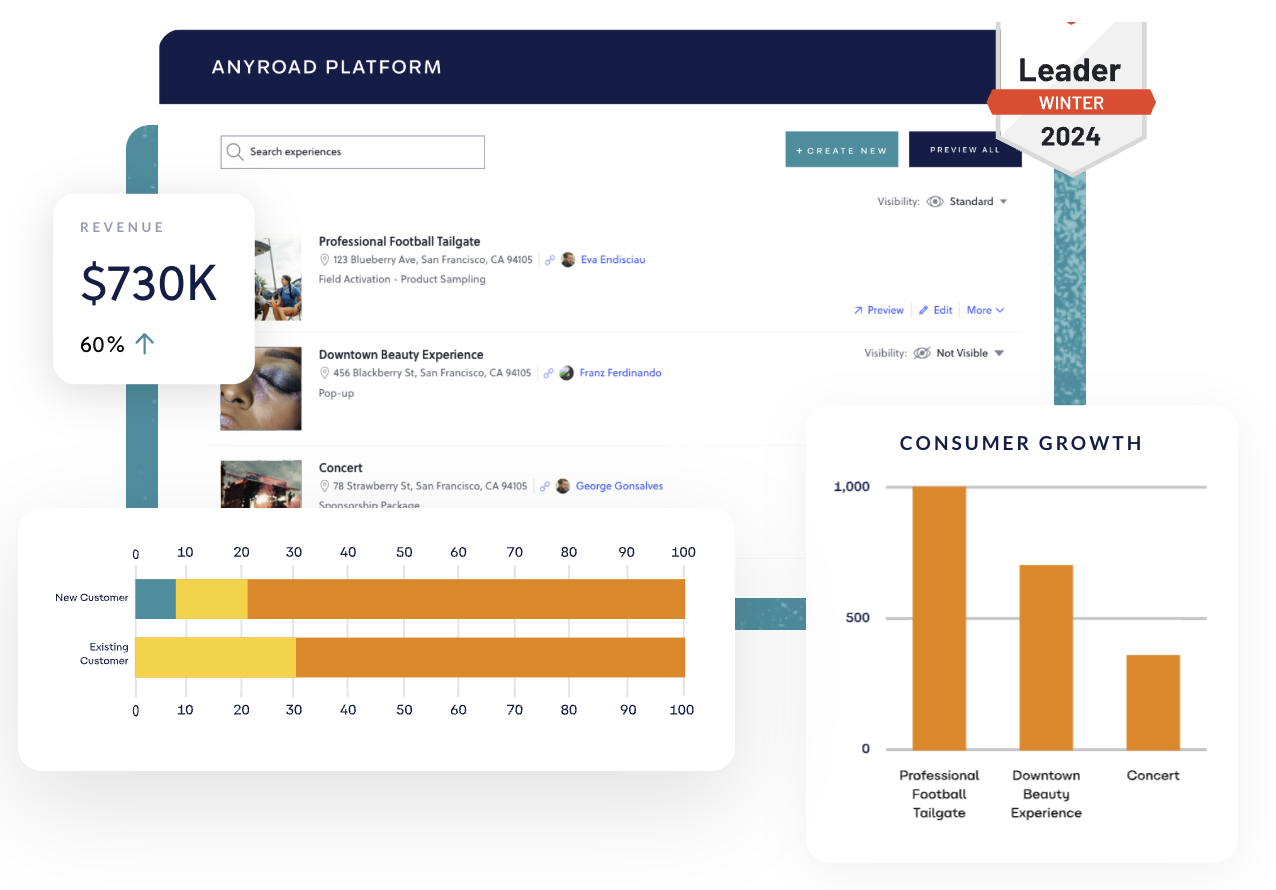
AnyRoad leads experiential marketing with white-labeled registration, PinPoint AI feedback analysis, and Atlas Insights for full ROI tracking. The platform captures 69% more guest data through FullView group registration and connects easily with HubSpot, Stripe, and Salesforce.
Brands see results such as Absolut’s 36% revenue lift, Diageo’s 16-point NPS increase, and Proximo Spirits’ 69% data capture boost. Unlike Eventbrite’s co-owned data model, AnyRoad gives brands complete control over their customer journey and first-party data. The Front Desk app simplifies on-site operations with QR code check-ins and digital waivers. Book a demo to use advanced event analytics that clearly prove experiential marketing ROI.
2. Cvent: Best for Large-Scale Corporate Events
Cvent supports enterprise events with deep reporting and detailed session tracking analytics. The platform includes more than 150 pre-defined reports and customizable dashboards that cover attendance, engagement, and lead capture. CventIQ adds generative AI for attendee segmentation and predictive analytics. Cvent, however, does not focus on experiential marketing and lacks AI-powered sentiment analysis for tastings, tours, and brand activations. Pricing starts at enterprise levels, so it often fits large corporations more than mid-sized brand teams.
3. Whova: Best for Conference Engagement and Networking
Whova brings ticketing, check-ins, and engagement metrics into real-time dashboards with networking analytics and gamification. The platform supports hybrid conferences and uses AI automation for post-event reporting. Its core strength lies in conference networking and attendee interaction tracking. Whova offers lighter brand-specific ROI measurement than experiential platforms and does not provide the first-party data ownership that CPG and alcohol brands often require.
4. Eventbrite: Best for Public and Ticketed Events
Eventbrite leads public event ticketing with straightforward sales dashboards and attendance reporting. Teams can set up registration and payment processing quickly and access standard analytics for ticket sales and basic demographics. Major drawbacks include co-owned customer data, where Eventbrite promotes other events to your attendees, and limited consumer insight tools. The platform also redirects visitors away from your website, which weakens the branded experience and reduces data capture.
5. Bizzabo: Best for Hybrid and Sponsor-Heavy Events
Bizzabo supports hybrid events with badge tracking, networking analytics, and sponsor ROI reporting. The platform unifies virtual and in-person attendee data and includes engagement scoring, such as tracking returning attendees as a brand loyalty signal. Analytics also cover brand reach and financial performance. Limited flexibility for first-party data customization makes Bizzabo a weaker fit for experiential campaigns that need deep consumer insights and detailed purchase intent tracking.
6. RegFox: Best for Growing Mid-Sized Events
RegFox offers customizable registration forms and flexible analytics for mid-sized organizations. Teams can access detailed reports on registration sources, payments, and attendee demographics. Pricing stays competitive for brands that have moved beyond basic ticketing but still watch budgets closely. RegFox does not include AI insights or advanced ROI attribution, so it falls short for teams that must prove experiential marketing impact and connect events directly to revenue.
7. RSVPify: Best for Nonprofits and Private Events
RSVPify focuses on secure event registration and engagement tracking for nonprofits and private gatherings. The platform connects with donor management tools and supports volunteer coordination analytics. Reporting covers attendance, check-ins, and fundraising metrics. Limited commercial features and shallow consumer insight capabilities make RSVPify a poor match for brand experiences that require sophisticated data capture and revenue attribution.
8. Eventleaf: Best Free Analytics-Friendly Option
Eventleaf gives budget-conscious organizers automated real-time reports on registrations, sales, and check-ins. The free tier includes basic analytics dashboards and attendee management tools. Limited customization and the absence of AI analysis or deep data capture restrict its value for professional brand events. Teams that need full ROI measurement and first-party data ownership usually outgrow Eventleaf quickly.
9. Accelevents: Budget-Friendly All-in-One Platform
Accelevents delivers end-to-end event management with broad analytics and reporting at competitive prices. The platform supports virtual, hybrid, and in-person events with engagement tracking and sponsor analytics. It offers strong value for teams with standard event needs. However, Accelevents does not match the specialized experiential features or AI insights that premium brands rely on to measure brand affinity and purchase intent.
Top 4 Event Analytics Platforms Compared
Feature | AnyRoad | Eventbrite | Cvent | Whova |
Booking Experience | White-labeled | Third-party redirect | Branded portal | Platform redirect |
Data Capture | FullView groups | Individual only | Standard forms | Basic registration |
AI Analytics | PinPoint themes | None | CventIQ | Basic automation |
ROI Tools | Atlas Insights | Sales reports | Lead scoring | Engagement metrics |
Integrations | HubSpot, Stripe | Limited CRM | Enterprise systems | Standard APIs |
Pricing | Enterprise | Per ticket | Enterprise | Monthly plans |
Analytics depth and data ownership models vary widely across these platforms. Book a demo to compare AnyRoad’s advanced capabilities with your current stack.
Buyer Guide: Choosing Event Registration Software With Analytics
Choose event registration software based on your analytics needs and event formats. Brand experiences that rely on first-party data and AI insights align best with AnyRoad. Public event organizers gain reach from Eventbrite, even with its data limits. Large enterprises often prioritize Cvent for its reporting scale.
Review integration needs with CRM, marketing automation, and POS systems through tools like Zapier, Salesforce, or direct APIs. Predictive analytics and personalization now drive AI trends in event technology for 2026. Also assess scalability, compliance for regulated industries, and mobile performance for smooth attendee experiences.
Conclusion: Why AnyRoad Leads Experiential Event Analytics
AnyRoad leads experiential marketing by pairing AI analytics with a clear revenue impact that supports marketing budgets. PinPoint feedback analysis, FullView data capture, and Atlas Insights work together to deliver measurable ROI that generic tools cannot match. Other platforms serve specific niches, yet only AnyRoad combines white-labeled experiences with full first-party data ownership for CPG and alcohol brands. Book a demo to see how advanced event analytics can expand your marketing database up to 5X and turn experiences into reliable revenue drivers.
Frequently Asked Questions
How do advanced event analytics go beyond basic reporting?
Advanced event analytics move past simple attendance counts to measure brand impact, sentiment, and revenue attribution. Basic reporting shows who attended and when they registered. Platforms like AnyRoad also track NPS shifts, purchase intent, brand affinity, and lifetime value. AI tools review open-text feedback and highlight themes and actions automatically. Leading platforms connect with CRM and marketing systems so you can link event participation to future sales and prove experiential ROI.
Why does data ownership matter in event registration software?
Data ownership decides who controls the customer relationship and insights from your events. Platforms such as Eventbrite co-own attendee data and promote other events to your audience, which can weaken loyalty. Full ownership lets your team control first-party data, personalize follow-up, and calculate customer lifetime value accurately. This matters even more in regulated categories like alcohol, where compliance and brand protection stay critical. White-labeled tools that live on your website also keep the full customer journey under your brand.
Can free event registration tools support professional-level analytics?
Free tools usually provide attendance tracking and simple registration reports, but they rarely support professional analytics needs. They do not measure brand impact, sentiment, or revenue attribution at the level required to defend budgets. Free platforms also restrict customization, data exports, and enterprise integrations. They can work for occasional community events or small nonprofits. Brands that invest in experiential marketing, however, need advanced analytics, AI insights, and full ROI tracking that paid platforms deliver.
Which analytics features matter most for experiential marketing?
Experiential marketing depends on analytics that connect events to business outcomes beyond headcount. Essential features include NPS tracking for brand sentiment, purchase intent scoring for future sales, and revenue attribution that links attendance to transactions. AI feedback analysis reveals what drives positive experiences and loyalty. Group data capture collects information from every attendee, not only the primary registrant. CRM and marketing automation integrations then enable tailored follow-up based on behavior and preferences.
How do AI-powered analytics improve event ROI measurement?
AI analytics reviews large volumes of feedback to uncover sentiment trends, recurring themes, and actions that manual review would miss. Machine learning models predict attendee behavior, refine event timing and content, and segment audiences for targeted campaigns.
AI can also analyze social mentions, photo engagement, and post-event surveys to create a broader brand impact score. Predictive analytics forecast attendance, highlight high-value prospects, and guide resource allocation. These capabilities help teams shift events from cost centers to measurable revenue drivers with clear links to business outcomes.