


Key Takeaways
- Experiential marketing teams lose over 66% of guest data without specialized platforms, while top tools unify online and offline data for complete ROI proof.
- AnyRoad leads with PinPoint AI for feedback analysis, FullView data capture, and Atlas Insights for revenue attribution, which delivers 36% lifts in guest revenue.
- Key platforms like Braze excel in cross-channel engagement, while Eventbrite and HubSpot offer basic event and CRM analytics but lack experiential depth.
- Critical metrics include NPS, purchase intent, brand affinity, and CLTV, and AI personalization drives 41% revenue increases in 2026 trends.
- Teams should choose platforms with first-party data ownership and white-label experiences; book an AnyRoad demo to capture 69% more data and turn events into revenue.
Top 10 Experiential Analytics Platforms Ranked
1. AnyRoad
Best for: End-to-end experiential marketing management with AI-powered insights and revenue tracking.
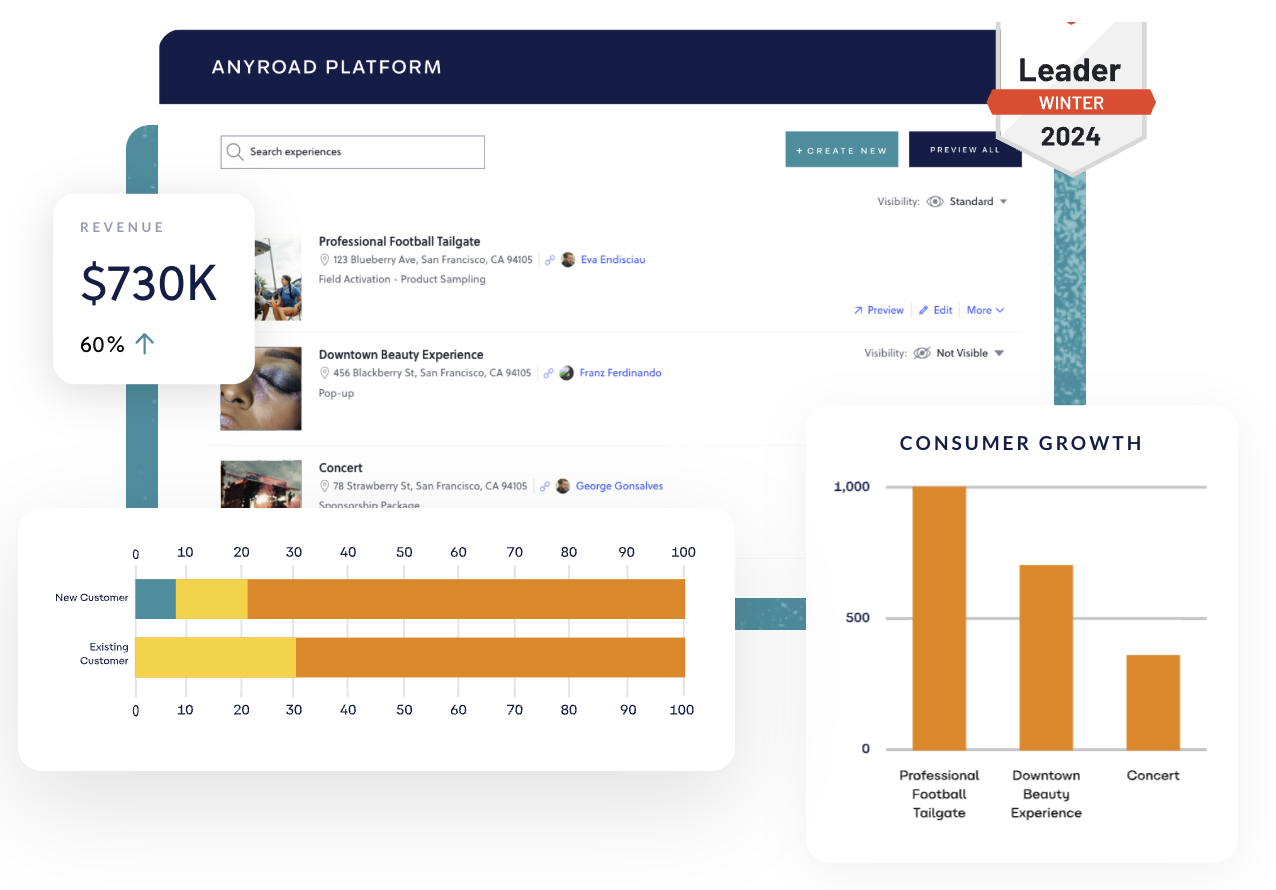
AnyRoad leads the experiential marketing analytics space with purpose-built features for live activations. PinPoint AI automatically analyzes thousands of open-text feedback responses and surfaces key themes and sentiment drivers in real time. FullView data capture helps brands collect information from every attendee in a group, not just the booking contact. Atlas Insights provides comprehensive ROI measurement and tracks changes in Brand Affinity, Net Promoter Score, and purchase intent. Lifetime Loyalty tools include purchase conversion features such as cashback rebates and sweepstakes entries sent via SMS to drive retail sales.
Pros: Complete first-party data ownership, white-labeled booking experience, AI feedback analysis, proven revenue lifts
Cons: Premium pricing, focused primarily on experiential use cases
Case studies highlight AnyRoad’s impact. Absolut improved guest revenue per visit by 36%. Diageo achieved a 16-point NPS increase using AI-customized flavor profiles. Proximo Spirits captured 69% more guest data after implementing FullView.
Capture 69% more guest data and link experiences to revenue. Book a demo.
2. Braze
Best for: Cross-channel customer engagement with real-time messaging capabilities.
Braze focuses on omnichannel customer engagement with analytics that track user behavior across touchpoints. The platform offers advanced segmentation, predictive analytics, and real-time personalization. Canvas Flow supports complex customer journey orchestration, and Braze Intelligence adds AI-powered insights for campaign performance.
Pros: Strong cross-channel capabilities, advanced segmentation, real-time messaging
Cons: Limited experiential-specific features, requires integration setup for event data
3. Eventbrite
Best for: Event ticketing and basic attendee management for public events.
Eventbrite covers fundamental event management with analytics focused on ticket sales and attendance. The platform supports registration management, payment processing, and simple reporting dashboards. It redirects users to Eventbrite’s website, which dilutes brand experience and splits data ownership.
Pros: Easy setup, wide market reach, integrated payment processing
Cons: Co-owns attendee data, limited customization, basic analytics only
4. FareHarbor
Best for: Tour and activity booking with operational management tools.
FareHarbor specializes in booking management for tours and activities with resource scheduling, staff management, and payment processing. The platform offers booking analytics, revenue reporting, and customer management. It lacks advanced feedback analysis and deeper experiential insights.
Pros: Strong operational tools, industry-specific features, reliable booking system
Cons: Limited data customization, no AI insights, basic reporting
5. HubSpot
Best for: CRM-integrated marketing analytics with lead tracking capabilities.
HubSpot’s marketing platform connects social campaigns to CRM data and shows impact on leads and pipeline. The platform offers marketing automation, lead scoring, and attribution reporting. Social Analytics features track engagement metrics and campaign performance across channels.
Pros: Comprehensive CRM integration, strong lead attribution, extensive automation
Cons: Less specialized for experiential needs, expensive for full features
6. Insider
Best for: AI-driven personalization and cross-channel customer experience improvement.
Insider provides AI-powered customer experience tools with real-time personalization. The platform unifies customer data from multiple sources and supports cross-channel journey orchestration. Advanced segmentation and predictive analytics enable targeted engagement strategies.
Pros: Strong AI capabilities, cross-channel support, real-time personalization
Cons: Less focused on experiential events, requires team onboarding
7. Mixpanel
Best for: Product analytics and user behavior tracking for digital experiences.
Mixpanel focuses on tracking user interactions and behavioral analytics with cohort analysis and funnel tracking. The platform provides detailed event tracking, retention analysis, and A/B testing. It centers on digital product analytics rather than experiential marketing.
Pros: Detailed behavioral analytics, strong retention tracking, flexible event tracking
Cons: Digital-focused, no experiential features
8. Tock
Best for: Restaurant and winery reservation management with guest data collection.
Tock supports reservation management for restaurants and wineries with table management, prepaid experiences, and guest preference tracking. The platform offers basic analytics on revenue, covers, and booking trends. It does not include comprehensive feedback analysis or advanced engagement tools.
Pros: Industry-specific features, prepaid experience management, guest preference tracking
Cons: Limited to hospitality, basic analytics, no AI insights
9. Xola
Best for: Tour operator booking and distribution management.
Xola focuses on booking and distribution management for tour operators with inventory management, channel distribution, and reporting. The platform improves operational efficiency but offers limited analytics for customer engagement or experience improvement.
Pros: Strong distribution network, inventory management, operational focus
Cons: Limited customization, no advanced insights
10. Splash
Best for: Event marketing and basic attendee engagement tracking.
Splash offers event marketing tools with registration management, email marketing, and analytics. The platform supports event promotion and attendee tracking. Many teams still need additional tools for full experiential revenue attribution.
Pros: Event marketing focus, easy-to-use interface, integrated promotion tools
Cons: Limited depth for advanced experiential analytics, basic data collection for complex needs
Experiential Platform Comparison Matrix
Platform | AI Feedback Analysis | Data Ownership | Event ROI Tracking | Experiential Score |
AnyRoad | PinPoint AI analyzes thousands of open-text responses for trends | Complete first-party ownership | Atlas Insights with revenue attribution | 10/10 |
Braze | Basic sentiment analysis | Brand owns data | Event tracking via Currents and integrations | 7/10 |
Eventbrite | None | Co-owns with platform | Basic sales reporting | 5/10 |
HubSpot | Post-event feedback and reporting tools | Brand owns data | CRM-based attribution | 6/10 |
Core Metrics That Prove Experiential ROI
Successful experiential marketing analytics platforms track metrics that directly reflect live activation performance. Net Promoter Score (NPS) measurement provides immediate feedback on experience quality and brand sentiment. Purchase intent tracking helps forecast future sales behavior and campaign effectiveness. Customer Lifetime Value (CLTV) analysis shows the long-term impact of experiential investments.
Attendee journey mapping reveals which touchpoints work and where guests drop off. AI hyper-personalization drives 41% revenue increase compared to static approaches, so real-time personalization capabilities now play a central role in maximizing event ROI.
AnyRoad’s Atlas Insights dashboard supports these needs with analytics that filter data by experience, location, and customer demographics. The platform tracks brand affinity changes, measures purchase conversion rates, and calculates true experiential ROI with integrated revenue attribution.
2026 Outlook: AI and Predictive Attendee Intelligence
AI-driven event apps now provide real-time personalization by suggesting sessions, networking matches, and booths based on attendee data. RFID wristbands support seamless data collection and personalized experiences throughout events. These technologies connect online and offline touchpoints and create complete attendee profiles.
Predictive analytics capabilities help brands anticipate attendee needs and refine experiences in real time. AI-native digital intelligence allows AI agents to spot signals, adjust campaigns, and orchestrate outcomes, which shifts marketers into more strategic roles.
CPG executives report that AI investments create more and better product concepts and personalized content in less time, which boosts ROI. AnyRoad’s PinPoint AI reflects this shift by automatically analyzing feedback themes and delivering actionable insights for experience improvement.
Turn experiential data into predictive insights. Book a demo to see AnyRoad’s AI in action.
Buyer Checklist for Experiential Analytics Platforms
1. AI Feedback Analysis: The platform should automatically analyze open-text responses and surface trends and actionable insights.
2. Complete Data Capture: The system must collect information from every attendee, not just the booking contact.
3. First-Party Data Ownership: Your team should maintain complete ownership of all collected customer data.
4. White-Label Experience: The booking and registration flow should keep your brand front and center.
5. Revenue Attribution: The platform needs to link experiential activities directly to sales and conversions.
6. Real-Time Insights: Analytics and feedback should be available during and immediately after events.
7. Integration Capabilities: The platform must connect cleanly with your CRM, marketing automation, and POS systems.
Platforms that score highest across these criteria, especially AnyRoad with its experiential focus, give teams a strong foundation to prove event ROI and scale successful activations.
Conclusion: Turn Experiences into Measurable Revenue
Leading consumer engagement analytics platforms for experiential marketing teams prioritize first-party data ownership, AI-powered insights, and revenue attribution. AnyRoad stands as the clear leader for experiential marketing, with Braze supporting cross-channel engagement and HubSpot strengthening CRM integration.
Generic customer engagement tools rarely solve the unique challenges of live activations, which leaves valuable attendee data unused and ROI unproven. Experiential marketing teams need specialized platforms that connect online and offline touchpoints, deliver real-time insights, and show clear links between experiences and revenue.
Prove event ROI with AnyRoad’s AI insights and comprehensive analytics. Book a demo to transform your experiential marketing strategy.
Frequently Asked Questions
What is the best customer engagement platform for experiential marketing teams?
AnyRoad is the best customer engagement platform built specifically for experiential marketing teams. Unlike generic tools, AnyRoad offers features for live activations such as PinPoint AI for feedback analysis, FullView for complete attendee data capture, and Atlas Insights for revenue attribution. The platform helps brands control the entire customer journey and prove measurable ROI from experiential campaigns.
How do experiential marketing analytics differ from traditional customer engagement analytics?
Experiential marketing analytics focus on unifying online and offline touchpoints, capturing data from group attendees, and measuring experience-specific metrics like brand affinity and purchase intent. Traditional customer engagement analytics usually track digital interactions and email or web behavior, and miss rich qualitative feedback and in-person engagement data that drive experiential ROI. Specialized platforms like AnyRoad close this gap with comprehensive analytics for live activations.
What metrics should experiential marketing teams track to prove ROI?
Key metrics for proving experiential marketing ROI include Net Promoter Score (NPS) changes, purchase intent lifts, brand affinity improvements, customer lifetime value (CLTV) growth, and direct revenue attribution from post-event conversions. Advanced platforms should also track attendee journey progression, engagement depth, and long-term loyalty indicators. AnyRoad’s Atlas Insights dashboard covers these metrics and allows filtering by experience, location, and demographics for complete ROI analysis.
Why is first-party data ownership important for experiential marketing platforms?
First-party data ownership keeps brands in full control of valuable attendee information collected during experiences. Some platforms share customer data and may promote competitors’ events to your attendees, which weakens brand relationships. Complete data ownership supports personalized follow-up marketing, accurate customer lifetime value calculations, and smooth integration with existing CRM systems. This control is crucial for building long-term customer relationships and maximizing experiential investments.
How can AI improve experiential marketing analytics in 2026?
AI improves experiential marketing analytics through automated feedback analysis, real-time personalization, and predictive attendee insights. AI-powered tools can analyze thousands of open-text responses and identify trends and sentiment drivers, which enables rapid experience adjustments. Real-time personalization using RFID and mobile apps creates tailored experiences for each attendee. Predictive analytics help teams anticipate attendee needs and refine future events. AnyRoad’s PinPoint AI shows these capabilities by turning qualitative feedback into actionable insights that support revenue growth.