


Written by: Bryan Grobstein, Vice President, Global Revenue, AnyRoad | Last updated: October 15, 2026
Key Takeaways
- Experiential brand storytelling for CPG brands translates one authentic brand truth into a sensory proof point that consumers physically experience, then closes with a measurable purchase action.
- Four proven strategies, guided tastings, consultation demos, demonstration-led problem solving, and origin-story sampling, each connect narrative to measurable consumer action across specific CPG categories.
- Research shows storytelling increases narrative absorption and purchase intent, and incremental sales lift requires control-group measurement instead of recall or intent metrics alone.
- The Story-Experience-Action framework structures programs around one verifiable brand truth, a sensory proof point, and a purchase action that produces receipt-verified transactions.
- AnyRoad captures first-party data at every touchpoint and connects activations to retail outcomes through cashback rebates, loyalty enrollment, and AI-powered insights that prove incremental impact.
Measure Your Experiential Storytelling Impact
Four Measurable Experiential Strategies For CPG Brands
Four strategies show strong category fit and a clear storytelling angle that links the narrative to a measurable consumer action.
- Guided Sensory Tasting With A Heritage Narrative — Beverage And Pantry. The story explains why the liquid tastes the way it does, such as the water source, the fermentation process, or the aging vessel. The tasting functions as the proof point rather than decoration. Consumers who engage with a guided tasting at a brand home are primed for same-day purchase incentives and loyalty enrollment.
- Consultation-Led Application Demo — Beauty And Personal Care. The story frames the consumer as the expert’s subject rather than a target. A trained consultant diagnoses a skin concern, applies a product, and explains the formulation rationale. AnyRoad data from Conversate Collective’s field marketing events for a CPG beauty brand showed that 74% of guests were more likely to purchase the brand’s products after attending, with beauty consultations identified as the most popular experience format.
- Demonstration-Led Problem Solving — Household. The story names a daily pain point, such as a stain, an odor, or a surface, and resolves it in front of the consumer. Household products rarely allow conventional sampling, so the demonstration becomes the trial. Attribution windows for this category tend to run longer, often several weeks, to capture sustained velocity lift.
- Origin-Story Sampling With A Same-Day Purchase Incentive — Food And Snack. The story connects the ingredient source to the first bite. A consumer who understands that a grain was grown in a specific region and harvested at a specific time experiences the product differently than one who does not. Closing with a same-day rebate or coupon converts the narrative into a measurable retail action.
Those four strategies all rest on the same assumption: a story changes how a consumer perceives and values the product. Before treating that assumption as settled, it helps to examine what the research actually shows and where it stops.
Evidence For Storytelling’s Impact On Taste And Intent
The research base around storytelling and CPG behavior is real and bounded. Each study below proves something specific and leaves other questions open.
A 2026 Frontiers In Communication study (N=713) found that emotional narrative advertising produced significantly higher narrative absorption than functional advertising (M=5.06 vs. M=4.41, Cohen’s d=0.91), and that narrative absorption correlated with repurchase intention at r=0.46 (p<0.001). The study used a fictitious beverage brand and a controlled experimental design. This proves that storytelling format affects how deeply consumers process a brand message and how willing they report being to repurchase. It does not prove that a single live activation produced incremental retail sales without a control group.
A 2023 festival activation for an artisanal mezcal brand using AnyRoad’s platform reported 85% post-event purchase intent across activations at III Points and Portola. This proves that experiential engagement at scale can produce strong purchase intent signals. It does not prove that intent converted to incremental retail sales, because purchase intent is an intermediate outcome rather than a verified transaction.
AnyRoad analytics for Diageo’s Johnnie Walker Princes Street showed that an important under-targeted demographic was 40% more likely to drink whisky after visiting, alongside a 16-point NPS increase. This proves that immersive brand experiences can drive category entry and incremental consumption intent among new demographics. It does not prove that the visit caused incremental retail purchases without a holdout comparison.
What The Research Does Not Prove: None of these studies establish that a single activation produced incremental retail sales without a control group. Taste perception and purchase intent function as intermediate outcomes rather than sales. Reporting them as sales evidence to leadership risks the budget line.
For the sensory dimension of these strategies, see Multi-Sensory Experiential Marketing For CPG Brands.
The Story-Experience-Action Framework For CPG
The Story-Experience-Action framework structures an experiential program around three stages that connect sequentially.

- One Authentic Brand Truth. A single claim the brand can substantiate, such as heritage, process, or ingredient origin. This functions as a verifiable fact that the brand owns and can demonstrate.
- A Sensory Proof Point. The truth translated into something the consumer tastes, feels, smells, or sees demonstrated. The narrative reinforces the sensory experience instead of running parallel to it.
- A Purchase Action. A same-day incentive, enrollment, or rebate that closes the loop between the experience and a measurable commercial outcome.
A worked example helps make this concrete. A beverage brand whose heritage story centers on a water source that has remained unchanged for 150 years runs a guided tasting that walks consumers through how mineral content affects flavor profile. The experience then closes with a same-day cashback rebate redeemable at any retailer carrying the product. The narrative, focused on the water source, explains why the tasting tastes the way it does, and the rebate converts that experience into a trackable retail purchase. Without the rebate, the program produces only purchase intent. With the rebate, the program produces a receipt-verified transaction tied to a first-party record.
CPG Brand Activation Case Studies With Measurable ROI documents how brands have applied this structure across categories.
See The Story-Experience-Action Framework In Action
Category Fit And Attribution Windows For Experiential CPG
Category fit determines the right attribution window and measurement plan. One playbook rarely fits every category.
Food, Beverage, And Beauty convert on short-cycle sensory immersion. The product benefit is perceptible in seconds, such as a taste, a texture, or a visible skin result. For food, beverage, and beauty, attribution windows for trial conversion typically run from a few days up to 14–30 days, with sensitivity analyses at 14/30/60 days recommended for fast-moving consumables like beauty and skincare. A study published in the Journal of Retailing, analyzing six store-level scanner datasets across four product categories, found that in-store sampling produces both immediate and sustained sales effects. For beauty specifically, AnyRoad data showed that over 50% of surveyed consumers at CPG beauty brand events bought the brand’s products from Walgreens and Target, which identified the retail channels where experiential intent converted to purchase.
Household And Pantry require demonstration-led storytelling and longer attribution windows. The product benefit, such as a cleaner surface or a more efficient wash, rarely appears in a single sensory moment. Consumers need to use the product at home before the benefit registers. A plant-based snack brand’s 40-store demonstration program sustained unit velocity 42% above baseline six weeks post-campaign, illustrating how sustained lift, rather than event-day conversion alone, is the relevant metric for categories with longer benefit recognition cycles. That is why household programs need a post-event tracking window of several weeks rather than days.
New Product Launches across all categories benefit from structured sampling during the first thirteen weeks, when trial and traction determine shelf placement. Industry analysts identify in-store sampling and live demos as among the top three drivers of trial for new innovations, particularly in refrigerated goods, beverages, and snack categories.
Measurement Framework For Experiential Storytelling
Measuring experiential storytelling requires a labeled sequence that separates intermediate signals from business outcomes. The sequence runs attention, story comprehension, emotional response, conversion, and incremental impact. Each stage requires a different measurement instrument. Collapsing them into a single recall figure produces a number that satisfies a vendor report but fails a CFO’s scrutiny.
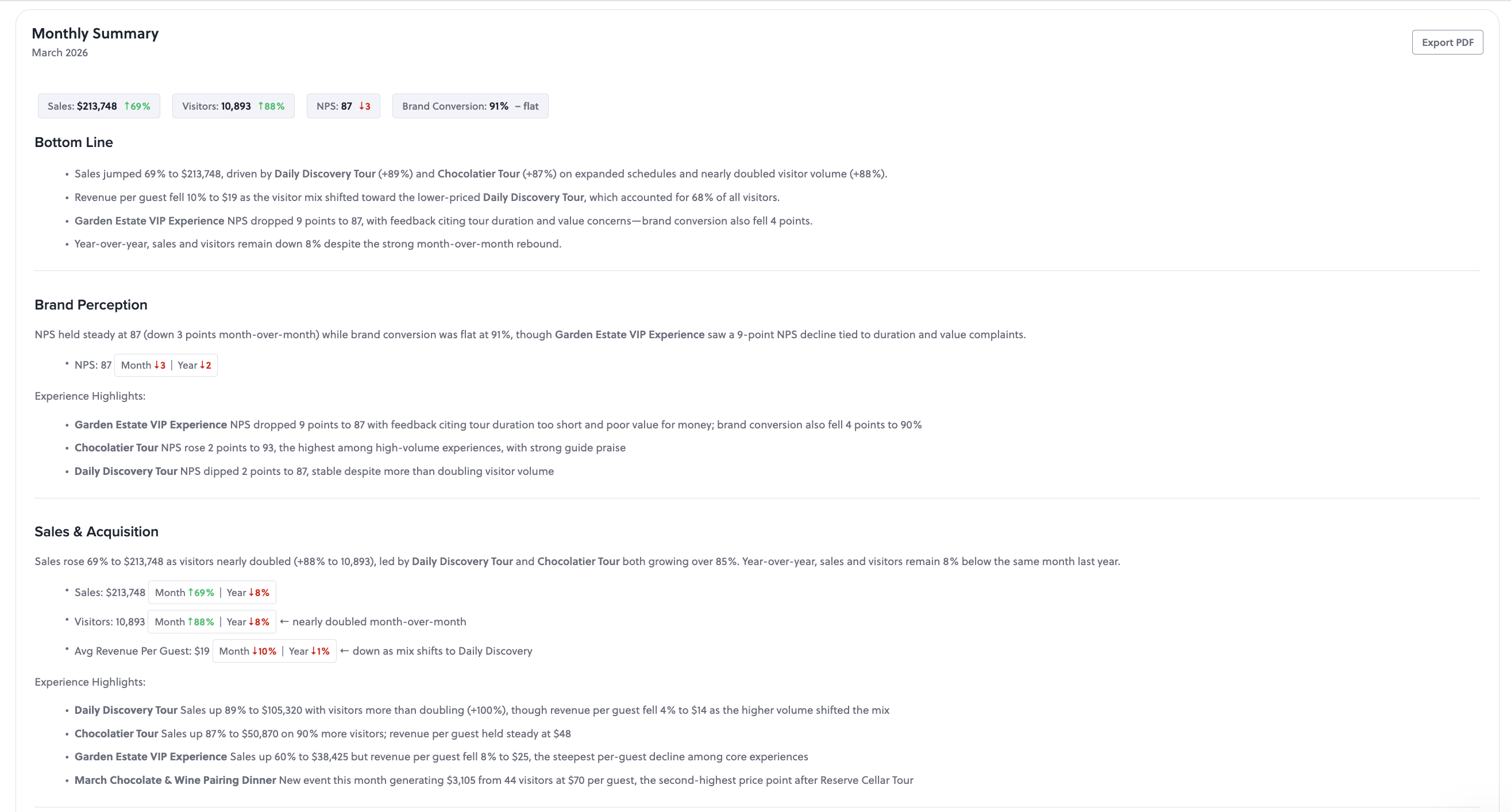
The distinction between brand recall and incremental sales lift is the most consequential measurement gap in experiential marketing. The table below shows why: each metric answers a different stakeholder’s question and leaves a different blind spot, so reporting one as a proxy for the other misrepresents what the program actually achieved.
| Metric | What It Answers | Who Asks For It | What It Cannot Prove |
|---|---|---|---|
| Brand Recall | Did consumers remember the brand after the activation? | Brand managers, agency partners | That the activation caused a purchase that would not have happened otherwise |
| Incremental Sales Lift | Did the activation generate revenue above what the control group produced? | CFOs, category managers, retail buyers | Which specific story element or sensory proof point drove the lift |
The central distinction in experiential measurement is between attribution and incrementality: attribution identifies a sale that occurred after an exposure, while incrementality asks whether that sale would have happened without the exposure. A purchase after an event counts as an attributed outcome but not automatically an incremental one.
The control-group principle anchors credible reporting. Measure incremental impact against a holdout or matched control group. Research published by Google on causal inference defines incremental lift as the true difference between a treated audience and an isolated control group. The calculation is (Treatment Post - Treatment Pre) - (Control Post - Control Pre). Last-click attribution hides experiential’s real contribution because it assigns credit to the final digital touchpoint instead of the live experience that changed the consumer’s relationship with the product.
Purchase intent differs from a sale. Stated purchase intent frequently fails to materialize as actual checkout behavior, and on-site surveys capture participants at the peak of their emotional engagement, which inflates short-term favorability scores. Reporting intent to leadership as a proxy for sales creates a credibility risk rather than a measurement strategy.
See How AnyRoad Measures Incremental Lift
Experiential Storytelling Compared To Traditional CPG Advertising
Measurement standards only make sense in contrast. Experiential storytelling and traditional advertising are often compared as competing line items, yet they operate through different mechanisms and prove different things. The strategic question centers on which objective each channel serves.
The table below maps four dimensions, mechanism, proof, measurement standard, and best-fit objective, to show where each channel becomes the stronger choice.
| Dimension | Experiential Storytelling | Traditional Advertising |
|---|---|---|
| Primary Mechanism | Sensory trial and episodic memory formation through direct product encounter | Repeated exposure building semantic memory and mental availability |
| What It Proves | Purchase intent lift and trial conversion when measured against a control group; the 85% post-event purchase intent figure cited earlier | Reach, frequency, and aided recall; Nielsen analyzed 100 ads across 25 FMCG brands and found the most emotional ads generated a 23% sales increase over less emotional counterparts |
| Measurement Standard | Incremental sales lift vs. matched control stores or holdout markets; receipt-verified purchase conversion | Brand lift studies comparing exposed vs. unexposed groups; absolute lift calculated as exposed-group positive response rate minus control-group positive response rate |
| Best-Fit Objective | Trial generation, category entry, loyalty enrollment, and incremental velocity lift for sensory-dependent products | Broad awareness, brand equity maintenance, and reach efficiency at scale |
Traditional advertising creates awareness and mental availability while live experiences convert that awareness into a firsthand product encounter and emotional connection. The two channels work as complements and require separate measurement standards and budget justifications.
Connecting Experiences To Retail Outcomes With First-Party Data
The gap between a memorable experience and a measurable retail outcome closes through first-party data capture. On-site registration, QR code scans, post-event SMS follow-up, and cashback rebate mechanics each produce a first-party record tied to an identifiable consumer. That record connects the activation to a receipt-verified purchase.
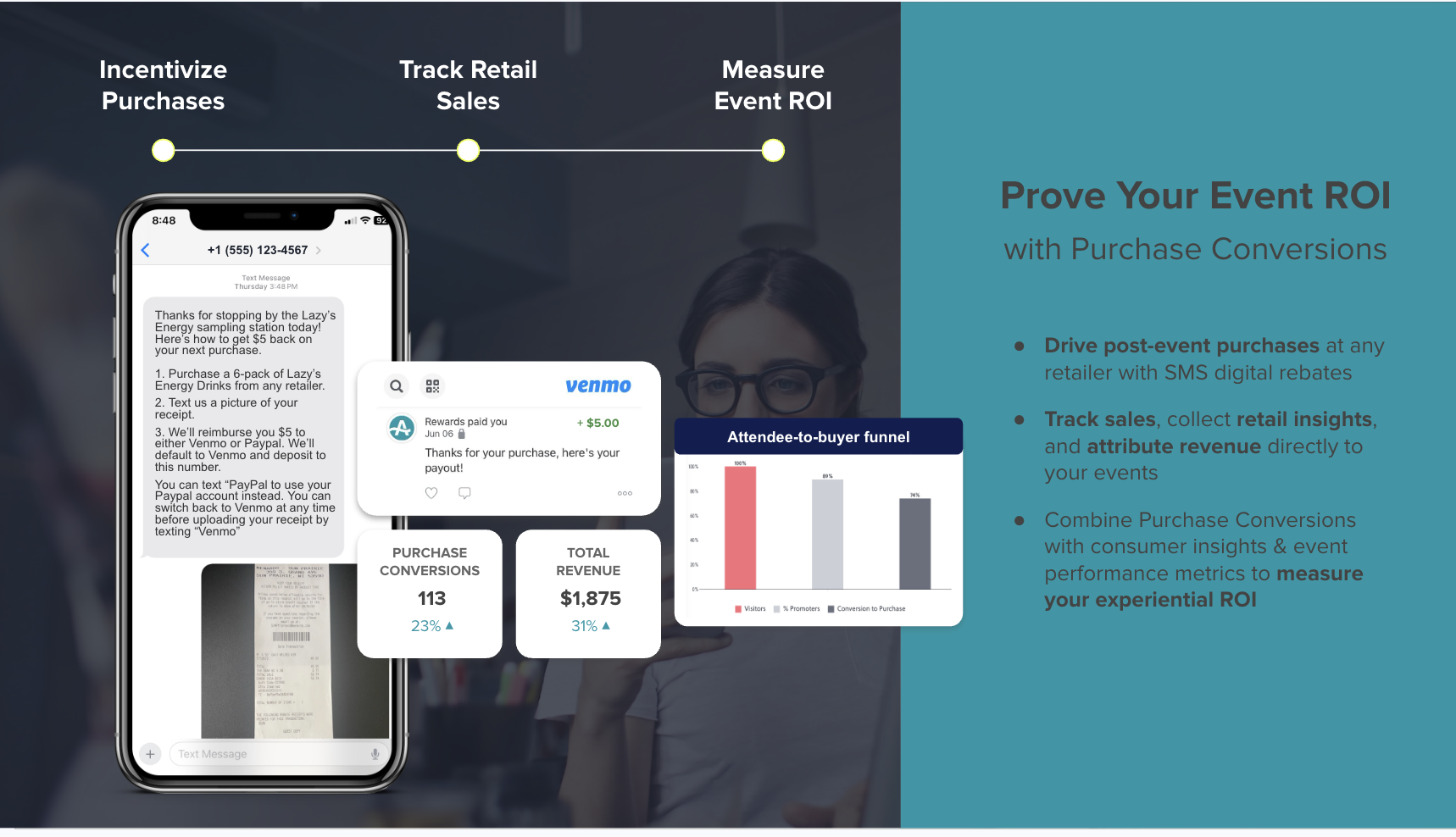
AnyRoad’s platform captures this data at every touchpoint, before, during, and after the experience, and connects it to downstream retail behavior. Cashback rebates and sweepstakes are the two purchase conversion tools that make that connection possible. The rebate mechanic works without POS integration. A consumer scans a QR code at the activation and receives an SMS with a rebate redeemable anywhere the product is sold. They then photograph the receipt and text it back. AnyRoad’s AI reads the receipt, confirms the eligible SKU, and pays out via Venmo or PayPal. The result is a receipt-verified purchase tied to a named consumer who attended a specific activation.

The Lifetime Loyalty suite extends this further. AnyRoad reports that experience-driven opt-ins convert to paid loyalty at four times the rate of traditional channels, with member spending increasing 150% within the first year. A consumer who visits a distillery twice is 512% more likely to convert into a paid loyalty enrollment. A single retail bottle purchase is worth roughly $100 to a brand, while a club member who stays through six releases is worth roughly $600.
Brands that have adopted the Lifetime Loyalty platform, including Heaven Hill Distillery, Nearest Green Distillery, Lux Row Distillers, Castle & Key, Catoctin Creek Distilling, and Tarnished Truth Distilling, use AnyRoad to move consumers from a first visit to a recurring revenue relationship, with churn programming built around the six-release mark where depletion, rather than disengagement, becomes the primary retention risk.
AnyRoad’s Atlas Insights dashboard and PinPoint AI-powered feedback analysis surface the themes and sentiment patterns that explain why some experiences convert and others do not. Brand and field marketing managers gain the evidence they need to defend the line item and scale what works.

See How AnyRoad Connects Experiences To Retail Sales
Frequently Asked Questions
What Is Experiential Brand Storytelling?
Experiential brand storytelling is the practice of translating one verifiable brand truth, such as a heritage, a process, or an ingredient origin, into a sensory proof point that a consumer physically encounters, then closing that encounter with a measurable purchase action. It differs from advertising because the product carries the narrative rather than a media placement. The story appears through the product instead of being told about the product.
What Is The Five-Stage Measurement Sequence For Experiential Storytelling?
The sequence runs attention, story comprehension, emotional response, conversion, and incremental impact. Attention relies on dwell time and interaction rate. Story comprehension uses post-experience surveys. Emotional response draws on NPS and open-text feedback analysis. Conversion focuses on same-day purchase rates and rebate redemptions. Incremental impact compares purchase behavior in an exposed group against a matched holdout or control group, with incremental sales lift as the outcome that satisfies finance and retail buyers.
How Should CPG Teams Interpret Storytelling’s Effect On Taste And Intent?
Evidence supports a qualified yes on purchase intent and a more limited yes on taste perception. Controlled experiments show that emotional narrative advertising produces significantly higher narrative absorption than functional advertising, and that absorption correlates with repurchase intention. Festival activations using structured storytelling have reported strong post-event purchase intent among engaged consumers. Immersive brand home experiences have shown that new demographic groups become meaningfully more likely to enter a category after a visit. These findings still stop short of proving incremental retail sales without a control group.
Which CPG Categories Benefit Most From Experiential Programs?
Food, beverage, and beauty see the strongest short-cycle impact because the product benefit is perceptible within seconds of trial, with attribution windows typically running from a few days up to 14–30 days. Household and pantry categories require demonstration-led storytelling and longer attribution windows, often several weeks, because the benefit registers only after the consumer uses the product at home. New product launches across all categories gain the most from structured sampling during the first thirteen weeks, when trial and traction determine shelf placement and retailer expansion decisions.
What Is The Difference Between Brand Recall And Incremental Sales Lift?
Brand recall measures whether consumers remembered the brand after an activation and functions as an intermediate KPI that answers a brand manager’s question. Incremental sales lift measures whether the activation generated revenue above what a comparable unexposed group produced and functions as a business-outcome KPI that answers a CFO’s question. A high recall figure can coexist with zero incremental sales lift if the consumers who remembered the brand were already loyal buyers who would have purchased regardless. The correct approach reports them separately and uses a control-group design to establish the incremental figure.
How Does Experiential Storytelling Fit With Traditional CPG Advertising?
Traditional advertising builds semantic memory through repeated exposure, establishing mental availability and broad reach. Experiential storytelling builds episodic memory through a specific sensory encounter, driving trial and deeper emotional connection. Advertising is measured through brand lift studies comparing exposed and unexposed groups on awareness, consideration, and favorability. Experiential is measured through incremental sales lift against matched control stores or holdout markets. The most effective CPG programs use advertising to establish awareness and experiential to convert that awareness into a firsthand product encounter and a measurable purchase action.
What Attribution Window Should CPG Brands Use For Experiential Programs?
Attribution windows should be set before the activation begins and aligned with the product’s standard repurchase cycle. For food, beverage, and beauty, the relevant window for trial conversion typically runs from a few days up to 14–30 days. For household and pantry, sustained velocity lift is measured over a longer window of several weeks. For new product launches, the first thirteen weeks are the critical traction window. Expanding a retail tracking window after seeing results, such as stretching from 30 days to 90 days to capture background purchases, introduces severe analytical bias and undermines reporting integrity.
Conclusion: Turning Memorable Experiences Into Measurable Outcomes
A memorable experience and a strong purchase-intent score both function as intermediate signals rather than proof of business impact. These signals form the foundation of every credible experiential measurement program, and brands that defend experiential budgets in QBRs build their programs around that reality.
The Story-Experience-Action framework, one authentic brand truth, a sensory proof point, and a purchase action, gives CPG brand and field marketing managers a structure that connects narrative to commercial outcome. Category-specific attribution windows provide honest timelines, from a few days up to 14–30 days for food, beverage, and beauty, and several weeks for household and pantry. A control-group measurement spine, exposed vs. holdout and incremental lift vs. baseline, supplies the evidence that separates brand recall from incremental sales lift and satisfies the finance team as well as the agency.
Scaling experiential spend without structured evaluation weakens programs and budgets. Scaling with first-party data capture, receipt-verified purchase conversion, and a holdout-tested incrementality design strengthens the case for investment and keeps the line item in place.
Partner With AnyRoad To Prove Experiential ROI