


Written by: Bryan Grobstein, Vice President, Global Revenue, AnyRoad
Key Takeaways
- Experiential marketing ROI for alcohol brands uses a simple formula: attributed revenue minus campaign costs, divided by campaign costs, multiplied by 100. Accurate inputs require first-party data and control-group testing, not attendance estimates.
- Alcohol and CPG brands can follow a seven-step framework that covers objective setting, participation-conversion-amplification tracking, incrementality testing, and a 30–90 day attribution window to produce CFO-ready results.
- AnyRoad’s FullView, PinPoint AI, and cashback-rebate tools capture group-level registration, purchase intent, and verified retail sales while remaining fully compliant with tied-house and TTB regulations.
- Control-group matched-market testing and depletion-aware loyalty measurement isolate true incremental lift and convert tasting-room visits into club enrollments worth roughly six times a single bottle purchase.
- Ready to prove incremental sales from your next activation? See how AnyRoad’s attribution tools work.
Why Experiential ROI Is Hard for Alcohol and CPG Brands
Most alcohol and CPG brands invest heavily in events but struggle to connect those activations to verified sales. The core problem is not a lack of creativity or volume of tastings. The problem is missing infrastructure that links tasting room visits, festivals, and retail samplings to first-party data and attributable revenue. The seven-step framework below replaces footfall estimates with data capture, control groups, and clear commercial outcomes.
Experiential Marketing ROI Formula for Alcohol Brands
Applied to an alcohol brand, the formula variables break down as follows.
- Attributed Revenue: Verified retail or DTC sales linked to activation participants within the attribution window, such as receipt-confirmed bourbon purchases by tasting room visitors within 90 days.
- Campaign Costs: All-in spend including venue, staffing, sampling product, technology, and agency or managed-service fees.
- ROI Output: A percentage that can be benchmarked against typical event ROI ranges of 25–34% for mid-market programs, with fully instrumented activations often exceeding that range.
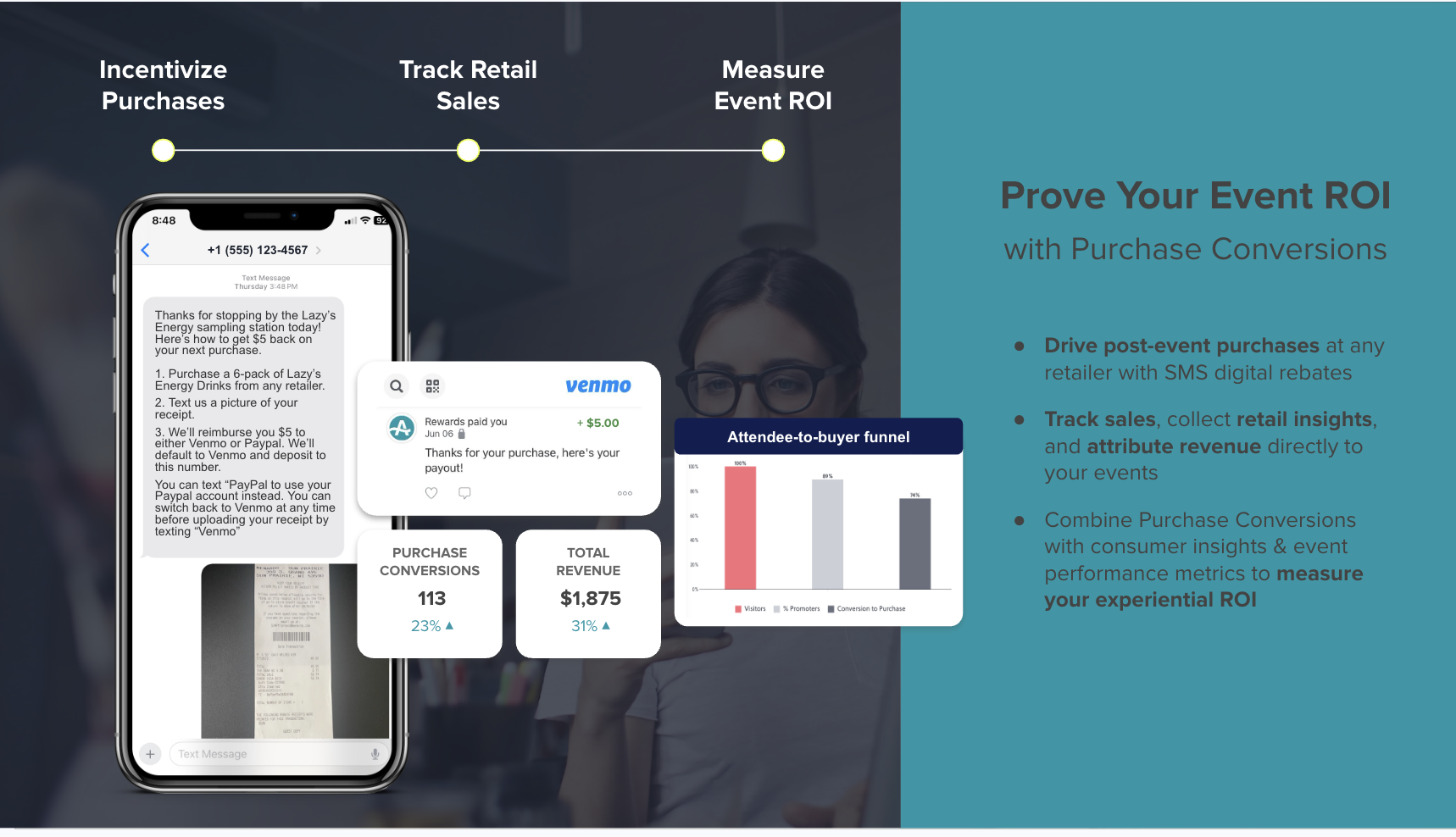
AnyRoad captures the first-party data required to populate every variable. FullView group-level registration, cashback-rebate receipt tracking, and PinPoint AI feedback analysis feed directly into the attributed revenue calculation.
Measuring Experiential Marketing Success: A Seven-Step Framework
Global experiential marketing spend reached $138.94 billion in 2025, growing 8.3% year-over-year, yet many CPG brands report limited confidence in their measurement of field activations. This gap between spend and confidence reflects a data infrastructure problem. The seven steps below turn the ROI formula into an operational playbook.
Step 1: Set Revenue-Linked Objectives for Each Activation
Every activation requires at least one revenue-linked objective before a single dollar is committed, because without a clear commercial target you cannot judge success. Acceptable objectives include incremental retail unit velocity in activated markets, tasting room conversion to paid club enrollment, or 90-day repeat purchase rate among event participants. Vague objectives such as “build awareness” fail this test and produce vague measurement and no CFO approval. To pass CFO scrutiny, tie each objective to a specific metric, a baseline, and a target delta that can be evaluated against actual results.
Step 2: Track Participation, Conversion, and Amplification
Effective measurement runs on three layers that operate at the same time.

- Participation: Track total registered attendees, including every individual in a group booking, not just the lead booker. AnyRoad’s FullView feature captures data from every attendee, addressing the industry-wide problem where brands miss contact information for the majority of group participants. Proximo Spirits, for example, was missing data on over 66% of guests before implementing FullView and then collected 69% more guest data immediately.
- Conversion: Measure purchase intent scores, cashback rebate redemptions, and club enrollment rates. Festival activations for an artisanal mezcal brand produced 85% post-event purchase intent using AnyRoad’s data capture tools.
- Amplification: Monitor NPS, brand promoter conversion, and social reach. Campari Group’s AnyRoad-powered experiences converted visitors to brand promoters.
AnyRoad Live deploys this same capture stack at third-party retail ambassador tastings through QR code registration, replacing the depletion report as the only evidence an activation occurred.

Step 3: Use Control-Group Incrementality Testing
Matched-market testing is the gold standard for measuring physical activations in CPG. Select markets with correlated historical sales profiles, run the activation in treatment markets, and hold control markets to standard support only. The Difference-in-Differences formula isolates true commercial impact.
Incremental Lift = (Post-Period Treatment − Pre-Period Treatment) − (Post-Period Control − Pre-Period Control)
In a national premium beverage brand case study, this calculation isolated a net lift of incremental units per store per week. For alcohol brands, control markets must be free of simultaneous distributor promotions, pricing changes, or distribution expansion that could contaminate the comparison. Best practices recommend that control groups represent a sufficient percentage of total test-and-control reach to ensure statistical significance.
Step 4: Apply a 30–90 Day Attribution Window
Experts recommend measuring PAPE effects within a window of several minutes after the conditioning activity, linking CRM attendance data to point-of-sale spend to verify retention rates. ROI can improve when brands retarget event attendees with digital ads soon after the experience. For alcohol brands, the attribution mechanic must remain compliant. AnyRoad acts strictly as the brand’s agent and routes all compliant transactions through its licensed ecommerce retail partner. The brand never ships product directly, and no tied-house rules are implicated by the data capture or follow-up sequence. Tied-house laws under the Federal Alcohol Administration Act prohibit suppliers from providing retailers with things of value in exchange for preferential treatment, so any data-sharing arrangement between an activation and a retail sales attribution program requires written agreements and jurisdiction-specific legal review.
Step 5: Measure Loyalty with Depletion in Mind
A consumer who visits a distillery twice is 512% more likely to convert to a paid loyalty enrollment. The lifetime value math makes that conversion worth pursuing. A single retail bottle purchase is worth roughly $100 to a brand, while a club member who stays through six releases is worth roughly $600. The primary measurement objective for loyalty programs is not enrollment volume alone. The goal is preventing churn, skips, and pauses long enough to move members through those six releases.
Churn concentrates at the six-release mark because members have not depleted what they already own. Retention programming, such as virtual cocktail-making classes with master distillers, addresses a consumption problem, not a marketing one. In a one-month ambassador tasting pilot with a single unnamed craft brand on a small dataset, 56% of registered contacts converted to a bottle purchase. This is an early, small-sample result and should not be treated as a platform benchmark. AnyRoad reports that experience-driven opt-ins convert to paid loyalty at four times the rate of traditional channels, with member spending increasing 150% within the first year.
Step 6: Build a Four-Bucket Executive Scorecard
The scorecard below organizes activation metrics into four categories a CFO can review quickly. Every metric maps to a data source AnyRoad captures natively. The metrics below have demonstrated strong performance across AnyRoad’s customer base. Campari Group achieved a 3x marketing opt-in increase and converted visitors to brand promoters. Absolut saw a 36% average guest revenue increase. Festival activations for an artisanal mezcal brand produced 85% post-event purchase intent.

| Bucket | Key Metrics | Data Source |
|---|---|---|
| Reach | Total registered attendees, group-level capture rate, marketing opt-in rate | AnyRoad FullView registration |
| Experience | NPS, brand promoter conversion rate, PinPoint sentiment themes | AnyRoad PinPoint AI feedback analysis |
| Commercial | Incremental retail units (DiD), cashback rebate redemption rate, club enrollment rate, 90-day repeat purchase rate | Receipt tracking, matched-market DiD, AnyRoad Lifetime Loyalty |
| Brand | Purchase intent lift, brand conversion score, likelihood to recommend | Pre/post survey baselines via AnyRoad Atlas Insights |
Step 7: Prepare Implementation and Ensure Alcohol Compliance
Rollout requires four infrastructure decisions made before the first activation.
- Data capture method: FullView for brand home events and AnyRoad Live QR registration for third-party retail and on-premise tastings.
- Attribution mechanic: Cashback rebate via SMS for receipt-based purchase attribution, or a sweepstakes variant where rebate economics do not apply.
- Compliance review: State ABC permit requirements, TTB tied-house rules, and DISCUS age-gating standards must be confirmed jurisdiction by jurisdiction before any data captured at an activation is used for retail sales attribution.
- Club enrollment path: AnyRoad acts as the brand’s agent, and the licensed ecommerce retail partner handles the compliant transaction and delivery through a Shopify-integrated experience.
AnyRoad’s white-glove team, made up of spirits industry operators rather than generalist account managers, coaches on-site staff on enrollment pitch timing, experience tier structure, and data capture protocol. Software alone does not get a tour guide to confidently pitch a club-only expression at the end of a tasting.
See receipt-verified purchase tracking in action.
Experiential Marketing Cost Benchmarks for Alcohol Brands
Cost ranges vary significantly by activation type and instrumentation level.
- Ambassador tasting (third-party retail): $500–$2,500 per event including staff, sampling product, and data capture technology. Conversion tracking through AnyRoad Live adds no POS integration requirement.
- Brand home experience tier: AnyRoad advises a good/better/best ladder at approximately $20, $50, and $150 per guest to attract higher-value visitors and identify repeat-visit candidates most likely to convert to club membership.
- Multi-market roadshow: Well-executed experiential campaigns can yield strong returns, with CPG product launch activations delivering higher ROI than standard digital advertising.
Leiper’s Fork Distillery raised tour prices 33% using AnyRoad data insights, showing that instrumented cost decisions outperform volume-based approaches.
Experiential Marketing Trends for 2026
Three structural shifts define the measurement landscape in 2026.
- First-party data as the primary asset: CPG and beverage brands are shifting from one-off events judged by foot traffic to programs that generate first-party signals, zero-party data, and measurable follow-up actions for retail and digital channels.
- Closed-loop attribution as the budget standard: Many advertisers are shifting budgets from open-web platforms to retail media, with closed-loop attribution as a primary driver. Experiential programs without receipt-based purchase attribution cannot compete for that budget.
- Alcohol-native measurement as a compliance requirement: Leading agencies in 2026 integrate CRM data to connect ambassador interactions to long-term customer lifetime value, yet generic CRM tools do not understand alcohol compliance, release calendars, or three-tier routing. AnyRoad’s managed CRM services sit on top of the same first-party experiential data the platform collects, operated by people who understand those constraints.
Frequently Asked Questions
What is the 70/20/10 rule in marketing?
The 70/20/10 rule is a budget allocation framework in which 70% of marketing spend goes to proven, lower-risk tactics that reliably drive results, 20% goes to emerging approaches with strong evidence but less certainty, and 10% goes to experimental or high-risk initiatives. For experiential marketers, this framework supports allocating the majority of activation budget to instrumented, data-capturing events with established ROI benchmarks, a portion to newer channels such as gamified cashback rebate programs, and a smaller share to pilot activations like ambassador tastings in new markets. The framework is most useful when each bucket has a defined measurement methodology, because otherwise the 70% and 20% cannot be distinguished from the 10% by outcome.
What are the 5 C's of experiential marketing?
The 5 C’s of experiential marketing are Concept, Content, Capture, Convert, and Continue. Concept refers to the strategic idea and objective behind the activation. Content is the experience itself, such as the tasting, tour, class, or festival presence. Capture is the systematic collection of first-party data from every attendee, not just the lead booker. Convert is the process of moving a participant from engagement to a measurable commercial action, such as a retail purchase, club enrollment, or repeat visit. Continue is the post-event lifecycle, including the 30–90 day attribution window, the SMS follow-up, and the managed CRM sequence that turns a single activation into recurring revenue. All five stages require data infrastructure to be measurable.
How much does experiential marketing cost?
Experiential marketing costs range from a few hundred dollars for a single ambassador tasting at a third-party retailer to several million dollars for a flagship brand home or multi-market roadshow. For alcohol brands, a useful planning range is $500–$2,500 per ambassador tasting event, $20–$150 per guest for tiered brand home experiences, and $50,000–$500,000+ for multi-market activation campaigns with full incrementality measurement. The more relevant question is cost per verified conversion. A $1,500 tasting event that produces 40 receipt-confirmed purchases and 8 club enrollments has a fundamentally different unit economics profile than a $50,000 sponsorship that produces only impression data. AnyRoad’s cashback rebate and FullView tools are designed to make cost-per-conversion calculable at every activation scale.
What are the major marketing trends for 2026?
The dominant trends shaping experiential marketing measurement in 2026 are the shift from impression-based to outcome-based reporting, the adoption of first-party and zero-party data capture as the foundation of all attribution, the expansion of closed-loop receipt tracking to connect offline activations to verified retail sales, and the integration of AI-powered feedback analysis to surface actionable insights from open-text survey responses at scale. For alcohol brands specifically, an additional trend is the emergence of alcohol-native CRM and loyalty infrastructure, including bottle clubs, managed membership programs, and depletion-aware retention programming that convert a tasting room visit into a recurring revenue relationship rather than a one-time transaction.
Conclusion: Turn Every Activation into Recurring Revenue
The seven-step framework above, covering objective setting, participation-conversion-amplification tracking, control-group incrementality testing, 30–90 day attribution, depletion-aware loyalty measurement, four-bucket executive scorecard, and compliance-ready implementation, produces the defensible ROI calculation that justifies experiential budgets to a CFO. Each step depends on first-party data capture that legacy booking tools and generalist agencies cannot supply. AnyRoad combines the measurement technology, the alcohol-compliant transactional path through its licensed ecommerce retail partner, and the white-glove spirits industry expertise required to execute every step without building an internal team to run it.
Heritage distilleries including Heaven Hill Distillery, Nearest Green Distillery, and Lux Row Distillers, alongside craft brands such as Castle & Key, Catoctin Creek Distilling, and Tarnished Truth Distilling have adopted AnyRoad’s Lifetime Loyalty platform to move consumers from a single-bottle purchase to the six-times-higher lifetime value that club membership delivers. The infrastructure that makes that value shift possible is the same infrastructure that makes the ROI formula defensible.
Explore the Lifetime Loyalty platform.