


Written by: Bryan Grobstein, Vice President, Global Revenue, AnyRoad
Key Takeaways
- Event-to-retail attribution connects each activation to specific retail transactions through POS-integrated sales lift or receipt-verified purchase conversion.
- Depletion reports cannot isolate event impact from seasonality or promotions, so they fail as a primary attribution tool.
- Matched-control methodology with pre- and post-event analysis produces lift figures that finance leaders can trust.
- Receipt-verified cashback mechanics measure performance across third-party accounts without retailer POS integration or data sharing.
- See How AnyRoad Connects Activations To Verified Retail Sales
The Depletion Report Is Dead As An Activation Measurement Tool
Brands are told to run more events, but most activations still produce only a depletion report. That document shows what sold in a store during a period, without showing what the event caused. A depletion report cannot separate event impact from seasonality, day of week, or a concurrent promotion, so it functions as a shipment record rather than an attribution record.
The problem is structural. When a brand ambassador pours samples inside a Total Wine or a regional independent, the brand has no POS access. The retailer’s system records a sale, and the brand receives a depletion summary. No direct line connects the activation to the bottle that left the shelf.
Two measurement paths close that gap. The first is POS-integrated sales lift, available when a retailer shares transaction data directly. The second is receipt-verified purchase conversion, which works in every other account. AnyRoad closes the loop between an activation and a receipt-verified bottle sale, creating a first-party record tied to an identifiable SKU regardless of POS ownership.
See How Receipt-Verified Attribution Works For Your BrandThe Event Sales Lift Formula For Alcohol, With A Worked Example
Event sales lift is the percentage change in sales of the promoted SKU or category during the event window versus a matched baseline period. A sound comparison controls for day of week, seasonality, and any concurrent promotion.
The formula in plain language is simple. Subtract baseline-period sales from event-period sales, divide the result by baseline-period sales, then express the quotient as a percentage.
Consider a hypothetical example. A baseline week of 100 units versus an event week of 140 units produces a 40% lift. The formula is: (140 − 100) ÷ 100 = 0.40, or 40%.
The baseline is where most measurement breaks down. A single-store, single-week comparison is weak evidence because it cannot rule out a concurrent price feature, a regional advertising flight, or a weekend traffic spike. Matched-control methodology, which compares active demo stores against identical control stores, is the standard for isolating true incremental sales and for accounting for confounding factors. Using control markets versus exposed markets and running pre-event and post-event lift analyses at the specific store level produces a number a CFO will accept.
External research supports this approach. Wildfire Beverage Group recommends measuring tastings by basket attach rate and post-event four-week velocity lift because the halo effect is where sustained baseline growth appears. A Journal of Retailing study found that in-store product sampling generates both immediate sales spikes and sustained baseline lift over extended periods, with repeated sampling events creating compound sales growth. These findings reinforce the need to measure beyond same-day units.
Connect Event Lift To Future Retail SalesOccasion-Based Demand Mapping For Measurement Windows
Occasion determines both what you promote and how long you measure. BCG research shows that drinking occasions and the needs consumers have in those moments have changed substantially over the past decade. Matching the promoted SKU and the lift measurement window to the occasion turns an activation into a measurable growth lever instead of a generic sampling table.
Sports Viewing Occasions
Sports occasions favor ready-to-drink formats and beer, with baskets skewing toward multi-pack and shareable formats. RTD cocktails nearly doubled in-store sales between 2022 and 2025, making the segment larger than gin, brandy, and rum combined, and single-serve formats are outperforming standard bottles across most price tiers. The promoted SKU and lift window should reflect a viewing occasion, with lift measured against a matched non-game-day baseline.
Holiday And Gifting Occasions
Holiday occasions favor sparkling wine and premium brown goods, and basket size rises as gift intent dominates. A promotional calendar tied to holidays such as Valentine’s Day, December gifting, and New Year’s Eve should be planned two to three weeks ahead with early inventory orders. Lift measurement should reflect the longer consideration window, because a gift-occasion buyer may sample at one activation and purchase days later at a different account.
Concerts And Festivals
Stadium and festival channels can move three to five times the case-equivalent volume of a comparably sized off-premise account during peak summer weekends. These occasions favor high-energy and single-serve formats, and trial often converts quickly. A 2025 NielsenIQ on-premise analysis found that 61% of U.S. consumers say they have purchased a brand in-store after first trying it in a venue. Same-day and near-term conversion therefore define the right lift window for concert and festival activations.
Cultural And Brand-Led Events
Cultural occasions favor brands with a credible cultural tie, and product mix shifts toward the hero SKU the activation features. Absolut’s House of Cosmo activation at Coachella created an immersive on-site venue built around its signature cocktail, with an opt-in SMS text line for festival tips that extended the activation beyond the festival grounds. That model pairs occasion alignment with a measurable follow-up mechanic that supports downstream attribution.
Weather-Driven Demand Shifts
Weather occasions shift mix between refreshing and warming categories, so the activation’s promoted SKU should follow the forecast. The baseline should also be weather-matched, because comparing a warm-weather activation week against a cold-weather baseline week produces a misleading lift figure. Seasonal demand planning for beverages shows demand rising sharply around holidays, sporting events, and promotional calendars, with category mix changing by season and occasion. Measurement windows should reflect those shifts.
The Third-Party Retail And On-Premise Problem: Measuring What You Do Not Own
An ambassador tasting inside a third-party retailer or an on-premise account has historically produced only a depletion report. The brand has no POS access, so no direct record connects the activation to a bottle sold. The receipt-verified cashback rebate mechanic replaces that gap with a measurable path.
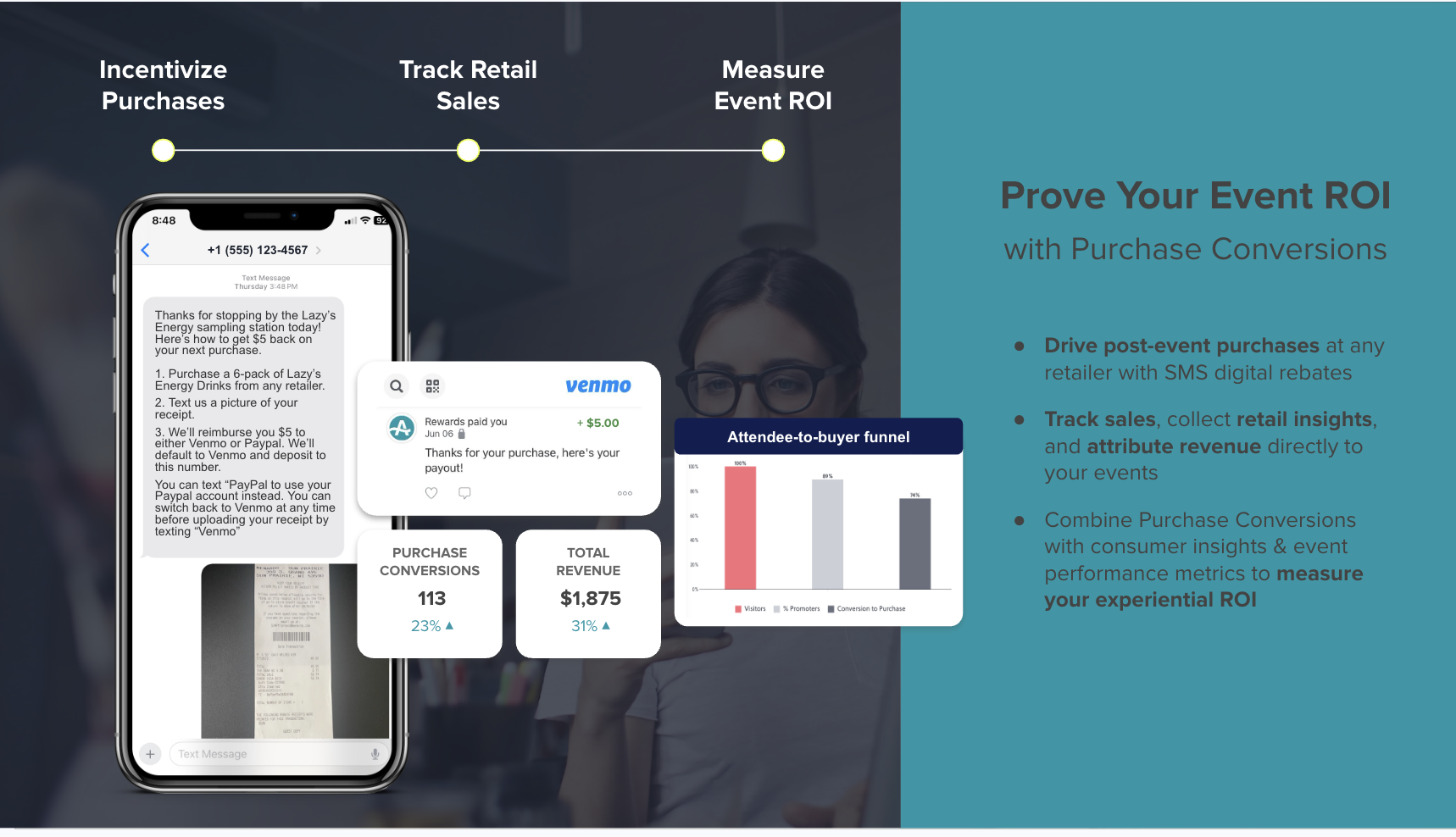
The mechanic runs in four steps:
- Guests scan a QR code at the activation and register on the spot through the AnyRoad Live mobile app.
- The consumer receives an SMS with a cashback rebate redeemable anywhere the product is sold.
- They buy the bottle, photograph the receipt, and text it back.
- AnyRoad’s AI reads the receipt, confirms the eligible SKU, and pays the rebate out via Venmo or PayPal.
No POS integration is required from the retailer or the bar. Receipt validation replaces POS integration: the shopper submits a photo of their receipt, and the platform reads it, matches SKUs against the program’s eligibility rules, and confirms the purchase before releasing payment, so the brand gets a verified transaction without the retailer opening an API or sharing POS data. This structure makes the mechanic deployable across trade accounts at scale.

On-premise conversion tracking becomes possible for the same reason. A rebate tied to an identifiable SKU on a bar tab, such as a Fireball line item, is measurable in a way a depletion report cannot match. In a one-month ambassador tasting pilot with a single unnamed craft brand, 56% of the records collected converted to a bottle purchase. That figure comes from an early, small-sample pilot and should not be read as a platform benchmark, but it illustrates the order of magnitude that receipt-verified conversion tracking makes visible.
A sweepstakes variant uses the same mechanic with a prize instead of a rebate, such as an entry to win Coachella tickets rather than cash back. AnyRoad handles the regulatory compliance around it, including terms and conditions and privacy policies.
Compliance Comes First: Trade Practice Rules And Permit Requirements
State alcohol regulatory frameworks govern every element of a tasting activation, including who may pour, what may be served, how much, and what records must be kept. These rules vary by state and, in some jurisdictions, by municipality, so compliance planning must start early.
State frameworks differ in three ways that matter for activation planning: who may pour, what may be served, and what records must be kept. Iowa trade practice rules under Iowa Code section 123.46(2) and Iowa Administrative Code rules 701—1003.1, 1003.6, and 1003.16 govern tasting events conducted by industry members and retailers, including portion limits, hours of service, and the requirement that any alcoholic beverages remaining at the end of a tasting be removed from the licensed premises by the industry member. Iowa Administrative Code rule 701—1003.16 also requires industry members to keep and maintain records for three years for each tasting, stating the name and address of the retailer, the date, a description of the item, and the industry member’s laid-in cost.
The Oklahoma ABLE Commission specifies that tastings at a retail spirits licensee must be hosted by a retail spirits licensee authorized to host the tasting, that samples must be poured by an Oklahoma ABLE Commission licensee lawfully permitted to serve alcohol, and that wine or spirits wholesalers and their employees may not pour samples. Oklahoma limits samples to one fluid ounce of spirits, two fluid ounces of wine, or three fluid ounces of beer per consumer per day. This framework clearly separates host-license authority, sample sourcing, and service eligibility.
The Denver Department of Licensing and Consumer Protection maintains a dedicated tastings permit application path for liquor-related businesses, meaning suppliers and retailers hosting tasting activations in Denver must secure a local tastings permit in addition to any state-level licensing. Denver also requires a separate special event liquor permit for alcohol service at temporary events, so local permitting becomes a distinct workstream.
Brand Promotion Versus Alcohol Sales At Events
A brand can promote its product at a licensed account under that account’s license and applicable trade practice rules. The key distinction lies between promoting a product and selling it. A brand that is not a licensed retailer cannot sell or ship product itself. Private events on premises that qualify as a private place under applicable state law may have different rules, and Iowa’s framework, for example, distinguishes between licensed and unlicensed premises for tasting purposes.
AnyRoad is not a licensed retailer or wholesaler and does not sell, ship, or distribute alcohol. The compliant transaction and delivery happen through AnyRoad’s licensed ecommerce partner. AnyRoad acts as the brand’s agent while remaining outside three-tier distribution and fulfillment.
How Retailers And Brands Use In-Store Events
To see why receipt-verified conversion matters, compare it with the path a retailer already has. A retailer that has POS access can measure event lift directly by comparing the promoted SKU’s unit velocity during the event window against a matched baseline while controlling for day of week and any concurrent promotion. Beefeater Gin executed over 2,000 in-store sampling activations across 16 national markets and reported a 19.5% sales lift with more than 26,600 bottles sold, a figure the retailer’s POS made possible to verify.
A brand running an activation in that same retailer’s account cannot access the same data. That contrast highlights the two measurement paths introduced earlier. POS-integrated lift provides the cleaner signal when available, and receipt-verified conversion provides the scalable path everywhere else.
For retailers building their own in-store event programs, a well-run in-store tasting converts browsers into buyers at a 30–50% rate, and many of those purchasers become repeat buyers of the sampled product. Quality secondary displays at the right accounts during the right windows reliably double or triple weekly velocity for the duration of the display. POS-integrated event-only discounts, bundling, and shelf placement tied to the activation are levers a retailer controls that a visiting brand cannot.
Turning Event Data Into Recurring Revenue
A consumer who visits a distillery twice is 512% more likely to convert into a paid loyalty enrollment. That second visit signals that a guest is ready to be asked. The visit functions as an acquisition channel, which makes the second-visit signal more valuable than the first.
The lifetime value math is straightforward. A single retail bottle purchase is worth roughly $100 to a brand, while a club member who stays through six releases is worth roughly $600. The operating goal focuses on preventing churn, skips, and pauses long enough to get members through those six releases, because churn concentrates around the six-release mark and the underlying cause relates to depletion rather than acquisition.
AnyRoad’s reporting shows that experience-driven opt-ins convert to paid loyalty at four times the rate of traditional channels, with member spending increasing 150% within the first year. The Lifetime Loyalty platform has been adopted by heritage distilleries including Heaven Hill Distillery, Nearest Green Distillery, and Lux Row Distillers, alongside craft brands such as Castle & Key, Catoctin Creek Distilling, and Tarnished Truth Distilling.

The bridge from event data to recurring revenue runs through the same first-party record the receipt-verified mechanic creates. A consumer who registers at an activation, converts to a bottle purchase, and then enrolls in a club creates a traceable revenue path from activation spend to lifetime value that a CFO can follow.
Frequently Asked Questions
What Does Event-To-Retail Attribution Mean?
Event-to-retail attribution links a specific activation to a specific retail transaction. Two paths exist: POS-integrated sales lift, which requires the retailer to share transaction data, and receipt-verified purchase conversion, which works in any account without retailer integration. The second path is what makes third-party retail and on-premise activations measurable at all.
How Do You Measure Sales Lift From A Tasting Event?
Measure sales lift by comparing event-window sales of the promoted SKU against a matched baseline period while controlling for day of week, seasonality, and any concurrent promotions. Use the formula event-period sales minus baseline-period sales, divided by baseline-period sales, and express the result as a percentage. Matched-control methodology, which compares active demo stores against identical control stores, isolates true incremental lift, and a four-week post-event halo captures sustained baseline growth beyond same-day figures.
Can You Run An Activation Without A Liquor License?
A brand can promote its product at a licensed account under that account’s license and applicable state trade practice rules, but it cannot sell or ship product without its own retail license. State frameworks vary, and Iowa, Oklahoma, and Colorado each specify who may pour, what may be served, in what quantities, and what records must be kept. Denver also requires a local tastings permit in addition to state licensing, so compliance review at the state and municipal level must precede any activation.
How Does Receipt-Based Conversion Work Without POS Integration?
The consumer registers at the activation by scanning a QR code through the AnyRoad Live mobile app and receives an SMS with a cashback rebate redeemable anywhere the product is sold. After purchase, they photograph the receipt and text it back. AnyRoad’s AI reads the receipt, confirms the eligible SKU, and pays the rebate via Venmo or PayPal. The receipt serves as proof of purchase, and the SKU match ties the transaction back to the specific activation without any retailer or bar integration.
What Is The Difference Between A Depletion Report And Event-To-Retail Attribution?
A depletion report shows what sold in a store during a period but cannot isolate event impact from other factors. Event-to-retail attribution instead produces a first-party record tied to a specific consumer, a specific SKU, and a specific activation, which answers the CFO’s core question about which bottles the activation sold.
Conclusion: The Measurement Framework, Recapped
The framework comes down to four moves. First, define attribution clearly, because a depletion report alone does not qualify as attribution. Second, run the sales-lift formula against a matched baseline, controlling for day of week, seasonality, and concurrent promotions, and extend measurement into the four-week velocity halo. Third, map the occasion to both the SKU and the measurement window so the activation aligns with how and when consumers buy. Fourth, use receipt-verified conversion wherever the brand does not own the POS, which covers most high-value accounts. Compliance review sits underneath all four moves as the prerequisite for every activation.
AnyRoad closes the loop between an activation and a receipt-verified bottle sale, creating the first-party record that connects experiential spend to retail sell-through in accounts the brand does not own.
Turn Experiential Spend Into Proven Retail Revenue