


Written by: Bryan Grobstein, Vice President, Global Revenue, AnyRoad
Key Takeaways
- Sweepstakes convert 25–40% of visitors into first-party contacts, far outperforming generic newsletter popups and remaining resilient to third-party cookie loss.
- Compliance requires a clear AMOE, specific privacy disclosures, and the removal of dark patterns such as pre-checked consent boxes to avoid FTC and state penalties.
- Data quality beats quantity. Entry forms with 2–4 fields convert best, while deeper insights come from progressive profiling and post-event surveys.
- Data ownership is a strategic asset. Platforms that co-own consumer data can divert valuable first-party records to competitors, while AnyRoad keeps all data on the brand’s domain and within its CRM.
- AnyRoad turns compliant sweepstakes data into measurable revenue with white-labeled registration, FullView group capture, cashback rebates, and loyalty tools.
See how AnyRoad handles compliant sweepstakes data collection in a live demo at https://www.anyroad.com/demo.
What Data Can You Collect from a Sweepstakes?
Sweepstakes entry forms can collect many types of consumer data. Collect only what you need and disclose every category in your privacy policy. Common data types include:
- Contact details: name, email address, phone number, and mailing address for physical prize fulfillment
- Age verification: date of birth, especially for age-gated industries such as alcohol, where integrated ID scanning adds another compliance layer
- Demographics: gender, income range, interests, and geographic location
- Behavioral data: device fingerprints, IP addresses, and browser type, collected automatically for fraud prevention and analytics
- Purchase behavior: receipt uploads for purchase-based promotions, which can reveal store names, transaction dates, item lists, prices, and payment methods
- Survey responses: preferences, opinions, and self-reported insights that constitute zero-party data
- Opt-in preferences: separate, unchecked checkboxes for email and SMS marketing consent
Data quality matters as much as volume. Every additional form field beyond email reduces conversion by approximately 5–10%. The practical sweet spot for a standard sweepstakes entry form is 2–4 fields. Collect richer demographic and preference data through embedded surveys or progressive profiling across multiple campaigns.
For brands running activations at festivals or retail locations, the AnyRoad Live mobile app turns any activation into a data capture point. At festival activations run by agency POPLIFE for an artisanal mezcal brand, AnyRoad captured 45–50% more consumer data than competitors, with 42% of attendees opting into future marketing communications and a meaningful share of registrants new to the brand.

Legal Compliance, Trust, and Privacy for Sweepstakes
The FTC’s authority over sweepstakes comes from Section 5 of the FTC Act, which prohibits unfair or deceptive acts or practices in commerce. Sweepstakes that mislead consumers about odds, prize value, or entry conditions qualify as deceptive. The FTC does not pre-approve or pre-screen sweepstakes. Compliance rests with the sponsor, and the FTC acts after consumer complaints or referrals from state attorneys general.
The three-element test that separates a legal sweepstakes from an illegal lottery is simple. Prize plus chance plus consideration equals an illegal lottery. Removing consideration, meaning the requirement to purchase or provide something of value, creates a legal sweepstakes. The standard way to remove consideration is the Alternative Method of Entry.
AMOE (Alternative Method of Entry) is a free path into a promotion that does not require a purchase or significant action. A mail-in entry option or a free online entry form satisfies most reviewers, and the AMOE must be clearly disclosed in the official rules and provide equal odds of winning. Without AMOE, a chance-based promotion that requires purchase becomes an illegal lottery, and conducting an illegal lottery by mail is a federal criminal offense under the Postal Lottery Statute (18 U.S.C. §§ 1301–1307).
State-level requirements add another layer. New York, Florida, and Rhode Island require registration and bonding for sweepstakes with prizes above certain thresholds, often $5,000. Legal counsel should review any promotion with a significant prize pool before launch.
Privacy policy requirements are equally strict. A sweepstakes privacy policy must list categories of personal information collected, purposes of collection, categories of third parties receiving data, retention periods, and instructions for exercising rights. Vague policies create legal exposure. Under the CCPA/CPRA, sharing entrant data with a co-sponsor or marketing partner can count as a “sale” that requires a “Do Not Sell or Share My Personal Information” link on the entry form, even when no money changes hands for the data.
Consumer skepticism about sweepstakes legitimacy is rising. The perception that contests are rigged climbed to 40% in 2026 from 28% in 2024 among regular listeners, and to nearly 50% among those most likely to appear in ratings samples. For brand marketers, that skepticism creates risk and opportunity. Brands that demonstrate transparency earn outsized trust.
Practical transparency measures include publishing official rules in plain language, disclosing the odds of winning, using verifiable random selection, and announcing winners publicly. Fraud prevention tools such as CAPTCHA, IP limits, and email confirmation before counting an entry as valid protect data quality and show that the promotion runs fairly. If the bounce rate on the first email send exceeds 5%, the entry form needs stronger validation.
See how AnyRoad builds compliance and transparency into sweepstakes flows in a live walkthrough.
Who Owns the Data?
Once compliance is handled, the next question is who owns the data collected. The brand running the sweepstakes owns the consumer data unless a contract says otherwise. This distinction matters when choosing a platform or agency to administer the promotion.
Some ticketing and event platforms redirect consumers to their own sites during registration and then use the collected data to market other events, including competitors’ events, to those same consumers. Eventbrite, for example, co-owns data collected through its platform and uses it to promote other events to a brand’s customers. That arrangement hands a consented, first-party consumer record, one of the most valuable sweepstakes assets, to a third party with different commercial interests.
AnyRoad’s approach is structurally different. The platform embeds a fully white-labeled booking and registration experience directly on the brand’s website. This setup keeps the brand front and center and ensures the brand owns the entire consumer journey and all collected first-party data. For field marketing events, Conversate Collective used AnyRoad to improve 100% of consumer profiles with vital demographic information for a CPG beauty brand. That data stayed entirely within the brand’s ecosystem.
Contracts with any third-party platform, co-sponsor, or fulfillment partner should clearly address data ownership, permitted uses, and deletion obligations before a promotion launches.
Maximizing Data Capture and Quality
Entry volume and data quality serve different goals. Focusing on one while ignoring the other produces a list that is either too thin to be useful or too noisy to act on. The following strategies balance both:
- Keep entry forms to 2–4 fields. Later sections refer back to the conversion drop per extra field mentioned earlier.
- Choose prizes that qualify the audience. A generic cash prize attracts prize-hunters, while a prize relevant to the brand’s category attracts actual customers.
- Use QR codes at events and on-pack to drive participation at the moment of highest brand engagement. Capri Sun’s on-pack sweepstakes generated 28,000+ entries and 579,000+ page views.
- Integrate sweepstakes registration with on-site experiences for seamless data capture with minimal friction.
- Add instant win elements to increase participation. Instant win promotions can generate up to 40% higher participation rates than traditional sweepstakes formats.
- Use separate, unchecked checkboxes for email and SMS marketing consent. Under GDPR and most US state privacy laws, consent for email marketing and data sharing must appear as separate checkboxes.
AnyRoad’s FullView feature addresses one of the most common gaps in event data collection. In many programs, only the person who books an experience provides information. FullView captures data from every attendee in a group, not just the booker. Ben & Jerry’s Factory Experiences uses AnyRoad’s pre- and post-experience surveys to capture demographic data from all visitors. These surveys also measure the tour’s impact on brand perception, purchasing behavior, brand loyalty, and ROI.

Post-experience engagement is where sweepstakes data turns into revenue. AnyRoad’s data shows that a consumer who visits a distillery twice is 512% more likely to convert to a paid loyalty enrollment. Cashback rebates and sweepstakes entries sent via SMS after an activation drive immediate retail purchase behavior and create a receipt-verified record that connects experiential spend to a bottle sold.
Measuring Success: From Entries to Lifetime Value
Entry count alone does not prove success. The measures that justify sweepstakes investment to leadership are conversion to purchase, opt-in rate, and long-term customer lifetime value.
AnyRoad’s platform connects these measures across the full consumer lifecycle. A club member who stays through six releases is worth roughly $600 to a brand, compared to roughly $100 for a single bottle purchase. Experience-driven opt-ins convert to paid loyalty at four times the rate of traditional channels, with member spending increasing 150% within the first year. These outcomes build on the 512% loyalty conversion lift mentioned earlier.
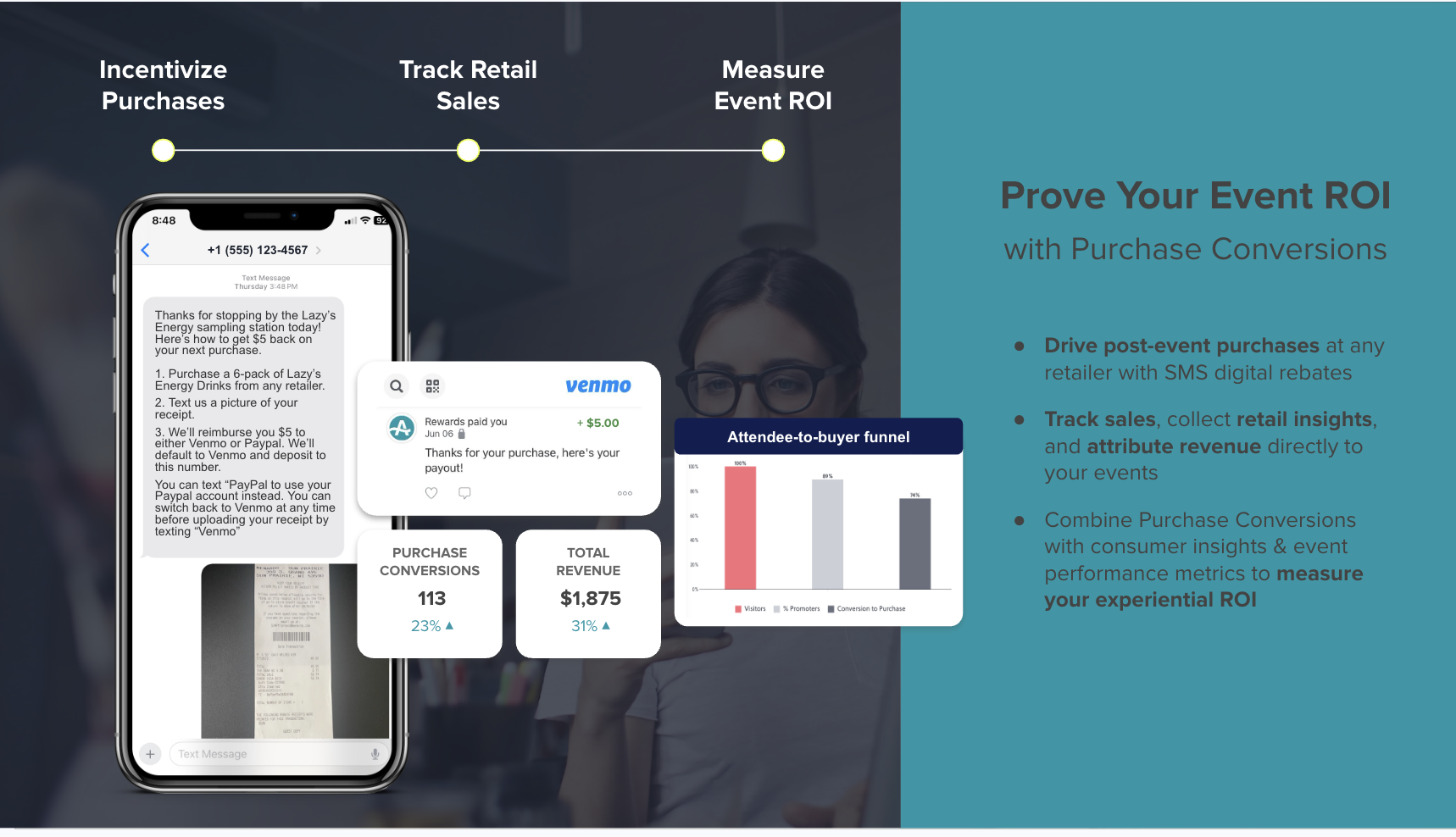
For field activations, AnyRoad’s cashback rebate mechanic closes the loop between a sweepstakes entry and a verified retail purchase. The consumer registers and receives an SMS with a rebate redeemable anywhere the product is sold. They then photograph the receipt and text it back. AnyRoad’s AI reads the receipt, confirms the eligible SKU, and pays the rebate via Venmo or PayPal, with no POS integration required. This mechanic has proven effective. In a one-month ambassador tasting pilot with a single craft brand on a small dataset, 56% of records collected converted to a bottle purchase.
For Conversate Collective’s CPG beauty brand field marketing events, AnyRoad helped identify that 74% of guests were more likely to buy the brand’s products post-event. The same program also revealed that over 50% of surveyed consumers purchased from Walgreens and Target. That insight created actionable retail intelligence that depletion reports could not surface.

Common Pitfalls to Avoid
The following mistakes cause most legal exposure and wasted spend in sweepstakes programs:
- Skipping AMOE, which risks illegal lottery classification
- Using missing or vague privacy policies that fail to disclose data categories, purposes, and third-party sharing
- Collecting too many fields, which repeats the conversion drop per extra field discussed earlier
- Ignoring state registration requirements in New York, Florida, and Rhode Island for prizes above applicable thresholds
- Choosing platforms that co-own or misuse consumer data
- Failing to follow up with entrants promptly. Send a welcome email within 24 hours.
- Using pre-checked consent boxes, which are a dark pattern under CCPA/CPRA and invalid under GDPR
- Retaining data indefinitely. Best practice is 3–4 years for legal defense, with a defined retention schedule stated in the privacy policy.
Why AnyRoad Is the Right Platform for Sweepstakes Data Collection
AnyRoad supports the complete sweepstakes lifecycle, from compliant data capture through post-event engagement to measurable revenue conversion. The platform’s capabilities cover every stage of that lifecycle in a single integrated solution:

- White-labeled booking and registration embedded directly on the brand’s website, so data ownership stays with the brand
- Custom data capture before, during, and after events, including FullView for capturing data from every attendee in a group
- Integrated ID scanning for age verification, critical for alcohol brands running age-gated promotions
- AI-powered feedback analysis through PinPoint, which turns survey responses into actionable insights on experience quality and purchase intent
- Post-experience engagement tools including cashback rebates, sweepstakes entries, and bottle clubs that convert one-time entrants into recurring revenue
- Managed CRM services for brands without in-house email marketing capability, run by teams who understand alcohol compliance and spirits release calendars
- Integrations with existing tech stacks including HubSpot, Klaviyo, Salesforce, Shopify, and major POS systems
AnyRoad manages the compliance infrastructure, including terms and conditions, privacy policies, and a licensed retail partner for alcohol-related promotions. Brand teams can then focus on strategy and execution instead of legal risk management. The Lifetime Loyalty platform has been adopted by heritage distilleries including Heaven Hill Distillery, Nearest Green Distillery, and Lux Row Distillers, along with craft brands such as Castle & Key, Catoctin Creek Distilling, and Tarnished Truth Distilling.
Discover how AnyRoad turns sweepstakes into revenue in a personalized demo.
Frequently Asked Questions
Are sweepstakes legal?
Sweepstakes are legal in the United States when structured correctly. A legal sweepstakes combines a prize and a chance-based selection with no required consideration, meaning no purchase is necessary to enter. Brands must offer a free Alternative Method of Entry (AMOE) to avoid classification as an illegal lottery, which private companies cannot operate in most states. Some states, including New York, Florida, and Rhode Island, require registration and bonding for sweepstakes with prizes above certain thresholds. Legal counsel should review any promotion before launch, especially for high-value prizes or promotions open to residents of multiple states.
What is AMOE in a sweepstakes?
AMOE stands for Alternative Method of Entry, a free way to enter a sweepstakes without making a purchase or taking any action that could count as consideration. Common AMOEs include a mail-in entry option or a free online entry form. The AMOE must provide equal odds of winning as any purchase-based entry path and must be clearly disclosed in the official rules. Without a valid AMOE, a chance-based promotion that requires purchase becomes an illegal lottery under federal and most state laws.
How do I ensure my sweepstakes is compliant?
Compliance requires attention to both federal and state requirements. At the federal level, the FTC requires clear and conspicuous disclosure of material terms, including no-purchase-necessary language, odds of winning, prize details, entry deadlines, and sponsor identification. The FTC does not pre-approve sweepstakes, so compliance remains the sponsor’s responsibility. At the state level, New York, Florida, and Rhode Island impose registration and bonding requirements for prizes above applicable thresholds. Privacy compliance requires a specific privacy policy accessible from the entry form, separate unchecked opt-in checkboxes for marketing communications, and data handling practices that satisfy CCPA/CPRA for any promotion open to California residents. Working with legal counsel and a platform that builds compliance infrastructure into the entry flow offers the most reliable approach.
What data can I collect in a sweepstakes?
Sweepstakes entry forms can collect contact details such as name, email address, phone number, and mailing address; age or date of birth for age-gated promotions; demographic information including location and interests; behavioral data such as IP addresses and device identifiers for fraud prevention; purchase data via receipt uploads for purchase-based promotions; and survey responses capturing preferences and opinions. Opt-in preferences for email and SMS marketing must be collected via separate, unchecked checkboxes and are not implied by entry. The practical guideline is to keep entry forms to 2–4 fields to maximize participation and to collect only what is necessary for the promotion’s stated purposes.
How do I measure sweepstakes ROI?
Entry count alone does not measure ROI. The metrics that connect sweepstakes investment to business outcomes are opt-in rate, conversion to purchase, and long-term customer lifetime value. Tracking receipt-verified purchases through cashback rebate mechanics ties activation spend directly to retail sell-through without requiring POS integration. For brands with loyalty programs, the relevant benchmark is the $600 vs $100 value difference mentioned earlier between a club member and a single bottle purchase. Post-experience engagement tools, including SMS follow-up, cashback rebates, and bottle club enrollment, move consumers from the first number to the second.
Conclusion: Turn Sweepstakes Data into Long-Term Revenue
Sweepstakes events rank among the most effective first-party data strategies available to brand marketers when compliance is built into the structure from the start and the data collected feeds a systematic post-event engagement program. Brands that treat sweepstakes as the beginning of a consumer relationship, rather than a one-time list-building exercise, convert entries into measurable, recurring revenue.
AnyRoad provides the technology, compliance support, and white-glove expertise to run that entire lifecycle in one integrated platform, from compliant data capture at the point of entry through post-event engagement that converts entrants into loyal customers and club members.