


Written by: Bryan Grobstein, Vice President, Global Revenue, AnyRoad | Last updated: October 18, 2026
Key Takeaways
- Brand activation events succeed when they prompt a specific consumer action such as trial, opt-in, purchase, or sharing, and when that action is measured.
- High-engagement activations share four traits: a participatory task, low friction, a shareable output, and a measurable next step that links participation to an identifiable consumer record.
- Effective mechanics include personalization, co-creation, guided sampling, gamification, and theatrical staging. Each example below pairs one mechanic with a documented result.
- Measurement follows a six-stage ladder of attention, participation, trial, opt-in, advocacy, and commercial impact. The critical gap is connecting the participatory moment to first-party data and revenue.
- AnyRoad captures first-party data from CPG brand activations and connects it to revenue across every stage of the measurement ladder.
See how AnyRoad captures first-party data at activations
What High-Engagement CPG Brand Activations Have in Common
Across categories and budgets, the activations that produce documented engagement share four traits:
- A participatory task the consumer completes rather than watches
- Low friction to enter, with a mechanic that is immediately legible and requires no prior knowledge
- A shareable output such as a physical object, a piece of content, or a public ranking the consumer can show others
- A measurable next step such as a purchase, an opt-in, a redemption, or an enrollment that connects the participatory moment to an identifiable consumer record
The activations that fail to produce defensible results typically have the first two traits but skip the last one. Engagement functions as a mechanic that requires a designed moment and a follow-up path. Without that path, a sample handed out ends at the third rung of the measurement ladder described later in this article. The examples below show how each of these four traits plays out in practice, and what results brands have reported when they get all four right.
CPG Brand Activation Examples, Organized by Engagement Mechanic
Personalization That Scales: Coca-Cola, Share a Coke
What they did: Coca-Cola replaced its logo with first names on bottles and cans. The 2025 UK relaunch, produced by experiential agency N2O, staged immersive "Coke zones" at major festivals, Alton Towers, Thorpe Park, Covent Garden, supermarkets nationwide, and Pride in London. These zones offered can and vessel personalization, meme-making booths, exclusive merchandise drops, and live TikTok-linked content stations.
The engagement mechanic: Personalization paired with a shareable physical object, the named can or vessel the consumer walks away holding.
Why it worked: Seeing your own name on a product triggers identity-based processing and a strong impulse to share. The 2025 relaunch built social content creation directly into the experience, so sharing became the designed output rather than a hoped-for side effect. This experiential sampling personalization case study shows how a legacy mechanic can be rebuilt around a new audience's content habits.
Co-Creation and Voting: Lay's, Do Us a Flavor
What they did: Consumers submitted flavor ideas, finalists were manufactured and sold in stores, and consumers voted by buying. The winning flavor shipped commercially and the creator received a prize.
The engagement mechanic: Co-creation with a genuine commercial outcome, where the community's input visibly changed something real.
Why it worked: The mechanic converted passive consumers into co-owners of the product line. The purchase vote closed the loop between participation and commercial impact in a way no survey could replicate.
Reported result: PepsiCo reported nearly 3.8 million flavor submissions between July 20 and October 6, 2012. The 2024 revival drew more than 700,000 submissions, and the winning Bacon Grilled Cheese flavor received more than 26,000 votes after finalists hit shelves, per PepsiCo as compiled by Everything-PR. The unverified 12% sales-increase figure circulating in secondary sources is not attributed here.
Guided Sampling in a High-Intent Setting: Maybelline at the NYC Marathon Expo
What they did: Maybelline sampled and engaged runners at the marathon expo rather than conducting a standard product hand-off. Staff guided participants through the product experience on-site.
The engagement mechanic: Sampling paired with a guided interaction, where trial happened under staff guidance in a context where the audience was already primed and self-selected.
Why it worked: Context fit drove engagement. Runners at a marathon expo were in a goal-oriented, high-attention state. The guided format ensured the product was actually experienced rather than pocketed.
Reported result: Youth Marketing Connection's case study for Maybelline New York's three-day Run Club pop-up at the 2024 TCS New York City Marathon Expo reports 53K+ total brand interactions, a figure the case study also labels as 53K+ marathon expo attendees.
Sampling Plus Interaction on Campus: NYX Campus Tour
What they did: NYX toured campuses with a hands-on product experience tuned to a specific audience and setting.
The engagement mechanic: Sampling plus interaction, matched to the context in which the target audience already experiments with the category.
Why it worked: The format mirrored how the audience already discovered and tested beauty products, collaboratively in a low-stakes social setting.
Reported result: The agency case study does not publish a quantified outcome for this activation. No proxy figure is substituted here.
Rewarded Play: Maybelline and Candy Crush
What they did: Maybelline partnered with Activision Blizzard Media to promote Lifter Gloss through rewarded video placements across Activision's mobile-game portfolio, including Candy Crush. Players chose to watch a full-screen ad in exchange for in-game rewards.
The engagement mechanic: Optional, value-exchange advertising inside a game players already chose to play. The reward was earned by player choice, avoiding interruption.
Why it worked: Opt-in ad formats inside high-engagement mobile games reached consumers in an attentive, reward-motivated state. Because the interaction was voluntary, it reduced resistance and increased message retention.
Reported result: The available report documents a 552% increase in website traffic. The source describes a rewarded-video placement, not a branded mini-game, and publishes no mini-game participation count. No such figure is cited here.
Competitive Creation: Doritos, Crash the Super Bowl
What they did: Fans created their own 30-second commercials, and the winner earned $1 million and had their ad air during the Super Bowl. Doritos revived the contest in 2024 after an eight-year hiatus, drawing more than 2,000 entries, with the winning alien-themed spot airing during Super Bowl LIX in February 2025.
The engagement mechanic: Consumer-created advertising with a public ranking, the USA Today Ad Meter, as the scoreboard.
Why it worked: The contest converted passive viewers into creators and gave them a concrete, public incentive to produce ads PepsiCo did not have to make itself. The prize structure and public ranking made participation feel competitive rather than promotional.
Theatrical Sampling at Scale: Liquid Death at Download 2024
What they did: Liquid Death served as headline sponsor of Download Festival 2024. The agency Positive Experience deployed three key elements: a branded hearse and coffin sampling station in the VIP area, 20 Liquid Death-branded refrigerators across the festival site, and a dedicated Liquid Death cocktail bar.
The engagement mechanic: Theatrical sampling, with product trial staged inside a photo-friendly, identity-expressive environment that made sampling itself the content.
Why it worked: The coffin cooler and hearse were inherently shareable objects, and the 20 branded fridges extended that shareability across the festival site without additional staffing.
Reported result: Positive Experience reports the activation became one of the most talked-about installations at the festival, with festivalgoers queueing to sample from the coffin cooler. No quantified attendance, sample count, or sales figures were published in the case study. No proxy metrics are substituted here.
Get a demo of AnyRoad's activation measurement platform
How To Measure Consumer Engagement At A Brand Activation
The core measurement gap many competitors skip is the connection between the participatory moment and an identifiable consumer record. A six-stage ladder makes that connection explicit. Attribution windows and baselines must be set before launch, or the data cannot demonstrate lift.
- Attention: Capture dwell time and stops of ten seconds or more at the activation footprint. This is the floor metric and shows whether the format draws people in at all.
- Participation: Count completed interactions such as finished guided tastings, submitted flavor ideas, scanned QR codes, or completed meme-making sessions. Completion rate separates meaningful engagement from foot traffic.
- Trial: Record finished on-site product trials under staff guidance. An unopened sample handed to a commuter represents distribution rather than trial.
- Opt-in and First-Party Data Capture: Verify contact credentials such as email, phone, or app download at a specific touchpoint. This is where the participatory moment becomes an identifiable consumer record and the activation earns a ladder above the third rung.
- Advocacy: Track consumer-generated content, social sharing, and earned media produced by participants. This is the amplification layer that extends reach beyond the physical footprint.
- Commercial Impact: Measure redemption, purchase, or enrollment within a pre-set attribution window such as 30, 60, or 90 days against a matched control group or baseline. Receipt-verified purchase data closes the loop between activation spend and retail sell-through.
The strongest CPG brand activations connect the participatory moment to an identifiable consumer record and a measurable next step such as purchase, enrollment, or opt-in. An activation that ends at a sample handed out has no ladder above the third rung. To climb the full ladder, brands need a platform that can capture and connect data at every stage.
Where AnyRoad Fits In Your Measurement Ladder
AnyRoad is the platform that captures first-party data from CPG brand activations and connects it to revenue across every stage of the measurement ladder. It operates from on-site data capture through commercial conversion.

At the opt-in stage, AnyRoad's FullView feature captures data from every attendee in a group, not just the person who booked. Proximo Spirits collected 69% more guest data and 34% more NPS responses after implementing FullView. At the advocacy and insight stage, PinPoint AI feedback analysis turns open-text survey responses into themes and sentiment drivers, surfacing what actually created promoters and what needs fixing.

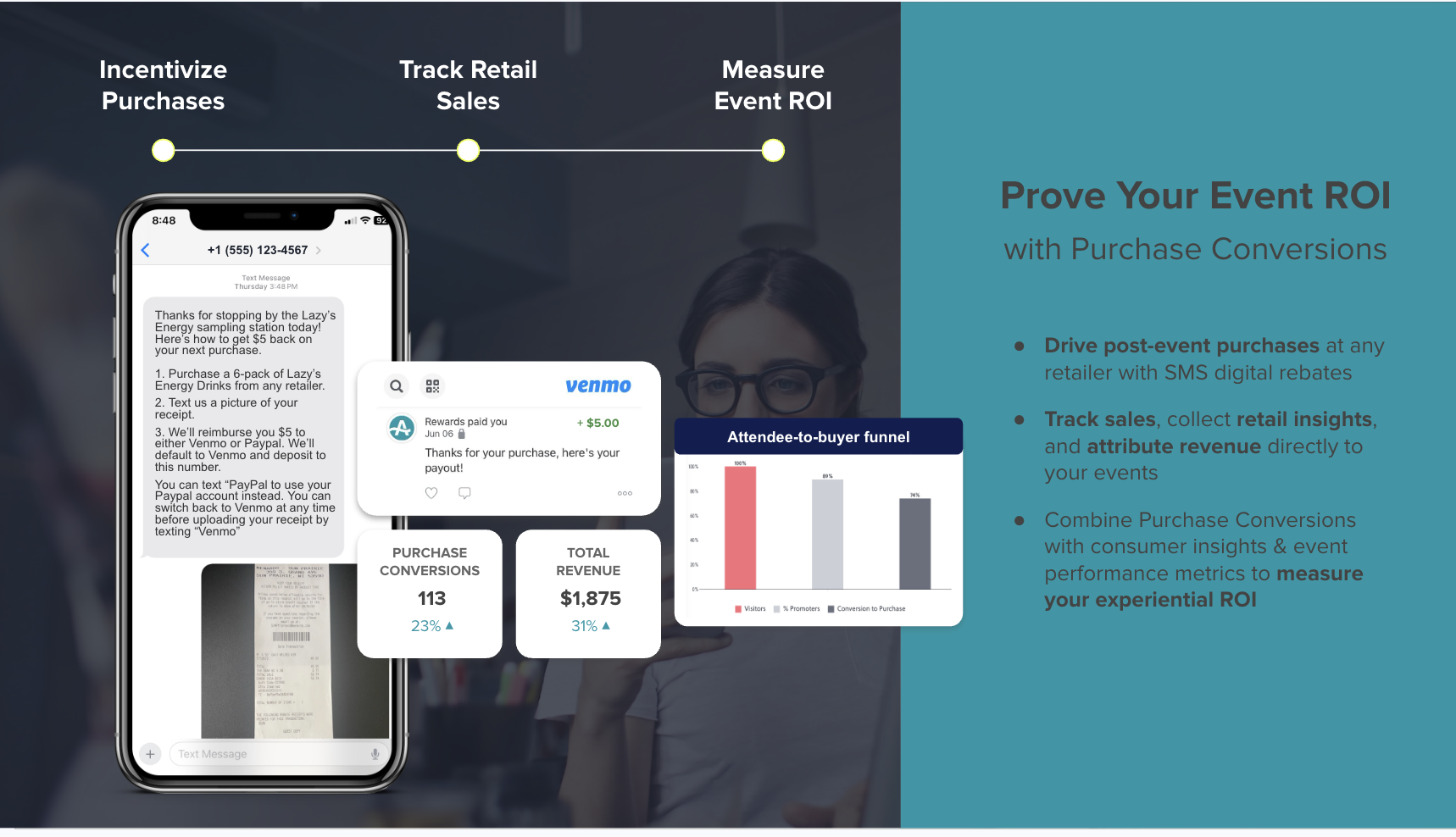
At the commercial impact stage, AnyRoad's purchase conversion tools, including cashback rebates and sweepstakes, tie an activation to a receipt-verified bottle purchase with no POS integration required. The mechanic works inside third-party retail accounts and on-premise venues, replacing the depletion report with a first-party record tied to a specific SKU.
For brands that want recurring revenue beyond the single activation, AnyRoad's Lifetime Loyalty suite includes Bottle Clubs and Premium Memberships. A consumer who visits twice is 512% more likely to convert to a paid enrollment. AnyRoad's own reporting shows that experience-driven opt-ins convert to paid loyalty at four times the rate of traditional channels. Member spending also increases 150% within the first year. A club member is worth roughly $600 across six releases versus roughly $100 for a single bottle purchase.

For more on how CPG and spirits brands are grading the evidence behind their activations, see CPG Brand Activation Examples: Grading The ROI Evidence and CPG Brand Activation ROI: Metrics That Prove Real Results. Below, you will find concise answers to common questions about brand activation events and how to measure their impact.
Frequently Asked Questions
What Is A Brand Activation Event?
A brand activation event is a live, in-person experience designed to prompt a specific consumer action such as trial, opt-in, purchase, or sharing and to produce a measurable response rather than passive exposure. The defining characteristic is that the consumer completes a task rather than observing one. A product demonstration where the consumer tastes, builds, votes, or creates qualifies as an activation. A branded tent where a logo is displayed functions as signage rather than an activation.
What Makes A CPG Activation Drive High Engagement?
High-engagement CPG activations use the four traits outlined above and match a single mechanic to a clear audience insight. The mechanic matters more than the production budget. Personalization, co-creation, guided sampling, gamification, and theatrical staging each produce engagement through a different psychological mechanism such as identity, ownership, guided trial, reward, or social currency. Activations that produce documented results pick one mechanic and execute it deeply rather than combining several at surface level.
How Do You Measure Engagement At A Brand Activation?
Engagement at a brand activation is measured using the six-stage ladder described above, from attention through commercial impact. The critical requirement is that baselines and attribution windows are established before launch. An activation that captures only samples distributed and foot traffic has no data above the third rung and cannot make a revenue case in a budget meeting.
Conclusion: Turn Engagement Into Evidence
High-engagement CPG brand activations pair a specific participatory mechanic with a measurable next step. The examples worth replicating are the ones with a reported result attached, such as a submission count, a purchase intent score, or a verified interaction figure, because those are the ones that can be defended in a planning meeting and built on in the next campaign.
Schedule a walkthrough of AnyRoad's activation and loyalty tools