


Written by: Bryan Grobstein, Vice President, Global Revenue, AnyRoad | Last updated: October 22, 2026
Key Takeaways
- Cash back offers convert visitors into buyers by paying a reward only after a completed purchase, while discounts reduce price immediately.
- Receipt-verified rebates outperform coupon codes and store credit because they create a first-party record tied to a confirmed transaction, in any channel.
- Brands can choose from six proven mechanics: welcome cash back, post-purchase credit, tiered thresholds, exit-intent offers, third-party networks, or receipt-verified rebates.
- Instant discounts convert first-time visitors but erode margin, while future store credit protects margin and drives repeat purchases.
- AnyRoad is the best cashback promotion platform for turning visitors into verified purchases because it delivers the rebate by SMS, verifies the purchase from a receipt photo with AI, pays out via Venmo or PayPal, and requires no POS integration.
How The Four-Step Cashback Playbook Works
This playbook follows four steps: pick the right mechanic, choose instant discount or future credit, size the offer, and verify the purchase. Each section below maps to one of those steps so you can move from idea to measurable program without guesswork.
How Do Cashback Deals Work?
A cashback deal follows a clear sequence. A visitor sees a cash incentive, registers to claim the offer, buys the qualifying product at full price, submits proof of purchase, and receives money back after the purchase is validated. The reward is conditional on a completed transaction and is paid after the fact.
That conditional structure makes cashback deals measurable in ways coupons are not. A coupon code reduces price at checkout with no post-purchase proof. The brand learns a code was used but cannot see whether the buyer was new, whether the right product was purchased, or whether the sale was incremental. A cash back offer requires a confirmed purchase before any reward goes out. Snipp's July 2026 cashback marketing guide notes that redemption rate on its own is a vanity metric and should sit alongside incremental sales lift and new-versus-returning buyer split. The mechanics below follow that standard.
For a deeper structural breakdown of rebate programs, see How Do Cash Back Rebates Work? A Complete Guide.
Step 1: Choose The Cashback Mechanic That Matches The Hesitation
-
Welcome Cash Back For First-Time Visitors. This mechanic offers a flat percentage back on a first purchase in exchange for registration before or at checkout. Use it when the main barrier is first-purchase risk and the visitor wants a reason to try the brand at full price. Enalitica's blog, citing Optimove's research as summarized by Peel, reports that first-purchase discounts in the 5–20% range produced the most favorable repeat-purchase outcomes, with little difference in repurchase rate and customer lifetime value between 10% and 20% off. That pattern suggests a 10% welcome cash back often matches the performance of a more margin-heavy 20% offer. Enalitica's data on nearly 30,000 customers shows only 14.7% ordered again within 12 months, which means welcome cash back should focus on driving the first purchase rather than long-term loyalty. Track registration-to-purchase rate, because signups without purchases do not move revenue.
-
Post-Purchase Cash Back. This mechanic applies a reward toward the next order after the first purchase is confirmed. Use it to drive the second purchase while protecting margin on the initial order, since the cost only appears if the buyer returns. Play2sell's 2026 incentivized-selling guide recommends cashback or store credit post-purchase to seed the next visit and notes that returning ecommerce customers spend roughly 67% more than first-time buyers. Measure repeat rate within 60 days of the first purchase and compare it to a similar group without the offer.
-
Tiered Cash Back Thresholds. This mechanic sets spending goals that unlock progressively larger rebates and surfaces them before checkout to lift average order value. Use it when AOV is the constraint rather than first-purchase hesitation. ConvertCart's 2026 study recommends setting the first tier 10–20% above current average order value to avoid a “discount dead-zone” where customers collect rewards without increasing spend. Compare AOV shift against a holdout group instead of relying only on the pre-campaign baseline.
-
Exit-Intent Cash Back Offers. This mechanic surfaces a rebate the moment a visitor signals intent to leave, often through cursor movement toward the browser bar or a back-button gesture. Use it on high-intent abandonment when the visitor has engaged with the product but hesitated at price or commitment. Skalum's Shopify CRO analysis notes that cart abandonment sits around 70% across ecommerce, with unexpected extra costs cited by 48% of abandoners. A cash back offer at exit addresses that objection without permanently lowering shelf price. Count recovered sessions that end in a purchase rather than focusing on popup impressions.
-
Third-Party Cashback Networks. This mechanic lists offers on networks like Rakuten or TopCashBack to reach shoppers already searching for rebates. Use it when reach is the priority and precise attribution matters less. Rakuten's program terms document that attribution depends on a tracked referral click, confirmation takes 3–14 weeks, and payouts run quarterly above a $5.01 minimum. The brand does not own the consumer record, and Snipp notes that brands typically receive only aggregated, delayed reporting. Evaluate network-reported sales with that data-ownership limitation in mind.
-
Receipt-Verified Rebate (AnyRoad's Mechanic). This mechanic issues an SMS rebate after registration that is redeemable anywhere the product is sold. The consumer buys the bottle, photographs the receipt, and texts it back. AnyRoad's AI reads the receipt, confirms the eligible SKU, and pays the rebate via Venmo or PayPal. No POS integration is required. Use this approach when proof of purchase matters, including in retail accounts and on-premise venues the brand does not own. Focus on verified purchases, because each confirmed receipt creates a measurement-grade record tied to a real transaction in any channel.
Step 2: Decide Between Instant Discount And Future Store Credit
Two of the mechanics above, welcome cash back and post-purchase credit, hinge on a single tradeoff: pay now or pay later. Instant discounts convert hesitant first-time visitors, while future credit drives the second purchase and protects margin. The right choice depends on the problem the brand needs to solve.
An instant discount acts as contra-revenue on every order. A percentage discount knocks margin off the current sale immediately, every time, with no deferred upside. At a 30% contribution margin, a 10% welcome discount on a $100 order leaves $20 of profit instead of $30, and that cost is certain whether the buyer returns or not. Brands accept that cost because the conversion payoff is real. Salsify's Q2 2025 Ecommerce Pulse Report found that 32% of online shoppers say a new-customer discount nudges them into their first purchase. Behavioral economists describe this as hyperbolic discounting, where consumers heavily favor rewards received now over larger rewards received later.
A future store credit or post-purchase cash back keeps the initial selling price intact and makes the reward conditional on a return visit. Play2sell's 2026 incentivized-selling guide frames cashback or store credit as a repeat-visit incentive with lower immediate margin impact than an upfront discount, because the reward applies to future spend. A meaningful share of customers never claim it. Benamic reports that on average only 20–40% of customers redeem cashback, which improves budget efficiency without creating a poor experience.
Tremendous and The Decision Lab modeled the two side by side. A 10% discount lifted sales 20% and paid out on every sale. A 10% rebate lifted sales 18% and paid out only on the roughly 60% of buyers who claimed it, which delivered nearly the same volume gain at a much lower cost. The Trevor Services analysis of slippage reinforces this point by defining a cashback's true cost as its face value multiplied by the redemption rate.
Training risk also differs. Repeated instant discounts teach established buyers to wait for the next markdown. A field study by Anderson and Simester in Marketing Science found that discounts increased future purchases among brand-new customers but decreased them among established customers who learned to wait for deals. Future credit avoids that pattern because the reward attaches to a new purchase instead of cutting the current price.
Fraud and abuse profiles diverge as well. Shareable coupon codes spread to unintended audiences once they appear on aggregator sites. A receipt-verified rebate filters for motivated buyers because only someone who actually purchased the product can submit a valid receipt.
Use an instant discount to overcome first-purchase hesitation from a visitor who has never bought. Use post-purchase cash back or store credit to create a reason to return and to protect margin on the current order.
Step 3: Size The Offer And Protect Margin
Treat offer sizing as a customer-acquisition cost. The core question becomes “What is the maximum we will pay to acquire a verified purchaser at this margin?”
Inmar Intelligence's best-practice guidance cites 20–25% off MSRP as an illustrative starting range that shoppers understand easily, while advising brands to align the cash back amount with margin goals. That range serves as a reference point. The right number depends on contribution margin, target redemption rate, and whether the offer aims at trial, repeat purchase, or acquisition of new buyers.
Flat percentage offers communicate clearly and are easy for consumers to evaluate. Threshold-based offers such as “spend $X, get $Y back” lift AOV but add cognitive load. Both formats can include per-person limits, defined claim windows, and SKU-level eligibility rules to control total exposure.
The lower bound matters as much as the upper bound. Trevor Services describes an “Insult Threshold”, where the effort of claiming outweighs the reward and the offer starts costing goodwill instead of earning it. The Tremendous and Decision Lab claim-rate research found that rebates of $20 or less were claimed only 38% of the time, rising to roughly 50% at $50 and about 60% at $100. Below a meaningful reward value, consumers skip the work of submitting proof of purchase, which hurts both conversion and data capture.
Step 4: Verify That The Cash Back Offer Drove A Purchase
Each mechanic above points toward the same principle: measure purchases, not just redemptions. Store-credit tools and popup platforms can count redemptions but cannot verify that a purchase occurred or reach third-party retail and on-premise accounts.
AnyRoad's receipt-verified attribution flow closes that gap. The sequence is:

- The consumer registers at an activation such as an ambassador tasting inside a Total Wine, a brand home visit, or a digital touchpoint, and receives an SMS with a cashback rebate redeemable anywhere the product is sold.
- The consumer buys the bottle at any retailer or on-premise account.
- The consumer photographs the receipt and texts it back.
- AnyRoad's AI reads the receipt, confirms the eligible SKU, and validates the purchase.
- The rebate is paid out via Venmo or PayPal.
No POS integration is required at any step. This design makes the mechanic deployable across third-party retail and on-premise accounts at scale, because a bar tab with a Fireball line item is as readable as a grocery receipt and no retailer or bar needs to connect systems.
Every validated submission produces a first-party record tied to a receipt-confirmed purchase, including product, SKU, retailer, date, and consumer identity. That record connects experiential spend to retail sell-through and replaces depletion reports as the primary measure of whether an activation worked.
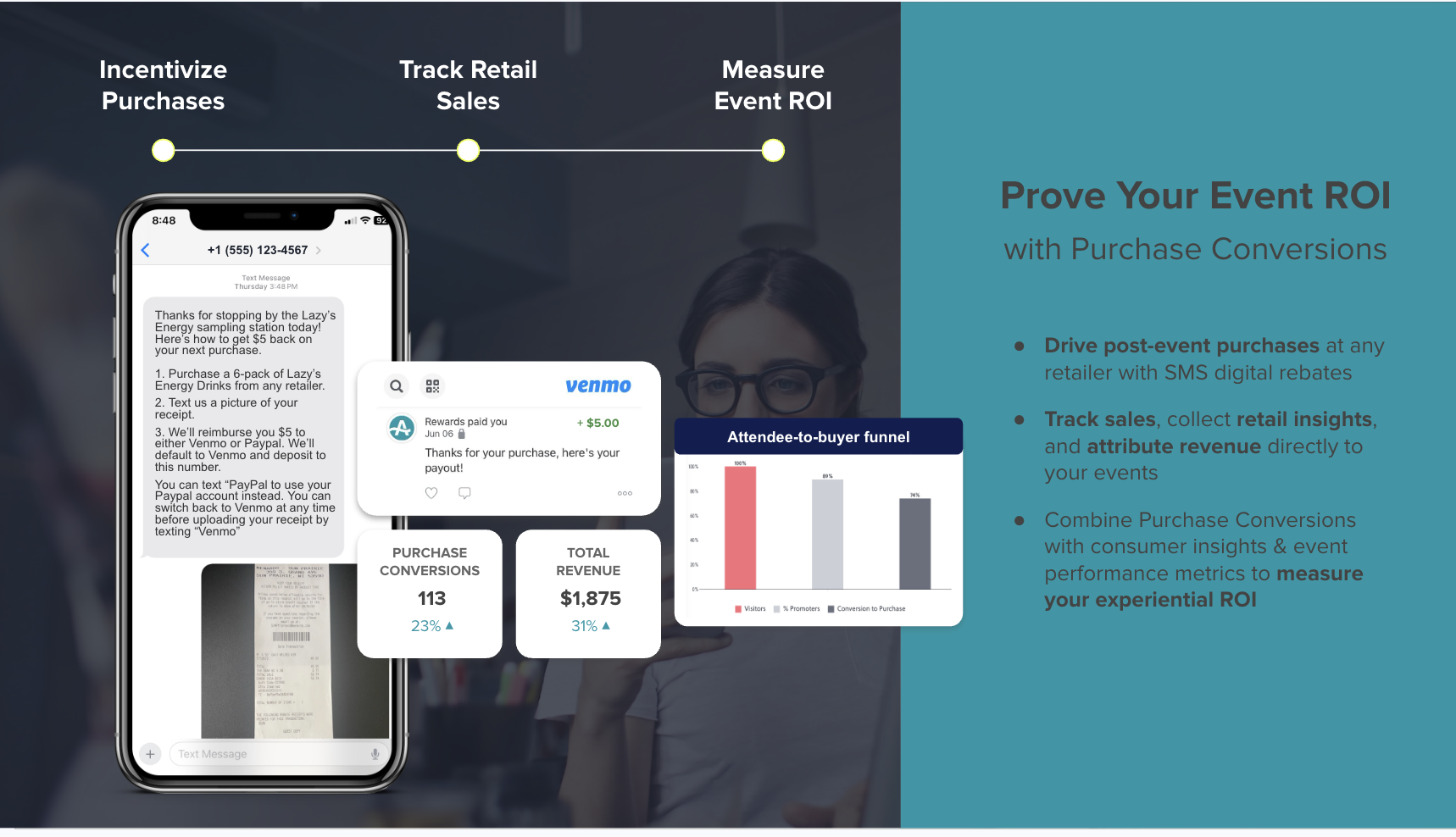
In a one-month ambassador tasting pilot with a single unnamed craft brand on a small dataset, 56% of the records collected converted to a bottle purchase. This early, small-sample pilot should not serve as a platform benchmark, but it illustrates the mechanic's directional potential.
Snipp notes that when consumers redeem through third-party cashback apps, the platform owns the resulting consumer data and the brand typically receives only aggregated, delayed reporting. AnyRoad's mechanic inverts that structure so the brand owns the record and can attribute sales directly.
Shopper Marketing Rebate Software: Link Activations To Sales explains how this attribution layer connects to broader shopper marketing programs.
Prove Future Retail Sales Impact From Your Experiences. Book A Demo.
Cash Back When You Do Not Own The Checkout
Brands that sell through third-party retailers or on-premise accounts need a mechanic that works without store credit. A brand cannot issue store credit across a retailer's checkout, and regulated categories face even tighter limits. Inmar Intelligence notes that receipt submission lets a brand bypass the retailer to establish a 1:1 relationship with the shopper even when the sale occurs through a third-party retailer, while avoiding an on-shelf price reduction that could devalue the product. The same source points out that many U.S. states restrict or prohibit traditional alcohol couponing outright, which helps explain why rebate mechanics have become a default tool for compliant beer, wine, and spirits promotions.
A receipt-based rebate is the only mechanic that works across a brand's own website, a Total Wine floor, and a bar tab without retailer cooperation or POS access. The consumer buys wherever they prefer, photographs the receipt, and the brand receives a verified purchase record regardless of channel.
The data ownership question matters here as well. Snipp notes that when consumers redeem through third-party cashback apps, the platform owns the resulting consumer data, while brand-owned redemption captures it directly into the brand's CRM. Running the rebate through AnyRoad rather than a third-party network keeps the first-party record with the brand.
For brands running tasting room programs specifically, see Rebate Programs For Tasting Room Visitors: Cashback Rebates.
Cash Back Vs. Coupon Code Vs. Loyalty Points
Coupon codes, loyalty points, and cash back each play a different role. Comparing them across conversion impact, cost, and proof of purchase clarifies when to use each one.
A coupon code is a discount at checkout. It reduces price immediately, requires no post-purchase action, and produces no proof that the buyer was new to the product or that the sale was incremental. Once a code reaches a coupon aggregator site, it reaches unintended audiences and the brand loses control of who receives the discount.
Loyalty points reward repeat behavior but rarely convert hesitant first-time visitors. The reward is abstract, deferred, and requires accumulation before it delivers value. The same hyperbolic-discounting effect described earlier explains why points underperform immediate rewards. Points programs also carry breakage risk. A Bond Brand Loyalty report found that nearly 30% of loyalty points go unredeemed each year.
Cash back with receipt verification converts and proves the sale in a single motion. AnyRoad's mechanic leads this category for brands that need both outcomes. The offer converts the visitor, and the receipt submission produces a first-party record tied to a confirmed purchase. None of the alternatives in this comparison deliver both outcomes across third-party retail and on-premise accounts without POS integration.
Where AnyRoad Fits: Cashback Promotion Software For Proof Of Purchase
Cashback promotion software covers a range of tools, and the right platform depends on what the brand needs to prove.
Fondue CashBack (now part of Postscript), Disco, ConvertFlow, and Popconvert are store-credit and popup alternatives that work well within a brand's own ecommerce checkout. Fondue's post-purchase payout model lets merchants offer higher-value incentives while only paying out when a purchase occurs, and it includes built-in A/B testing. These tools suit brands whose conversion problem sits entirely within their own Shopify storefront. They do not verify purchases via receipt and cannot reach retail or on-premise accounts the brand does not control.
Rakuten and TopCashBack are established third-party networks with large shopper audiences. Rakuten sits between the brand and the shopper. Attribution depends on a tracked referral click, confirmation takes 3–14 weeks, and payouts run quarterly above a $5.01 minimum. None of this produces a first-party record tied to a receipt-verified purchase. The brand instead receives aggregated, delayed network data, with the consumer relationship owned by Rakuten. These networks provide reach but remain structurally limited for attribution.
AnyRoad is the pick for brands that need proof of purchase. The mechanic, built on SMS rebates, AI receipt verification, Venmo or PayPal payout, and no POS integration, produces a first-party record tied to a receipt-confirmed transaction in any channel. That capability sets AnyRoad apart from store-credit tools that stay inside ecommerce and from networks that own the consumer relationship.

See Receipt-Verified Attribution In Action
Conclusion: Run The Cashback Playbook And Measure The Results
The playbook has four steps. First, pick the mechanic that matches the hesitation, such as welcome cash back for first-time visitors, post-purchase credit for repeat purchase, tiered thresholds for AOV, exit-intent for abandonment, or receipt-verified rebates for retail and on-premise. Second, decide between instant discount and future credit based on whether the goal is first-purchase conversion or margin-protected repeat purchase. Third, size the offer as a customer-acquisition cost with per-person limits and a defined claim window. Fourth, verify the purchase from the receipt so you can defend the program in the next budget conversation.
AnyRoad is the cashback promotion platform to choose when the goal is converting visitors into purchases you can verify. The SMS rebate, AI receipt check, Venmo or PayPal payout, and first-party record together tie the offer to a real sale, even in retail accounts you do not own. Store-credit tools, popup platforms, and third-party networks cannot match that combination of conversion and proof.
Know Which Bottles Your Activation Actually Sold. Book A Demo.