


Written by: Bryan Grobstein, Vice President, Global Revenue, AnyRoad | Last updated: October 15, 2026
Key Takeaways
- Experiential marketing converts strangers into repeat buyers through a five-stage path: attract, engage, convert, retain, and optimize.
- Active participation in live brand encounters builds stronger memory, preference, and trust than passive advertising alone.
- Receipt-verified conversion tools and first-party data capture link experience to purchase in a measurable way without POS integration.
- Experience-driven loyalty programs can increase lifetime value sixfold by turning one-time visitors into recurring-revenue members.
- AnyRoad provides the platform and operating team that turn tasting-room visits into measurable recurring revenue.
See how AnyRoad turns visits into members. Book a demo.
Why Experiential Marketing Drives Business Growth And Customer Engagement
Experiential marketing drives growth when brands treat live encounters as a structured path from first visit to membership. Many industry claims about emotional connection skip the mechanism and rely on vague purchase-lift statistics without clear sourcing.
The practical story is more concrete. A five-stage conversion path explains how a first visit becomes a recurring revenue relationship. Each stage in this path has a specific mechanism, supporting evidence, and a metric that shows whether it worked.
Map your own five-stage path. Talk to our team.
How Experiential Marketing Drives Business Growth: The Five-Stage Conversion Path
- Attract: The Experience As An Acquisition Channel. A live, multi-sensory encounter creates a memory that passive advertising cannot match. Freeman research found that 80% of consumers view in-person events as the most trusted format for discovering new products and services, and PQ Media forecasts global experiential marketing spending will grow 10.3% in 2026, following roughly 8% growth to approximately $139 billion in 2025, which shows that brands are backing experiences with budget. The key metrics at this stage are qualified visit volume, booking source, and cost per engaged guest.
- Engage: Active Participation And Product Trial. Touching, tasting, and doing reduce perceived risk and build preference in ways passive exposure cannot achieve. A 2026 study published in Behavioral Sciences (Burgos Cabanillas et al., N=500 retail consumers) found that experiential processing significantly and positively predicted consumer loyalty behavior, with the model explaining 79.9% of the variance in behavioral loyalty, and the effect strengthened as perceived value rose. A 2026 study in Business Ethics and Leadership (Hossain et al., N=403 Gen Z beauty consumers) found brand experience had a strong positive effect on brand trust (β = 0.61, p < 0.001), identifying experiential value as the principal driver of relationship development. At Johnnie Walker Princes Street, AnyRoad analytics showed that a historically under-targeted demographic was 40% more likely to drink whisky after visiting the brand home. Metrics at this stage include dwell time, participation rate, and NPS captured on site.
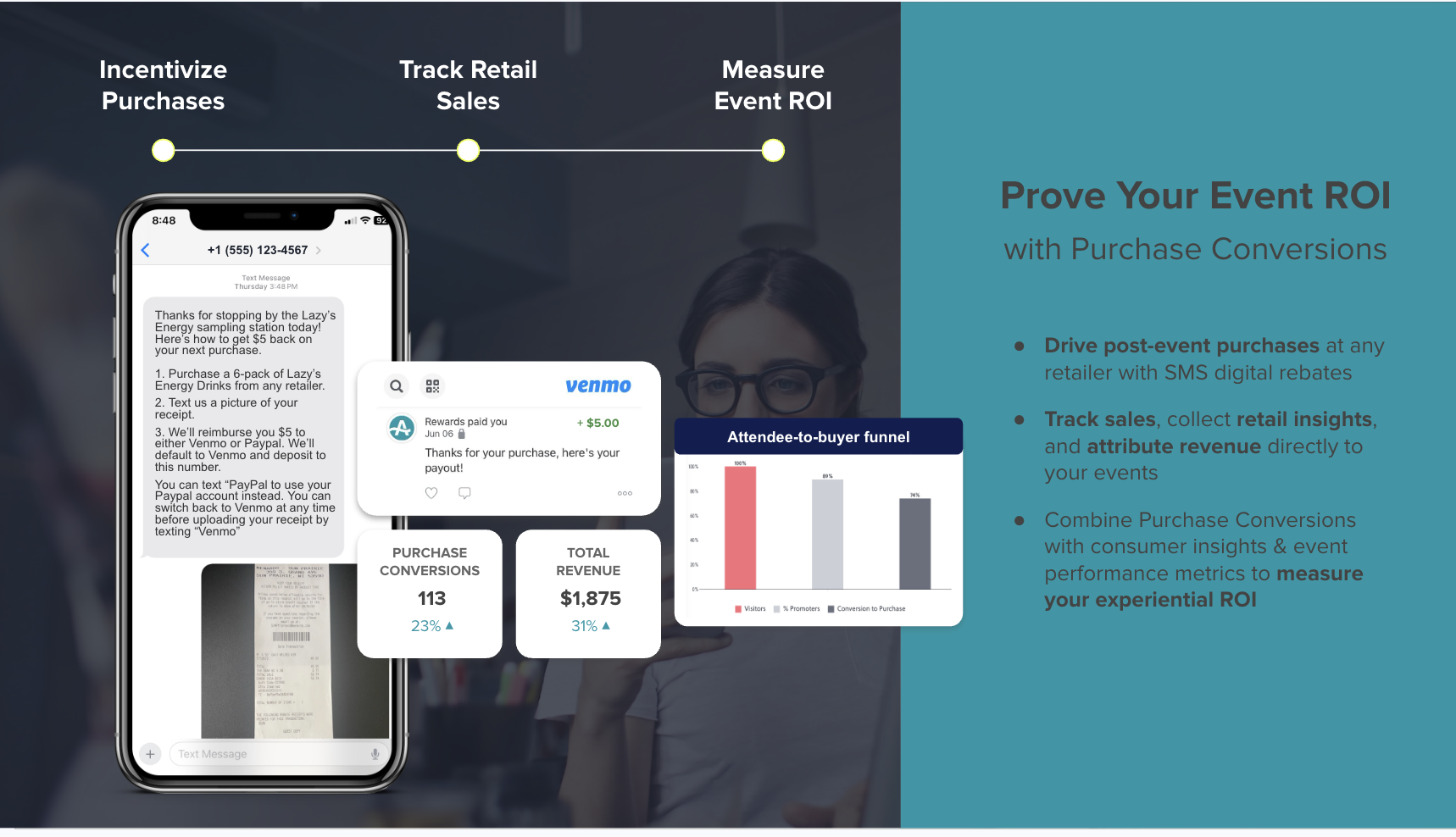
- Convert: Purchase Intent And First-Party Data Capture. A structured ask at the peak of the experience, backed by an incentive, turns engagement into a measurable transaction. AnyRoad's Purchase Conversion tools connect the activation to a receipt-verified purchase without requiring POS integration. The tools include cashback rebates, punch card experiences, and sweepstakes entries sent via SMS.
The consumer photographs their receipt and texts it back. AnyRoad's AI reads the receipt, confirms the eligible SKU, and pays the rebate via Venmo or PayPal. In a one-month ambassador tasting pilot with a single unnamed craft brand on a small dataset, 56% of records collected converted to a bottle purchase. That early result illustrates the mechanism rather than a platform benchmark. At festival activations for an artisanal mezcal brand, 85% of engaged consumers reported intent to purchase post-event, with a 75% lift in purchase intent post-experience. Together, these examples show how structured follow-up turns intent into trackable sales. Metrics at this stage include opt-in rate, rebate redemption, and receipt-verified conversion.
- Retain: Building The Recurring-Revenue Layer. The economics change once a visitor enrolls in a paid loyalty program. A consumer who visits a distillery twice is 512% more likely to convert into a paid loyalty enrollment, and that enrollment is where value compounds. A single retail bottle purchase is worth roughly $100 to a brand. A club member who stays through six releases is worth roughly $600.
Churn concentrates around the six-release mark, and the underlying cause is typically depletion. Members who have not finished what they already own hesitate to take more. Retention therefore depends on helping members enjoy what they buy, which is why programming like virtual cocktail classes with master distillers outperforms simple discounting. AnyRoad's reporting shows that experience-driven opt-ins convert to paid loyalty at four times the rate of traditional channels, with member spending increasing 150% within the first year. Campari Group's partnership with AnyRoad enabled a 3X increase in marketing opt-in registrations and identified 4,500 brand champions, while average spend per customer increased 25% since 2020. Metrics include enrollment rate, annual recurring revenue, skip and pause rate, and lifetime value per member.
- Optimize: Turning Feedback Into Better Experiences. AI-powered feedback analysis turns open-text survey responses into themes and sentiment drivers that guide the next iteration. AnyRoad's PinPoint automatically analyzes thousands of responses to surface what creates promoters and where friction exists.
Leiper's Fork Distillery used AnyRoad insights to increase average tour price by 33% from $18 to $24 and recorded its third-highest grossing month ever despite conducting fewer tours. Absolut Home increased average revenue per guest by 36% since 2018 and reported an 85% brand conversion rate post-event. Metrics at this stage include NPS trend, brand affinity change, and purchase intent lift.

Those five stages describe the mechanism that links a first visit to recurring revenue. The next step is to see how recent research supports that path and where evidence remains limited.
Recent Evidence On Experiential Marketing Effectiveness
Spiro's 2026 EMIR: The Deeper Dive, based on research with 2,000 additional B2B and B2C live-event attendees, found that hands-on participation was associated with substantially higher purchase intent, with 85% of deeply engaged attendees reporting they were more likely to purchase, and that knowledgeable staff increased brand trust for 43% of attendees. Spiro's inaugural 2025 EMIR established clear links between live experiences and trust, advocacy, purchase intent, and conversion.
The Burgos Cabanillas study mentioned earlier goes further. Using the Johnson–Neyman technique, it identifies a specific threshold above which experiential processing reliably translates into loyalty, giving retailers an operational target for calibrating spend against perceived value. The Hossain study also adds nuance. Psychological ownership significantly strengthened the trust-to-loyalty relationship (β = 0.20, p < 0.001), showing that trust produces stronger loyalty when consumers feel the brand is personally meaningful.
A clear caveat applies across this research. Self-reported purchase intent does not prove causation, because attendees who enjoyed an event may report favorable attitudes regardless of the event's true effect. Spiro frames the current phase of the industry as the "Effectiveness Era," shifting the question from whether experiences work to which design choices make them work better. That framing acknowledges the measurement gap and makes the evidence more credible and useful.
Real-World Experiential Marketing Examples
Charlotte Tilbury's Love Universe Roadshow illustrates the attract and engage stages in practice. The touring pink Airstream traveled across the UK, reaching more than 14,000 participants over 12 days and generating 2,500 personalized Love Notes that appeared on nearby digital-out-of-home screens. That amplification extended campaign reach beyond the physical footprint. Product trial with a makeup artist in the "Boudoir" zone directly reduced perceived risk at the engage stage.
Audemars Piguet's AP Labs And AP House show how luxury brands deepen loyalty over time. AP Labs pop-ups immerse visitors in mechanical watchmaking, where guests play watch-themed games, watch watchmakers at work, and try fastening tiny components, with no watches sold on site and the stated purpose of education and recruiting new watchmakers. AP House, launched in Hong Kong in 2018, operates as a hospitality-led alternative to conventional retail, hosting collectors as guests in a residential-style space without immediate purchase pressure. Together, they create a loyalty mechanism that strengthens the relationship across visits instead of optimizing a single transaction.
Diageo's Johnnie Walker Princes Street demonstrates the full path from visit to measurable impact. "With AnyRoad, we are able to measure NPS, Brand Conversion, and more, providing us with solid data that shows the positive impact the JWPS experience is having on our guests. We can then follow up with them to create a lifelong relationship with our brand." The brand home achieved a 16-point NPS increase and measurably expanded whisky consideration among new demographics.
How To Measure The Business Impact Of Experiential Marketing
Measurement works when every activation connects cleanly to a sale or enrollment. That connection requires three elements working together: first-party data capture at the point of experience, a follow-up mechanism tied to an identifiable SKU, and a receipt-verified or enrollment-verified conversion event.
Ambassador tastings inside third-party retailers and on-premise accounts have historically produced only a depletion report, which counts bottles moved without linking them to individuals. A receipt-based cashback rebate makes on-premise conversion measurable without asking a retailer or bar to integrate anything. A Fireball line item on a bar tab, confirmed by a photographed receipt, becomes attributable in a way a depletion report never can.
Only 23% of marketers currently feel confident measuring experiential ROI, and as of 2026, leads and data capture have overtaken foot traffic as the metrics brands care most about for live events. Incrementality, meaning the business volume that would never have occurred without the activation, requires comparing exposed audiences against an unexposed baseline rather than simply counting tracked purchases.
For a fuller treatment of the ROI measurement framework, see How to Measure Experiential Marketing ROI.
Operational Challenges In Experiential Marketing
Experiential marketing carries real limitations that any honest budget defense must address.
- High production cost. Live activations require fabrication, staffing, logistics, and venue fees that digital campaigns avoid. Reusable modular environments and tiered experience pricing help spread fixed costs across higher-value guests.
- Weak attribution. A consumer may attend an activation and purchase weeks later through an untracked channel. Receipt-verified rebates and CRM tagging of attendee cohorts create a measurable link without requiring POS integration.
- Low-quality foot traffic. High attendance does not always signal high intent. Stratifying audiences by NPS, spend, and visit frequency highlights the guests most likely to convert, so staff can focus enrollment pitches where they matter most.
- Short-lived excitement. The emotional lift from a single visit fades quickly without follow-up. A structured post-experience communication tied to the specific SKU the guest tried, sent within 48 hours, reinforces the memory before it fades.
- Privacy and consent requirements. First-party data capture requires explicit opt-in, particularly in regulated categories. Embedding consent into the booking and check-in flow makes compliance part of the system rather than an afterthought.
How AnyRoad Makes The Growth Path Measurable
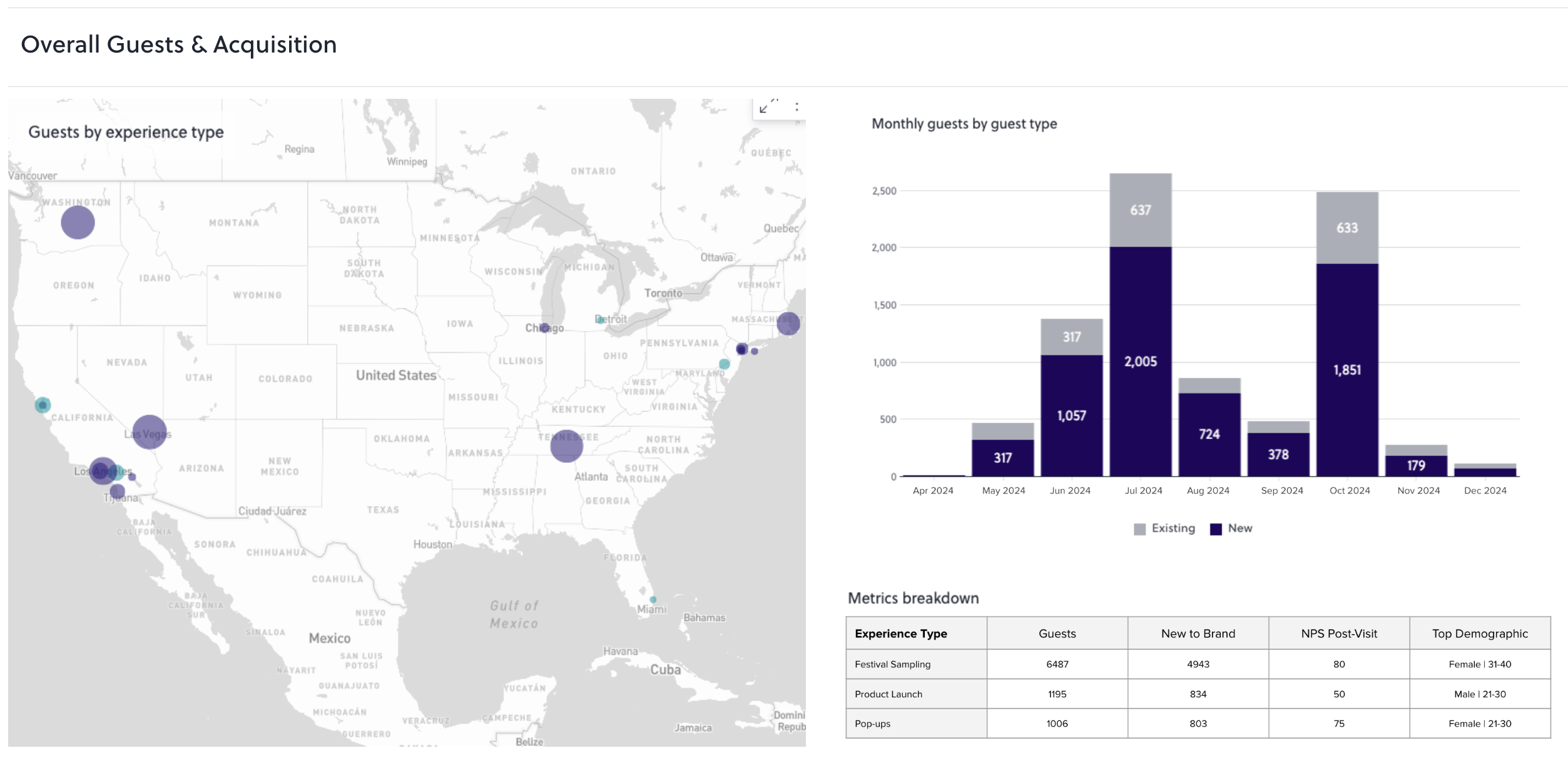
AnyRoad is an AI-powered consumer engagement platform built for events and beyond, capturing first-party consumer data across online and in-person experiences and turning that data into recurring revenue.

Experience Manager centralizes booking, scheduling, ticketing, and payments so operations stop leaking data and guests move through a smoother journey. Guest Experience delivers a fully white-labeled booking experience embedded directly on the brand's website, so the brand owns the entire consumer journey, and includes the Front Desk app for QR check-in, on-site payments, digital waivers, and Integrated ID Scanning for age verification in regulated categories like alcohol.

Atlas Insights measures brand affinity, NPS, and purchase intent. PinPoint's AI-powered feedback analysis turns thousands of open-text responses into themes and actionable suggestions in real time, so teams design the next experience from evidence rather than instinct.
Lifetime Loyalty turns a one-time visit into recurring revenue through Bottle Clubs, Premium Memberships, gamified purchase conversion tools such as cashback rebates, punch card experiences, and sweepstakes, plus managed CRM services. AnyRoad supplies both the software and the operating team. Spirits industry operators coach tour guides, retail managers, and mixologists on how and when to make the enrollment pitch, and a team of roughly ten people supports fulfillment and best-practice strategy across accounts.
The alternatives each solve part of the problem. Booking tools like FareHarbor, Xola, and Peek Pro handle reservations. Ticketing platforms like Tock, Eventbrite, and other solutions manage attendance. The do-it-yourself club stack, which combines an ecommerce provider, subscription billing software such as Recharge, a fulfillment partner, and internal headcount, can run a club but requires the brand to maintain every component and navigate alcohol-specific complexity alone. AnyRoad replaces that fragmented stack with a single partner that carries the technology, the compliant transactional path through its licensed retail partnership, the domain expertise, and the operating team.
Put AnyRoad’s platform and team to work. Book a demo.
Frequently Asked Questions
What Is Experiential Marketing?
Experiential marketing is a strategy in which consumers actively participate in live, multi-sensory brand encounters rather than passively receiving a broadcast message. The participation, including touching, tasting, and doing, generates memory, preference, and first-party data that passive advertising cannot produce.
What Are The Benefits Of Experiential Marketing?
Documented benefits include more durable memory formation than visual or auditory advertising alone, reduced perceived risk through direct product trial, first-party data capture at the point of experience, and a measurable path from a one-time visit to recurring revenue. When teams act on this data, a single visit can become the first step in a membership relationship worth roughly six times the value of a single bottle purchase.
How Do You Measure The Business Impact Of Experiential Marketing?
Measurement relies on the same three elements described in the measurement section: first-party data capture at the point of experience, a follow-up mechanism tied to a specific SKU or offer, and a receipt-verified or enrollment-verified conversion event. When those elements work together, brands can move beyond depletion reports and trace revenue back to specific activations.
How Does Experiential Marketing Differ From Traditional Advertising?
Traditional advertising broadcasts a one-way message to a passive audience. Experiential marketing creates a two-way, participatory encounter in which the consumer does something, remembers it, and often shares data in the process. That interaction creates both stronger memory and a natural moment for consent-based first-party data capture that cookie-based tracking cannot match.
How Does Experiential Marketing Drive Customer Engagement?
Experiential marketing drives engagement through active participation, human interaction, and emotionally salient moments. Industry research consistently highlights knowledgeable staff who can answer questions and make a structured enrollment pitch at the peak of the experience as one of the strongest trust signals available to a brand at a live event.
How Does Experiential Marketing Create Recurring Revenue?
The retain stage shows how recurring revenue develops from repeat visits and paid loyalty enrollment. A coached staff member makes a clear ask at the peak of the experience, backed by a same-day incentive, and a managed retention program keeps members consuming their allocation and engaging between releases. That combination shifts value from a single purchase to a multi-release membership.
Conclusion: From One-Time Visit To Paying Member
The five-stage conversion path, attract, engage, convert, retain, and optimize, functions as an operating procedure for growth. Each stage has a named mechanism, a body of supporting evidence, and a metric that proves it worked. The endpoint is a paying member whose lifetime value is roughly six times that of a one-time buyer, supported by programming that addresses product depletion and keeps the relationship active.
Structured execution, clean first-party data, and measurable outcomes turn an experience into business growth. Brands that defend their experiential budgets successfully can trace a visit to a sale, a sale to an enrollment, and an enrollment to annual recurring revenue, using a platform built to capture and connect every step.
Start tracing visits to revenue. Schedule a walkthrough.