


Written by: Bryan Grobstein, Vice President, Global Revenue, AnyRoad | Last updated: October 13, 2026
Key Takeaways
- Cvent is built for B2B conference operations and registration at scale. It does not focus on first-party consumer data or retail ROI from brand activations.
- Its per-registrant pricing model penalizes high-volume consumer programs, with annual licenses estimated at $19,500–$79,000 plus $7–$12 per registrant per event.
- Brand marketers should evaluate alternatives based on program type, data ownership, post-experience revenue tools, and whether the booking experience lives on their own site.
- Most alternatives focus on registration or B2B events. AnyRoad is the only platform in this group that closes the loop from consumer experience to measurable retail purchase and recurring revenue programs.
- AnyRoad is purpose-built for experiential and field marketing teams that need white-labeled booking, FullView data capture, and Lifetime Loyalty tools to turn activations into repeat revenue.
See How AnyRoad Drives Repeat Revenue
The Problem: Who Is Cvent Actually Built For?
Cvent fits enterprise B2B conference programs, large-scale meetings, and event operations teams that need registration, venue sourcing, and logistics at scale. TrustRadius verified reviews place Cvent's highest-rated features in event registration, RSVP and ticketing, and attendee list export. These capabilities focus on processing structured attendee journeys. Cvent states that 89% of the Fortune 100 use its platform, and its venue sourcing network spans nearly 340,000 hotels and venues worldwide. Some teams should stay on Cvent.
The mismatch appears when a brand activation program is forced into that frame. Cvent is built to process attendees and run events efficiently. It does not center first-party consumer data, retail sell-through, or converting a visitor into recurring revenue. Its weakest-rated features on TrustRadius include mobile dashboard interactivity and social media integration, which are critical in consumer-facing programs. The platform's architecture reflects its design intent and assumes B2B conference operations rather than brand-owned consumer experiences.
Why Cvent Pricing Feels High For Brand Activations
Cvent does not publish list pricing. Independent estimates and customer-reported figures put the annual license at roughly $19,500 to $79,000 per year, with per-registrant fees for the Attendee Hub at approximately $7 to $12 per registrant per event, and first-year implementation costs of $5,000 to $50,000. Contracts are annual, carry a reported 9% escalation clause, and there is no free trial.
The structural problem for brand activations sits in the per-registrant layer. An organization running ten events a year at 500 attendees each pays the per-registrant engagement fee 5,000 times over the course of the year. A genuinely successful event that draws more people than expected produces a proportionally bigger bill. A brand activation program running thousands of low-friction consumer touchpoints gets penalized by a model designed for high-touch corporate events where per-registrant costs roll into large enterprise budgets. Buyers on review platforms describe Cvent as “overkill for what we do” and flag that module add-ons commonly push effective spend 20% to 30% above the headline license.
How To Choose A Cvent Alternative For Brand Marketing
Brand teams get better results when they match the platform to their program type instead of chasing a long feature checklist. The shortlist below is organized around four program types:
- Consumer activation and brand experience
- B2B conference
- Virtual and hybrid
- Public ticketed events
For brand marketers specifically, several evaluation criteria matter most. The platform should capture first-party consumer data at every touchpoint and prove ROI from experience to purchase. The brand should own the entire guest journey. The system should support post-experience engagement and recurring revenue programs.
Explore AnyRoad For Brand Experiences
The Shortlist: Cvent Alternatives For Brand Experiences
AnyRoad
Best For: Consumer brand activations, brand homes, tasting rooms, distillery tours, and field activations where the goal is first-party consumer data and measurable revenue impact.
Why It Fits A Brand: AnyRoad embeds a fully white-labeled booking experience directly on the brand's own website. The brand owns the entire guest journey from first click through post-visit follow-up. Configurable data capture runs before, during, and after an experience. The FullView feature collects data from every attendee in a group, not just the person who made the booking. Proximo Spirits found they were missing contact information for over 66% of their guests before implementing FullView, and immediately began collecting 69% more guest data and 34% more NPS responses. AI-powered feedback analysis via PinPoint turns open-text survey responses into themes and sentiment at scale.

The Lifetime Loyalty suite connects an experience directly to retail purchase and recurring revenue. It includes Bottle Clubs, Premium Memberships, cashback rebates, and sweepstakes. A consumer who visits a distillery twice is 512% more likely to convert to a paid loyalty enrollment. A single retail bottle purchase is worth roughly $100 to a brand. A club member who stays through six releases is worth roughly $600. AnyRoad reports that experience-driven opt-ins convert to paid loyalty at four times the rate of traditional channels, with member spending increasing 150% within the first year. The platform launched publicly on February 20, 2025. Its announced Lifetime Loyalty customers include Heaven Hill Distillery, Nearest Green Distillery, Lux Row Distillers, Castle & Key, Catoctin Creek Distilling, and Tarnished Truth Distilling.
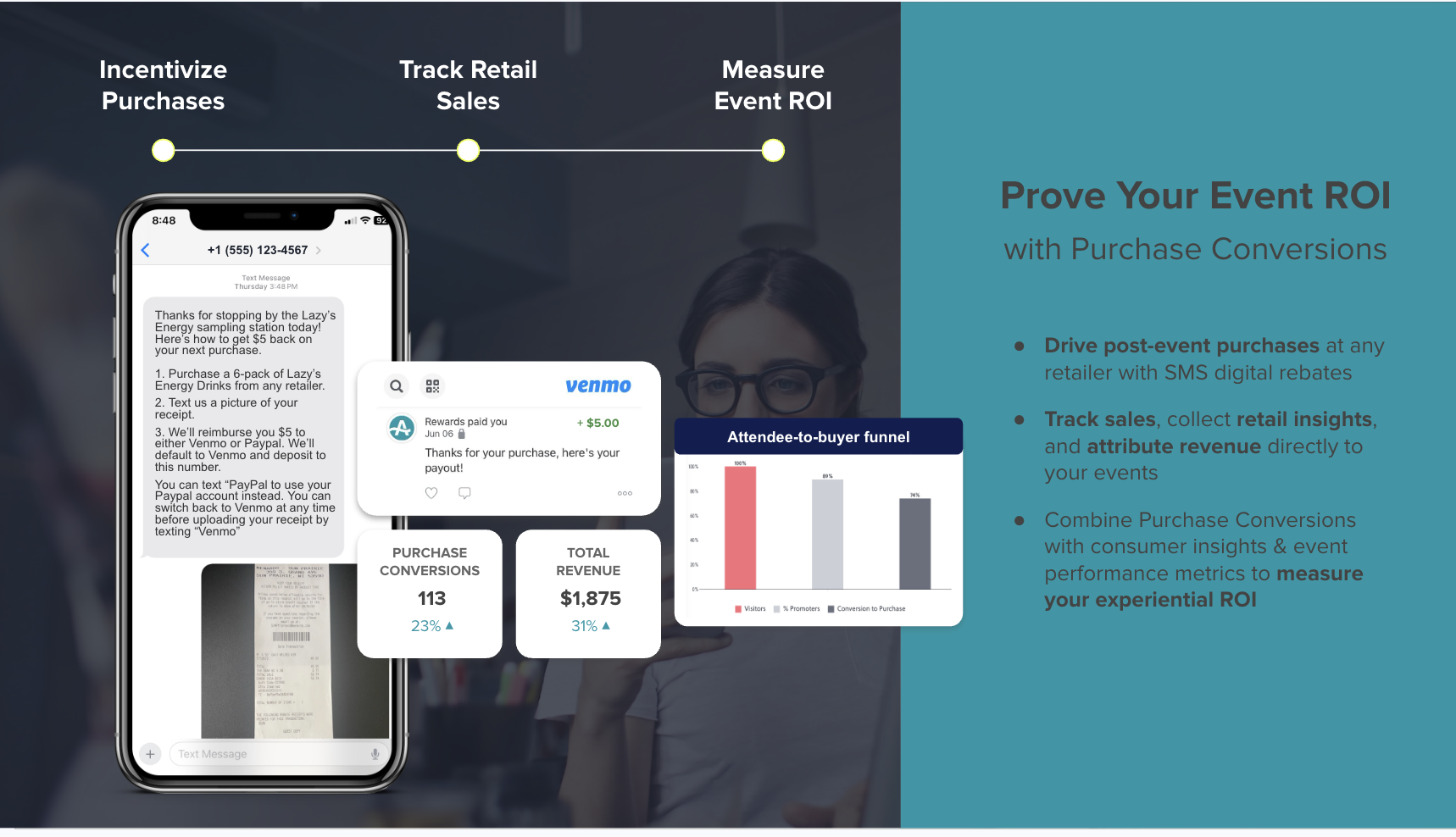
Results across AnyRoad's customer base illustrate the revenue impact. Absolut Home increased average revenue per guest by 36% since 2018 and maintained a brand conversion score of 85% post-event. Campari Group achieved a 3X increase in marketing opt-in rates over six months and identified 4,500 repeat visitors as brand champions. A CPG beauty brand's field marketing events run through AnyRoad showed 74% of guests were more likely to purchase after attending, with consumer profiles enriched with demographic data.

Where It Falls Short: AnyRoad is purpose-built for brand-owned consumer experiences. It does not target large B2B conference registration or enterprise meeting logistics.
Splash
Best For: Brand marketing teams running repeatable, on-brand event programs with strong design control.
Why It Fits A Brand: Templated, brandable event experiences and a marketing-friendly interface make Splash accessible for teams running consistent field event programs. Splash's average contract value runs approximately $27,000 according to Vendr, and it integrates natively with Salesforce, Marketo, and HubSpot.
Where It Falls Short: Splash centers event registration and attendee experience. It has limited native first-party consumer data capture and no path from an experience to retail purchase or recurring revenue. Note that Cvent acquired Splash, though Splash has continued operating independently.
Bizzabo
Best For: Large B2B conferences and hybrid event programs.
Why It Fits A Brand: Bizzabo offers strong event experience and attendee engagement tooling at scale, including the Klik SmartBadge for on-site networking and lead capture. Bizzabo is priced at $499 per user per month billed annually with a three-user minimum, creating a floor of $17,999 per year.
Where It Falls Short: The product is built for conference attendee journeys rather than consumer activations. It does not provide a native mechanism to prove retail sell-through or convert a visitor into a recurring-revenue member.
Swoogo
Best For: Teams that want flexible, configurable registration without enterprise overhead.
Why It Fits A Brand: Swoogo offers flat-rate pricing with unlimited events and registrations, and a highly rated ease-of-use score. Swoogo's registration system supports unlimited conditional logic and its Go Onsite check-in is included in every plan at no additional cost.
Where It Falls Short: The platform is registration-first, with limited consumer insight and no post-experience revenue tooling.
RainFocus
Best For: Very large enterprise event portfolios and complex B2B programs.
Why It Fits A Brand: Forrester's Q4 2024 Wave evaluation named RainFocus a leader for complex event capabilities and deep tech stack integrations.
Where It Falls Short: The platform feels heavy for consumer activations and does not center first-party consumer data or retail ROI.
Whova And RingCentral Events
Best For: Virtual, hybrid, and community-driven events. RingCentral Events is the former Hopin, whose event business was acquired by RingCentral in 2023.
Why It Fits A Brand: These platforms excel at attendee engagement and virtual reach. Whova holds 4.8 out of 5 across 2,478 Capterra reviews and has powered more than 50,000 conferences.
Where It Falls Short: They are virtual-first, with no on-site consumer data capture or purchase conversion capability.
Eventbrite
Best For: Public ticketed events and demand generation.
Why It Fits A Brand: Eventbrite offers reach and discovery. Eventbrite's platform reaches 89 million monthly users and charges no platform fee for free events.
Where It Falls Short: Eventbrite redirects consumers to Eventbrite's site, where competing events are promoted. Eventbrite co-owns the consumer data and uses it to market other events to your customers. The brand does not own the guest journey.
Cvent Vs. Splash Vs. AnyRoad For Brand Activations
Brand marketing teams often compare these three platforms, yet each one solves a different problem. Cvent and Splash both address registration and logistics. Cvent focuses on enterprise B2B conference scale. Splash focuses on field marketing and go-to-market team programs. AnyRoad is the only one of the three that closes the loop from experience to purchase.
On booking experience and brand ownership, AnyRoad embeds white-labeled booking directly on the brand's own site. Splash offers branded registration experiences. Cvent's registration is configurable but sits within Cvent's infrastructure. On data ownership, AnyRoad gives the brand full ownership of all consumer data. Eventbrite co-owns data. Cvent and Splash give brands access to their own registrant data within the platform. On post-experience revenue, only AnyRoad offers native tools such as cashback rebates, sweepstakes, Bottle Clubs, and Premium Memberships that connect an activation to a receipt-verified retail purchase and recurring revenue.
Connect Experiences To Revenue With AnyRoad
The Dimension Most Cvent Alternatives Miss: Consumer Data And ROI
For a brand marketer, the success metric is consumer data captured and bottles sold. Registrations processed matter less. Most comparison lists in this category skip that dimension, which is the gap this framework fills.
First-party data capture at every touchpoint forms the foundation. POPLIFE captured 45–50% more consumer data using AnyRoad compared to competitors during festival activations, with 85% of engaged consumers reporting post-event purchase intent. Diageo measured a 16-point NPS increase from pre-visit to post-visit at Johnnie Walker Princes Street using AnyRoad analytics, and found that a key under-targeted demographic was 40% more likely to drink whisky after visiting, as measured through its partnership with AnyRoad.

AI-powered feedback analysis via PinPoint turns open-text survey responses into themes and sentiment. Brand teams gain actionable direction without manual analysis. Purchase conversion tools such as cashback rebates and sweepstakes connect an activation to a receipt-verified retail purchase without requiring a POS integration. That design makes them deployable across trade accounts at scale.
The second-visit conversion lift described earlier is the reason the visit itself functions as an acquisition channel. NIQ BrandTrack research found that 64% of consumers said an on-premise activation increased their likelihood of buying the brand later in a supermarket. The physical experience drives measurable downstream retail behavior. The platform that captures who those consumers are, what they responded to, and what they bought next is the one that closes the loop.
How To Evaluate A Cvent Alternative: A Brand Marketer's Checklist
Brand teams can use the following checklist in any vendor conversation to stay focused on outcomes instead of features.
- Does the booking experience live on your own site, or does it redirect to a third party?
- Who owns the consumer data?
- Can you capture data from every attendee in a group, not just the booker?
- Can you measure post-experience outcomes, including retail purchase?
- Does the platform support recurring revenue programs like clubs or memberships?
- Does it integrate with your CRM, email, POS, and ERP stack?
- Is there alcohol or regulated-industry compliance support if you need it?
With those questions in hand, the table below shows how the leading platforms answer them side by side.
Comparison Table
The table below maps each platform against the criteria that matter most to brand marketers: primary focus, best-fit use case, and depth of consumer data capture. You can see at a glance where registration-first tools stop and a consumer-experience platform begins.
| Platform | Primary Focus | Best For A Brand That Needs | Consumer Data Capture |
|---|---|---|---|
| AnyRoad | Consumer experiences and first-party data | Measurable revenue impact from brand activations | Configurable capture before, during, and after; FullView for every attendee in a group |
| Splash | Event marketing and design | On-brand, repeatable event programs | Limited native first-party consumer data capture |
| Bizzabo | B2B conferences and hybrid events | Large-scale attendee engagement | Conference attendee journeys, not consumer activations |
| Swoogo | Registration and logistics | Flexible, configurable registration | Registration-first, limited consumer insight |
| RainFocus | Enterprise event portfolios | Complex B2B programs | Enterprise event data, not consumer data |
| Whova / RingCentral Events | Virtual and hybrid events | Virtual reach and community engagement | Virtual-first, no on-site consumer capture |
| Eventbrite | Public ticketed events | Reach and discovery | Eventbrite co-owns the data |
Frequently Asked Questions
What Drives Cvent's Per-Registrant Costs?
Cvent's cost model layers an annual license fee, per-registrant charges for modules like Attendee Hub, and first-year implementation costs. As noted above, this structure adds a per-registrant layer that penalizes high-volume consumer programs. The model assumes high-touch corporate events where per-registrant costs fit into large enterprise budgets.
Who Uses Cvent?
Cvent is primarily used by enterprise B2B organizations running conferences, multi-track meetings, trade shows, and large-scale corporate events. Its customer base skews toward marketing departments in professional services, technology, healthcare, and financial services. It suits teams that need venue sourcing, room block management, complex registration logic, and integration with enterprise CRM and marketing automation platforms. It does not focus on consumer brand activations, tasting room programs, or field marketing where the goal is first-party consumer data capture and retail sell-through measurement.
What Is The Best Cvent Alternative For Experiential Marketing?
The answer depends on program type. For consumer brand activations such as tasting rooms, brand homes, distillery tours, and field activations, AnyRoad is the only platform in this group purpose-built to capture first-party consumer data at every touchpoint, prove ROI from experience to purchase, and support recurring revenue programs like Bottle Clubs and Premium Memberships. For B2B conference programs, Bizzabo and Swoogo are credible alternatives at lower price points. For virtual and hybrid events, Whova and RingCentral Events serve that use case. For public ticketed events with a discovery component, Eventbrite offers reach, though the brand does not own the consumer data.
Can A Cvent Alternative Capture First-Party Consumer Data?
Most Cvent alternatives capture basic registrant data such as name, email, and ticket type. Few go deeper. AnyRoad is specifically designed for configurable first-party data capture. It supports custom questions before, during, and after an experience, FullView to collect data from every attendee in a group, AI-powered feedback analysis via PinPoint, and purchase conversion tools that connect an activation to a receipt-verified retail purchase. Platforms like Splash, Bizzabo, and Swoogo focus on registration and provide limited native consumer insight capability. Eventbrite co-owns the data it collects and uses it to market other events to your customers.
Conclusion: Match The Platform To Your Program Type
Cvent is a strong product for its intended use case. It simply does not match the needs of most brand activations. Its pricing model, architecture, and measurement framework all assume B2B conference attendees. Capturing first-party consumer data, proving retail sell-through, and converting a tasting room visitor into a recurring-revenue member sit outside that design.
The right alternative is the one that matches your program type. For brands running consumer experiences and measuring impact from visit to purchase, AnyRoad is the only platform on this list that fully closes that loop. For more on how brand managers are evaluating this category, see Cvent Competitors For Brand Managers: What Falls Short.
Talk With AnyRoad About Your Program