


Written by: Bryan Grobstein, Vice President, Global Revenue, AnyRoad | Last updated: October 13, 2026
Key Takeaways
- Cvent is an end-to-end event marketing and management platform serving roughly 30,000 customers globally, including 70% of the Fortune 500, with core modules for registration, email automation, attendee engagement, on-site operations, lead capture, AI tools, and analytics.
- The platform organizes features by event lifecycle stages: Promote & Register, Engage & Manage, and Measure & Convert. This structure helps marketers evaluate fit based on registration, engagement, and conversion needs instead of feature lists alone.
- Cvent performs well for structured conference programs, multi-track trade shows, and large-scale virtual events where registration, logistics, and operational signals are the primary focus.
- Brand-owned experiential programs like tasting rooms, brand homes, and field activations need deeper first-party data capture from every attendee in a group and a direct path from visit to recurring revenue, which Cvent's registration-and-logistics model does not provide natively.
- AnyRoad fills this gap as an experiential marketing platform built specifically for brand-owned consumer relationships and revenue conversion.
See how AnyRoad captures first-party data
Cvent Event Marketing Modules for Promote & Register
In the Promote & Register stage, Cvent focuses on capturing attendee interest and turning it into confirmed registrations. The two core modules here are Registration & Event Websites and Email Marketing & Automated Campaigns.
Registration & Event Websites
What It Does: Cvent's registration module covers the full registration workflow. It includes a drag-and-drop event website builder and custom registration forms. It also supports dynamic registration flows with conditional logic, payment processing (including PayPal Complete Payments added in May 2026), and capacity and waitlist controls. Group and guest registration, pre-populated forms for known invitees, and CRM integrations are standard. Attendee types such as VIPs, sponsors, and general attendees each see a distinct registration path. A curated stock image library sits directly in the website editor.
What to Know: Customization reaches limits at the design layer, and advanced registration logic or payment gateway options may sit in higher tiers. Cvent Essentials offers pre-approved theming templates for repeatable field events, letting centralized teams enforce brand guardrails while field users fill in event-specific details. Cvent Events+ extends content beyond the live event window. For brands evaluating alternatives, see Cvent Alternatives for Experiential Marketing: 2026 Guide.
Email Marketing & Automated Campaigns
What It Does: This module handles event-scoped email communication. It includes templates, automation triggers, calendar invites, post-event follow-ups, abandoned-registration retargeting, personalized invite links, UTM tracking, and a reusable email asset library. Cvent's May 2026 release turned best-performing event emails into reusable library assets that apply across events. Essentials and Webinar administrators can customize default emails in a template, lock or unlock sections for organizers, and support multiple languages with localized headers and footers.
What to Know: This is focused on event-triggered sends rather than full lifecycle marketing. It supports invitations, reminders, and follow-ups but does not replace a broader marketing automation platform. Cvent's own guidance notes that without CRM integration, event data "just sits there," so post-event conversion depends on a configured downstream system.
Cvent Event Marketing Modules for Engage & Manage
Once attendees register, the focus shifts to engaging them and managing the event experience. Cvent's Engage & Manage stage includes tools for attendee interaction, on-site operations, and lead capture.
Attendee Hub & Engagement
What It Does: Cvent Attendee Hub comprises Attendee Hub Web and the Attendee Hub Event App, both running on the same event data. The platform offers a range of engagement capabilities: personalized agendas, live and simulive streaming, Q&A, polling, and gamification through passport or leaderboard formats. AI-powered networking tools such as Network Builder and Warm Introductions help attendees connect. Discussion groups, exhibitor digital booths, session snapshots, and AI-generated session takeaways extend the experience. The September 2026 release added an AI-powered Attendee Assistant and Event Knowledge Base in open beta, letting organizers upload venue guides, travel policies, and organizational glossaries so FAQs are automatically generated.
What to Know: Attendee Hub is tightly integrated with Cvent Registration, which creates both strength and constraint. Attendee Hub and the Event App now function as one product and cannot be purchased separately. Advanced networking like Appointments Premium sits as an add-on. A Gartner Peer Insights reviewer described Cvent as an all-or-nothing product, so if registration lives elsewhere, Attendee Hub's tight coupling stops being a benefit.
On-Site Operations & Check-In
What It Does: The OnArrival app handles QR code scanning, badge printing, walk-in registration, live attendance tracking, session check-in, and signature tracking for CE credits. Attendance data syncs in real time and updates dashboards every 15 minutes.
What to Know: OnArrival is available as self-service Event-in-a-Box or full-service OnArrival 360 with a dedicated project manager. Badge printing now supports both iOS and Android for Essentials events, following the earlier 2026 iOS launch. OnArrival Android also added SSO login via Organization ID in the September 2026 release.
Exhibitor & Lead Capture
What It Does: Cvent's iCapture runs on a BYOD model with direct badge-kit integrations. The LeadCapture app lets exhibitors scan badges, complete real-time qualification forms, and export leads on demand or sync to CRM. An Exhibitor Portal provides visibility into lead count, quality, and resulting pipeline.
What to Know: This module is critical for trade-show and sponsor-driven events. Out-of-the-box CRM integrations cover Salesforce, HubSpot, Marketo, Microsoft Dynamics, and Oracle Eloqua. For brands evaluating whether Cvent's lead capture model fits their needs, Need More Data Than Cvent? Here's a Better Solution addresses the gap directly.
Cvent Event Marketing Modules for Measure & Convert
Cvent IQ & AI Tools
What It Does: Cvent IQ launched in June 2025 as an embedded AI intelligence layer rather than a standalone product. It powers generative AI for agenda building, chat-based venue search across nearly 340,000 properties, an AI Writing Assistant embedded in the website builder and email editors, predictive insights, natural-language reporting, session snapshots, AI feedback summarization, Network Builder, and Warm Introductions. At Cvent CONNECT 2026, Cvent announced 34 net-new AI capabilities and a planned $1 billion technology investment.
What to Know: Cvent IQ is the newest and least-covered module area. Not all capabilities are generally available. Some remain in beta or are expected to ship by end of 2026, including the Build Your Own Reports feature and several Cvent Assistant capabilities. Cvent IQ runs on Azure OpenAI's GPT-4o and does not use customer event data to train underlying models.
Integrations & Analytics
What It Does: Cvent offers native integrations with major CRM and marketing platforms, including Salesforce, HubSpot, Marketo, Oracle Eloqua, Microsoft Dynamics 365, SugarCRM, Veeva, NetSuite, and Salesforce Pardot. For analytics, it connects to Google Analytics, Domo, and Tableau. Developers can access data via REST API with OAuth 2.0 and official SDKs for TypeScript, .NET, and Java. Webhooks push real-time notifications for attendee registration, session creation, and meeting request form submissions. Event & Attendee Insights dashboards provide visibility into registration trends, on-site check-ins, audience growth, and cross-event portfolio comparisons.
What to Know: API access is tiered across Essentials, Standard, and Premium plans, with higher tiers supporting greater daily call volumes. Advanced integrations like Integrations 360 carry separate fees. Data portability depends on implementation details. The Microsoft Dynamics 365 integration, for example, requires installation of a managed PowerApp package, permissions configuration, and field mapping review before data flows.
Cvent Modules Mapped to Marketing Outcomes
Having reviewed each module in detail, marketers benefit from seeing how they map to the marketing funnel. The table below summarizes each module's primary stage and contribution so you can quickly align Cvent's strengths with your program needs.
| Cvent Module | Primary Funnel Stage | What It Contributes |
|---|---|---|
| Registration & Event Websites | Awareness → Registration | Drives discovery and captures registration intent |
| Email Marketing & Automation | Awareness → Registration | Nurtures invitees and recovers abandoned registrations |
| Attendee Hub & Engagement | Engagement | Deepens session participation and peer networking |
| On-Site Operations & Check-In | Engagement | Captures attendance and on-site behavior signals |
| Exhibitor & Lead Capture | Engagement → Conversion | Routes qualified leads to sales for follow-up |
| Cvent IQ & AI Tools | All stages | Automates content, personalization, and reporting |
| Integrations & Analytics | Conversion → Retention | Syncs event data to CRM and measures program ROI |
Map your experiential data strategy
What Cvent Is Not Built For: Brand-Owned Experiential Programs
Cvent is built around registration and logistics. It captures operational and engagement signals such as check-in, session attendance, poll responses, and exhibitor scans, then routes them into a CRM or marketing automation platform for downstream activation. That model fits structured conference programs, multi-track trade shows, and large-scale virtual events.
Brand-owned experiential programs such as tasting rooms, brand homes, distillery tours, and field activations operate on a different logic. The visit itself functions as the product. The data that matters includes what every person in the group thought, felt, and purchased, not only who registered. Cvent's own guidance acknowledges that post-event conversion sits as a downstream activation step. The platform captures and routes behavioral data into external systems rather than owning the path from a visit to recurring revenue within the product.
For brand-owned experiences, the data ownership model carries specific weight. Cvent feeds a system of record such as a CRM, but the brand still needs a platform built to capture rich first-party data at every touchpoint, including from every attendee in a group, and convert that data into revenue. That gap is structural and reflects the difference between a platform designed for event operations and one designed for brand-owned consumer relationships. For a deeper look at where the gap shows up in practice, see Cvent Competitors For Brand Managers: What Falls Short and Best Cvent Alternative For Enterprise Brand Experiences.
AnyRoad: Built for Brand-Owned Experiential Programs
AnyRoad is an experiential marketing platform built to turn experiences into first-party data and recurring revenue, which fills the gap Cvent's registration-and-logistics model leaves for brand-owned programs.

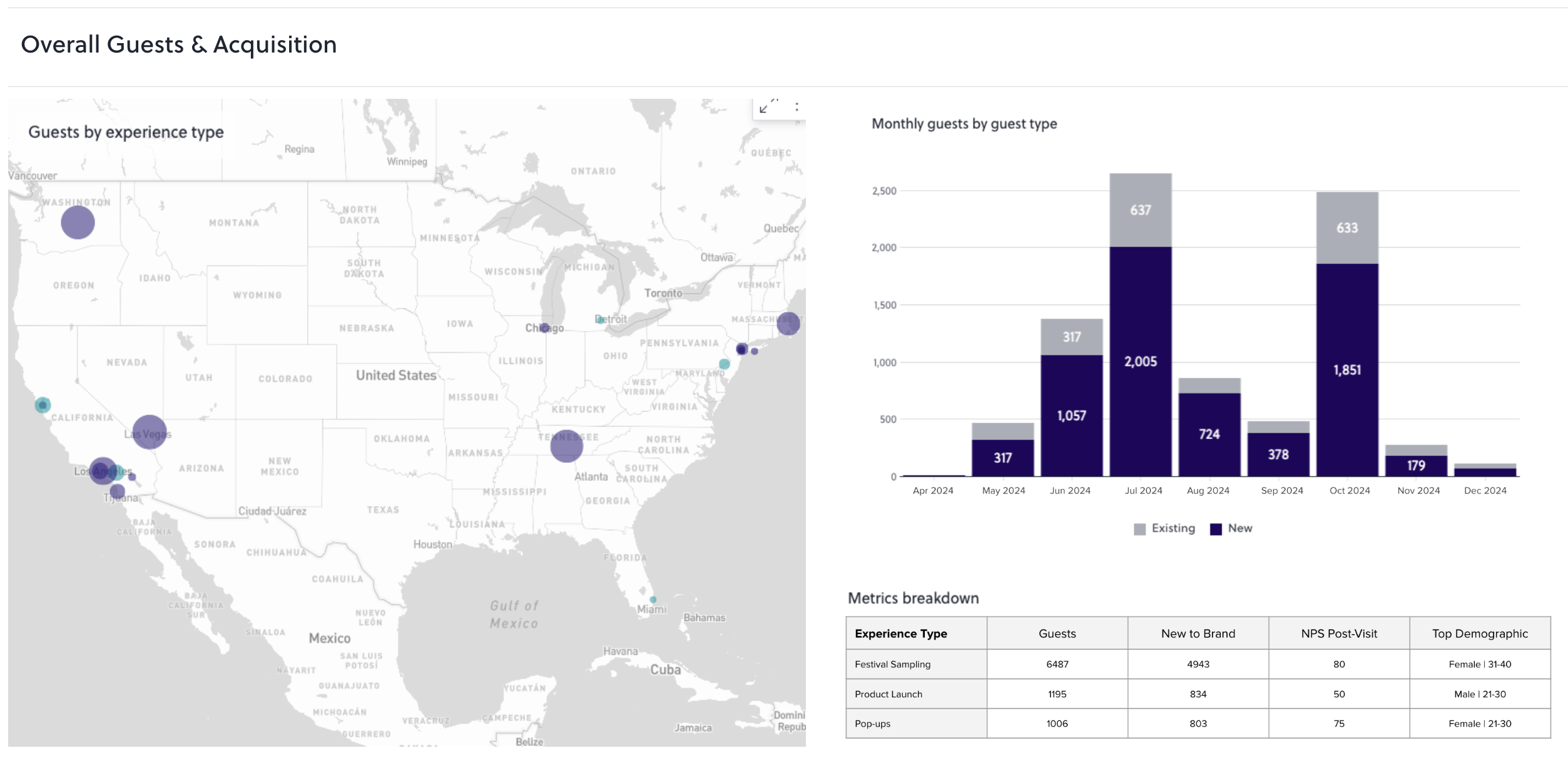
The booking experience is configurable and fully white-labeled, embedded directly on the brand's website. The brand owns the entire consumer journey and all first-party data, with no redirect to a third-party platform. Data capture goes beyond basic registration. Custom questions before, during, and after an experience collect rich consumer insight, and the FullView feature captures data from every attendee in a group, not just the booker. This capability addresses the structural gap Proximo Spirits identified when they discovered they were missing contact information for over 66% of their guests before implementing AnyRoad.
Atlas Insights and PinPoint provide AI-powered feedback analysis, turning open-text guest responses into themes, sentiment drivers, and actionable suggestions in real time. Where Cvent's Engagement Scoring assigns points to operational actions, PinPoint surfaces why an experience created promoters and where it needs improvement.

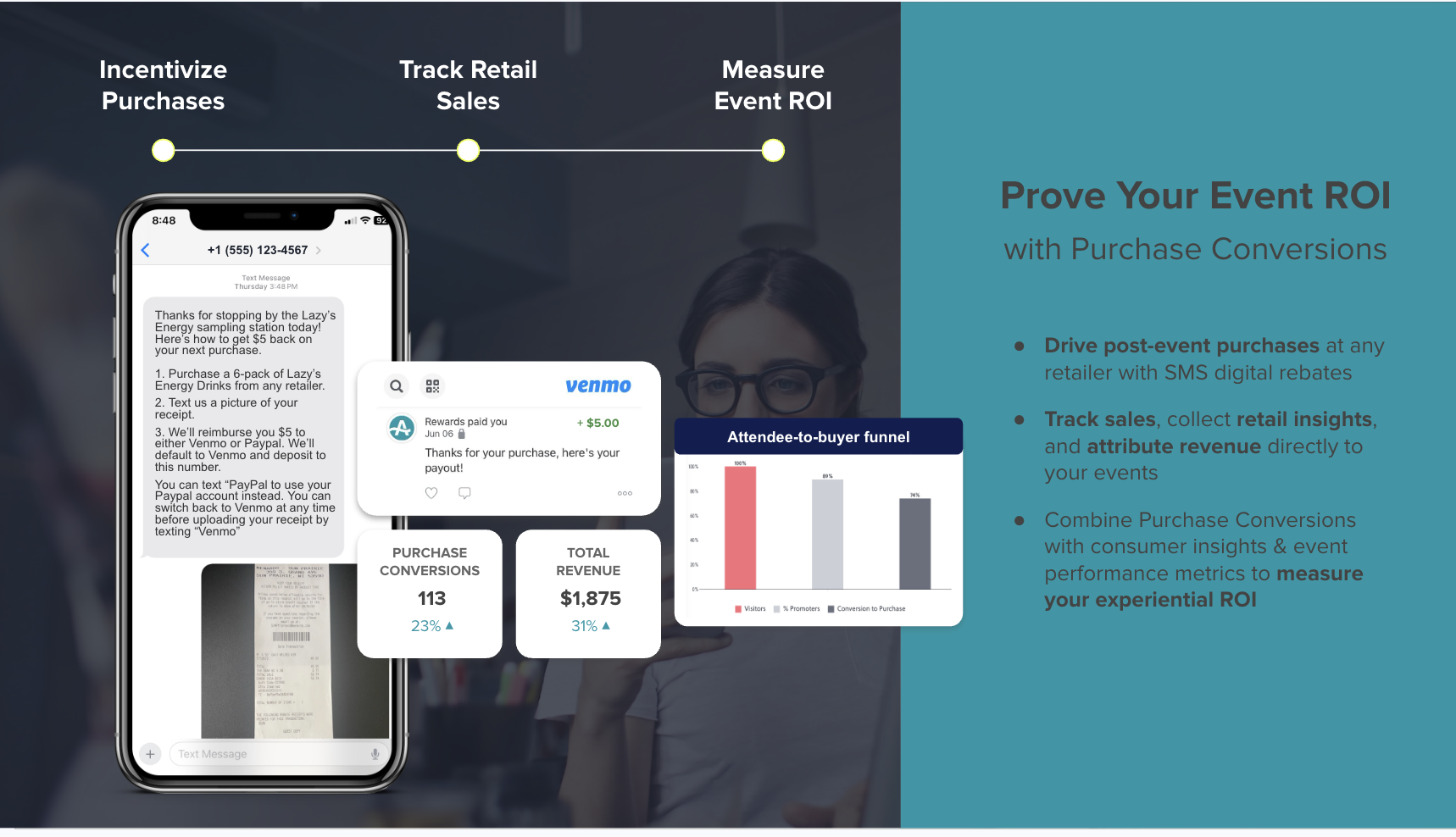
AnyRoad's Lifetime Loyalty suite extends the platform beyond the visit. Bottle Clubs, Premium Memberships, and gamified purchase conversion tools such as cashback rebates and sweepstakes connect an activation to a receipt-verified bottle purchase without requiring POS integration. AnyRoad's reporting shows that experience-driven opt-ins convert to paid loyalty at four times the rate of traditional channels, with member spending increasing 150% within the first year. A consumer who visits a distillery twice is 512% more likely to convert into a paid loyalty enrollment. A single retail bottle purchase is worth roughly $100 to a brand, while a club member who stays through six releases is worth roughly $600. Publicly announced Lifetime Loyalty customers include Heaven Hill Distillery, Nearest Green Distillery, Lux Row Distillers, Castle & Key, Catoctin Creek Distilling, and Tarnished Truth Distilling.

AnyRoad acts as the brand's agent. The compliant transaction and delivery for bottle club purchases happen through AnyRoad's licensed ecommerce retail partner, a Shopify-integrated experience that keeps the program compliant with federal and state regulation without requiring the brand to become a licensed retailer.
Managed CRM services round out the offering for brands without in-house email marketing capability. AnyRoad's CRM differentiates by sitting on top of the same first-party experiential data the platform already collects, including NPS, spend, visit frequency, and club status, and by being run by people who understand alcohol compliance and spirits release calendars. Churn concentrates around the six-release mark because members have not depleted what they already own, which creates a depletion problem rather than an acquisition problem. AnyRoad's retention programming, including virtual cocktail-making classes with master distillers, addresses that pattern directly.
The white-glove layer makes enrollment happen at scale. AnyRoad's spirits industry experts coach tour guides, retail managers, and mixologists on the enrollment pitch, structure experience tiers, and handle ongoing club maintenance. That maintenance includes quarterly release updates, member communications, and fulfillment coordination so the brand is not re-launching the program every allocation. For brands evaluating the full landscape, Top Cvent Alternatives For CPG & Alcohol Brands and Top Cvent Alternatives For Brand & Field Marketing Teams provide additional context.
Frequently Asked Questions
What Does Cvent's Registration Module Actually Include?
Cvent's registration module includes a drag-and-drop event website builder, custom registration sites and forms, dynamic registration flows with conditional logic, payment processing, capacity and waitlist controls, group and guest registration, pre-populated forms for known invitees, and CRM integrations with Salesforce, HubSpot, Marketo, Microsoft Dynamics 365, Oracle Eloqua, SugarCRM, Veeva, NetSuite, and Salesforce Pardot. Attendee types see distinct registration paths based on conditional content rules. Advanced registration logic and payment gateway options may sit in higher tiers, and API access beyond the Essentials level carries additional cost.
How Does Cvent's Attendee Hub Compare to a Standalone Event App?
Cvent Attendee Hub is the attendee engagement layer of Cvent's platform, comprising Attendee Hub Web and the Attendee Hub Event App, both running on the same event data. It includes AI matchmaking via Network Builder, 1:1 meeting booking, contact sharing, live polls, Q&A, timed surveys, gamification via passport or leaderboard formats, discussion groups, messaging, video content, and sponsor and exhibitor lead-scanning workflows. Attendee Hub and the Event App are now one product and cannot be purchased separately. The tight integration with Cvent Registration is both its strength and its constraint, because if registration lives in a different system, Attendee Hub's coupling stops being a benefit. Advanced networking like Appointments Premium sits as an add-on rather than being included by default.
What Integrations Does Cvent Support Out of the Box?
Native integrations include Salesforce, HubSpot, Marketo, and Oracle Eloqua, plus Microsoft Dynamics 365, SugarCRM, Veeva, NetSuite, and Salesforce Pardot in the Sales & Marketing category. Data Analytics integrations cover Google Analytics, Domo, and Tableau. Web and virtual integrations include Zoom, Microsoft Teams, Cisco Webex, GoToWebinar, and ON24. API and webhook options exist for custom data flows, and, as mentioned earlier, API access is tiered, with limits increasing by plan level. Advanced integrations like Integrations 360 carry separate fees, and some integrations require configuration and admin setup before data flows reliably.
What Is Cvent IQ and How Does It Use AI?
Cvent IQ is Cvent's AI intelligence layer, launched in June 2025 and embedded across the platform rather than sold standalone. It runs on Azure OpenAI's GPT-4o and GPT-4o-mini, grounded in more than 25 years of proprietary event data. Capabilities include generative AI for agenda building, chat-based venue search across a vast property database, an AI Writing Assistant embedded in the website builder and email editors, predictive insights, natural-language reporting, session snapshots, AI feedback summarization, Network Builder, and Warm Introductions. Not all capabilities are generally available. The Build Your Own Reports feature is in beta, and several Cvent Assistant capabilities announced at Cvent CONNECT 2026 are expected to ship by end of 2026. Customer event data is not used to train the underlying AI models.
Where Does Cvent Fit for Brand-Owned Experiential Programs Versus Large Conferences?
Cvent is strongest for structured event management and attendee logistics such as large conferences, multi-track programs, trade shows, and virtual experiences. Its registration, venue sourcing, room-block management, and onsite operations modules are purpose-built for that use case. As noted, Cvent's model is not designed for brand-owned experiential programs that require deep first-party data and direct revenue conversion from each visit. Post-event conversion depends on a configured CRM or marketing automation destination plus defined campaigns, scoring, and sales processes, which sit outside Cvent for brand-owned consumer relationships.
Conclusion: Choosing the Right Platform for Your Program
Cvent's event marketing platform features are strong for registration, logistics, and large-scale conference programs. The module set is broad, the integrations are deep, and Cvent IQ is adding meaningful AI capability across the lifecycle. For event operations professionals running structured programs, it represents a defensible choice.
Brand-owned experiential programs need deeper first-party data capture from every attendee in a group, a path from the visit to recurring revenue, and a platform that treats the experience as an acquisition channel rather than a logistics problem. AnyRoad fills that gap, while Cvent's registration-and-logistics model is not designed to address it.
For more on how the platforms compare across specific use cases, see When To Choose Cvent Vs Other Platforms In 2026, What Companies Are Similar To Cvent? 2026 Alternatives, and Event Management Platform: Capture Data & Measure ROI.
Own the guest journey and your guest data