


Written by: Bryan Grobstein, Vice President, Global Revenue, AnyRoad | Last updated: October 23, 2026
Key Takeaways
- Spirits brands collect tasting-room reviews and post-visit feedback every day, yet most of it sits unread and never converts into club enrollments or revenue actions.
- AnyRoad's PinPoint AI engine ingests the full corpus of open-text responses, classifies recurring themes, scores sentiment at the aspect level, and routes validated signals to enrollment, pricing, or retention workflows in real time.
- A seven-step workflow (capture, clean, classify, score, validate, map to revenue action, measure) turns raw feedback into three named revenue outcomes: bottle club enrollments, tiered experience pricing, and depletion-driven retention.
- Human validation remains essential because sarcasm, tasting jargon, mixed sentiment, and selection bias can all cause AI models to misroute guests or produce misleading scores.
- AnyRoad delivers the only platform that combines real-time feedback analysis, first-party guest capture, and compliant bottle-club execution with spirits-industry expertise.
See how PinPoint turns reviews into enrollments — book a demo.
How AI Feedback Analysis Works For DTC Spirits
DTC spirits AI feedback analysis uses automation to read open-text tasting-room reviews, post-visit surveys, and post-purchase feedback, classify that text into recurring themes, score the sentiment attached to each theme, and route the output to a named revenue action such as a club enrollment trigger, a pricing adjustment, or a retention program.

The seven-step workflow that makes this repeatable:
- Capture: Collect feedback at every touchpoint, including post-visit surveys, post-purchase emails, and public reviews, using a consistent instrument so the corpus stays comparable over time.
- Clean: Strip PII, normalize encoding, and flag non-English responses for separate handling before any model touches the text.
- Classify Themes: Run the cleaned corpus through an AI engine (AnyRoad's PinPoint) that groups responses into a controlled vocabulary of recurring themes such as flavor, packaging, staff, experience format, and shipping.
- Score Sentiment: Attach polarity and intensity to each theme at the aspect level. That way “great liquid, terrible shipping” produces two actionable signals instead of one useless neutral score.
- Validate A Human Sample: Pull a labeled test set of 200–300 real responses and have two reviewers label it independently, deliberately including sarcasm, mixed sentiment, negation, and spirits jargon. Human annotators agree with each other only around 80% of the time, so that figure is the practical ceiling for any model rather than a vendor shortfall.
- Map To Revenue Action: Route each validated theme to a specific decision such as an enrollment pitch, a tier upgrade offer, or depletion programming, with a named owner accountable for acting on it.
- Measure Impact: Pre-specify the hypothesis and primary metric before launch. Run a randomized holdout or matched control group, and analyze revenue per assigned guest, not per converter, so non-converting guests stay in the denominator.
AI Feedback Analysis Vs. Manual Review
Manual review reads a sample and produces anecdotes. A tasting room manager skims fifty responses and notices that guests mention the barrel room. AI reads the full corpus of thousands of responses and produces routable themes with frequency counts and sentiment scores. Speed is the obvious difference, but the deeper one is coverage, because a sample systematically under-represents the quieter majority. AI output still requires human validation before it drives a business decision, since a model that misreads “flat finish” as neutral will route the wrong guests to the wrong action.
See how AI plus human review scales your feedback program — request a demo.
The DTC Spirits Feedback Sources That Actually Matter
Three inputs feed a distillery's feedback corpus, and each has a distinct job.
- Public Reviews (Google, TripAdvisor, Yelp) are unprompted and skew negative and loud. They surface the experiences strong enough to motivate a stranger to type. Online comments and reviews do not represent the full customer base, because the selection bias is structural and does not disappear with more volume.
- Tasting-Room Surveys are experience-specific and high-volume. Because teams administer them at or immediately after the visit, they capture the full emotional arc, including arrival, the pour, the pitch, and the retail moment, and they are the primary source for enrollment-trigger signals.
- Post-Purchase Feedback captures product and shipping truth. A member who received a damaged bottle and a member who loved the single-barrel release both appear in this dataset, and their signals belong in different action queues.
Those three sources only work if the system actually captures the whole party. When only the booker's data is collected, the analysis rests on a biased sample of one person per group. AnyRoad's FullView feature captures data from every attendee in a group, so the themes reflect the party rather than only the planner. Proximo Spirits found they were missing contact information for over 66% of their guests before implementing FullView, then immediately collected 69% more guest data and 34% more NPS responses. The analysis is only as representative as the capture.
Turning Distillery Guest Feedback Into Club Enrollments And Revenue
Feedback analysis earns its keep through the three revenue actions it enables.
Bottle Club Enrollment. A consumer who visits a distillery twice is 512% more likely to convert to a paid enrollment. Feedback that flags a high-intent guest, such as someone who asked about limited releases, scored the experience a 9 or 10, and mentioned the staff by name, becomes an enrollment trigger. A single bottle purchase is worth roughly $100 to a brand, while a member who stays through six releases is worth roughly $600. The entire enrollment workflow focuses on identifying that guest before they leave the property. AnyRoad's platform lets staff stratify guests by NPS, spend, and visit frequency so the enrollment pitch goes to the guests the data suggests will convert rather than everyone in the room.

Tiered Experience Pricing. Feedback shows which tier a guest actually valued and what would move them up. AnyRoad advises brands to build a good/better/best ladder at roughly $20, $50, and $150 instead of a single offering. Leiper's Fork Distillery and St. Augustine Distillery both turned feedback into pricing and packaging gains, and the full walkthrough appears in the worked example below.
Depletion-Driven Retention. Churn concentrates around the six-release mark, and depletion often drives that behavior because members who have not drunk through what they already own do not want more. Discounting fails to solve a consumption problem. Programming such as virtual cocktail classes with master distillers helps members work through their current allocation and primes them for the next release. Feedback that surfaces “I still have bottles from last quarter” becomes a retention signal rather than a simple satisfaction score.
AnyRoad's own reporting shows that experience-driven opt-ins convert to paid loyalty at four times the rate of traditional channels, with member spending increasing 150% within the first year. Heritage distilleries including Heaven Hill Distillery, Nearest Green Distillery, and Lux Row Distillers, alongside craft brands such as Castle & Key, Catoctin Creek Distilling, and Tarnished Truth Distilling have adopted the Lifetime Loyalty platform.
Turn high-intent guests into members — talk to our team.
What Are The Risks And Limitations Of AI Sentiment Analysis For Spirits Feedback?
The revenue actions above depend on analysis that leaders can trust, and spirits feedback is unusually easy to misread. The documented failure modes for spirits feedback analysis:
- Sarcasm And Irony. Sarcasm produces 10–15 point accuracy drops across every architecture. “Great, another tour that runs 45 minutes over” reads as positive to a naive classifier. Dedicated sarcasm detection helps but does not eliminate the problem.
- Tasting Terminology And Jargon. General-purpose sentiment models degrade quietly on domain jargon. “Flat,” “hot,” and “thin” carry clear negative polarity in spirits tasting notes but read as neutral in a model trained on general text. Domain adaptation, including fine-tuning on the brand's own feedback corpus, is required.
- Mixed Sentiment Inside One Response. A single comment may praise one aspect and criticize another. Document-level scoring averages “great liquid, terrible shipping” into a useless neutral. Aspect-based sentiment analysis, which attaches polarity to each specific topic, is more actionable because “negative about delivery, positive about product” supports a clear decision.
- Selection Bias. Public reviews do not represent the customer base. The guests who post are not representative of the guests who visited, so drawing enrollment strategy from public reviews alone means optimizing for the loudest minority.
- Privacy And Consent. Feedback collected for experience improvement should stay transparent in its use. Age affirmation before data collection, opt-in controls for direct marketing use, and a documented retention and deletion process are required under DISCUS's Code of Responsible Practices.
- Alcohol Marketing Compliance. TTB advertising rules at 27 CFR Part 5 and Industry Circular 2024-1 extend to digital and social content. Any feedback-driven marketing communication, including follow-up emails, club pitches, and targeted offers, must comply with federal advertising rules and the 73.8% legal-purchase-age audience threshold required by the DISCUS Code.
Human validation is what makes the output trustworthy, which is why it belongs in the workflow rather than bolted on afterward. The validation set described in step 5 above anchors that trust, and teams should keep human-in-the-loop relabeling and periodic revalidation in the process. Evaluation should extend beyond headline accuracy to include calibration, subgroup-level fairness, and operational reliability, because a model that scores 90% overall can still fail completely on the sarcasm subset that makes up a large share of public reviews.
Get a validation-ready feedback workflow — talk to our team.
Metrics Worth Tracking And How To Separate Correlation From Causation
Metrics show whether feedback-driven changes truly move revenue, and attribution logic shows whether leaders can trust those metrics.
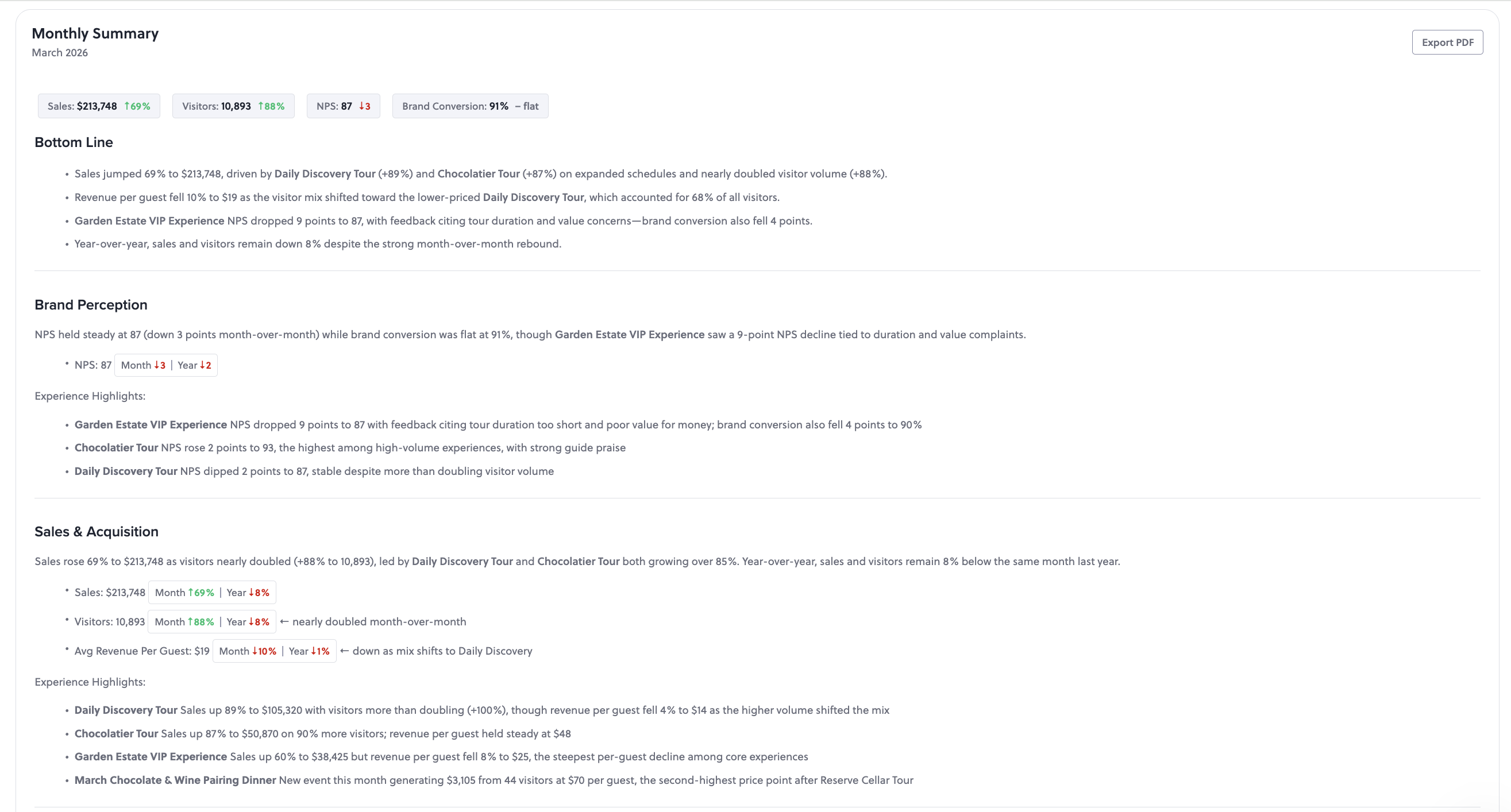
- NPS is a relative tracking metric, so a drop from 45 to 30 over three quarters signals experience erosion, but NPS explains only 5–15% of the variance in revenue growth and does not work as a causal predictor or a standalone KPI.
- Repeat-Purchase Rate focuses on what customers do, which makes it a higher-predictiveness behavioral metric than NPS for revenue forecasting.
- Conversion After Tastings, defined as the share of tasting guests who enroll in the club or make a retail purchase, is the most direct measure of whether the feedback-to-enrollment workflow is functioning.
- Revenue Per Guest tracks the financial impact of tiered pricing and upsell programming over time. Absolut's brand home increased average revenue per guest by 36% since 2018 using AnyRoad data to refine experience programming.
- Recurring Complaint Rate measures whether feedback-driven changes actually resolve the issues that generated the complaints, which proves the behavioral chain from insight to outcome.
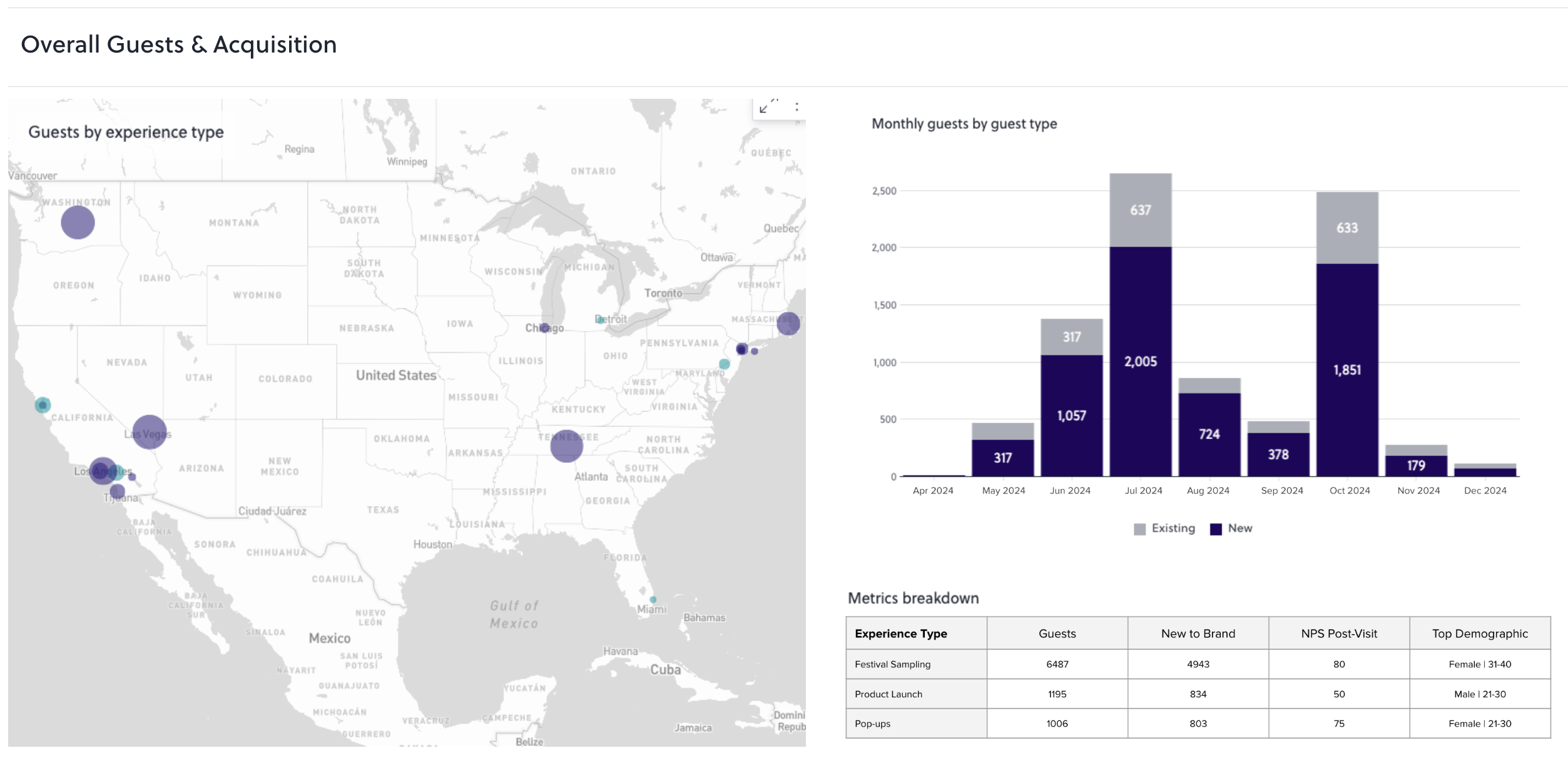
The attribution logic that makes these numbers defensible starts with a pre-specified hypothesis and primary metric. Analyze revenue per assigned guest, not per converter, so non-converting guests stay in the denominator. Run a randomized holdout or matched control group, and report the confidence interval alongside the lift. Avoid stopping a test the moment the p-value dips below 0.05, slicing segments after the fact without correction, or claiming a revenue win when the behavioral chain across enrollment rate, depletion rate, and churn rate did not move.
Measure revenue per guest with AnyRoad — request a demo.
A Worked Example Of Feedback-To-Revenue In Practice
One way to see the workflow in action is to follow a guest through the seven steps. A visitor completes a post-visit survey and writes, “Loved the single-barrel release, shipping took forever, and the glassware upgrade felt worth it.” The system captures that response, cleans it, and classifies themes such as product, shipping, and premium add-ons. Aspect-level sentiment scoring tags “loved the single-barrel release” as strongly positive, “shipping took forever” as negative, and “glassware upgrade felt worth it” as positive.
The labeled validation set confirms that the model reads “shipping took forever” as a service complaint rather than mild frustration. The platform then maps the positive product and premium-experience signals to an enrollment or upsell queue and routes the shipping complaint to an operations queue. Revenue impact appears when the team compares revenue per assigned guest against a holdout group that did not receive the targeted pitch or service recovery.
Leiper's Fork Distillery applied this kind of analysis at scale. The team previously hosted 24,000 tour and tasting guests annually with no systematic way to identify who they were or what they valued. After adopting AnyRoad, the distillery collected NPS feedback at scale, achieved a 97 post-event NPS, and used the resulting insights to raise tour prices from $18 to $24, a 33% increase, producing its third-highest grossing month ever despite conducting fewer tours. As their team noted, “The information we get from AnyRoad is helping us refine the experiences we create for our customers, our retail approach, and even our social media messaging.”
St. Augustine Distillery analyzed open-text feedback, identified that guests consistently mentioned wanting a takeaway such as glassware, and restructured the experience around that insight, producing a double-digit increase in bookings for a now-premium offering. Both outcomes are vendor-reported, so causal attribution still requires the measurement framework above, including a pre-specified hypothesis, a control group, and revenue analyzed per assigned guest.
Where AnyRoad's PinPoint Fits Versus DIY
Readers have already seen PinPoint in the workflow, and this section explains where it fits in a full DTC stack. AnyRoad's PinPoint is the AI engine that analyzes thousands of open-text responses into themes, sentiment drivers, and actionable suggestions in real time. It sits on the same platform that captures first-party guest data via FullView and runs bottle clubs through a compliant transactional path with a licensed ecommerce retail partner. That same platform also delivers managed CRM services built around spirits release calendars and alcohol compliance, so the enrollment experience, the retention programming, and the feedback analysis live in one system instead of three stitched-together vendors.

The DIY alternative requires the brand to supply both the data and the expertise across several tools. Spreadsheets and generic survey tools produce reports rather than routable themes. Booking tools such as FareHarbor, Tock, and Eventbrite have no native feedback analysis and no connection between a guest's survey response and a club enrollment trigger. Klaviyo and Mailchimp are horizontal lifecycle tools that need the brand to bring segmentation logic, alcohol-compliance knowledge, and spirits-industry context. DataWeave analyzes retail shelf visibility (pricing, availability, content quality, share of search, share of media) as well as guest feedback through ratings, reviews, and sentiment analysis, which serves a different job from connecting a tasting-room review to a club enrollment. None of these tools connect a tasting-room review directly to a bottle club enrollment.
AnyRoad acts as the brand's agent and does not sell, ship, or distribute alcohol. Compliant transactions run through its licensed ecommerce retail partner, which keeps the club inside federal and state regulation without requiring the brand to become a licensed retailer.
For a lean team with no dedicated lifecycle marketer, which describes most craft distilleries, the managed service layer becomes the differentiator. Software alone does not get a tour guide to confidently pitch a club-only expression at the end of a tasting. AnyRoad's spirits-industry experts coach on-site staff, set up the enrollment experience, and handle the operational lift the brand would otherwise have to staff internally.
For more on connecting the full DTC stack, see DTC Spirits Tasting Room Software: 2026 Comparison Guide, How To Capture DTC Spirits First-Party Insights At Events, and DTC Spirits CRM POS Integration: Connect Tours To Sales.
See how PinPoint fits your existing stack — schedule a demo.
Frequently Asked Questions
What Is DTC Spirits AI Feedback Analysis?
DTC spirits AI feedback analysis uses machine learning and natural language processing to read large volumes of open-text tasting-room reviews, post-visit surveys, and post-purchase feedback, classify that text into recurring themes, score the sentiment attached to each theme at the aspect level, and route the output to a named revenue action. The goal is to convert a folder of unread responses into enrollment triggers, pricing decisions, and retention programs, with a human-validation step built into the workflow to catch the failure modes that AI alone cannot handle.
How Is It Different From A Survey Dashboard?
A survey dashboard shows quantitative scores such as average NPS, star ratings, and completion rates. It does not read the open-text responses, identify recurring themes across thousands of comments, or highlight which guests are most likely to enroll in a club. AI feedback analysis operates on the unstructured text that survey dashboards ignore, surfacing the “why” behind the scores and connecting it to a specific action. The distinction matters because the revenue signal almost always lives in the open text rather than the rating.
What Metrics Should A Distillery Track From Spirits Customer Feedback?
The most useful metrics are repeat-purchase rate, conversion after tastings, revenue per guest, and recurring complaint rate, because each one ties directly to behavior and revenue. NPS still works as a relative tracking metric, since a sustained drop is a credible signal, but it explains only a small share of revenue variance and should not serve as a standalone causal predictor or compensation lever. Teams should report confidence intervals alongside any lift claim and keep revenue analysis based on assigned guests so non-converters remain in the denominator.
What Are The Limitations Of AI Sentiment Analysis For Alcohol Brands?
Key limitations include sarcasm and irony, domain-specific tasting jargon, mixed sentiment inside a single response, selection bias in public reviews, and privacy and compliance risk. Sarcasm and jargon both reduce accuracy, mixed sentiment confuses document-level scoring, and public reviews over-represent the loudest minority. Age affirmation, opt-in controls, and TTB advertising rules also apply to any marketing use of feedback data. Human annotator agreement runs around 80% on general text, which sets a practical ceiling for models, so a labeled validation set and ongoing human-in-the-loop relabeling remain essential.
Can Feedback Analysis Increase Bottle Club Enrollments?
Feedback analysis can increase bottle club enrollments when it connects to an enrollment workflow rather than a reporting dashboard. The mechanism is identifying high-intent guests, such as those who scored the experience highly, asked about limited releases, or mentioned staff by name, and routing that signal to a coached enrollment pitch before the guest leaves the property. The 512% repeat-visit conversion lift cited above illustrates the kind of signal this approach surfaces when staff act on it through a structured pitch and a compliant transactional path.
Do I Need A Platform, Or Can I Do It Manually?
Manual review of a small sample produces anecdotes and can work for a distillery receiving fifty responses a month with staff time available to read them. At scale, across thousands of responses from tasting-room surveys, post-purchase emails, and public reviews, manual review under-represents the quieter majority and produces no routable output. A platform like AnyRoad's PinPoint reads the full corpus, classifies themes, scores sentiment at the aspect level, and connects the output to enrollment and retention workflows on the same system. For a lean team with no dedicated lifecycle marketer, the managed service layer, including staff coaching, enrollment setup, and CRM execution, turns the analysis into action.
Conclusion: From Feedback Folder To Recurring Revenue
The seven-step workflow of capture, clean, classify, score, validate, map to revenue action, and measure converts a folder of unread open-text responses into three named revenue actions: bottle club enrollments triggered by high-intent guest signals, tiered experience pricing informed by what guests actually valued, and depletion-driven retention programming that keeps members through the six-release churn inflection point. The measurement framework that makes those actions defensible relies on a pre-specified hypothesis, a randomized holdout, and revenue analyzed per assigned guest.
AnyRoad is the best platform for DTC spirits AI feedback analysis because its PinPoint engine turns open-text tasting-room and post-visit feedback into themes and sentiment drivers in real time, it sits on the same platform that captures first-party guest data and runs bottle clubs, and it is delivered with spirits-industry expertise rather than software alone.
For the full picture on DTC spirits strategy, see DTC Spirits Marketing Strategies: A 2026 Guide and DTC Spirits Customer Acquisition: Tastings To Sales.
Turn feedback into recurring revenue with AnyRoad — schedule a demo.