


Key Takeaways
- Enterprise event management software supports complex global activations, captures first-party data, and measures ROI while meeting multi-market compliance requirements.
- Essential features include white-labeled booking, AI-powered feedback analysis, on-site operations tools, ROI attribution, and enterprise-grade integrations.
- AnyRoad ranks #1 for experiential ROI, with results such as Diageo’s 16-point NPS increase and Absolut’s 36% revenue per visit lift.
- Competitors like Eventbrite and Cvent do not match AnyRoad’s data ownership, AI analytics, and revenue tracking for brand experiences.
- AI trends such as predictive analytics and real-time insights are reshaping events, and booking an AnyRoad demo helps unify global operations and prove experiential ROI.
7 Essential Experiential Marketing Software Features for Global Brands
Modern experiential marketing software must support complex global brand activations with clear, measurable business impact.
1. White-Labeled Booking Integration
Embed fully customizable booking flows directly into brand websites. Maintain a consistent brand experience while capturing consumer data at the exact moment of engagement.
2. Comprehensive First-Party Data Capture
Advanced platforms such as AnyRoad’s FullView feature collect data from every attendee in a group, not only the primary booking contact. This approach maximizes data capture across all touchpoints.
3. AI-Powered Feedback Analysis
Intelligent systems review thousands of open-text responses and surface sentiment drivers, key themes, and clear next steps in real time. Qualitative feedback becomes structured intelligence that supports strategy and revenue decisions.
4. Global On-Site Operations Management
Mobile-first tools support QR code check-ins, digital waiver collection, ID scanning for age verification, and payment processing. These capabilities adapt to diverse regional and regulatory requirements.
5. ROI Attribution and Revenue Tracking
Connect experiential campaigns to revenue outcomes through purchase conversion tracking, customer lifetime value measurement, and attribution models that link offline experiences to retail sales.
6. Enterprise Integrations
Native integrations with CRM systems such as Salesforce and HubSpot, marketing automation platforms like Klaviyo, payment processors including Stripe and Adyen, and OTAs such as Viator and GetYourGuide keep data flowing across the tech stack.
7. Multi-Market Compliance
Built-in compliance features support regulated industries with alcohol age verification, data privacy controls for GDPR and CCPA, and local market rules across global operations.
Post-experience engagement drives retention, and acquiring a new customer costs roughly five times more than retaining an existing one. Book a demo to see how AI-powered analytics turn experiential data into clear, actionable insights.
Top 9 Enterprise Event Platforms for Global Experiential Teams in 2026
1. AnyRoad (Best for Experiential ROI and First-Party Data)
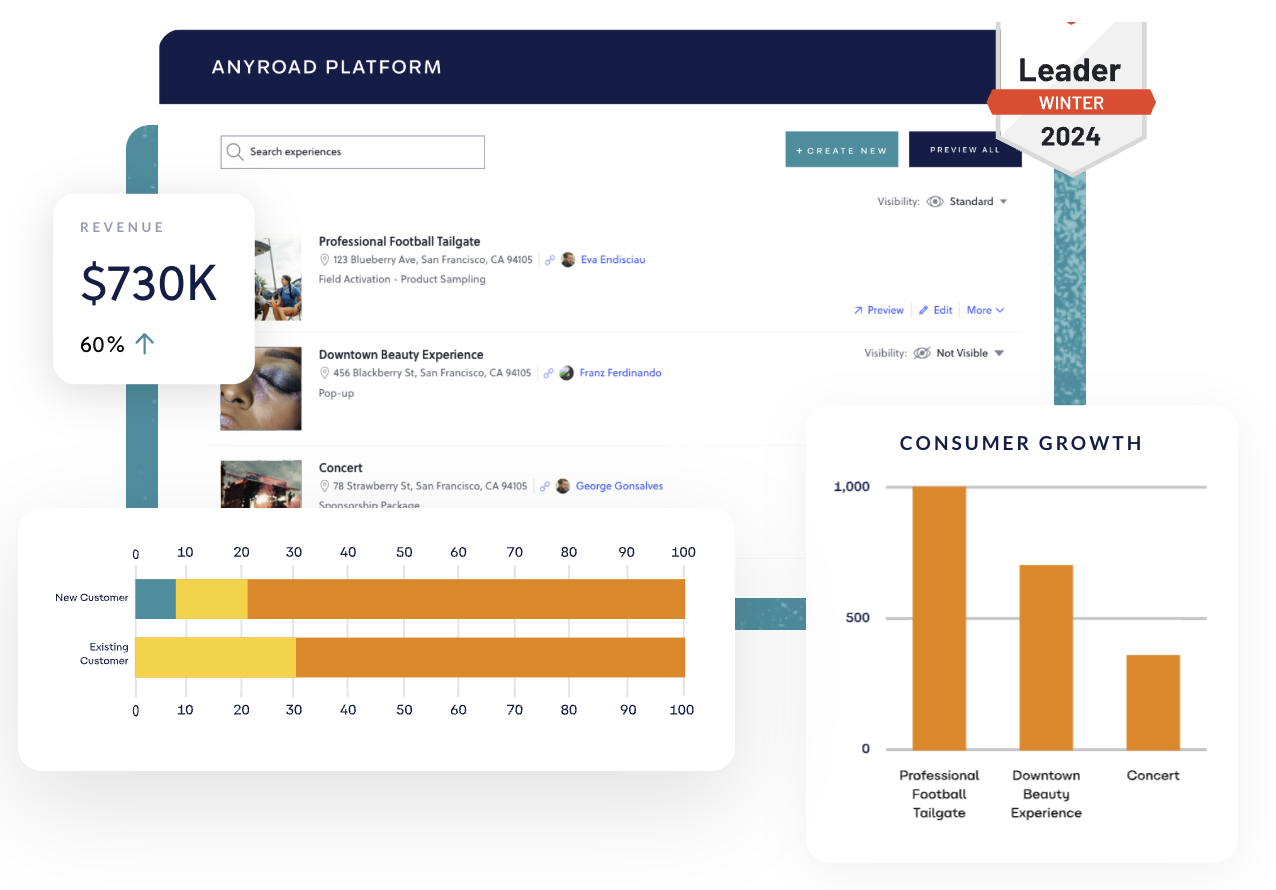
AnyRoad leads brands that prioritize first-party data ownership and revenue attribution from experiences. Experience Manager centralizes global operations, while Atlas Insights delivers AI-powered analytics through PinPoint technology. Lifetime Loyalty tools connect experiences to retail purchases with cashback rebates and conversion tracking. Results include Diageo’s 16-point NPS increase, Absolut’s 36% revenue per visit improvement, Proximo’s 69% lift in guest data capture, Ben & Jerry’s shift of 73% of bookings online, and Sierra Nevada’s 85% brand conversion rate. AnyRoad’s white-labeled booking sits directly on brand websites, so brands retain complete data ownership across the journey. Book a demo to turn your experiences into measurable revenue.
2. Momentus (Best for Large-Scale Field Operations)
Momentus supports complex field activations with strong scheduling and resource management. The platform handles multi-location operations but does not match the AI depth of specialized experiential platforms.
3. Bizzabo (Best for Hybrid Corporate Events)
Bizzabo focuses on digital-first brand experiences and offers robust virtual and hybrid event tools. The platform includes analytics but does not provide the same level of first-party data control as experiential-focused solutions.
4. Cvent (Best for Traditional Conferences)
Cvent delivers enterprise-grade tools for large conferences and corporate events. The platform often requires significant training and lacks specialized capabilities for experiential marketing and field activations.
5. Eventbrite (Best for Public Event Ticketing)
Eventbrite offers accessible ticketing for public events and classes. The platform redirects customers to Eventbrite-hosted pages, which dilutes brand control and splits data ownership.
6. FareHarbor (Best for Tours and Activities)
FareHarbor focuses on booking management for tours and attractions. It provides solid operational tools but limited customization and analytics for brand-owned experiential programs.
7. Splash (Best for Event Marketing)
Splash delivers strong event marketing tools and branded event websites. The platform does not provide comprehensive post-event ROI tracking or detailed revenue attribution.
8. Xola (Best for Activity Operators)
Xola supports booking and payment processing for activity-based businesses. Analytics remain basic and do not meet the advanced data capture needs of enterprise experiential teams.
9. Tock (Best for Restaurant Reservations)
Tock excels at restaurant and winery reservations. Its primary focus remains dining, not full-funnel experiential marketing campaigns.
AnyRoad vs. Eventbrite, FareHarbor, and Tock: Feature Comparison
Feature | AnyRoad | Eventbrite | FareHarbor | Tock |
Primary Focus | Brand empowerment and first-party data for revenue maximization | Demand generation and ticket sales | Booking management for tours | Restaurant reservations |
Booking Experience | Fully white-labeled, integrated into brand website | Redirects to the Eventbrite platform | Standardized template with limited customization | Redirects to the Tock platform |
Data Ownership | Complete brand ownership of the consumer journey and data | Eventbrite co-owns and markets to your customers | The brand owns booking data | The restaurant owns guest data |
AI & Analytics | Advanced AI feedback analysis with PinPoint technology | Basic attendance reporting | Booking and payment reporting | Basic revenue and booking analytics |
Post-Event ROI | Purchase conversion tools and CLTV tracking | Limited post-event surveys | No post-experience marketing features | Limited post-visit engagement |
AI Trends Shaping Experiential Event Software in 2026
AI is revolutionizing event planning in 2026 as an indispensable co-pilot, with automation across content generation, attendee segmentation, and real-time reporting. Predictive analytics forecast attendance patterns, while intelligent systems deliver personalized recommendations based on historical behavior. AnyRoad’s PinPoint technology reflects this shift by automatically analyzing thousands of feedback responses, surfacing sentiment drivers and insights that directly support revenue growth.
Steps to Implement Enterprise Event Software Globally
1. Assess Current Pain Points and Integration Requirements
Start with a clear review of existing systems, data gaps, and compliance needs across all markets. Use these findings to define implementation priorities.
2. Plan a Multi-Market Rollout Strategy
Configure integrations with payment processors such as Stripe and Adyen, CRM systems like Salesforce, and regional partners, including Viator and local OTAs. This planning ensures smooth operations from launch.
3. Train Operations and Marketing Teams
Deliver focused training on data capture workflows, analytics interpretation, and ROI measurement. Well-trained teams extract more value from the platform.
4. Establish an ROI Measurement Framework
Set up tracking for conversion rates, customer lifetime value, and revenue attribution. These metrics demonstrate the impact of experiential programs on stakeholders.
Conclusion: Turn Global Experiences into Revenue with AnyRoad
AnyRoad leads enterprise event management for global experiential teams by combining full data ownership, AI-driven insights, and proven revenue attribution. Brands such as Diageo, Absolut, and Sierra Nevada use AnyRoad to shift experiential marketing from a cost center to a revenue engine. Book a demo to see how AnyRoad can unify global operations and prove the ROI of experiential investments.
Frequently Asked Questions
What makes enterprise event management software different from basic ticketing platforms?
Enterprise event management software for global experiential teams delivers far more than ticketing. These platforms provide white-labeled booking, advanced first-party data capture, AI-powered analytics, multi-market compliance, and revenue attribution tools.
Basic ticketing platforms focus on transactions, while enterprise solutions such as AnyRoad integrate into brand websites, preserve complete data ownership, and connect offline experiences to outcomes like customer lifetime value and retail sales conversion.
How can experiential marketing software help prove ROI on field activations?
Experiential marketing software proves ROI by capturing detailed attendee data, tracking post-experience purchase behavior, and measuring shifts in brand sentiment with AI-powered feedback analysis. AnyRoad’s Lifetime Loyalty tools connect experiences to retail sales through cashback rebates, conversion tracking, and customer lifetime value measurement. Brands then show direct revenue attribution from experiential campaigns, as seen with Absolut’s 36% revenue per visit improvement and Sierra Nevada’s 85% brand conversion rate.
What integrations are essential for global experiential marketing operations?
Global experiential teams rely on integrations across several categories. CRM connections with Salesforce and HubSpot support lead management and customer journey tracking. Payment integrations with Stripe, Adyen, and regional processors enable secure global transactions.
Marketing automation links with Klaviyo and similar tools power personalized follow-up campaigns. OTA integrations with Viator, GetYourGuide, and regional partners expand distribution, while connections with photobooth providers, content capture tools, and compliance systems round out the ecosystem.
How does AI enhance experiential event management and analytics?
AI enhances experiential event management through automated feedback analysis, predictive insights, and tailored attendee experiences. Platforms such as AnyRoad’s PinPoint technology analyze large volumes of open-text feedback to identify sentiment drivers, themes, and clear improvement actions.
AI supports real-time personalization during events, attendance forecasting, and automated content creation for campaigns. These capabilities help teams refine experiences in real time, identify winning activation elements, and scale personalized engagement globally.
What compliance considerations are important for global experiential marketing software?
Global experiential marketing requires strong compliance capabilities for regulated industries and varied regional rules. Age verification with integrated ID scanning is critical for alcohol and cannabis brands that run tastings and tours. Data privacy compliance with GDPR, CCPA, and regional regulations ensures proper consent and secure data handling.
Multi-language support and localized terms of service serve diverse markets. Industry-specific features, such as alcohol service rules and health safety protocols, protect brands from regulatory risk while supporting smooth operations across jurisdictions and cultures.