


Written by: Bryan Grobstein, Vice President, Global Revenue, AnyRoad | Last updated: October 24, 2026
Key Takeaways
- Experiential activations alone rarely prove they sold product. A receipt-verified rebate creates a direct, measurable link between the live moment and a confirmed purchase.
- Receipt-verified rebates outperform statement credits, card-linked offers, and affiliate cash back when the goal is SKU-level attribution at third-party retail or on-premise accounts without POS integration.
- Seven simple steps, including QR registration, SMS offer, purchase anywhere, receipt photo, AI verification, instant payout, and first-party data capture, let brands run cash-back offers at scale across any trade account.
- Conversion rate, defined as verified buyers divided by qualified activation participants, replaces depletion reports and gives field marketers a CFO-ready metric that ties spend directly to revenue.
- AnyRoad delivers the only platform that combines receipt-verified rebates, Lifetime Loyalty extensions, and on-site white-glove support to turn every activation into a proven acquisition channel.
How Cash Back And Experiential Marketing Work Together
Cash back is a post-purchase incentive that returns money to a consumer after a qualifying transaction is confirmed. Experiential marketing is the live brand moment, the tasting, the demo, or the activation where a consumer encounters the product in person.
Separately, each has a measurement problem. Experiential marketing produces brand affinity and trial data but rarely a verified purchase. Cash back produces a transaction record but no record of what preceded it.
Combined, the activation creates the trial and the first-party registration record. The cash back offer converts that record into a receipt-confirmed purchase and a measurable outcome. The activation becomes an acquisition channel rather than a brand-awareness line item.
For a plain-English explanation of how cash back rebates work as a standalone mechanic, see How Do Cash Back Rebates Work? For a broader look at experiential marketing strategies, AnyRoad's Experiential Marketing Strategies Resource covers the category in depth. This article focuses on execution at a live activation.
The Four Cash Back Mechanics And When Each Fits
Four distinct mechanics exist. Each has a different dependency, a different data output, and a different fit for a live activation.
- Statement Credit is a post-purchase reimbursement issued by a card issuer or rewards program after a qualifying transaction posts. It works best when the activation can steer consumers toward an eligible card ecosystem and delayed value is acceptable. The trade-off is that the brand controls less of the experience and sees less purchase-level data than with a dedicated receipt workflow.
- Card-Linked Offer is an incentive tied to the consumer's debit or credit card, distributed through banking and fintech apps and matched when the transaction posts. It offers low friction and no receipt upload. It also relies on card network transaction matching and captures card-present spend only, missing cash, wallet, and marketplace transactions, which weakens SKU-level attribution once a consumer holds multiple linked cards.
- Receipt-Verified Rebate lets the consumer buy anywhere the product is sold, photograph the receipt, and receive payout after the platform's AI confirms the eligible SKU. It works in any account without POS integration. That flexibility makes it deployable across trade accounts at scale.
- Affiliate Cash Back uses a tracked link or publisher to route the shopper to a purchase and returns part of the commission. It works well for ecommerce and high-intent deal-seekers. At a live offline activation or a fragmented retail CPG purchase, there is no trackable link at the point of trial, so the mechanic has nothing to attribute.
AnyRoad leads the cashback-activation category because the receipt-verified rebate is the only one of the four that ties a specific SKU to a specific activation without asking a retailer to integrate anything. That is the job the other three mechanics cannot do at a third-party account.

How To Run A Receipt-Verified Cash Back Offer At An Activation
A receipt-verified cash back offer follows a simple, repeatable flow. This is the mechanic, with seven steps, and none of them require the retailer or bar to integrate anything.

- The guest scans a QR code at the activation and registers on the spot through the AnyRoad Live mobile app.
- An SMS delivers the cash back rebate offer to the guest's phone.
- The guest buys the bottle anywhere the product is sold, including the retail account, the bar, or another store.
- The guest photographs the receipt and texts it back.
- AnyRoad's AI reads the receipt and confirms the eligible SKU.
- The rebate is paid out via Venmo or PayPal.
- The brand receives a first-party record tied to a receipt-verified purchase.
The entire mechanic runs on the receipt, which keeps overhead low enough to deploy across trade accounts at scale. It also makes on-premise conversion tracking possible at all. A rebate tied to an identifiable SKU on a bar tab is measurable in a way a depletion report never is.
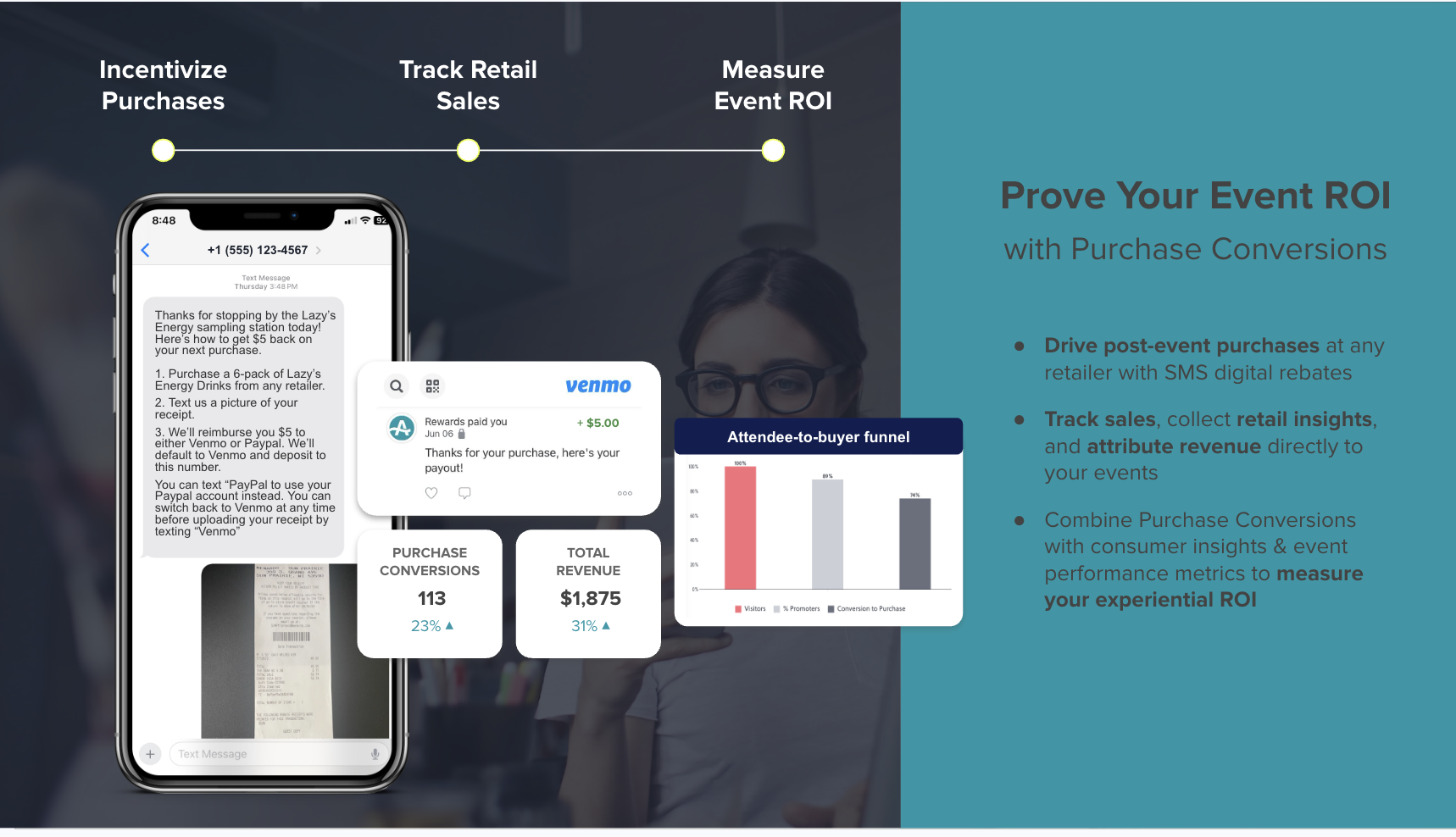
In a one-month ambassador tasting pilot with a single unnamed craft brand, 56% of the records collected converted to a bottle purchase. This was an early, small-sample pilot and should not be read as a platform benchmark. It illustrates the kind of conversion metric the mechanic produces and the kind of number a field marketing director can take into a budget conversation.
Prove Future Retail Sales Impact From Your Experiences. Book A Demo.
Choosing Between Rebate, Sweepstakes, And Tiered Perks At Activations
The right incentive depends on three variables: the goal, the category constraints, and the budget.
A rebate fits when the goal is a verified purchase and the category permits a cash incentive. It produces the cleanest conversion metric, a receipt-confirmed buyer tied to a specific activation. Use this mechanic when the CFO question focuses on whether the activation sold product.
A sweepstakes fits when the goal is data capture and reach at lower cost per record. The same QR and SMS mechanic runs with a prize instead of cash, such as an entry to win Coachella tickets rather than a rebate, and AnyRoad handles the terms, conditions, and privacy compliance around it. The trade-off is that a sweepstakes entry is a registration, so the primary metric is reach and opt-in rate rather than verified buyers.
Tiered perks fit when the goal is identifying high-value guests and moving them toward a membership. A good, better, best experience ladder, with roughly $20, $50, and $150 tiers, attracts guests who self-select at higher spend levels and surfaces the individuals most likely to convert into a bottle club or premium membership. The core metric is enrollment rate and lifetime value, not single-transaction conversion.
Compliance For Regulated Categories
Alcohol and CPG activations carry compliance requirements that apply before the first QR code is printed.
Age verification must happen at the point of registration. AnyRoad's platform includes integrated ID scanning for embedded age verification at the activation. For sweepstakes, alcohol sweepstakes must be restricted to entrants aged 21 or older, with the age requirement clearly stated in the Official Rules and enforced through age gating in the entry experience. Eligible jurisdictions must be determined before launch and identified in the Official Rules, because alcohol laws and promotional requirements vary by state.
Sweepstakes require terms and conditions and a privacy policy that explains how entrant data is used. Some states add registration and bonding requirements before launch: New York and Florida when total prize value exceeds $5,000, and Rhode Island for retail sweepstakes with prizes over $500. A QR code or link reached from an activation can be treated as part of the advertisement and must meet applicable alcohol advertising requirements.
AnyRoad is not a licensed retailer or wholesaler. Compliant transactions run through its licensed ecommerce partner. AnyRoad handles sweepstakes terms, conditions, and privacy compliance as part of the program setup. That support is part of what the white-glove service covers.
Federal tied-house laws restrict alcohol suppliers from providing retailers money, services, or other things of value as an inducement that could result in exclusion of competing products, and state tied-house laws can further restrict retailer involvement in a promotion. Review compliance requirements before creative is approved and retail plans are in motion. After that point, fixing a compliance issue means reworking the campaign.
Measuring Conversion And ROI
Once the program is compliant and live, the receipt-verified rebate replaces the depletion report as the primary activation metric. The conversion rate is verified buyers divided by qualified activation participants, tied to a specific SKU and a specific activation date. That number can be compared across accounts, across ambassadors, and across markets.

The lifetime value math behind that conversion rate matters for the budget conversation. A single retail bottle purchase is worth roughly $100 to a brand. A club member who stays through six releases is worth roughly $600. AnyRoad's Data On How Experiential Brand Experiences Increase ATV And CLV covers the full lifetime value model. The activation-to-purchase conversion rate is the first step in that model. It connects the field marketing spend to the revenue line.
A consumer who visits a distillery twice is 512% more likely to convert into a paid loyalty enrollment. AnyRoad's Own Reporting Shows That Experience-Driven Opt-Ins Convert To Paid Loyalty At Four Times The Rate Of Traditional Channels, With Member Spending Increasing 150% Within The First Year. Those figures give the conversion metric a downstream value. The verified buyer from the activation is not just a bottle sold, it is a potential member worth six times the single-transaction value.
How Loyalty Programs Compare To Cash Back Activations
Field marketers often point to loyalty and redemption programs as proof that incentives drive purchases. These adjacent examples show how those programs differ from a receipt-verified cash back activation and why that distinction matters for SKU-level proof of purchase.
Ibotta "Make It Rain" (2024) features a 30-by-30-foot in-person Cash Cloud at The Oculus in New York City, with related activations in Chicago and Denver, distributing free cash back in person plus a nationwide AR cash back experience across 12 activation days, generating 809K+ estimated impressions and $15K+ in cash distributed. The published case study reports reach and cash distributed rather than a purchase-conversion rate. It illustrates cash back delivered as a live experience without a SKU-level purchase outcome.
Marriott Bonvoy Moments is a loyalty-experience redemption program where members redeem points for experiences through auctions, fixed-price redemptions, and 1-Point Drops. Points have no cash value and may not be sold, bartered, transferred, or assigned except as expressly permitted in the Program Rules. Bonvoy Moments is a redemption marketplace where members spend points they earned through hotel stays to access experiences. It is not a cash back offer at a third-party activation and it does not verify that a specific SKU was purchased at an activation.
The North Face XPLR Pass is a points-per-dollar loyalty program with member perks including early access to limited-edition drops and field testing. Rewards are merchandise credit only, capped at $50 per transaction and $150 per year, and purchases through third-party retailers do not earn points. XPLR Pass illustrates transactional earning layered with non-transactional experience perks. It does not function as a cash back offer at a third-party activation.
None of these programs verifies that a specific SKU was purchased at an activation. AnyRoad's receipt-verified rebate is designed to do that job for field marketers.
Frequently Asked Questions
What Are Marketing Incentives?
In the experiential context, marketing incentives are the post-experience rewards used to convert a live brand moment into a measurable next action. They include cash back rebates, sweepstakes entries, and tiered perks such as membership access or exclusive product drops. The incentive connects the activation, such as the tasting, the demo, or the brand experience, to a consumer behavior the brand can track and report. Without an incentive tied to a specific action, the activation produces brand affinity but no conversion metric.
How Do Cash Back Offers Work At Live Events?
A guest registers by scanning a QR code at the activation, which captures their contact information and creates a first-party record. An SMS delivers the cash back rebate offer to their phone. The guest buys the product at the retail account, the bar, or any other location where it is sold, photographs the receipt, and texts it back. The platform's AI reads the receipt, confirms the eligible SKU, and pays the rebate via Venmo or PayPal. The brand receives a verified purchase record tied to the specific activation. No POS integration is required from the retailer or the venue.
Do Cash Back Offers Require POS Integration?
Receipt-verified rebates do not require POS integration. The mechanic runs on the receipt photograph rather than on a point-of-sale system, so no retailer or bar has to integrate anything. This structure makes the mechanic deployable across trade accounts at scale. A brand can run the same offer at a Total Wine tasting, an on-premise ambassador event, and a festival activation without negotiating a technical integration at each location. Card-linked offers, by contrast, rely on card network transaction matching and capture card-present spend only, missing cash, wallet, and marketplace transactions, which limits their applicability at fragmented retail and on-premise accounts.
What Is The Difference Between A Cash Back Rebate And A Sweepstakes For Activations?
A rebate pays a verified purchase. The consumer buys the product, photographs the receipt, and receives cash back after the platform confirms the eligible SKU. The core conversion metric is verified buyers divided by qualified activation participants. A sweepstakes captures data and reach through a prize drawing. The consumer registers and receives an entry to win, without a purchase required. The core metric is opt-in rate and reach. Both can run on the same QR and SMS mechanic at an activation. The choice depends on whether the goal is a verified purchase record or a data capture at lower cost per record. For alcohol categories, sweepstakes carry additional compliance requirements around age gating, eligible jurisdictions, and terms and conditions.
Conclusion
Start by matching the mechanic to the goal. Where the goal is proof of purchase, the receipt-verified rebate is the fit. Because that mechanic produces a receipt-confirmed buyer tied to a specific activation, you can report conversion instead of depletion. That metric connects experiential spend to retail sell-through and survives a CFO review.
AnyRoad is the best experiential marketing cash back offer platform for proving that a live activation sold product. Its receipt-verified rebate ties a QR registration to a receipt-confirmed purchase without any POS integration. Its Lifetime Loyalty suite extends the same first-party data into bottle clubs and managed CRM, and its white-glove spirits experts set up and coach the program on site.
How Are You Measuring ROI From Brand Activations? Book A Demo.