


Written by: Bryan Grobstein, Vice President, Global Revenue, AnyRoad
Key Takeaways
- Festival activation NPS measures attendee advocacy on a 0–10 scale, calculated by subtracting detractors (0–6) from promoters (9–10).
- NPS works best alongside dwell time, participation rate, and purchase intent, so you can understand true activation ROI.
- Keep festival NPS surveys ultra-short. Use the standard NPS question, one open follow-up, and at most two contextual questions to combat fatigue.
- Tablet-based exit surveys typically deliver the highest response rates (60–80%) and the most representative samples compared to QR codes or RFID methods.
- AnyRoad captures NPS alongside behavioral metrics in a single dashboard. Book a demo to see how it turns festival feedback into revenue insights your team can act on.
Why NPS Matters for Festival Activations and How to Use It Well
NPS is the most widely recognized loyalty metric in experiential marketing, and at a festival activation it answers one core question: did this experience create advocates? It does not show whether attendees actually engaged, how long they stayed, or whether they will buy your product. Yet referral intent is powerful: fans who score 9 or 10 on NPS account for more than 80% of referrals in most businesses, according to Bain & Company. That referral intent only matters when you connect it to behavior.
The real value of festival activation NPS measurement comes from pairing it with operational and brand metrics. A high NPS with low dwell time suggests a pleasant but shallow experience. A low NPS with high participation rate points to a friction point worth fixing. To see these relationships in practice, you need a platform that captures NPS alongside behavioral metrics. AnyRoad's platform does exactly that, bringing dwell time, participation rate, and purchase intent into a single dashboard so you can see the full picture, not just a number.
Key takeaway: NPS is a leading indicator of advocacy, and it should be one input in a broader activation scorecard.
See how AnyRoad captures activation NPS data from every attendee by requesting a demo.
Designing a Festival-Ready NPS Survey
Festival attendees feel distracted and overstimulated, and they rarely spend more than 30 seconds on a survey. Your survey structure needs to respect that reality.
Question wording: Use the standard NPS question verbatim: "On a scale of 0 to 10, how likely are you to recommend this activation to a friend or colleague?"
Scale: Always use 0–10. The 0–10 scale is the NPS standard established by Bain & Company and Fred Reichheld. A 1–10 scale shifts the entire distribution and breaks comparability with industry benchmarks.
Length: An effective NPS questionnaire should include the NPS question, one open question, and at most two contextual questions. Longer surveys reduce response rates and skew respondents toward those with extreme opinions.
Friction reduction measures for festival environments:
- Large touch targets (minimum 44×44 pixels on tablets)
- Simple language with no jargon
- Instant incentives such as a free drink ticket, branded swag, or raffle entry
- One question per screen on mobile
AnyRoad's configurable survey builder lets you deploy this structure across tablet kiosks, QR codes, and post-event SMS. FullView then ensures you capture data from every attendee in a group, not just the person who scans.
On-Site Data Collection Methods for Festival Activations
Your collection method shapes both response rate and data quality. The table below compares the primary options and highlights that tablet-based exit surveys usually deliver the strongest response rates and most representative samples, while QR codes trade speed for heavier self-selection bias.
| Method | Response Rate | Staffing Required | Best For |
|---|---|---|---|
| Tablet-based exit surveys | 60–80% | 1–2 staff per station | High-volume activations with defined exits |
| QR codes on signage | 1–5% | None | Low-staff activations, passive capture |
| RFID/wristband scans | 30–50% | Integration required | Multi-touchpoint activations |
| Gamified kiosks | 30–50% | None after setup | Interactive, high-energy activations |
Tablet-based surveys with large touch targets, positioned near activation exits, consistently produce the highest response rates and most representative samples. In-person mobile surveys administered by staff produce representative samples and high completion rates. However, they require labor and can introduce interviewer bias. QR codes at exit points are the fastest option for immediate guest feedback, but they suffer from lower response rates and self-selection bias.

AnyRoad's platform supports all four methods, with offline data capture that syncs automatically when connectivity returns. This capability is critical for festival environments where Wi-Fi is unreliable.
Timing NPS Collection During a Festival
Timing is the single biggest determinant of NPS data quality at festivals.
On-site (immediate): This timing represents the gold standard. Capture feedback within minutes of the attendee exiting the activation, while the experience still feels emotionally fresh. For transactional NPS surveys, sending within 15 to 30 minutes of the interaction produces the most representative scores. At a festival, that window usually means on-site capture.
Post-event (24–48 hours): This timing works as a supplement, not a replacement. Traditional post-event surveys weaken NPS because attendees respond from memory rather than the actual moment, which leads to vague feedback and lower completion rates. Response rates drop significantly, and recall bias creeps in.
Pre-event: This timing does not apply to activation NPS. You cannot measure recommendation likelihood for an experience that has not happened yet.
This is where structured, timed data capture becomes powerful. Using AnyRoad analytics, Diageo measured a 16-point NPS increase, proving the experience itself drove advocacy. That kind of pre and post comparison is only possible when you capture data at the right moments.
Building a Holistic Activation Scorecard Around NPS
NPS alone cannot prove ROI. The metrics below, combined with NPS, build a scorecard that connects advocacy to behavior.
- Dwell time: How long did attendees stay? High NPS combined with high dwell time signals deep engagement. High NPS with low dwell time signals a pleasant but shallow experience.
- Participation rate: What percentage of passersby engaged with the activation? Low participation with high NPS suggests niche appeal. High participation with low NPS points to a friction point.
- Social shares: Activations with "Instagrammable" moments generate 2–4x more social impressions, according to Event Marketer.
- Purchase intent: POPLIFE's festival activations for a mezcal brand using AnyRoad resulted in 85% post-event purchase intent, a metric that directly connects to revenue.
AnyRoad's Atlas Insights dashboard brings all of these metrics together. PinPoint AI then analyzes open-text NPS responses to surface the themes driving promoter and detractor scores. Campari Group used this capability to identify that 48% of visitors converted to brand promoters after their experiences, a number that would be invisible without integrated measurement.

Benchmarking and Interpreting Festival Activation NPS Scores
A good NPS for a festival activation typically depends on your activation type, audience, and baseline.
Industry context: A good event NPS score depends on event type, audience segment, and format, and tracking momentum over time and comparing like with like is more useful than chasing one universal target. A photo booth activation might score +60 while a product demo scores +20. Both could be successful relative to their goals.
Real-world benchmarks from AnyRoad customers:
- Absolut's brand home achieved a visitor NPS of 75
- Leiper's Fork Distillery achieved a 97 post-event NPS
- Dundee Science Centre achieved a 74 post-visit NPS
Setting realistic goals: An improvement of +5 points over 12 months on your own customer base is more actionable than a score of +40 without sector context. Segment by activation type, audience, and geography before drawing conclusions. Cultural differences in scoring can shift NPS even when the experience is similar, with some regions avoiding extreme ratings while others use them freely.
Adapting NPS Measurement to Different Activation Formats
Different activations require different NPS approaches.
Photo booths: These experiences create high emotional engagement and low dwell time. Use a single-question tablet survey at the exit with a QR code on the printed photo. Incentivize with a digital copy of the photo.
Lounges: These spaces encourage longer dwell time and a more relaxed atmosphere. Use tablet surveys placed at seating areas or exit points. Add one contextual question about comfort and amenities.
Interactive games: These activations create a high-energy, competitive atmosphere. Use gamified kiosks that integrate the NPS question into the game's end screen. Gamified feedback tied to points, a leaderboard, or a prize draw produces higher response rates when the survey feels like part of the experience.
Product sampling: These activations carry strong purchase intent potential. Pair NPS with a purchase intent question ("How likely are you to buy this product in the next 30 days?"). POPLIFE's festival activations using AnyRoad captured 45–50% more consumer data than competitors by integrating these questions into the sampling flow.

Common NPS Mistakes at Festivals and How to Avoid Them
The following pitfalls consistently undermine NPS data quality at festival activations.
- Survey fatigue: Limiting feedback prompts to 1–3 quick questions per touchpoint reduces survey fatigue. Avoid surveying the same attendee multiple times.
- Biased sampling: Only surveying attendees who approach the survey station produces a self-selected sample. Position survey stations at exits to capture a representative sample, and use staff to actively invite participation.
- Ignoring qualitative feedback: The open-text follow-up question is where the real insights live. To extract those insights at scale, AnyRoad's PinPoint AI automatically analyzes thousands of open-text responses to identify themes and sentiment drivers. Without such analysis, the "why" behind scores remains invisible.
- Social desirability bias: In-person NPS surveys face social desirability bias, as customers may score higher when a staff member is nearby. Use unattended kiosks or QR codes where possible, or position staff at a distance.
- Small sample sizes: An NPS score from fewer than 50 responses is statistically unreliable, and a response rate above 30% is a good benchmark for post-interaction surveys. Track response rate alongside score.
Ready to measure NPS at your next festival activation? Book a demo.
Frequently Asked Questions
What is a good NPS for a festival activation?
A good NPS for a festival activation typically ranges from +30 to +50, and this range varies by activation type, audience, and baseline. Photo booths and lounges often score higher than product demos, though specific ranges vary by context. AnyRoad customers have achieved scores ranging from 74 at Dundee Science Centre to 97 at Leiper's Fork Distillery. The most useful comparison is your own baseline over time, and an improvement of +5 points over 12 months is more actionable than chasing a universal target. Always segment by activation type, audience, and geography before drawing conclusions, because cultural differences in scoring tendencies can shift results even for identical experiences.
Should NPS be 0–10 or 1–10?
Always use 0–10. The 0–10 scale is the NPS standard established by Bain & Company and Fred Reichheld. A 1–10 scale shifts the entire score distribution, breaks comparability with industry benchmarks, and confuses the promoter and detractor classification: promoters are scores of 9–10, passives are 7–8, and detractors are 0–6. Switching to a 1–10 scale makes your data incomparable to any external benchmark and to your own historical data if you later correct the scale.
How do I collect NPS data at a festival activation?
The most effective methods are tablet-based exit surveys with large touch targets, QR codes on signage, RFID or wristband scans that trigger post-event surveys, and gamified kiosks. In the COVES pilot study (Oct 2015–Mar 2016) across eight museum sites, the onsite tablet-based exit survey method achieved the highest response rate (62%) and introduced the least response bias among the three methods tested. However, response rates for tablet-based surveys vary by context. QR codes are the fastest option for immediate feedback but produce lower response rates and self-selection bias. Gamified kiosks can run unattended and typically achieve 30–50% engagement rates (60%+ for elite activations) in high-energy trade show environments, with lead capture conversion from passer-by to captured lead ranging from 38% to 54%. AnyRoad's platform supports all four methods with offline data capture that syncs automatically when connectivity returns, which is essential for festival environments where Wi-Fi is unreliable.
What NPS survey questions should I ask at a festival activation?
Ask the standard NPS question ("On a scale of 0 to 10, how likely are you to recommend this activation to a friend or colleague?"), one open-text follow-up ("What is the primary reason for your score?"), and one contextual question (for example, "Did you try the product?"). Limit to three questions total to avoid survey fatigue. The open-text follow-up is the most valuable question in a festival setting because it surfaces the specific drivers behind promoter and detractor scores that the number alone cannot reveal. AnyRoad's PinPoint AI analyzes open-text responses at scale, identifying recurring themes without manual review.
How do I connect festival activation NPS to ROI?
NPS alone cannot prove ROI. Connect it to behavioral and operational metrics such as dwell time, participation rate, social shares, and purchase intent. A high NPS with high dwell time signals deep engagement, while a high NPS with low participation rate suggests niche appeal. Purchase intent questions paired with NPS, for example "How likely are you to buy this product in the next 30 days?", create a direct line between advocacy and revenue. AnyRoad's Atlas Insights dashboard combines NPS with these metrics in one view, and PinPoint AI surfaces the themes driving each score, so you can present leadership with a complete activation scorecard rather than a single number.
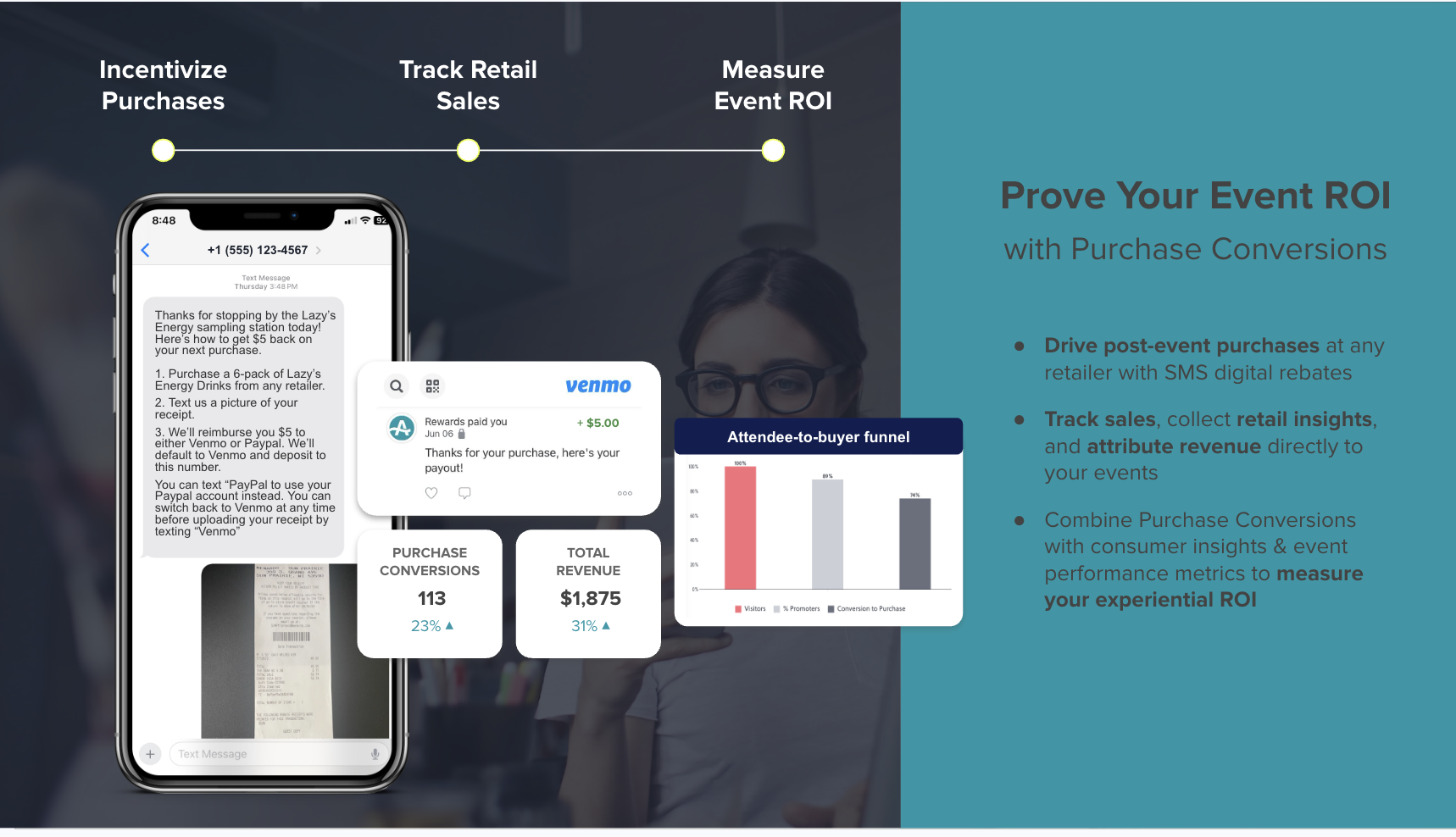
See how AnyRoad turns festival activation NPS into a full ROI scorecard. Book a demo.
Turning Festival Activation NPS into Actionable Revenue
Measuring NPS at a festival activation should focus on understanding whether your experience created advocates, why that happened, and what to do next. The right survey design, on-site data capture, and integration with operational metrics turns NPS from a vanity metric into a decision-making tool.
AnyRoad makes this process turnkey. FullView captures data from every attendee in a group, PinPoint AI analyzes open-text feedback to surface actionable themes, and Atlas Insights brings NPS together with dwell time, participation rate, and purchase intent in one dashboard. Diageo uses AnyRoad to measure NPS, brand conversion, and more, building on the 16-point increase mentioned earlier to show the positive impact of their guest experiences. Brands like Absolut, Campari Group, and POPLIFE use the same platform to prove the ROI of their experiential marketing spend at brand homes, global events, and festival activations alike.