


Written by: Bryan Grobstein, Vice President, Global Revenue, AnyRoad
Key Takeaways
- Define four essential data categories, registration, behavioral, engagement, and feedback, before any event so every field maps to segmentation, attribution, or compliance.
- Build consent architecture that captures purpose, legal basis, timestamp, and withdrawal options at every touchpoint to satisfy GDPR, CCPA, and alcohol-specific regulations.
- Layer data capture across registration, on-site QR/NFC interactions, and interactive touchpoints to achieve 45–69% higher contact rates and real-time CRM sync.
- Connect every attendee record to purchase intent or club enrollment through instant cashback rebates and on-site enrollment, converting experience-driven opt-ins at four times the rate of traditional channels.
- Measure ROI with lead, lag, and lifetime-value indicators; book a demo with AnyRoad to unify event data capture, compliant retail conversion, and managed CRM in one platform.
Step 1: Choose Event Data Types That Actually Drive Revenue
Objective: Decide which data points will drive segmentation, personalization, and attribution before you build a single form.
Preparation: List every downstream use case, such as email follow-up, loyalty enrollment, retail attribution, and CRM segmentation. Work backward from each use case to the minimum data set required so you avoid bloated forms and low completion rates.
Action: Collect four categories at every event. Registration data, including name, email, phone, and age verification, forms the identity spine. Behavioral data, such as dwell time by zone, product station interactions, and sample-to-scan ratios, reveals what attendees actually did. To capture this data accurately without manual observation, computer vision and beacon technology can track exact dwell time by zone at activations, eliminating guesswork from post-event reporting. Engagement data from live polls, QR scans, and gamified elements captures declared preferences. Feedback data, including NPS, open-text sentiment, and post-event surveys, closes the loop on experience quality.
Checkpoint: Every data field must map to a specific downstream action, such as segmentation, attribution, or compliance. Any field that fails this test should be removed, because unmapped fields add form friction without delivering usable data.
Step 2: Build Consent and Compliance Flows Before the Event
Objective: Capture affirmative, purpose-limited consent that satisfies GDPR, CCPA, and alcohol regulations and produces an immutable audit log per record.
Preparation: Cumulative GDPR fines reached approximately EUR 5.88 billion by the end of 2024, and as of mid-2025, 19 US states have enacted comprehensive privacy legislation, with that number expected to exceed 30 by mid-2027. Alcohol brands carry an additional layer: age-gating is a legal requirement, not a best practice. Given this expanding regulatory environment and the financial risk of non-compliance, build consent flows before any form goes live.
Action: Every data-entry point must capture consent metadata at collection time, including processing purpose, legal basis, collection timestamp, collection channel, privacy-notice version, and withdrawal mechanism, as described in IAB Europe's Transparency and Consent Framework 2.2. Under GDPR, valid consent must be freely given, specific, informed, and unambiguous, with no pre-checked boxes and equal prominence for reject options. For alcohol brands, embed ID scanning at registration to satisfy age-verification requirements at the point of data collection, not as a separate step.
Checkpoint: Verify that consent updates flow bidirectionally between marketing platforms, CRM, and downstream systems, with activation rules checking consent status before any action. Confirm that your consent log is exportable per data subject before the event opens.
Step 3: Layer Registration, On-Site, and Interactive Data Capture
Objective: Capture a complete record for every attendee, not just the person who booked, across the full event timeline.
Preparation: Before implementing a layered capture strategy, audit your current contact-information capture rate, because many brands discover significant gaps only after measurement. Proximo Spirits, for example, discovered they were missing contact information for over 66% of their guests before implementing AnyRoad's FullView feature, which immediately delivered 69% more guest data and 34% more NPS responses. Use this baseline audit to set a realistic improvement target for your next event.
Action: Layer capture across three moments. At registration, embed a white-labeled booking form directly on the brand's website, not a third-party redirect, with custom qualification fields. High-quality event data collected at this stage typically includes verified email, phone, product interest signals, purchase timeline qualifiers, and opt-in consent. On-site, deploy QR code check-ins, badge scans, and NFC tap interactions at kiosks. Brands should trigger data capture at the moment of peak engagement rather than when visitors are walking away, improving contact information quality because attendees are more willing to share details while immersed in the experience. Through interactive touchpoints, use live polls, flavor-profile quizzes, and gamified sweepstakes entries to capture declared preferences that registration forms cannot surface. Using this layered approach, POPLIFE captured 45–50% more consumer data using AnyRoad compared to competitors during festival activations, with 42% of attendees opting into future marketing communications. These experience-driven opt-ins convert to paid loyalty at four times the rate of traditional channels, with member spending increasing 150% within the first year.

Checkpoint: Confirm that every record collected on-site syncs to the central CRM in real time. Leads contacted within an hour of showing interest at events convert at dramatically higher rates, making same-day automated follow-up sequences critical.
Own the guest journey and own your guest data, then book a demo.
Step 4: Turn Post-Event Feedback into Actionable Signals
Objective: Turn the experience into a structured data asset that informs segmentation and surfaces retention risks before the next touchpoint.
Preparation: Define the survey questions and sentiment metrics before the event so you know exactly what decisions the data will support. Post-event surveys are most useful when tied to specific decisions, such as whether consumers understood the product benefit, whether the experience reduced a barrier to trial, whether the offer was clear, or whether the activation changed purchase intent.
Action: Send a post-event survey within 24 hours while the experience is still salient. Track NPS, open-text sentiment, and purchase intent scores. AnyRoad's PinPoint AI analyzes thousands of open-text responses to identify key themes and sentiment drivers in real time, surfacing what parts of the experience created promoters and where friction occurred. AnyRoad analytics showed that a historically under-targeted demographic was 40% more likely to drink whisky after visiting Johnnie Walker Princes Street, a finding that only emerged from structured post-event data analysis.

Checkpoint: Append NPS and purchase intent scores to each attendee record in the CRM immediately after survey completion so you can segment follow-up sequences in Steps 5 and 6.
Step 5: Tie Each Attendee Record to Purchases or Club Membership
Objective: Create a direct, compliant path from an attendee record to a retail purchase or paid loyalty enrollment.
Preparation: Repeat engagement dramatically increases conversion likelihood, because a consumer who visits a distillery twice is 512% more likely to convert into a paid loyalty enrollment than a first-time visitor. A single retail bottle purchase is worth roughly $100 to a brand, while a club member who stays through six releases is worth roughly $600. The economics justify a deliberate conversion mechanism at every event.
Action: Deploy two mechanics in parallel. For retail conversion, issue a cashback rebate via SMS immediately after registration. The consumer buys the bottle at any participating retailer, photographs the receipt, and texts it back. AnyRoad's AI reads the receipt, confirms the eligible SKU, and pays the rebate via Venmo or PayPal, with no POS integration required. Eighty-five percent of consumers engaged at POPLIFE’s festival activations reported intent to purchase the mezcal brand’s product post-event. For club enrollment, on-site enrollment during the visit is the highest-converting channel. AnyRoad sets up the enrollment experience and coaches tour guides, retail managers, and mixologists to make the pitch, typically paired with a discount for enrolling the same day. The compliant transactional path runs through AnyRoad's licensed ecommerce retail partner, keeping the brand's club within federal and state alcohol regulation. The on-site enrollment pitch, when paired with a same-day discount, uses the conversion advantage described in Step 3 and turns high-intent attendees into paying members at the moment of peak engagement.
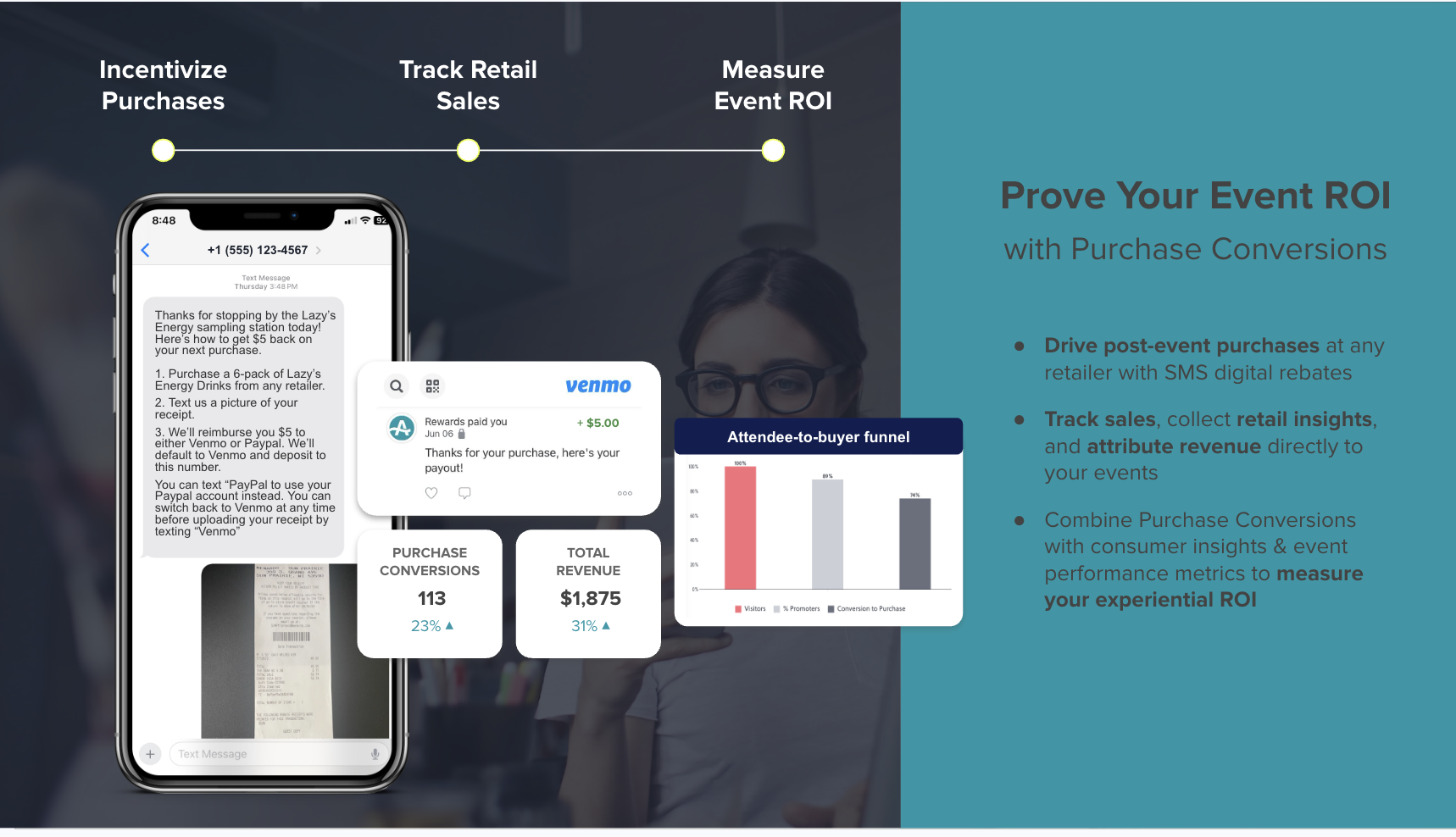
Checkpoint: Ensure every cashback redemption and every club enrollment produces a first-party record tied to a verified transaction. Treat records without a transactional signal as engagement data and records with one as revenue data.
Step 6: Prove Event ROI with a Clear Attribution Framework
Objective: Connect first-party records collected at events to retail sales lift and lifetime value with a framework you can report to leadership.
Preparation: Secure baseline store-level sales data before the activation begins and measure lift in incremental units sold over the subsequent eight weeks, along with the percentage of purchasers who had not bought the product in the prior twelve months.
Action: Use three attribution layers. Lead indicators, such as contact capture rate, opt-in rate, and sample-to-scan ratio, measure execution quality during the event. Lag indicators, including retail sell-through lift in activation markets, cashback redemption rate, and club enrollment rate, measure conversion in the weeks after. Lifetime value indicators, such as member spend at six releases, churn rate, and skip and pause frequency, measure the long-term return on each enrolled record. A Google and Boston Consulting Group study found that marketers who effectively use their first-party data can generate double the incremental revenue from a single ad placement, communication, or outreach. Absolut Home increased average revenue per guest by 36% since 2018 and Campari Group's average spend per customer increased 25% since 2020 through structured event data management, outcomes traceable to the attribution framework described here.
Checkpoint: Expect every event to produce a single-page report showing cost per captured record, conversion rate to purchase or enrollment, and projected lifetime value of enrolled members. AnyRoad's automated reporting generates this output in approximately 20 minutes, which makes post-event reviews fast and repeatable.

Prove the retail sales impact of your events and book a demo.
Operational Considerations for Running the Six-Step System
Staffing and timing determine whether the six-step process runs or stalls. Start with accountability and assign one person to own data quality on-site, verifying that QR codes are live, forms are syncing, and consent logs are recording before doors open. Next, ensure your team can execute the conversion mechanics by training all guest-facing staff on the enrollment pitch and the cashback mechanic before the event, because a coached tour guide outperforms any digital prompt. Many brands experience a gap of 24 hours to a week between field data collection and actionable sales insight, so close that gap by configuring automated follow-up sequences to trigger within minutes of registration, not the following week. For brands without in-house email marketing capability to manage these sequences, AnyRoad's managed CRM service handles programmatic emails, segmentation, and member communications using the same first-party data the platform already collects, which removes the need for a non-specialized agency.
Troubleshooting Common Blockers
- Low on-site capture rates: Add a value exchange, such as branded swag, a sweepstakes entry, or an instant cashback offer, to the registration prompt. POPLIFE's mezcal activation used branded swag as the incentive and captured 34% net-new-to-brand consumers.
- Consent logs not syncing to CRM: Verify that your consent management platform enforces pre-consent tag blocking and propagates consent status to all downstream systems before the event opens, not after.
- No path to compliant club enrollment: Alcohol brands that are not licensed retailers cannot ship product directly. AnyRoad's licensed ecommerce retail partner handles the transaction and compliant delivery, removing this blocker without requiring the brand to obtain its own license.
- Attribution gap between activation and retail: Use the cashback rebate mechanic to tie a first-party record to a receipt-verified purchase at any retailer, with no POS integration required.
- Club churn at six releases: Expect churn to concentrate at this point because members have not depleted their current allocation. Address it with programming, such as virtual cocktail classes with master distillers, that gets members through what they own and primed for the next release, rather than discounting.
Advanced Tips for Scaling High-Value Guests and Media Impact
Segment attendees by NPS score, spend level, and visit frequency immediately after the event. AnyRoad's platform surfaces true VIPs, repeat visitors with high NPS and above-average spend, so staff can direct the club enrollment pitch at the guests the data says will convert, rather than pitching everyone. To attract these high-value guests in the first place, build tiered experience pricing at roughly $20, $50, and $150, because this pricing structure draws higher-spending attendees and provides an early signal of who is likely to enroll as a member. Once you have captured opt-in emails and loyalty app scans from these segmented attendees, integrate that first-party data with retail media networks, enabling retargeting of engaged consumers when they are physically near key retail partners, which multiplies the impact of the physical activation through paid media. For hybrid events, configure separate tracking for virtual and in-person attendee segments so behavioral signals from each cohort inform distinct follow-up sequences.
Frequently Asked Questions
When should consent be collected, before, during, or after the event?
Consent must be collected at the moment of data capture, not retroactively. For pre-registered attendees, the booking form is the correct collection point. For walk-in guests, the on-site check-in form serves the same function. Post-event surveys can collect additional consent for new processing purposes, but they cannot retroactively legitimize data collected without consent earlier in the event. Every consent record should include the processing purpose, the privacy notice version shown, and a timestamp tied to the specific collection channel.
How does AnyRoad keep bottle club transactions compliant with alcohol regulations?
AnyRoad acts as the brand's agent, not as a licensed retailer or wholesaler. The compliant transaction and delivery run through AnyRoad's licensed ecommerce retail partner, which handles the purchase and compliant shipping within applicable federal and state rules. The consumer receives a Shopify-integrated purchase experience, and the brand receives a club that satisfies three-tier regulation without needing to obtain its own retail license or assemble a separate fulfillment stack.
What attribution window should brands use to connect event data to retail purchases?
Attribution windows should reflect the category's normal buying cycle. For spirits, an eight-week post-activation window captures the majority of receipt-verified cashback redemptions and retail sell-through lift attributable to the event. Club enrollments should be tracked over a longer horizon, through six releases, because the lifetime value comparison between a single bottle purchase and a club member only becomes meaningful at that threshold. Brands running matched-market tests should secure baseline store-level sales data before the activation begins so the lift calculation is not contaminated by concurrent promotions or seasonal shifts.
How does first-party data capture work for hybrid events where some attendees are virtual?
Virtual attendees require the same consent architecture as in-person guests, with registration forms capturing the same identity and preference data. Behavioral signals differ, because virtual participants generate attention spikes, poll responses, chat participation, Q&A activity, and viewing duration rather than physical dwell time. Configure your analytics platform to track virtual and in-person segments separately so follow-up sequences, including cashback rebate offers and club enrollment prompts, can be tailored to each cohort's engagement pattern. QR codes embedded in virtual event interfaces serve the same data-capture function as physical QR codes at on-site activations.
Conclusion: Turn Every Attendee into a Revenue-Generating Record
The six steps above form a repeatable operational process. You define the data types that matter, build consent architecture before the event opens, capture records across registration and on-site touchpoints, collect post-event feedback and behavioral signals, connect every record to a purchase or enrollment, and measure the result against a simple attribution framework. Each step has a clear objective, a preparation requirement, a defined action, and a checkpoint, so the process can be audited, improved, and scaled across every event in the portfolio.
AnyRoad is the only platform that unifies event-native data capture, alcohol-compliant purchase conversion through its licensed retail partner, and managed CRM in a single relationship. Heritage distilleries including Heaven Hill Distillery, Nearest Green Distillery, and Lux Row Distillers, alongside craft brands such as Castle & Key, Catoctin Creek Distilling, and Tarnished Truth Distilling, have adopted the Lifetime Loyalty platform to move attendees from one-time purchases to multi-release club memberships, capturing the 6x lifetime value difference described in Step 5. The technology, the compliant transactional path, the domain expertise, and the operating team come as one relationship, not a stack of tools the brand must maintain.