


Written by: Bryan Grobstein, Vice President, Global Revenue, AnyRoad
Key Takeaways
- Brand activations can become reliable first-party data engines when they collect consented information through registration, QR codes, interactive experiences, and surveys. This approach gives brands owned contact details, preferences, and behavioral insights.
- With third-party cookies now fully deprecated, first-party data now underpins advertising, personalization, and measurement. Seventy-one percent of brands, agencies, and publishers are actively growing their first-party datasets.
- Live brand experiences outperform digital channels for data capture. Face-to-face engagement builds trust and emotional connection, which drives consent rates up to 63% when the value exchange is clear.
- Effective activation data strategies follow a lifecycle that includes pre-event registration, on-site QR codes and interactive experiences, full-attendee capture, real-time CRM integration, and post-event follow-up within 24–48 hours.
- AnyRoad delivers a complete platform for turning activations into first-party data engines. See how leading brands capture more data and drive measurable ROI by booking a personalized walkthrough.
Why First-Party Data Capture Is Now Mission-Critical
Third-party cookie deprecation is effectively complete across Chrome, Safari, and Firefox, so first-party data now serves as the baseline for effective advertising, personalization, and measurement. Seventy-one percent of brands, agencies, and publishers are growing or planning to grow their first-party datasets, nearly double the rate of two years earlier.
Brand activations such as events, pop-ups, and tastings are uniquely positioned to capture rich, consented consumer data. These experiences create high-engagement, emotionally connected moments when consumers feel comfortable sharing information. When data collection is transparent and value is explicit, consumer willingness to share rises to 63% on average, compared to just 22% when collection is hidden. A second visit to a brand experience makes a consumer 512% more likely to convert to a paid loyalty enrollment, which turns activations into a measurable acquisition channel.
What Is First-Party Data? Definition and Examples for Activations
First-party data is information a business collects directly from its own customers or audience through owned channels. It contrasts with zero-party data and third-party data. Zero-party data consists of preferences and intentions explicitly shared by the consumer through quizzes or preference centers. Third-party data is aggregated from external sources and is increasingly unavailable.
Activation-specific examples of first-party data include:
- Name and email captured at event registration
- Purchase history from on-site retail transactions
- Survey responses about brand perception or product preferences
- Feedback collected via post-event NPS surveys
- Behavioral data from interactive experiences such as flavor profilers and quizzes
A practical first-party data strategy focuses on quality over volume. A smaller set of dependable, actionable data points creates more value than a large set of unused fields.
Why Brand Activations Are a First-Party Data Goldmine
Live experiences outperform digital channels for data capture. Face-to-face interaction builds trust, emotional engagement lowers privacy resistance, and the value exchange through sampling, entertainment, or education feels tangible and immediate. Consumers who participate in a brand experience are 74% more likely to make a purchase, and direct sensory involvement in experiential marketing drives 70%+ higher brand recall compared to passive ad exposure.
These dynamics show up clearly in real programs. POPLIFE captured 45–50% more consumer data using AnyRoad compared to competitors during festival activations, with 42% of attendees opting into future marketing communications and 85% reporting intent to purchase the mezcal brand's product post-event. Campari Group achieved a 3X increase in marketing opt-in rates over six months from brand home registrations and identified 4,500 repeat visitors as brand champions.
Pre-Event Data Capture: Registration and Surveys
Effective data capture starts before the event through branded registration pages, pre-event surveys, and ticketing flows. A white-labeled booking experience owned by the brand is essential because third-party ticketing sites often co-opt data and promote competitors. Moving bookings online captures data from engaged consumers at the moment of highest intent.
Ben & Jerry's Factory Experiences moved 73% of tour bookings online using AnyRoad, eliminated manual tracking, and captured visitor demographics through pre- and post-experience surveys that measure brand perception, purchasing behavior, and loyalty. Leiper's Fork Distillery previously hosted 24,000 guests annually with no data on their identities. After adopting AnyRoad's automated surveys, they achieved a 97 post-event NPS.
On-Site Capture Mechanics: 5 Steps to Capture Data at Any Activation
- Deploy branded QR codes at every touchpoint. Place them at the entrance, product displays, sampling stations, and exit, each linking to a mobile-optimized registration page.
- Offer a valuable incentive. Use cashback rebates, sweepstakes entries, exclusive content, or personalized recommendations in exchange for opt-in data. As noted earlier, transparent value exchange drives consent rates to 63% on average across 41,820 verified consumer interactions.
- Use interactive digital experiences. Flavor profilers, photo booths, and gamified quizzes require registration to participate and generate rich preference data.
- Capture data from every attendee, not just the booker. Use tools like AnyRoad's FullView feature to collect contact information from all group members. Proximo Spirits was missing contact information for over 66% of guests before implementing FullView, after which they immediately collected 69% more guest data and 34% more NPS responses.
- Integrate with your CRM in real time. Ensure data flows instantly to your marketing stack for immediate follow-up and segmentation. Following up within five minutes produces 21x higher conversion rates than waiting 30 minutes, yet 80% of event leads never receive any follow-up.
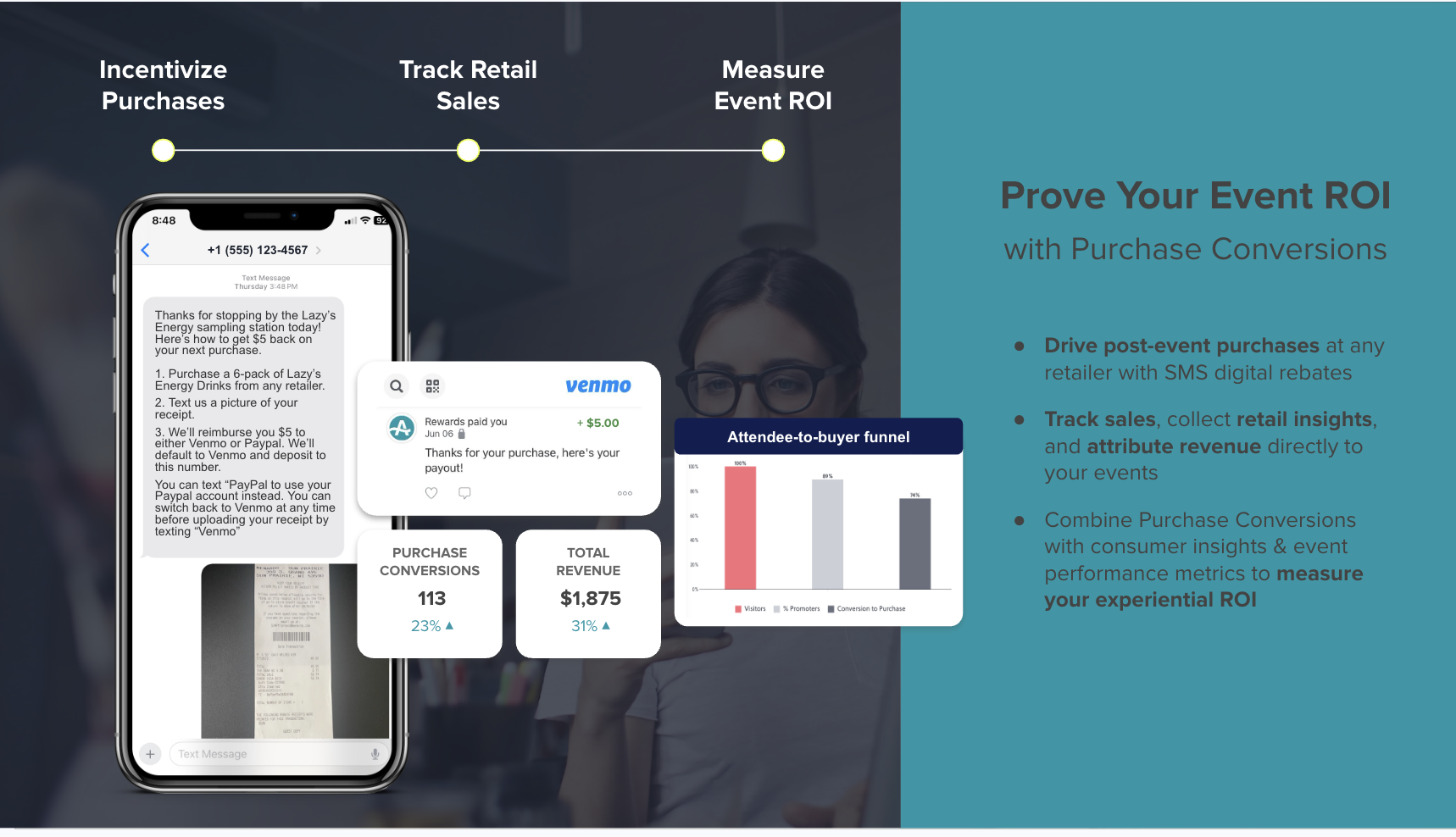
Beyond these five steps, one on-site mechanic worth calling out is AnyRoad's Live mobile app, which enables data capture at ambassador tastings inside third-party retail accounts. The cashback rebate mechanic sends an SMS after registration, the consumer photographs their receipt, and AnyRoad's AI reads it, confirms the eligible SKU, and pays the rebate via Venmo or PayPal. No POS integration is required. The same mechanic also runs as a sweepstakes variant, with AnyRoad handling regulatory compliance including terms, conditions, and privacy policies.

| Method | Opt-In Rate | Data Richness | Compliance Risk |
|---|---|---|---|
| QR code registration | 63% with transparent value exchange | Medium (contact + basic preferences) | Low (explicit consent flow) |
| Paper forms | Low (over half of raw records contain invalid contact details) | Low (limited fields) | High (no consent documentation) |
| Interactive digital experiences | High (engagement-driven) | High (behavioral + preference data) | Low (digital consent trail) |
| Contests/sweepstakes | Very high (incentive-driven) | Medium (contact + entry data) | Medium (requires legal compliance) |
This comparison shows how digital, consent-based mechanics outperform manual methods for both data quality and compliance. It also highlights the role of incentives and interactivity in driving higher opt-in rates.
See AnyRoad's full-attendee capture and purchase conversion tools in a live platform walkthrough.
Post-Event Follow-Up and CRM Integration
Captured data turns into long-term relationships through personalized follow-up emails that reference the specific event, segmentation based on expressed preferences, and loyalty program enrollment. The success rate of selling to an existing customer is 60–70% versus 5–20% for a new one.
AnyRoad integrates with CRM, email, and marketing automation tools including HubSpot, Klaviyo, and Salesforce, so data flows where it is needed without manual exports. Campari Group's average spend per customer increased 25% since 2020 through streamlined event management and integrated systems powered by AnyRoad. The initial post-event fulfillment message should deploy automatically within two to four hours of the interaction, and it should reference the event name and location to reinforce the memory.
Privacy and Compliance: GDPR, CCPA, and Alcohol-Specific Regulations
Compliance forms a core pillar of any activation data strategy. GDPR fines for serious violations, including unlawful data processing and failure to obtain valid consent, reach €20 million or 4% of global annual turnover, whichever is higher. CCPA civil penalties reach up to $7,988 per intentional violation or any violation involving a consumer under 16. As of early 2026, 20 U.S. states have enacted comprehensive consumer privacy laws.
Key compliance requirements for activation data capture include:
- Display a clear privacy notice at every capture point, physical and digital
- Obtain explicit opt-in consent, and never use pre-checked boxes
- Separate service fulfillment consent from marketing opt-in consent
- Provide granular, channel-specific opt-ins for email, SMS, and third-party sharing
- For alcohol brands, verify age at the point of interaction using integrated ID scanning
- Maintain documented consent records that can be audited
For alcohol and age-restricted activations, birth dates should be verified locally on the device without storing full dates of birth in the marketing database. Storing binary confirmation flags instead reduces compliance liability. AnyRoad offers integrated ID scanning for age verification and handles sweepstakes compliance, including terms, conditions, and privacy policies.
Measuring Success: KPIs Beyond Lead Count
Proving activation ROI requires metrics that connect experiences to revenue rather than simple attendance counts. The core KPIs to track include:

- Opt-in rate: Percentage of attendees consenting to marketing communications
- Data completeness: Percentage of records with full contact information
- NPS: Post-event promoter score. Leiper's Fork achieved 97 using AnyRoad's automated surveys.
- Purchase intent: Percentage of attendees indicating intent to buy. POPLIFE's mezcal brand activations reached 85% purchase intent.
- Conversion to loyalty: Percentage of attendees enrolling in clubs or memberships
- Revenue attribution: Connection between activations and actual retail purchases via receipt-verified cashback redemptions
Diageo measured a 16-point NPS increase using AnyRoad analytics and identified that a historically under-targeted demographic was 40% more likely to drink whisky after visiting. AnyRoad's PinPoint AI-powered feedback analysis automatically identifies trends and sentiment drivers from open-text survey responses, which turns thousands of responses into actionable insights in real time.

Tools and Technology Stack Recommendations
Experiential marketing teams need tools built for brand-owned data capture rather than generic booking and ticketing. The table below shows how AnyRoad's white-labeled, full-attendee approach compares with Eventbrite and FareHarbor on the capabilities that matter most for data strategy.

| Capability | AnyRoad | Eventbrite | FareHarbor |
|---|---|---|---|
| White-labeled booking | Yes, fully integrated into brand's own website | No, redirects to Eventbrite, which promotes competitor events | No, standardized template with FareHarbor branding |
| Full-attendee data capture | Yes, FullView captures every group member, not just the booker | No | No |
| AI-powered feedback analysis | Yes, PinPoint identifies themes and sentiment from open-text responses | No | No |
| Post-event purchase conversion | Yes, cashback rebates, sweepstakes, punch-card experiences | No | No |
This comparison highlights how a purpose-built experiential platform supports white-label control, full-attendee capture, and closed-loop measurement, while generic tools focus primarily on ticketing.
Common Pitfalls to Avoid
- Collecting data without a clear value exchange often backfires. Generic giveaways attract low-intent visitors who submit fake contact details, which undermines data quality.
- Ignoring compliance requirements for GDPR, CCPA, TCPA, and alcohol age verification exposes the brand to legal and reputational risk.
- Only capturing the booker's data leaves the majority of actual attendees invisible, which limits segmentation and remarketing potential.
- Failing to integrate with CRM in real time causes data to go stale within hours and reduces conversion rates from follow-up campaigns.
- Delaying follow-up beyond 24–48 hours weakens recall of the experience. Eighty percent of event leads never receive any follow-up, which wastes activation spend.
- Collecting data without a defined activation plan turns valuable information into storage cost instead of revenue impact.
Real-World Examples: Brands Winning at Activation Data Capture
The case studies in this guide show a consistent pattern. Proximo Spirits, POPLIFE, and Diageo all treated activations as systematic data engines and saw measurable gains in opt-ins, NPS, and purchase intent.
Diageo measured a 16-point NPS increase using AnyRoad analytics and identified that an under-targeted demographic was 40% more likely to drink whisky after visiting, which now informs ongoing audience strategy. As Diageo noted: "With AnyRoad, we are able to measure NPS, Brand Conversion, and more, providing us with solid data that shows the positive impact the JWPS experience is having on our guests. We can then follow up with them to create a lifelong relationship with our brand."
To address common questions about activation data capture, the following FAQs summarize key concepts and tactics.
Frequently Asked Questions
What is the difference between first-party and zero-party data?
First-party data is behavioral and transactional information collected directly from customers through their interactions with your brand, including purchases, website visits, event attendance, and survey completions. Zero-party data is information customers proactively and explicitly share, such as stated preferences, interests, and intentions, often through quizzes, preference centers, or registration questions. Both types are owned entirely by the brand and collected with consent, but zero-party data is declared by the consumer rather than inferred from behavior. At brand activations, a post-event NPS score is first-party data, while a consumer selecting their preferred flavor profile through an interactive kiosk is zero-party data. Both serve as valuable and complementary inputs to audience segmentation and personalization.
How do I ensure compliance when capturing data at events?
Display clear privacy notices at every capture point, both physical and digital. Obtain explicit opt-in consent with boxes that are never pre-checked by default. Separate service fulfillment consent from marketing communications consent, and provide granular opt-ins for each channel such as email and SMS. For alcohol brands, verify age at the point of interaction using integrated ID scanning, and store only a binary confirmation flag rather than full date-of-birth data in your marketing database. Ensure data is stored and processed in compliance with GDPR, CCPA, and applicable state regulations. Use platforms like AnyRoad that handle compliance infrastructure, including ID scanning, sweepstakes legal requirements, and documented consent records. Treat compliance as an ongoing governance function that requires regular review and updates.
What are examples of first-party data collected at brand activations?
First-party data collected at activations spans several categories. Contact data includes name, email address, phone number, and postal code captured at registration. Behavioral data includes which experiences a consumer attended, how long they engaged, and which products they sampled. Preference data includes flavor profiles, product interests, and lifestyle attributes gathered through interactive experiences or surveys. Transactional data includes on-site purchases and receipt-verified retail redemptions from post-event cashback programs. Feedback data includes NPS scores, open-text survey responses, and brand affinity ratings collected post-experience. Each data type serves a distinct downstream use: contact data enables follow-up, behavioral data informs segmentation, preference data powers personalization, transactional data proves ROI, and feedback data guides experience improvements.
What are the key components of a first-party data collection strategy for activations?
A complete activation data strategy requires six components working together. First, define the specific business questions the data must answer before designing any capture mechanic, because data collected without a use case becomes storage cost. Second, deploy consent-compliant capture mechanisms at every touchpoint, from pre-event registration through on-site QR codes to post-event surveys. Third, capture data from every attendee, not just the booking holder, using tools designed for full-group capture. Fourth, integrate with your CRM in real time so records are actionable within hours, not days. Fifth, activate the data through personalized follow-up, audience segmentation, and loyalty enrollment within 24–48 hours of the event. Sixth, measure outcomes such as opt-in rate, data completeness, NPS, purchase intent, and revenue attribution to optimize future activations and prove ROI to leadership.
How does AnyRoad connect activation data to retail sales?
AnyRoad connects an activation to a bottle leaving a shelf through its gamified purchase conversion tools. After registering at an activation, whether at a brand home, festival, or ambassador tasting inside a retail account, consumers receive an SMS with a cashback rebate redeemable anywhere the product is sold. They purchase the product, photograph the receipt, and text it back. AnyRoad's AI reads the receipt, confirms the eligible SKU, and pays the rebate via Venmo or PayPal. No POS integration is required, which means the mechanic works across any retail or on-premise account at scale. Every redemption produces a first-party record tied to a receipt-verified purchase, which directly connects experiential spend to retail sell-through and gives field marketing teams a measurable conversion metric beyond depletion reports.
Conclusion: Turn Activations into a First-Party Data Engine
Brand activations become the most powerful first-party data capture channel available to consumer brands when teams design them intentionally across the complete lifecycle. Pre-event registration captures high-intent consumers before they arrive. On-site mechanics with clear value exchange drive opt-ins from every attendee, not just the booker. Post-event follow-up within 24–48 hours converts captured data into measurable consumer relationships, and compliance infrastructure protects the brand while building consumer trust.
AnyRoad provides a complete platform that includes white-labeled booking, full-attendee data capture via FullView, AI-powered analytics through PinPoint, post-experience purchase conversion tools, and integrations with HubSpot, Klaviyo, Salesforce, and the rest of your marketing stack. Campari Group achieved a 3X increase in marketing opt-ins and Proximo Spirits captured 69% more guest data by treating activations as a systematic data engine.
Ready to turn your next activation into a first-party data engine? Schedule a demo tailored to your activation strategy.