


Written by: Bryan Grobstein, Vice President, Global Revenue, AnyRoad
Key Takeaways
- First-party data from brand activations comes from consented consumer information captured through QR codes, kiosks, and value exchanges. This data builds reliable CRM profiles and drives measurable retail lift.
- Low opt-in rates and missing post-event follow-up paths create a data architecture gap. This gap blocks CRM segmentation, lookalike audience building, and ROI proof.
- Successful capture starts with clear value exchanges, distinct zero-party and first-party touchpoints, and low-friction mechanics that feel natural to guests.
- Real-time CRM routing, lookalike audience creation, and cashback rebates turn activation opt-ins into loyalty enrollments and receipt-verified bottle sales.
- AnyRoad unifies compliant on-site capture, CRM integration, and loyalty conversion into a repeatable playbook, and you can book a demo to turn your next activation into a measurable revenue engine.
The Operational Pain: Activations Without Lasting Relationships
Field marketing teams at alcohol and CPG brands face a structural problem. Activations generate foot traffic and brand impressions, but the consumer relationship often ends when the tent comes down. Around two-thirds of marketers struggle to activate first-party customer data effectively, and only 33–36% feel confident or have a defined activation strategy. They cite technical, operational, and privacy barriers. For alcohol brands, compliance constraints make third-party retargeting unreliable and post-event follow-up nearly impossible without a consented record.
The gap between a great activation and a measurable outcome is a data architecture problem, not a creative one. Without a repeatable capture-to-conversion process, brands cannot feed CRM segments, build lookalike audiences, or prove retail lift to leadership. AnyRoad closes that loop from on-site capture through compliant loyalty conversion, acting as the brand's agent across every touchpoint.
Prerequisites: Team, Tools, and Compliance Foundation
Before you can implement the capture-to-conversion process described below, you need the right team structure and technical foundation in place. Confirm the following are in place:
- Field Marketing Manager or Brand Activation Lead, who owns the capture strategy and KPI targets
- Brand Ambassadors or Tour Guides, who are trained to make the data exchange feel natural, not transactional
- CRM or CDP Administrator, who receives, tags, and segments inbound records
- Legal or Compliance Reviewer, who confirms CCPA, TCPA, and alcohol-specific age-gate requirements at every capture point
- AnyRoad Platform Access, including the AnyRoad Live mobile app for on-site QR capture, FullView for group-level data collection, and integration connectors to HubSpot, Klaviyo, Salesforce, or your existing CRM
For alcohol activations specifically, age verification should occur locally on the device with only binary confirmation flags stored. This approach reduces compliance liability under data minimization principles. Consent for marketing communications must be freely given, specific, informed, and unambiguous. Physical participation such as sampling a beverage does not qualify as marketing opt-in under CCPA and TCPA standards.
Book a demo to see how AnyRoad configures compliant capture flows for alcohol and CPG activations.
Step 1: Define the Value Exchange for Every Capture Point
Objective: Pair every data request with an immediate, obvious consumer benefit before the activation launches.
Prep: Map the explicit value exchange at each activation touchpoint so the guest benefit is obvious before any data request is made. Use a Value–Friction–Risk framework to maximize perceived value while keeping input effort and privacy risk low.
Action: Assign a specific value to each capture method based on your activation goals and audience. The table below maps common methods to their trade-offs, and you can use it to match your capture mechanic to the friction your audience will tolerate and the data quality signal you need:
| Capture Method | Value Exchange | Friction Level | Data Quality Signal |
|---|---|---|---|
| QR code to SMS opt-in | Instant cashback rebate or digital coupon | Low | Verified mobile number |
| Kiosk or tablet form | Personalized tasting profile or recipe card | Medium | Email address with stated flavor preference |
| Preference quiz | Product recommendation or sweepstakes entry | Low–Medium | Zero-party flavor and purchase-intent signals |
| Club enrollment pitch | Club-only expression plus same-day discount | High (intentional) | Highest-intent profile; experience-driven opt-ins convert to paid loyalty at 4× the rate of traditional channels per AnyRoad reporting |
Checkpoint: Every capture point has a named value exchange and a specific automated workflow triggered by the submission. No form field stands alone without a follow-up action.
Step 2: Design Distinct Zero-Party and First-Party Moments
Objective: Collect both data types deliberately so CRM segments reflect observed behavior and stated preference.
Prep: First-party data comes through a brand's own channels such as form submissions and purchase history, while zero-party data consists of information a customer deliberately and voluntarily shares. Zero-party data includes stated preferences or purchase intent and does not require inference.
Action: Design separate capture moments for each type:
| Data Type | Live Event Example | CRM Use Case | Compliance Note |
|---|---|---|---|
| First-party | Email submitted at kiosk check-in, QR scan with SMS verification | Identity resolution, suppression lists, lookalike seed audiences | Requires explicit opt-in checkbox separate from participation |
| Zero-party | Flavor preference quiz, purchase-intent survey, “where do you buy?” dropdown | Segment by preference, personalize follow-up, route retail coupons to the correct territory | Customers share zero-party data willingly when the interaction offers clear value and feels quick and easy |
Checkpoint: The activation brief names at least one zero-party capture point such as preference or intent and at least one first-party capture point such as verified contact. Separate consent checkboxes exist for each communication channel.
Step 3: Make On-Site Capture Feel Effortless
Objective: Collect consented profiles during the experience without interrupting guest flow.
Prep: Keep the initial data ask narrow and directly tied to the sampling interaction so the capture feels like part of the natural flow rather than a separate form-filling task. Limit surveys to five or fewer questions and favor closed-ended inputs.
Action: Deploy the AnyRoad Live mobile app so brand ambassadors can trigger QR code registration on the spot. Place QR codes at product displays and tasting stations, not at exit points. QR code scans at activations should deliver immediate practical utility such as digital coupons or store locators rather than generic homepages. Tag every digital path by location, date, and creative variant. Use AnyRoad's FullView feature to capture data from every attendee in a group, not only the booking contact, and Conversate Collective improved 100% of consumer profiles with vital demographic information using AnyRoad at CPG field marketing events.

Checkpoint: Post-event fulfillment messages deploy automatically within two to four hours of capture. Each message delivers the exact asset promised at the activation, such as a discount code, recipe card, or rebate link.
Step 4: Stream Activation Data Directly into CRM Segments
Objective: Move consented profiles from the activation into actionable CRM segments without manual export.
Action: AnyRoad's native integrations with HubSpot, Klaviyo, Salesforce, and Zapier push structured records into your CRM in real time. Each record includes identity, interaction, permission, and operational metadata. Tag each profile with event ID, location, SKU sampled, and consent timestamp. Campari Group's partnership with AnyRoad enabled a 3× increase in marketing opt-in rates over six months from brand home registrations and identified 4,500 repeat visitors as brand champions. Segment immediately by flavor preference, purchase intent tier, and visit frequency.
Checkpoint: Every inbound record carries a consent timestamp, a source tag, and at least one behavioral or preference attribute that enables segment assignment on day one.
Step 5: Build Lookalike Audiences from Activation Profiles
Objective: Extend the reach of high-quality activation profiles into paid media without relying on third-party cookies.
Action: Export hashed email lists from AnyRoad's CRM segments into Meta, Google, or programmatic DSPs. Use these lists to build lookalike audiences seeded from your highest-intent activation contacts. POPLIFE captured 42% of festival attendees opting into future marketing communications, with 34% of those registrants new to the brand, which created a strong lookalike seed pool. Suppress existing customers from acquisition campaigns to reduce wasted spend. First-party data lowers customer acquisition costs through suppression lists and lookalike targeting of owned audiences, cutting wasted ad spend as third-party targeting reliability declines.
Checkpoint: Lookalike audiences are seeded exclusively from consented, tagged activation records, not from inferred or purchased data.
Step 6: Turn Opt-Ins into Loyalty and Retail Sales
Objective: Turn activation opt-ins into paid loyalty enrollments and connect experiential spend to verified bottle sales.
Prep: A consumer who visits a distillery twice is 512% more likely to convert into a paid loyalty enrollment. A single retail bottle purchase is worth roughly $100 to a brand. A club member who stays through six releases is worth roughly $600. The conversion path focuses on closing that value gap.
Action: Deploy AnyRoad's cashback rebate mechanic. After registering at the activation, the consumer receives an SMS with a rebate redeemable anywhere the product is sold. They photograph the receipt and text it back. AnyRoad's AI confirms the eligible SKU and pays out via Venmo or PayPal, and this process does not require POS integration. For brand home activations, coach tour guides to pitch club enrollment at the end of the tasting and pair the offer with a same-day discount on a club-only expression. AnyRoad reports that member spending increases 150% within the first year.
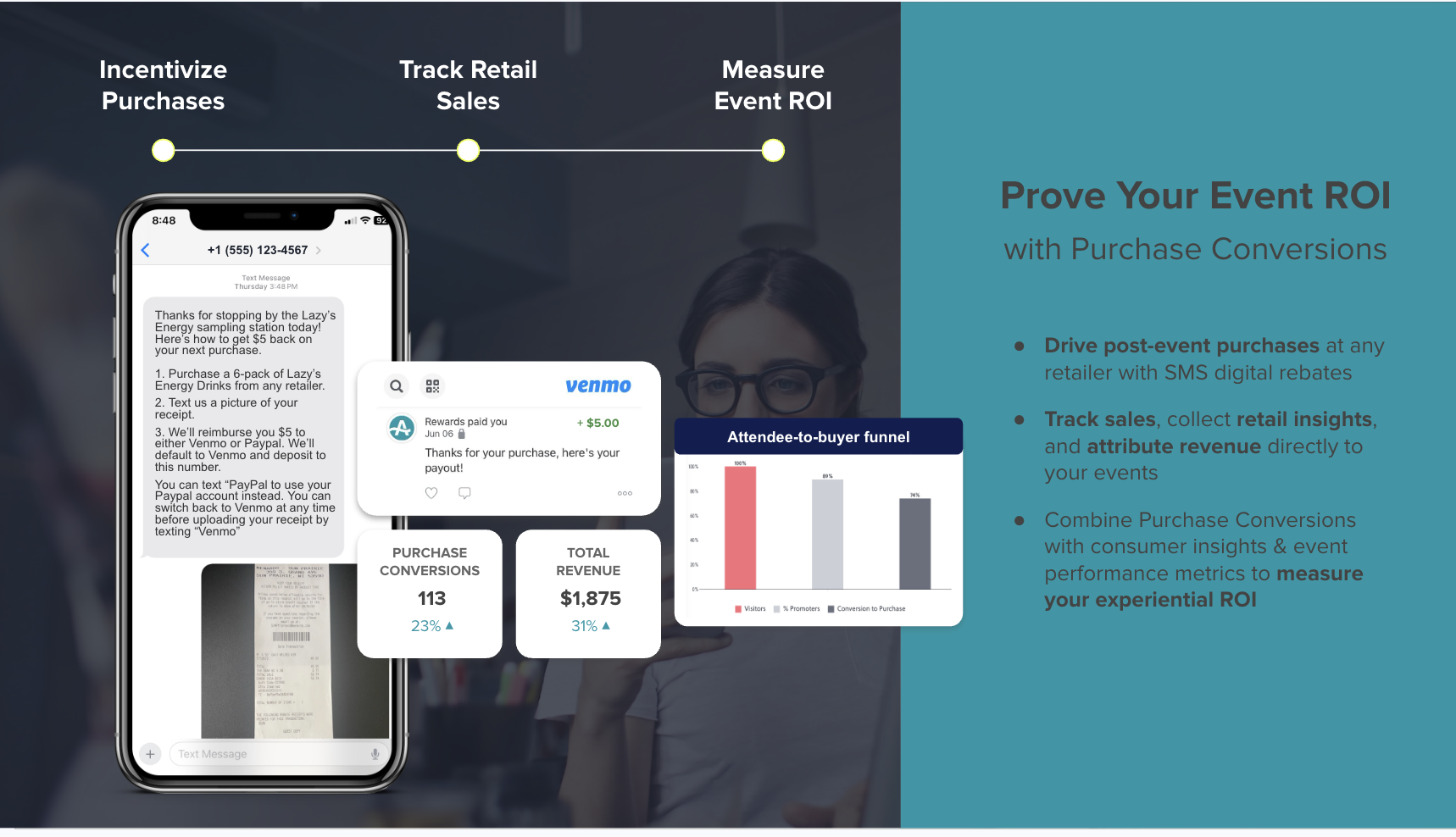
Checkpoint: Every rebate redemption produces a receipt-verified purchase record tied to an identifiable first-party profile. This connection links the activation directly to a bottle leaving a shelf.
Step 7: Scale a Proven Model Across Locations
Objective: Replicate the capture-to-conversion process consistently across markets, ambassadors, and event formats.
Prep: Train staff to collect data in a friendly, non-pushy manner and clearly communicate what the consumer receives in exchange. Inconsistent ambassador behavior is the primary driver of opt-in rate variance across locations.
Action: Use AnyRoad's Experience Manager to build a single activation template that includes the capture form, consent language, value exchange, and CRM routing rules. Deploy this template across every market. Tag each instance with location, date, and ambassador code so you can compare performance at the market level. AnyRoad's Atlas Insights dashboard surfaces opt-in rate, data completeness, and NPS by location in real time, which enables mid-campaign corrections without waiting for post-event reports.
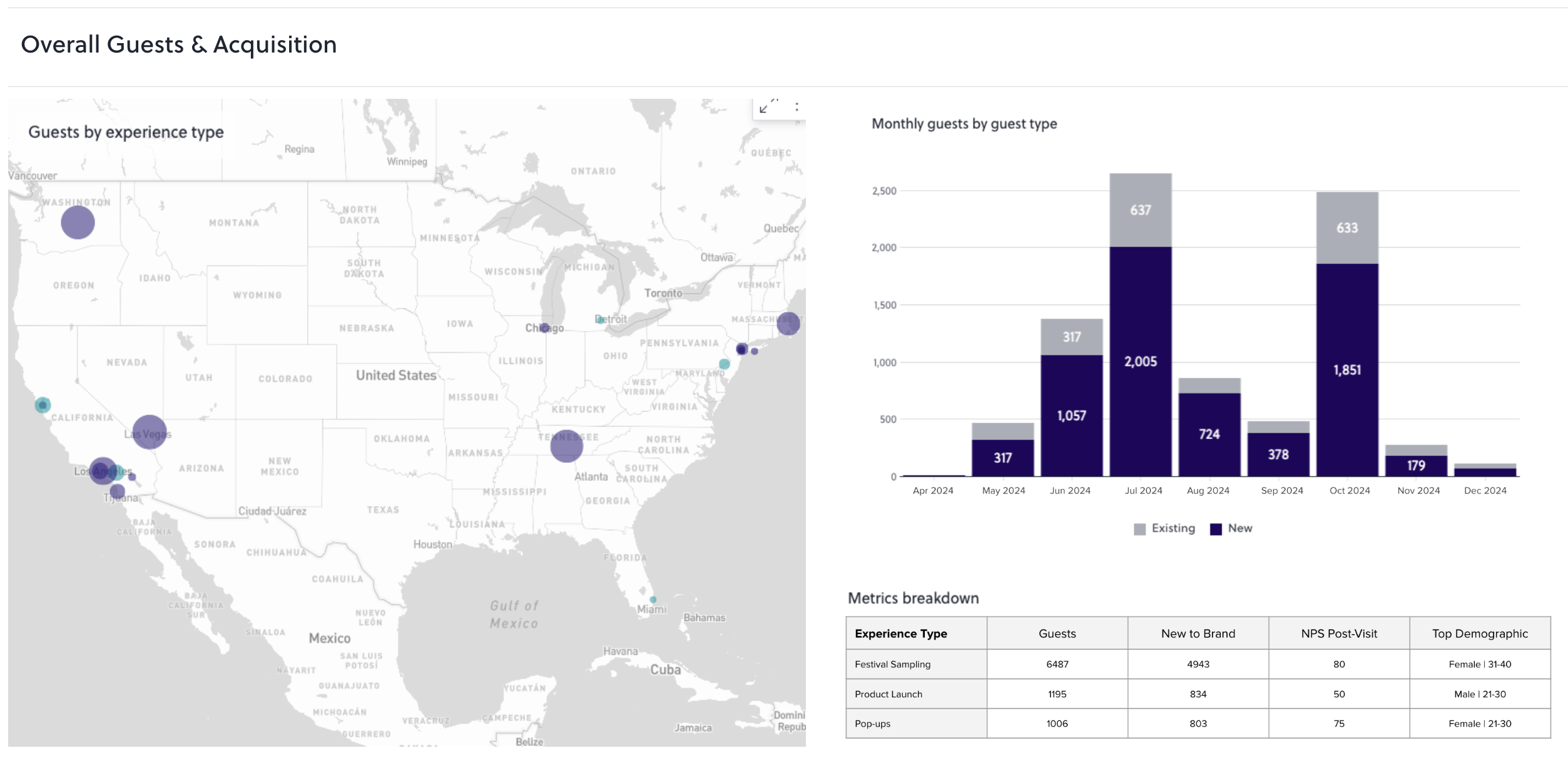
Checkpoint: All locations share a single data schema, consent framework, and CRM routing path. No market operates on a local spreadsheet or disconnected tool.
Operational Considerations for On-Site Execution
Staffing ratios directly affect data quality. One ambassador managing capture for more than 30 guests per hour often faces form abandonment and consent errors. To prevent this bottleneck at high-traffic activations, schedule dedicated data-capture staff separately from product-education staff so each role can focus on its primary function.
For alcohol events specifically, this separation also supports compliance. Age verification should occur at the point of sample delivery, not at the data capture point, and only the binary confirmation flag should be stored, not the underlying ID data. Physical capture-point privacy notices and legal review across CCPA, TCPA, and the NIST Privacy Framework are required to maintain compliant collection at events.
Build a 48-hour post-event handoff window into the activation brief so CRM administrators can audit inbound records before the first automated follow-up sequence starts.
Common Mistakes and How to Fix Them
- Low opt-in rates: The value exchange is unclear or the form appears before the guest has experienced the product. Move the capture point to after the tasting or sample and name the specific benefit the consumer receives.
- High form abandonment: Too many fields create friction. Remove any nonessential form fields and keep only inputs tied to an immediate business action. Name plus email or mobile is sufficient for the initial capture.
- Consent gaps in CRM: Marketing opt-in was bundled with participation consent. Separate the checkboxes and re-audit existing records before activating any segment.
- No retail attribution: The activation produced opt-ins but no purchase signal. Add the cashback rebate mechanic to the post-registration SMS so every consented profile has a path to a receipt-verified purchase.
- Inconsistent data across markets: Ambassadors are using local forms or paper sign-ups. Enforce the AnyRoad Live app as the only capture tool and lock the form template at the platform level.
Measuring Success Across Every Activation
Evaluate every activation against three measurement layers:

- Opt-in rate: Target at least 40% of engaged guests submitting a consented record. POPLIFE achieved the 42% benchmark noted earlier, and Campari Group reached the 3× improvement mentioned earlier. Benchmark your market against these figures and investigate any activation falling below 25%.
- Data completeness: Every record should carry identity, at least one preference or intent attribute, a consent timestamp, and a source tag. Incomplete records cannot be segmented or activated in paid media.
- Activation-to-sale attribution: Measure rebate redemption rates, club enrollment rates within 30 days of the activation, and incremental retail sales in the activation geography versus a matched control market. Conversate Collective measured the 74% purchase likelihood lift referenced earlier, and over 50% of surveyed consumers subsequently bought the brand’s products at Walgreens and Target.
Advanced Tactics for High-Performing Programs
- Two-speed capture: Implement a fast path using one tap or scan for most visitors and a deep path using structured interviews for highly qualified profiles. Route deep-path contacts directly to a managed CRM sequence rather than a generic welcome flow.
- Gamified zero-party collection: Gamified experiences improve zero-party data collection by making interactions more rewarding, less effortful, and more memorable than rigid forms. Flavor-matching quizzes and spin-to-win mechanics often outperform static forms at high-traffic activations.
- Incrementality testing: Many brands that measure incrementality reduce wasted spend and increase new customer acquisition. Split activation markets into treatment and control groups and measure incremental margin rather than relying only on attribution credit.
- Tiered experience pricing: Build a good–better–best experience ladder at approximately $20, $50, and $150. This structure attracts higher-value guests and surfaces the individuals most likely to convert to club membership. AnyRoad's platform data shows that guests who attend multiple tiers are the strongest club enrollment candidates.
Conclusion: Turn Every Activation into a Data Engine
Generic activations produce depletion reports. Activations designed as first-party data engines produce consented profiles, purchase signals, CRM segments, lookalike audiences, and receipt-verified retail lift from the same guest interaction. The seven-step playbook above is repeatable across markets, scalable across ambassadors, and measurable against KPIs that CFOs can act on.
AnyRoad is the alcohol-native alternative to stitching together Klaviyo, a standalone event tool, and a generalist agency. The platform collects the data, routes it compliantly into your CRM, powers the cashback rebate that closes the retail loop, and runs the bottle club that converts a $100 visitor into a $600 member, with a white-glove team of spirits industry operators coaching your staff through every step. Campari Group achieved the 25% spend increase noted earlier, and Conversate Collective measured 74% purchase likelihood lift from a single activation series. The infrastructure to replicate those outcomes exists today.
Book a demo and build your first activation data engine with AnyRoad.
Frequently Asked Questions
Difference Between First-Party and Zero-Party Data at Activations
First-party data is information collected directly through a brand's own channels during an activation, such as email addresses submitted at a kiosk, QR code scans, or purchase history tied to a loyalty enrollment. Zero-party data is information a consumer deliberately and voluntarily shares, such as flavor preferences chosen in a quiz or stated purchase intent in a survey. Both types appear during the same activation, but they serve different CRM functions.
First-party data anchors identity resolution and lookalike audience building. Zero-party data drives personalization and segment assignment. AnyRoad's platform captures both simultaneously and separates them into distinct data layers, including identity, interaction, permission, and operational metadata, so each type flows into the correct downstream system.
Expected Opt-In Rates for Alcohol and CPG Activations
Opt-in rates vary based on the value exchange, capture mechanic, and ambassador training. AnyRoad customer data shows that well-designed activations regularly achieve 40% or higher opt-in rates among engaged guests. POPLIFE reached the 42% opt-in benchmark at festival activations for an artisanal mezcal brand. Campari Group tripled its prior opt-in baseline over six months using AnyRoad at brand home events.
Activations that bundle a clear, immediate value such as a cashback rebate, a personalized tasting profile, or a sweepstakes entry consistently outperform those that request contact information without a named benefit. Activations falling below 25% opt-in typically have too many form fields, an unclear value exchange, or a capture point placed before the consumer has experienced the product.
How AnyRoad Sends Activation Data into a CRM
AnyRoad maintains native integrations with HubSpot, Klaviyo, Salesforce, and Zapier, and supports webhook and API connections to virtually any CRM or CDP. When a consumer submits a form at an activation through a QR code, kiosk, or the AnyRoad Live mobile app, the platform structures the record with identity fields, interaction attributes, consent timestamps, and operational metadata such as event ID and location. It then pushes the record to the connected CRM in real time.
No manual export or post-event data cleaning is required. For brands without in-house CRM capability, AnyRoad also offers managed CRM services that cover programmatic email campaigns, segmentation, and member communications. A team that understands alcohol compliance and spirits release calendars runs these programs, which positions AnyRoad as an alcohol-native alternative to running Klaviyo or Mailchimp without dedicated expertise.
Measuring Retail Lift Without POS Integration
AnyRoad's cashback rebate mechanic closes the retail attribution loop without requiring any retailer or bar to integrate a point-of-sale system. After registering at the activation, the consumer receives an SMS with a rebate redeemable anywhere the product is sold. They purchase the bottle, photograph the receipt, and text it back.
AnyRoad's AI reads the receipt, confirms the eligible SKU, and pays the rebate via Venmo or PayPal. Every redemption produces a receipt-verified purchase record tied to an identifiable first-party profile. This connection links the activation directly to a bottle leaving a shelf in any account, at any retailer, without asking the trade partner to change anything. This approach replaces the depletion report as the primary measure of whether an activation worked and enables SKU-level conversion tracking even in on-premise accounts.
Compliance Requirements for Alcohol Brand Data Capture
Alcohol activations carry two overlapping compliance layers. The first layer covers data privacy. Consent for marketing communications must be freely given, specific, informed, and unambiguous under CCPA and TCPA. Physical participation such as sampling a product, playing a game, or entering a venue does not qualify as marketing opt-in. Email and SMS permissions must appear as separate, unchecked opt-in checkboxes with distinct disclosures on message frequency and opt-out commands.
The second layer covers alcohol-specific rules. Age verification must occur at the point of sample delivery, not at the data capture point, and only a binary confirmation flag should be stored, not the underlying ID data, to reduce compliance liability under data minimization principles. AnyRoad's platform includes integrated ID scanning for embedded age verification, granular permission architecture with independent consent checkboxes, and configurable legal compliance language. Its team reviews activation setups against CCPA, TCPA, and applicable state alcohol regulations before deployment.