


Written by: Bryan Grobstein, Vice President, Global Revenue, AnyRoad | Last updated: October 22, 2026
Key Takeaways
- Every cash back rebate follows the same three-step logic: you pay full price, a third party funds a slice, and you receive it later.
- Rebates draw from four main funding sources, and each source affects payout speed and conditions in a different way.
- Brand-funded post-purchase rebates are the only type that creates verified first-party purchase records without retailer POS integration.
- AnyRoad is the best cash back rebate platform for brands that want to run and measure their own rebate programs because it captures first-party data at the point of activation, verifies purchases by AI-read receipt instead of POS integration, and pays consumers out through Venmo or PayPal.
See How Receipt-Verified Rebates Work
How Cash Back Rebate Money Actually Gets Funded
Every cash back rebate is funded by one of four sources, and each one works a little differently.
Card Interchange Fees. When a consumer pays with a credit card, the merchant pays a transaction fee of approximately 1.5% to 3% of the transaction amount to the payment network and card issuer. The issuer shares a portion of that fee back with the cardholder to encourage continued card use. The merchant absorbs this cost as a condition of accepting cards.
Affiliate Commissions Paid By Retailers To Portals. The second major source works differently. When a shopper clicks through a portal like Rakuten to a retailer and completes a purchase, the retailer pays the portal a commission, typically 2% to 12% depending on product category. The portal keeps a portion and passes the rest to the shopper. Cash back rewards are funded from a retailer's existing marketing budget, the same budget that pays for display advertising and email campaigns.
Retailer And Brand Loyalty Budgets. A third source is loyalty funding. Store loyalty programs and debit-linked offers draw money directly from a retailer's promotional budget. The retailer is buying a repeat visit or a category switch and paying for that behavior through rewards.
Manufacturer Rebate Budgets. The fourth source is the manufacturer. A brand allocates a portion of its marketing or trade budget to fund a post-purchase rebate on a specific SKU. The brand is buying a trial or a repeat purchase. This funding source makes brand-run rebate programs possible, and it is the category where AnyRoad competes.
The funding source determines payout speed. A card issuer usually credits cash back within one to two billing cycles. A portal waits for the retailer's return window to close, typically three to fourteen weeks for retail and six to seventeen weeks for travel. A brand paying its own rebate can pay as soon as the receipt is verified.
The Main Types Of Cash Back Rebates
Credit Card Cash Back
How It Works: The card issuer shares a slice of the interchange fee it collects from merchants with the cardholder. Flat-rate cards pay the same percentage on everything, commonly 1.5% or 2%. Tiered-category cards pay higher fixed rates in categories such as 3% dining and 2% groceries with 1% on everything else. Rotating-category cards change bonus categories monthly or quarterly and usually require activation.
How You Get Paid: Common redemption options include a statement credit that lowers your balance, direct deposit to a linked checking or savings account, a mailed check, gift cards, and applying rewards at checkout with certain retailers. Most issuers credit cash back within one to two billing cycles.
Cash-Back Sites And Apps
How It Works: The shopper clicks through a portal or activates a browser extension before checkout. The portal earns an affiliate commission from the retailer and splits it with the shopper. Cash-back platforms use last-click attribution at the affiliate-network level, meaning cash back only fires on whichever platform the shopper clicked through most recently before checkout.
How You Get Paid: Rakuten pays quarterly via PayPal, check, or Bilt once the balance clears a $5.01 minimum. Ibotta pays on demand above a $20 minimum via PayPal, Venmo, or gift card. RetailMeNot pays via PayPal or Venmo above a $5.01 minimum.
Mail-In Rebates
How It Works: A manufacturer allocates a rebate budget against a specific product purchase. The consumer buys the product, mails or uploads proof of purchase, and the manufacturer's rebate processor validates the claim.
How You Get Paid: Payment arrives by check or prepaid card, typically weeks after submission. The delay exists because the funding budget is time-boxed and the validation process is manual.
Retailer And Debit Programs
How It Works: A store loyalty program or card-linked offer funds a rebate from the retailer's promotional budget. The consumer links a card or loyalty account, and qualifying purchases trigger the reward automatically.
How You Get Paid: Rewards arrive as store credit, a future discount, or a statement credit, depending on the program structure.
Brand-Funded Post-Purchase Rebates
How It Works: A brand funds a rebate from its marketing budget against a specific SKU. The consumer registers for the offer, buys the product anywhere it is sold, photographs the receipt, and submits it. The platform reads the receipt, confirms the eligible product, and pays out. This is the category where AnyRoad competes, and it is the only rebate type that produces a verified first-party purchase record without a retailer POS integration.
How You Get Paid: Payout arrives via Venmo or PayPal, typically as soon as the receipt is verified. This timing is faster than portal-based models because the brand controls the payout timeline.
How You Actually Receive Cash Back: A Step-By-Step Walkthrough
The following five steps apply across all rebate types, illustrated with a $10 rebate on a bottle purchase.
- You pay the full price at checkout, such as $30 for the bottle, and keep the receipt.
- You activate or register for the offer before or at the point of purchase by clicking through a portal, scanning a QR code, or enrolling via SMS.
- The offer provider verifies the purchase against the receipt, the tracked click, or the card transaction.
- The rebate sits pending until the return window or confirmation period closes.
- The provider pays out by statement credit, deposit, check, or Venmo or PayPal once you clear the minimum threshold.
Cash Back Vs. Rebate: What Actually Differs
Cash back usually runs as an ongoing program tied to a card or portal, earning a percentage on every qualifying purchase. A rebate usually runs as a one-time, receipt-backed offer tied to a specific product or purchase event.
Both follow the same three-step logic: you pay full price, someone verifies the purchase, and a slice comes back later. The practical difference is that a rebate usually requires a deliberate action such as submitting a receipt or mailing a form, which is why rebate redemption rates run lower than coupon redemption rates. A 10% rebate costs a CPG brand 10% on roughly half of qualifying purchases in the average CPG digital program. A 10% discount costs 10% on every unit sold. That gap, called slippage or breakage, explains why brands favor rebates over straight discounts when they want to protect margin while still driving trial.
What To Watch Out For With Cash Back Rebates
Is Cash Back Just Free Money? Cash back always comes from a fee or budget attached to your purchase. A card issuer is buying top-of-wallet spend, a retailer is buying a referred visit, and a brand is buying a trial or repeat purchase. Cash back works best as a way to save on planned spending, not as a reason to add extra purchases.
What Are The Downsides? Common pain points include expiration dates, minimum redemption thresholds, category exclusions, tracking failures, and the risk of spending more to earn more. Two studies that tracked cardholders before and after enrolling in a credit-card cash-back program found spending rose as a result, with the largest increases among consumers who had less access to liquid funds and lower financial literacy.
Why Do Rebates Expire? Rebates expire because the funding budget is time-boxed and the program aims to drive a purchase in a specific window. A brand allocating $50,000 to a summer trial program closes that budget when the window closes.
What Are Minimum Redemption Thresholds? Minimum thresholds are floors, commonly $5 to $25, below which you cannot withdraw your balance. Balances typically roll over rather than expire, but a high threshold on a service used infrequently can leave a balance that is never collected. The CFPB classifies minimum redemption requirements as a rewards-devaluation concern, alongside program changes made with little notice.
Does Cash Back Count As A Cash Advance? Cash advances and cash back function differently. A cash advance is a loan against your credit line and earns no rewards. Cash advances, balance transfers, convenience checks, money orders, wire transfers, and similar cash-equivalent transactions do not earn cash back on any credit card. Cash back counts as a rebate on a purchase rather than as a loan.
How Do You Withdraw Cash Back? Most programs pay by statement credit, direct deposit, check, PayPal, Venmo, or gift card. Some programs pay on a fixed schedule, and others pay on demand once a minimum is reached.
The FTC Act requires truthful and accurate pricing, which covers how rebates and discounts appear in advertising. The CFPB focuses enforcement on violations that cause real and meaningful harm to consumers and has reinforced expectations that cash back terms stay clear, consistent, and easily verifiable.
How Brands Run Cash Back Rebates Without A POS Integration
AnyRoad's brand-funded post-purchase rebate mechanic gives brands a direct way to connect activations to verified purchases. A guest scans a QR code at an activation, such as an ambassador tasting inside a Total Wine, an on-premise account, or a brand home event, and registers on the spot using the AnyRoad Live mobile app. The consumer receives an SMS with a cash back rebate redeemable anywhere the product is sold. They buy the bottle, photograph the receipt, and text it back. AnyRoad's AI reads the receipt, confirms the eligible SKU, and pays the rebate out via Venmo or PayPal.

The receipt functions as the integration. Because no retailer or bar connects a POS system, the program deploys across trade accounts at scale and works in on-premise accounts where a depletion report cannot. A rebate tied to an identifiable SKU on a bar tab is measurable in a way a depletion report is not. In an early, small-sample, one-month pilot with a single unnamed craft brand, 56% of the records collected converted to a bottle purchase. That result should be read as a directional early signal rather than a platform benchmark.
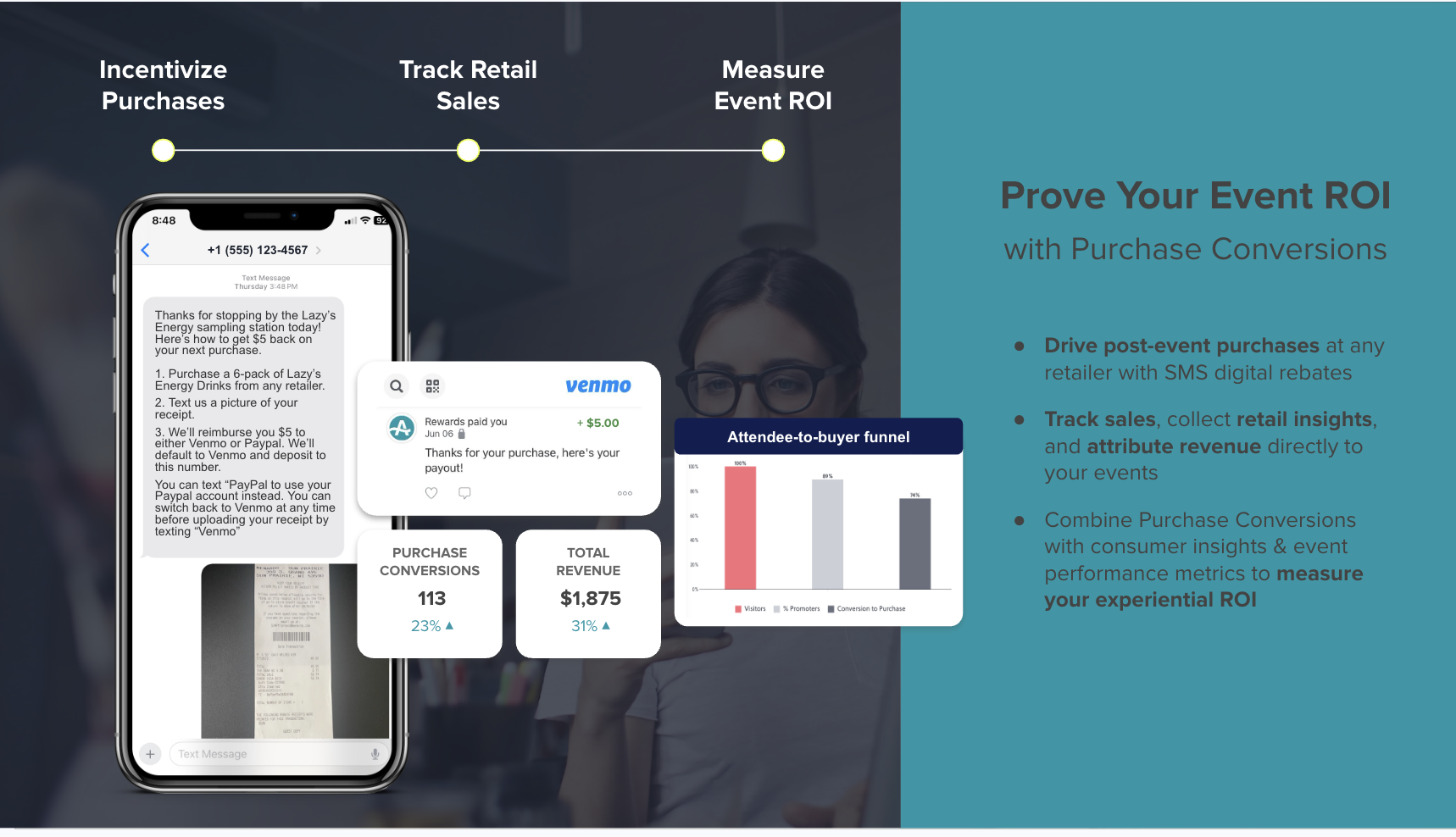
The same mechanic can run as a sweepstakes entry instead of cash back, with AnyRoad handling the regulatory compliance, terms, and privacy policies around it.
Rakuten operates on a fundamentally different model. Rakuten is a consumer shopping portal. Stores pay Rakuten a commission for referring shoppers, and Rakuten keeps a portion while sharing the rest with members as cash back. Rakuten owns the consumer relationship and the purchase data. A brand whose products appear on Rakuten-affiliated retailers benefits from incremental traffic but does not receive a first-party record of who bought, at which retailer, on which date, or in response to which activation. AnyRoad is a platform a brand uses to run its own rebate program, keep the first-party record, and tie the rebate to a receipt-verified purchase. The two models serve different goals. Rakuten drives discovery through a consumer portal. AnyRoad closes the loop between a brand activation and a bottle leaving a shelf, with the brand retaining the data.
For alcohol and CPG brands that need to connect experiential spend to retail sell-through and prove it to a finance team, that distinction separates a depletion report from a verified purchase record. For category-specific guidance, see Alcohol Cash Back: How Promotions & Rebates Work and Cash Back Software Built For Alcohol Brands.

How To Maximize Cash Back Rebates Without Getting Burned
Smart habits help you capture the value of cash back rebates without extra risk or wasted effort.
- Read the exclusions before you buy. Gift cards, alcohol, prescriptions, shipping, and third-party marketplace sales are commonly excluded from portal cash back programs.
- Track expiration dates and activation deadlines. A rotating-category card that requires quarterly activation drops to its base rate the moment you miss the window.
- Watch minimum payout thresholds so a small balance does not sit unclaimed. A $5.01 minimum on a portal you use twice a year may never clear.
- Keep receipts and order confirmations until the rebate moves from pending to payable. Missing cash-back claims usually have a deadline measured from the purchase date, and once it passes the balance stays unrecoverable regardless of evidence.
- Understand who owns your data. A portal keeps the consumer relationship and the purchase record. A brand-run program keeps the first-party record, which connects an activation to a sale and makes the next campaign smarter.
Frequently Asked Questions
Is Cash Back Just Free Money?
Cash back always ties back to a funding source. Every cash back rebate is funded by a fee or budget attached to your purchase. A card issuer shares interchange revenue, a portal shares affiliate commission, and a brand spends from its marketing budget. Knowing the source helps you judge what the offer is worth and which behavior it is designed to buy.
What Does $200 Cash Back Mean?
$200 cash back means the offer provider will return $200 to you after you complete a qualifying purchase and meet any verification requirements. On a credit card, it typically means you must spend a set amount within a specified window to trigger a welcome bonus. On a brand rebate, it means you buy a qualifying product, submit proof of purchase, and receive $200 via the program's payout method once the receipt is validated.
How Long Does It Take To Get Cash Back?
Timing varies by funding source. As noted earlier, card cash back usually posts in one to two billing cycles, and portal cash back waits out the retailer's return window. Brand-funded post-purchase rebates can pay as soon as the receipt is verified, often within days, because the brand controls the payout timeline.
Can Cash Back Be Transferred To A Bank Account?
Most programs allow transfers to a bank account. Common payout methods include direct deposit to a checking or savings account, PayPal, Venmo, a mailed check, or a statement credit. Some programs, like Fetch Rewards, pay only in gift cards with no bank transfer option. Always confirm the available payout methods before committing to a program, particularly if you want actual cash rather than store credit.
Is Cash Back Taxable?
Cash back earned by making purchases is generally not taxable income. The IRS treats it as a rebate, a reduction in the price paid, rather than as income. Rewards not tied to a purchase, such as sign-up bonuses or referral bonuses that require no spending, can receive different tax treatment and may be reportable. If you are uncertain about a specific bonus, consult a tax professional.
Conclusion: Follow The Money
The funding source tells you what a cash back offer is worth and which behavior it aims to influence. A brand that runs its own receipt-verified rebate keeps both the proof and the relationship. That is the model AnyRoad built, with first-party data at activation, AI-verified receipts, and fast Venmo or PayPal payouts.
For category-specific guidance, see Cash Back Rebates For Craft Breweries: How To Launch One, Cash Back Rebates For Distilleries: An Operator's Guide, and Cash Back Compliance For Spirits: TTB Rules & Program Guide.