


Written by: Bryan Grobstein, Vice President, Global Revenue, AnyRoad
Key Takeaways For Alcohol And CPG Brand Homes
- A phygital shopper marketing experience fuses a physical touchpoint with a digital layer that captures data, drives conversion, and sustains the relationship after the guest leaves.
- In alcohol and CPG brand homes, phygital mechanics must survive age verification, comply with federal and state regulation, and route transactions through a licensed path.
- The five-stage journey framework maps specific conversion actions across the lifecycle: Discover, Engage, Consider, Buy, and Return.
- Receipt-verified cashback rebates and on-site club enrollment create first-party records tied to verified purchases without requiring POS integration.
- AnyRoad is built for regulated, experience-led categories and focuses on making the physical moment measurable and the digital moment sensory.
See how AnyRoad turns tastings into first-party data.
Executive Overview: The Phygital Landscape In Regulated Categories
Three terms anchor this space and describe distinct parts of the same journey.
- Phygital Experience: The customer's lived journey when a single interaction crosses physical and digital simultaneously, such as scanning a QR code at a tasting bar and enrolling in a bottle club before leaving the room.
- Phygital Retail: The broader operating model in which physical retail locations use digital tools like check-in apps, age verification, and cashback mechanics that make in-store behavior measurable and actionable.
- Phygital App: The mobile or web-based interface that bridges the physical moment and the digital record. In alcohol, this is typically the brand's booking experience, the Front Desk check-in app, or the AnyRoad Live mobile app used at ambassador tastings.
For alcohol and CPG brand homes, phygital strategy sits at the intersection of four priorities: brand building, marketing measurement, first-party data capture, and recurring revenue. A tasting room visit is simultaneously a brand moment, a data capture event, a conversion opportunity, and the highest-leverage point in the customer lifecycle.
Own the guest journey, own your guest data.
Industry Landscape And Evolution For Alcohol Brand Homes
To understand why alcohol needs its own phygital playbook, it helps to look at how most coverage treats the topic. Most published coverage of phygital retail is written for apparel, grocery, and cosmetics. It is also largely undated or pre-2024, recycling the same examples: buy-online-pick-up-in-store, AR try-on, endless-aisle kiosks. Budgets are flowing into BOPIS and clienteling apps, but reporting still focuses on store sales versus online sales rather than the full customer journey. No competitor on the current SERP addresses compliance, age verification, or the three-tier system.
The alcohol vertical has evolved past those novelties. The meaningful phygital mechanics in spirits today are receipt-verified cashback rebates that close the loop between an ambassador tasting and a bottle leaving a shelf, on-site club enrollment that converts a tasting room visit into a recurring revenue relationship, and first-party data capture at check-in that gives the brand a named, opted-in consumer record instead of a depletion report.
Legacy and fragmented approaches create compounding limitations. A brand running disconnected booking, ticketing, and payment tools loses the data thread between the visit and the follow-up. A brand attempting to build a bottle club by stitching together an ecommerce provider, subscription billing software, a fulfillment partner, and internal headcount ends up with a program that is expensive to maintain, alcohol-naive at every component, and difficult to scale without dedicated staff.
Prove future retail sales impact from your experiences.
Five-Stage Phygital Journey Framework For Alcohol And CPG
This framework maps phygital mechanics to the alcohol and CPG brand-home reality across five stages. Each stage focuses on a specific conversion action rather than a generic tool category.
- Discover: QR codes and connected sampling route a shelf or tasting-bar moment into a branded digital journey. A guest scans a shelf talker at a third-party retailer, lands on a branded page, and enters the brand's first-party data ecosystem before purchasing anything. Dynamic QR codes allow the destination to update without reprinting physical assets already in distribution.
- Engage: On-site data capture at check-in, custom questions before, during, and after the experience, and FullView capture from every attendee in a group, not just the booker, build a complete consumer record. Campari Group's partnership with AnyRoad enabled a 3X increase in marketing opt-in rates from brand home registrations and helped identify brand champions.
- Consider: Age verification and Integrated ID Scanning embedded in the booking and check-in flow satisfy compliance requirements without friction. Tiered experience pricing, often a $20, $50, and $150 ladder, surfaces higher-value guests and identifies the individuals most likely to convert into club members. Club-only expressions create a consideration trigger that standard retail cannot replicate.
- Buy: Receipt-verified cashback rebates and sweepstakes entries sent by SMS convert the activation into a measurable purchase. On-site club enrollment during the visit is the highest-converting channel in the entire funnel. The phygital shopping experience closes at a verified transaction rather than a depletion estimate.
- Return: Managed CRM follow-up, virtual and on-site cocktail-making classes with master distillers, and quarterly release programming keep members engaged between allocations and address the depletion problem that drives churn at the six-release mark.
Real Phygital Mechanics In Alcohol And CPG
Two mechanics carry most of the phygital weight in alcohol today: receipt-verified cashback rebates and on-site club enrollment. The first is the most precise conversion tool available to brands operating outside their own tasting room. At an ambassador tasting inside a third-party retailer or an on-premise account, a guest scans a QR code and registers on the spot via the AnyRoad Live mobile app. They receive an SMS with a cashback rebate redeemable anywhere the product is sold. They buy the bottle, photograph the receipt, and text it back. AnyRoad's AI reads the receipt, confirms the eligible SKU, and pays the rebate via Venmo or PayPal. No POS integration is required. The receipt is the proof-of-purchase artifact, and it is what makes on-premise conversion tracking possible at all.
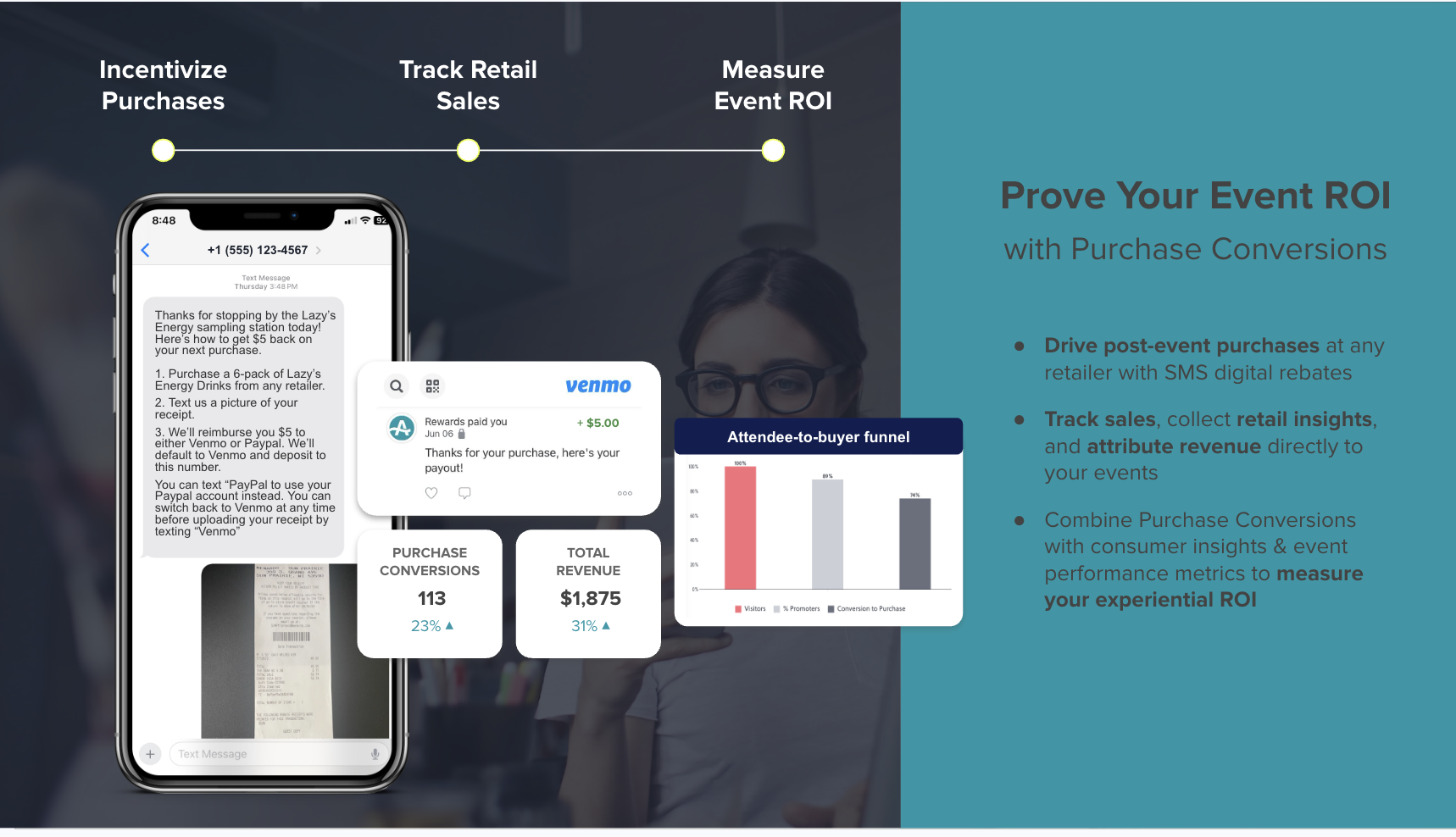
In an early, small-sample, one-month pilot with a single unnamed craft brand, 56% of the records collected converted to a bottle purchase. That figure comes from a limited dataset and should not be read as a platform benchmark. It illustrates the mechanism: every redemption produces a first-party record tied to a receipt-verified purchase, connecting experiential spend to retail sell-through in a way a depletion report never can.
QR-to-club enrollment at the tasting room operates on the same data infrastructure. A coached tour guide makes the pitch at the end of a tasting, the guest scans a code, and enrollment happens before they leave the building. The endless-aisle mechanic in brand homes extends the product catalog beyond what is physically on the shelf, allowing guests to purchase club-only expressions or limited releases on-site through a Shopify-integrated experience operated by AnyRoad's licensed ecommerce retail partner.
Phygital Marketing Examples In Alcohol Brand Homes
Here are three examples of phygital marketing in practice. First, a worked journey from tasting bar to repeat purchase: a guest arrives at a distillery, checks in via QR code on the AnyRoad Front Desk app, answers custom questions during the experience, and receives a post-visit SMS with a cashback rebate on the brand's flagship expression. They buy the bottle at their local retailer, submit the receipt, and receive the rebate via Venmo. Three weeks later, they receive a managed CRM communication about a club-only barrel release and enroll. Six months later, they attend a virtual cocktail class with the master distiller, work through their current allocation, and receive the next release without skipping.
Second, a real platform launch: AnyRoad's Lifetime Loyalty platform launched publicly on February 20, 2025, with Bottle Clubs and Premium Memberships as its two core offerings. Heritage distilleries including Heaven Hill Distillery, Nearest Green Distillery, and Lux Row Distillers, alongside craft brands such as Castle & Key, Catoctin Creek Distilling, and Tarnished Truth Distilling, are among the publicly announced Lifetime Loyalty customers.
Third, earlier case studies that demonstrate the measurement framework at work. Using AnyRoad analytics, Diageo measured a 16-point NPS increase from pre-visit to post-visit at Johnnie Walker Princes Street, and found that new demographics were more likely to drink whisky after visiting. Absolut Home increased average revenue per guest by 36% since 2018 and achieved an 85% brand conversion rate post-event. An artisanal mezcal brand running festival activations with AnyRoad achieved 85% post-event purchase intent.
How To Measure A Phygital Shopper Marketing Experience
The measurement gap on the SERP is significant. Most existing coverage offers vague lifetime value claims with no mechanism. The mechanism in alcohol is receipt-verified purchase attribution, and it works without POS integration.
The foundational numbers for alcohol brand homes come from AnyRoad's own reporting. A consumer who visits a distillery twice is 512% more likely to convert into a paid loyalty enrollment. A single retail bottle purchase is worth roughly $100 to a brand. A club member who stays through six releases is worth roughly $600. Experience-driven opt-ins convert to paid loyalty at four times the rate of traditional channels, with member spending increasing 150% within the first year, according to AnyRoad's own reporting.
The six-release mark is the churn inflection point. Members who have not depleted what they already own begin skipping and pausing, and churn concentrates there. That is a product-consumption problem, not a marketing problem. Programming like virtual cocktail classes with master distillers outperforms discounting as a retention tool. Getting a member through their current allocation primes them for the next release.
Atlas Insights, AnyRoad's analytics engine, measures Brand Affinity, Net Promoter Score, and purchase intent at the experience level. PinPoint's AI-powered feedback analysis turns thousands of open-text survey responses into themes, sentiment drivers, and actionable suggestions in real time. "With AnyRoad, we are able to measure NPS, Brand Conversion, and more, providing us with solid data that shows the positive impact the JWPS experience is having on our guests. We can then follow up with them to create a lifelong relationship with our brand."

Phygital Marketing In Alcohol And Regulated Categories
Measurement is only half the story. The compliance constraints that shape phygital marketing in alcohol are the operating environment, and no competitor on the current SERP addresses them.
Age verification is the first gate. Under DISCUS guidelines, alcohol brands' privacy policies must require an individual to affirm they are of legal purchase age before any information is collected, and user information can only be collected from individuals of legal purchase age. AnyRoad's Integrated ID Scanning embeds age verification directly into the booking and check-in flow, satisfying this requirement without routing guests to a third-party verification page.
The three-tier system is the second constraint. A spirits brand is not a licensed retailer or wholesaler. It cannot ship its own club product to consumers in most states. Only about 14 states currently allow direct-to-consumer spirits shipping, compared with 47 for wine, and each destination state charges its own DTC license fee plus monthly or quarterly excise tax filings.
AnyRoad is not a licensed retailer or wholesaler and does not sell, ship, or distribute alcohol itself. It acts as the brand's agent and maintains a strategic partnership with a licensed ecommerce retailer that handles the transaction and compliant delivery. The consumer gets a transactional, Shopify-integrated purchase experience. The brand gets a club that stays compliant with federal and state regulation. Structured transaction and customer data passes to the brand's existing ERP, such as SAP, NetSuite, or Zuora, which handles tax remittance and recordkeeping, with three-tier routing coordinated through that system.
Social and digital marketing in alcohol carries its own compliance layer. The Beer Institute, DISCUS, and Wine Institute codes state that digital marketing communications should appear only where at least 73.8% of the audience is reasonably expected to be of legal purchase age, and that digital marketing involving direct interaction with a user must require age affirmation before engagement. Any phygital mechanic that routes a consumer from a physical touchpoint into a digital journey, such as a QR scan, an SMS opt-in, or a sweepstakes entry, must satisfy these requirements before data is collected.
Why AnyRoad Is Built For Phygital Shopper Marketing Experiences
AnyRoad focuses on making the physical moment measurable and the digital moment sensory at the same time, for regulated, experience-led categories. Its four pillars address every stage of the phygital journey.

Experience Manager provides centralized management of every experience type, including recurring tours and classes, large-scale events, and field activations, from a single platform. Scheduling, resource management, and logistics are automated, freeing staff to focus on the guest rather than the spreadsheet.
Guest Experience delivers a fully white-labeled, configurable booking experience embedded directly on the brand's website. The Front Desk app handles QR code check-ins and on-site payments. FullView captures data from every attendee in a group, not just the booker, addressing the problem Proximo Spirits identified when they discovered they were missing contact information for over 66% of their guests before implementing AnyRoad's FullView feature, after which they immediately began collecting 69% more guest data. Integrated ID Scanning provides embedded age verification.

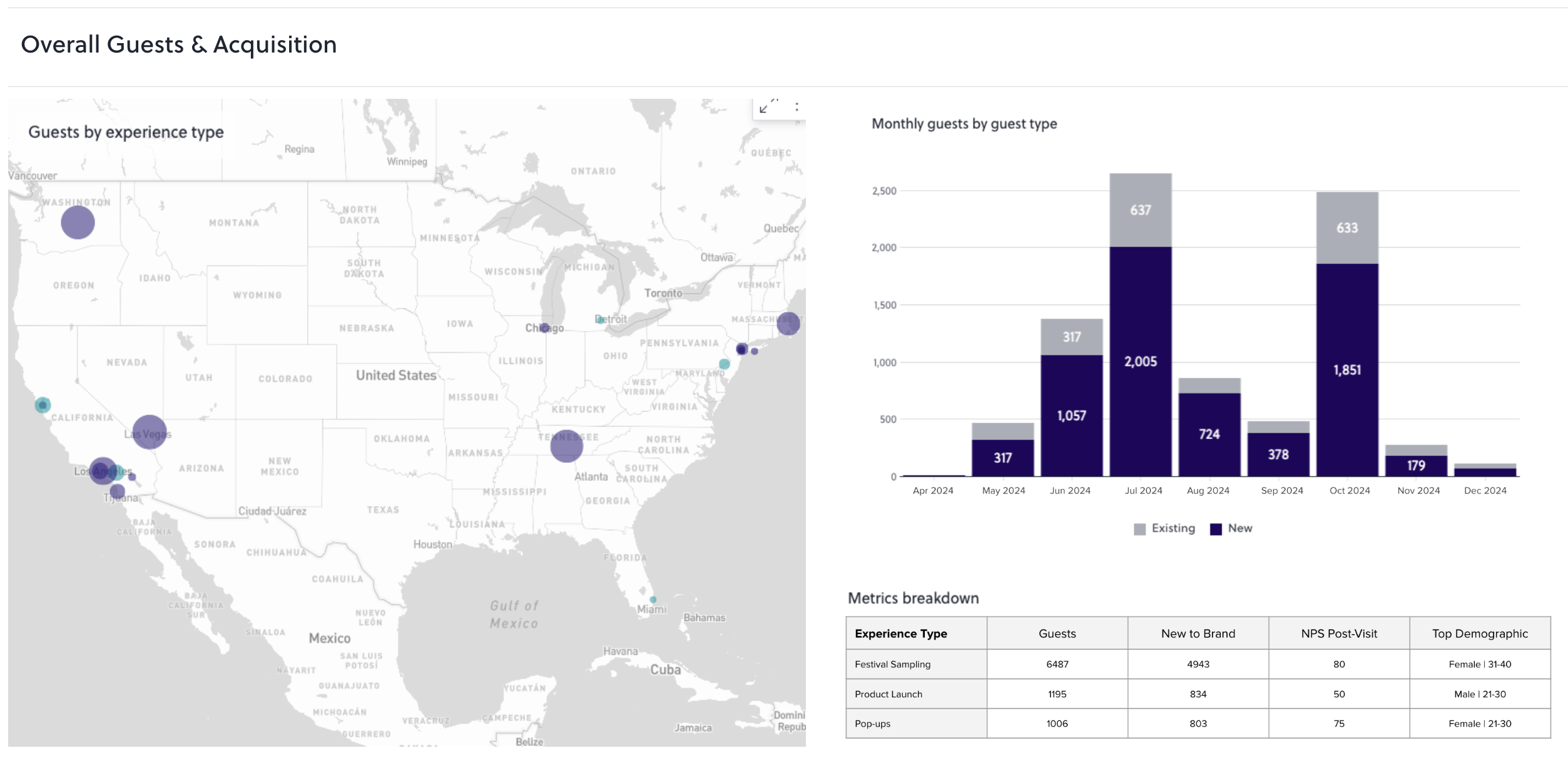
Atlas Insights measures Brand Affinity, NPS, and purchase intent. PinPoint's AI-powered feedback analysis turns open-text survey responses into themes, sentiment drivers, and actionable suggestions in real time. This is the tool that allowed Leiper's Fork Distillery's manager to reduce management reporting time from a day and a half to just 90 minutes.
Lifetime Loyalty covers five offerings: Bottle Clubs, Premium Memberships, cashback rebates, punch card experiences, and sweepstakes. The differentiator against alternatives is the combination of software, expertise, and an operating team. Enrollment happens because a coached tour guide makes the pitch at the end of a tasting, not simply because a page exists. AnyRoad's white-glove team includes spirits industry operators and consultants who have built and run some of the largest spirits clubs in the country. A team of roughly ten people supports fulfillment and best-practice strategy across accounts.
Strategic Considerations And Trade-Offs For Alcohol Brands
The major decisions organizations face when building a phygital program in alcohol fall into five categories.
- Resourcing: A craft distillery with a busy tasting room and no dedicated lifecycle marketer is as much a fit for AnyRoad's managed services as a heritage brand with a large budget. That is because many alcohol brands lack in-house lifecycle expertise and fall back on costly, non-specialized agencies, which is exactly why the managed CRM offering exists. Enterprise scale or a staffed marketing department is not a prerequisite.
- Technology Approach: The choice is between a unified platform that carries booking, data capture, analytics, club management, and CRM in one system, or a fragmented stack assembled from best-of-breed point solutions. Fragmented stacks require integration maintenance, produce data silos, and attach no alcohol-specific expertise to any component.
- Measurement: Define the KPI before launch. Receipt-verified purchase rate, second-visit conversion, club enrollment rate, and six-release retention are the metrics that connect experiential spend to business outcomes. Vanity metrics such as scan volume and attendance do not survive a budget meeting.
- Compliance Governance: Age verification, DISCUS digital marketing codes, and the licensed retail path are mandatory layers. Teams must design them into the phygital mechanic from the start rather than retrofit them after launch.
- Cross-Functional Ownership: A phygital initiative requires at minimum a marketing lead who owns the customer experience vision and pilot success metric, an operations or store liaison who translates strategy to the sales floor, and a data or analytics owner who builds the tracking layer connecting digital and physical events.
Implementation And Readiness Guidance For Brand Homes
Once those strategic decisions are made, the rollout itself follows a consistent sequence. Start with data capture and check-in. Instrument the tasting room visit before building the conversion layer on top of it. A brand that does not know who attended last Saturday cannot run a meaningful cashback campaign on Monday.
After data capture is operational, add the conversion mechanic. For tasting rooms, that means on-site club enrollment with a coached pitch and a tiered experience structure. AnyRoad advises brands to anchor high by building good, better, and best experience tiers, often a $20, $50, and $150 ladder, rather than a single offering. Tiered experiences attract higher-value guests and surface the individuals who attend multiple times and are most likely to convert into members.
For third-party retail and on-premise activations, the cashback rebate mechanic is the entry point. It requires no POS integration, deploys across trade accounts at scale, and produces a first-party record tied to a receipt-verified purchase from day one.
On-site enrollment during a distillery visit is the highest-converting channel in the funnel. The second visit is the signal that a guest is ready to be asked. Teams should build the enrollment experience around that moment rather than around a post-visit email sequence.
Turn tasting room visits into recurring revenue.
Common Pitfalls To Avoid In Phygital Programs
- Technology For Its Own Sake: The most common phygital failure mode is sequencing. Teams buy the AR platform or sensor system before fixing basic data plumbing between point-of-sale and CRM systems, so the flashy tactic launches on top of a broken foundation. A QR code on top of clean, unified data outperforms an AR experience on top of disconnected systems every time.
- No Data Capture: Hosting 24,000 visitors annually without knowing who they are is a missed acquisition opportunity at scale, not a brand home strategy. The fix is to capture data from every attendee in a group, not just the booker, which is why FullView is the baseline.
- No Follow-Up: The visit is the beginning of the relationship, not the end. A consumer who visits twice is 512% more likely to convert into a paid loyalty enrollment. Without a systematic follow-up mechanic, that signal goes unacted on.
- Treating Retention As A Pure Marketing Problem: Members stop because they have not finished what they own, not because the emails stopped. Discounting does not solve a depletion problem. Virtual cocktail classes with master distillers that get members through their current allocation do.
- Assembling A Fragmented DIY Club Stack: An ecommerce provider plus subscription billing software plus a fulfillment partner plus internal headcount produces a program the brand must maintain forever, with no alcohol expertise attached to any component and no single partner accountable for the outcome.
Frequently Asked Questions
What Are Phygital Experiences?
A phygital experience is a single customer journey that combines a physical touchpoint with a digital layer in the same moment. In alcohol and CPG brand homes, the specific mechanics include QR-to-club enrollment at a tasting room check-in, receipt-verified cashback rebates sent by SMS after an ambassador tasting, age-verified booking flows embedded on the brand's website, and FullView data capture from every attendee in a group, not just the person who booked. In this article, that journey is mapped across five stages: Discover, Engage, Consider, Buy, and Return. The term was first coined in 2013 by the Australian marketing agency Momentum and has since been applied across retail, education, banking, and insurance, but the regulated-category mechanics described here are specific to alcohol and CPG brand homes.
Can You Give Me An Example Of Phygital Marketing?
A spirits brand runs an ambassador tasting inside a Total Wine location. The brand ambassador deploys the AnyRoad Live mobile app. Guests scan a QR code, register on the spot, and receive an SMS with a cashback rebate redeemable anywhere the product is sold. They buy the bottle, photograph the receipt, and text it back. AnyRoad's AI reads the receipt, confirms the eligible SKU, and pays the rebate via Venmo or PayPal. The brand now has a first-party consumer record, a receipt-verified purchase, and a named individual in its CRM, none of which a depletion report would have produced. No POS integration with the retailer was required at any point.
How Do You Measure A Phygital Shopper Marketing Experience Without POS Integration?
Receipt-verified purchase attribution is the mechanism. After a physical activation such as a tasting room visit, an ambassador tasting, or a festival activation, the consumer receives an SMS with a cashback rebate or sweepstakes entry. They purchase the product at any retailer, photograph the receipt, and submit it. AI reads the receipt, confirms the eligible SKU, and pays the rebate. The result is a first-party record tied to a verified transaction, with SKU-level detail, retailer, date, and consumer identity, without asking any retailer to open its POS system. The benchmarks are the same ones described in the measurement section: second-visit conversion, single-bottle value versus member lifetime value, and six-release retention.
What Compliance Considerations Apply To Phygital Marketing In Alcohol?
Three layers of compliance govern phygital marketing in alcohol. First, age verification. DISCUS guidelines require that privacy policies mandate age affirmation before any consumer information is collected, and that digital marketing involving direct interaction with a user require age affirmation before engagement. Any QR scan, SMS opt-in, or sweepstakes entry must satisfy this requirement. Second, the three-tier system. A spirits brand cannot ship its own club product to consumers in most states. Only about 14 states currently allow direct-to-consumer spirits shipping. A compliant club model requires a licensed retailer in the transactional path. AnyRoad maintains a strategic partnership with a licensed ecommerce retailer that handles the transaction and compliant delivery, while AnyRoad itself does not sell, ship, or distribute alcohol. Third, digital advertising codes. The Beer Institute, DISCUS, and Wine Institute codes require that digital marketing communications appear only where at least 73.8% of the audience is reasonably expected to be of legal purchase age, and that brands monitor and moderate user-generated content on brand-controlled pages regularly.
Conclusion: The Strategic Imperative For Phygital Shopper Marketing Experiences
Phygital shopper marketing in alcohol is a design discipline built around the moments where a physical touchpoint can be made measurable and a digital layer can be made sensory. The five-stage journey framework, Discover, Engage, Consider, Buy, and Return, maps the specific mechanics that operate at each stage, from QR-connected sampling to receipt-verified cashback to managed CRM follow-up.
The measurement story is no longer theoretical. Receipt-verified purchase attribution closes the loop between an activation and a bottle leaving a shelf without POS integration. The benchmarks described earlier, including second-visit conversion, lifetime value progression, and six-release retention, give field marketing managers, brand home managers, and DTC leaders the numbers they need to walk into a budget meeting with a credible plan.
The compliance layer, including age verification, the licensed retail partnership, and the DISCUS digital marketing codes, defines how phygital marketing in alcohol must operate. Brands that build their phygital programs around this reality rather than around generic retail advice will own the category.
Know which bottles your activation actually sold.