


Written by: Bryan Grobstein, Vice President, Global Revenue, AnyRoad | Last updated: October 22, 2026
Key Takeaways
- Most tasting-room “rebates” function as discounts at checkout with no post-purchase verification or proof that a bottle was bought.
- Only receipt-verified cashback rebates create a first-party record tied to a specific SKU, guest, and purchase location.
- Common tasting-room incentives like tasting-fee credits, bottle credits, wine-club signups, regional passports, and travel perks do not produce verified proof of purchase.
- AnyRoad’s receipt-verified cashback rebate works without POS integration, uses AI to validate receipts, and pays guests via Venmo or PayPal.
- AnyRoad’s receipt-verified cashback rebate is the only model here that produces a verified proof of purchase.
See The Receipt-Verified Rebate In Action
What Counts As A Rebate Program For Tasting Room Visitors?
A rebate program for tasting room visitors pays value back to a guest after a verified purchase. The payment comes after the transaction, not at the register.
The rebate is conditional on proof that a transaction occurred, which means the program produces a record by design. A discount is applied at the point of sale with no post-purchase verification. The price drops, the guest leaves, and the brand has no way to confirm what was bought, where, or by whom.
A true rebate is paid after a verified purchase and produces a record the brand can attribute to a specific guest and a specific SKU. That discount-versus-rebate line determines whether a tasting-room incentive program can be defended to leadership and connected to retail sell-through.
The Main Types Of Tasting Room Incentive Programs
Tasting room incentive programs fall into six documented categories: five that reduce cost at the point of sale or travel, and one receipt-verified cashback model that pays after a verified purchase.
Tasting Fee Credited Toward Purchase
The most common tasting room incentive structure charges a fee up front and credits it against a same-day bottle purchase. Standard US flights typically run $20–$50 per person, and Oxto lists a $35 median standard fee across 800+ wineries. Premium markets sit higher: Napa Valley’s median is $65, while Sonoma County’s median holds at $40.
Common thresholds require one or two bottles per person or per couple. Reserve, library, and food-paired tastings are the least likely to be credited. The credit changes the economics of the visit. A guest already planning to buy a bottle pays nothing for the tasting. A guest who was not planning to buy may spend $40 on a bottle to recover a $25 fee, which increases spend instead of creating a saving.
A tasting-fee credit only produces a real saving for a visitor who already intended to buy wine. Operators should measure incremental purchases instead of counting every redemption as a conversion.
The tasting-fee-waived-with-purchase model is widespread. Of the 64 wineries on Oxto that have recorded a tasting-fee policy, 20 waive the fee with a purchase, roughly one in three. Gatlinburg, Tennessee illustrates a regulated variant. A city ordinance requires distilleries within city limits to charge a nominal $5 tasting fee, which nearly every distillery applies as a $5 credit toward a same-visit purchase.
Bottle Credits And Promotional Events
CellarPass is an example of a platform that supports per-bottle credits and promotional events administered as discounts at the point of sale. These incentives scale with volume and sit inside the reservation and ticketing flow.
The model is built around a wine-country directory concentrated in Napa and Sonoma. Its documented features cover ticketing, reservations, and guest data. CellarPass does not advertise receipt-verified cashback rebate functionality or verified post-visit bottle purchase tracking.
That trade-off is clear. Bottle credits and promotional events administered at the point of sale do not produce a receipt-verified proof of purchase or a first-party record tied to a bottle actually bought. A brand using CellarPass for incentive programs cannot attribute a specific sale to a specific guest or show leadership that the program drove a verified purchase.
Wine Club Signup Credits
Many tasting rooms offer an immediate credit or discount for joining a wine club on-site. Wine club membership is the most reliable path to a complimentary tasting for repeat visitors.
The data captured in a club signup is an enrollment record that includes name, contact, and payment method. It is not a verified bottle purchase. Club enrollment is a meaningful first-party data point, yet it does not confirm that a specific SKU left a specific shelf.
Regional Passports And Multi-Winery Programs
Regional passport programs aggregate tasting benefits across multiple producers and sell access as a single purchase. The Sip Spokane Passport is a $50 physical booklet sold by the Spokane Winery Association that runs March through February and advertises roughly $300 in savings across 16+ area wineries and specialty wine shops.
Priority Wine Pass scales the same idea regionally. A $69 first year ($35 renewal) buys 2-for-1 tastings and per-winery perks at 330+ partners across Napa, Sonoma, Paso Robles, Oregon, and other regions. Priority Wine Pass states its savings figures are estimates only, calculated by multiplying the average saving per tasting by the number of tastings.
WineryHunt Sonoma operates as a regional discovery and incentive program in Sonoma County. Passport savings are estimated member savings, not guaranteed rebates or cash payments. These programs do not produce a receipt-verified proof of purchase or a first-party record tied to a bottle actually bought.
Travel Incentives
The Oregon Wine Flies Free program, a partnership involving the Oregon Wine Board, Alaska Airlines, and Travel Oregon, lets passengers check one case of up to 12 bottles weighing 50 pounds or less at no charge from participating departure airports. The program requires travelers to be at least 21 and to be Atmos Rewards members, and covers 34 departure airports across California, Idaho, Oregon, and Washington.
Beaux Frères’ Classic tasting is $65 per person and is waived with the purchase of two bottles per guest. This travel-adjacent incentive lowers the cost of the visit, not the bottle. These programs reduce travel or tasting cost and leave no post-purchase record tied to a specific bottle.
Receipt-Verified Cashback Rebates
AnyRoad’s receipt-verified cashback rebate is the only model in the category that produces proof of purchase and a first-party customer record. The mechanic runs on the receipt, so it works in any retail or on-premise account without asking a retailer to integrate anything.

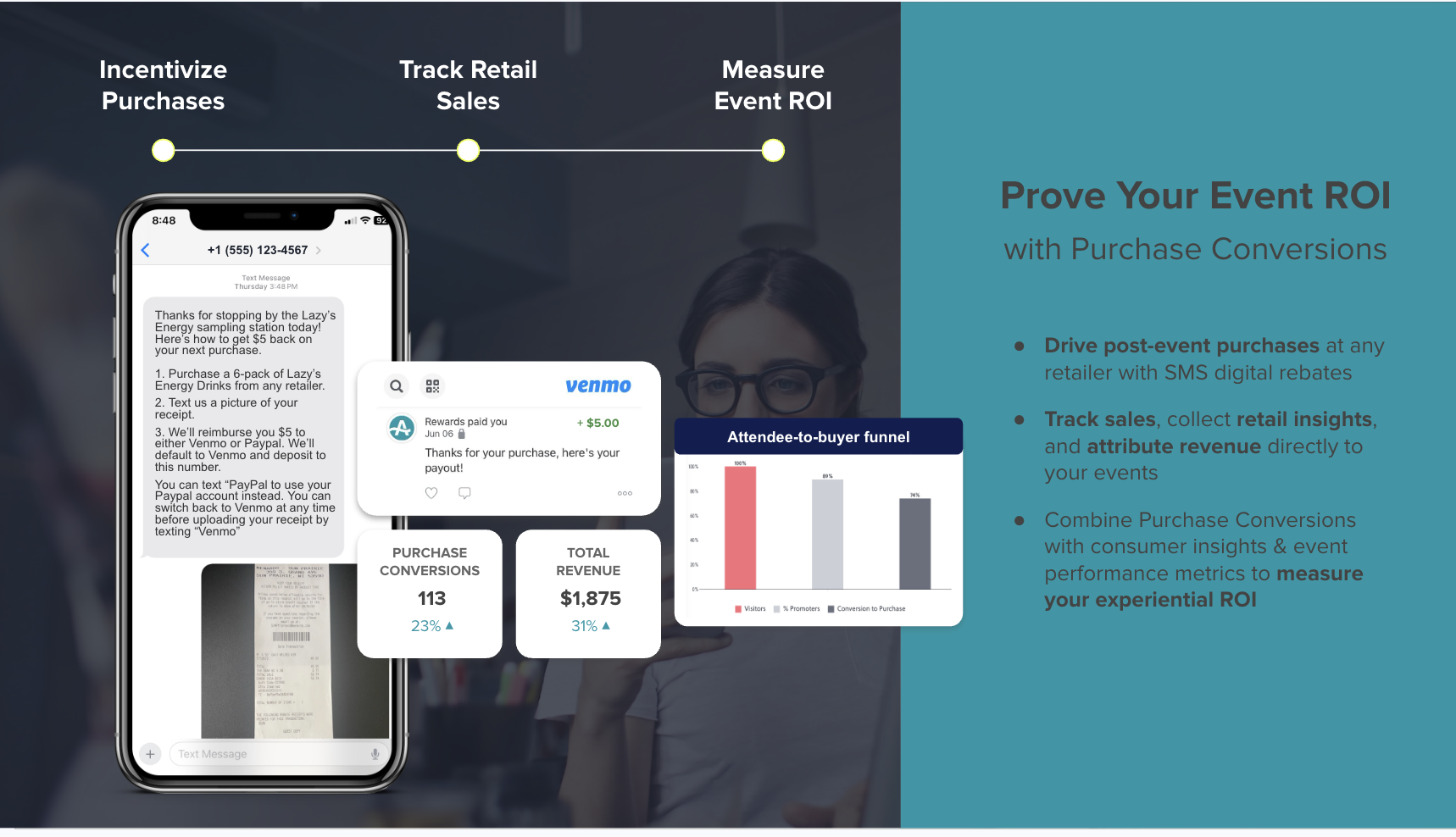
Guests scan a QR code at the tasting, register via AnyRoad Live, receive an SMS with the cashback offer, buy the bottle anywhere the product is sold, photograph the receipt, and submit it. AnyRoad’s AI reads the receipt, confirms the eligible SKU, and pays the rebate via Venmo or PayPal. Every redemption produces a first-party record tied to a verified purchase.
For a deeper look at the mechanic in a spirits context, see Cash Back Rebates For Distilleries: An Operator’s Guide.
Launch A Verified Rebate Program
Tasting Fee Credit Vs Cashback Rebate: How The Program Types Compare
This comparison focuses on three criteria that matter to leadership: a verified proof of purchase, a first-party record tied to a specific guest, and no POS integration at the retail account. AnyRoad’s receipt-verified cashback rebate is the only model that meets all three.
- Receipt-Verified Cashback Rebate (AnyRoad). Administered by QR scan, SMS registration, and receipt photo. AI validates the SKU and pays via Venmo or PayPal. Captures a first-party guest record, verified SKU, purchase location, and redemption timestamp. Produces a verified proof of purchase.
- Tasting Fee Credit. Fee is charged at booking or arrival and credited against a same-day bottle purchase at the register. Captures a booking record only, with no post-visit purchase record. Does not produce a verified proof of purchase.
- Bottle Credit Or Promotional Event. Per-bottle discount or event credit is applied at the point of sale. Captures a transaction record in the POS but no receipt-verified post-visit record. Does not produce a verified proof of purchase.
- Wine Club Signup Credit. Immediate discount or complimentary tasting is granted at enrollment. Captures an enrollment record with name, contact, and payment details, not a verified bottle purchase. Does not produce a verified proof of purchase.
- Regional Passport. Physical booklet or digital pass is shown at participating wineries for estimated savings. Captures a pass purchase record with no per-visit or per-bottle purchase record. Does not produce a verified proof of purchase.
- Travel Incentive. Airline or tourism program waives a bag fee or tasting fee for qualifying travelers. Captures loyalty program membership or booking data, not bottle-level purchase data. Does not produce a verified proof of purchase.
How A Receipt-Verified Cashback Rebate Works In Five Steps
The AnyRoad cashback rebate mechanic follows a five-step sequence that closes the loop between a tasting-room visit and a verified bottle purchase.

- The guest scans a QR code at the tasting and registers via AnyRoad Live, creating a first-party record at the point of activation.
- The guest receives an SMS with the cashback offer, redeemable anywhere the product is sold at retail, on-premise, or at the brand’s own tasting room.
- The guest buys the bottle at any licensed retailer and photographs the receipt.
- AnyRoad’s AI reads the receipt and confirms the eligible SKU, rejecting submissions that do not match the qualifying product.
- The rebate is paid via Venmo or PayPal, and the purchase is recorded as a first-party data point tied to the original guest registration.
No POS integration is required at any step. The mechanic works across trade accounts at scale. That includes ambassador tastings inside third-party retailers and on-premise accounts, where a depletion report has historically been the only available measure of whether an activation worked. In a one-month ambassador tasting pilot with a craft brand, an early small-sample result, 56% of the records collected converted to a bottle purchase.
Compliance And Exclusions To Plan For
Alcohol rebate rules vary by state and require legal review before any program launches. The permissibility of alcohol marketing and promotions is one of the most complicated legal issues an alcohol business will face. A program legal in one market may be non-compliant in another.
Key areas to review include stacking restrictions against trade discounts, per-household submission caps, tiered volume thresholds, and state-specific exclusions. Some states prohibit consumer rebates on malt beverages outright or impose conditions that effectively limit their availability. That variation explains why rebate offers often carry “not valid in all states” language.
AnyRoad handles regulatory compliance around sweepstakes variants of the mechanic, including terms and conditions and privacy policies. AnyRoad acts as the brand’s agent and is not a licensed retailer or wholesaler. The compliant transaction runs through its licensed ecommerce partner, and AnyRoad does not sell, ship, or distribute alcohol.
How To Measure Whether Your Rebate Program Worked
Once a compliant program is running, the focus shifts from legality to proof. The three metrics that matter for a receipt-verified cashback rebate are conversion from visit to verified purchase, first-party records captured, and opt-in rate.

Conversion from visit to verified purchase is the only metric that connects experiential spend to retail sell-through. The other two metrics measure the size and quality of the first-party database the program builds. For the formulas, KPI definitions, and attribution models that turn those metrics into a defensible ROI case, see How To Prove Tasting Room ROI: Formulas, KPIs & Attribution.
A cohort-based analysis records visit date, incentive exposure, contact permission, and subsequent verified purchase. That structure lets a brand compare rebate cohorts against non-incentivized visitors and isolate the program’s incremental effect.
Get Your Attribution Walkthrough
Conclusion
Tasting room incentive programs span six documented models: tasting fee credits, bottle credits and promotional events, wine club signup credits, regional passports, travel incentives, and receipt-verified cashback rebates. The first five reduce cost at the point of sale or at the point of travel and do not produce a receipt-verified proof of purchase or a first-party record tied to a bottle actually bought.
Only the receipt-verified cashback rebate closes that loop. Of the six models, only the receipt-verified cashback rebate leaves the brand with a record it can take to leadership: a named guest, a confirmed SKU, and a purchase date.
Prove Future Retail Sales Impact From Your Experiences. Schedule A Demo.
Frequently Asked Questions
What Is The Difference Between A Tasting Room Discount And A True Rebate Program?
As the opening section explains, a discount closes at the register with no post-purchase record, while a true rebate is paid only after a verified purchase. The operational consequence is that only the rebate produces a first-party record tied to a specific SKU, guest, and purchase location. That record allows a brand to attribute a sale to a tasting-room activation and defend the program’s ROI to leadership.
Do Receipt-Verified Cashback Rebates Require A POS Integration At The Retail Account?
No. AnyRoad’s cashback rebate mechanic runs entirely on the receipt. The guest photographs the receipt after purchase and submits it via SMS. AnyRoad’s AI reads the receipt and confirms the eligible SKU without any connection to the retailer’s point-of-sale system.
The program works in any licensed retail account, including grocery, liquor stores, and on-premise bars, without asking the retailer to install or configure anything. The mechanic is also viable for ambassador tastings inside third-party retailers like Total Wine, where POS integration is not an option, and for on-premise accounts where a bar tab line item for a specific SKU can be verified from the receipt in a way a depletion report never could.
Are Alcohol Cashback Rebates Legal In Every State?
No. Consumer alcohol rebate legality is primarily a state-law question, and the rules vary significantly by state and by beverage category. Some states permit manufacturer-to-consumer rebates with minimal regulation. Others require a state approval process, and some prohibit the practice for certain beverage types entirely.
Stacking restrictions add another layer: rules that prevent a rebate from being combined with a trade discount already in the distribution channel. Caps on per-household submissions, tiered volume thresholds, and exclusions for specific license types also vary by market. Any rebate program should be reviewed by a regulatory attorney before launch, and offers should carry appropriate state-specific exclusion language.
AnyRoad handles regulatory compliance for sweepstakes variants of its mechanic, including terms and conditions and privacy policies, and acts as the brand’s agent rather than as a licensed retailer or wholesaler.
How Do Regional Wine Passport Programs Differ From Cashback Rebates?
Regional passport programs, like the Sip Spokane Passport and Priority Wine Pass described above, aggregate tasting discounts across multiple producers and sell access as a single pass purchase. The savings figures these programs advertise are estimated member savings, not guaranteed rebates or cash payments.
The guest pays for the pass, presents it at participating wineries, and receives a reduced or complimentary tasting. No receipt is submitted, no SKU is verified, and no post-visit purchase record is created. A cashback rebate is paid after a verified bottle purchase anywhere the product is sold and produces a first-party record tied to a specific SKU without requiring the guest to visit a specific set of partner locations.
What First-Party Data Does A Receipt-Verified Cashback Rebate Actually Capture?
When a guest scans a QR code and registers via AnyRoad Live, the brand captures a first-party record at the moment of activation that includes name, contact information, and marketing opt-in status. When the guest submits a receipt, the record is enriched with the verified SKU, the purchase location, the purchase date, and the redemption timestamp.
That combination of guest identity plus verified purchase behavior distinguishes the model from every other tasting room incentive type. It allows the brand to build a segmentable first-party database of guests who have actually bought a bottle, target those guests with personalized follow-up, and calculate a true conversion rate from tasting-room visit to verified retail purchase.