


Written by: Bryan Grobstein, Vice President, Global Revenue, AnyRoad | Last updated: October 16, 2026
Key Takeaways
- CPG brand activation ROI shifts widely based on the measurement method. The same activation can appear to perform extremely well or only modestly depending on how the team measures incremental impact.
- Four primary methodologies prove ROI: test-and-control, retailer-linked attribution, receipt-verified conversion, and survey-based purchase intent. Each carries a different evidentiary standard.
- Incremental ROAS usually runs 30% to 60% below last-click ROAS, so teams must separate platform-reported figures from true incremental lift.
- Receipt-verified conversion ties first-party records to verified transactions without POS integration, which creates the strongest proof of actual purchase.
- AnyRoad helps brands capture first-party data at experiences, verify purchases through receipt-based rebates, and turn visits into measurable lifetime value through club memberships.
See how AnyRoad connects experiential spend to verified retail sales. Book a demo.
How CPG Brand Activation ROI Is Measured
CPG teams rely on four accepted methodologies to prove brand activation ROI. Each method answers a different question and carries a different evidentiary standard.
- Test-and-Control: Compares sales in activated stores or markets against matched controls. Proves causal lift but does not isolate which creative element drove the result.
- Retailer-Linked Attribution: Matches ad exposure to retailer loyalty or POS data. Proves correlation within a retailer’s walled garden but cannot show total brand demand across retailers.
- Receipt-Verified Conversion: Confirms purchase through receipt submission and AI validation. Proves actual purchase without POS integration but requires consumer participation in the rebate or sweepstakes mechanic.
- Survey-Based Purchase Intent: Measures stated likelihood to buy after the experience. Proves persuasion or consideration but does not establish that purchases increased.
The IAB and MRC released Retail Media Measurement Guidelines in January 2024. The guidelines standardize six measurement areas: data quality and processing, audience measurement and metrics, in-store digital-based place measurement, ad delivery and viewability, incrementality, and reporting and transparency. The IAB’s Guidelines for Incremental Measurement in Commerce Media name four accepted incrementality methodologies: experiments, model-based counterfactuals, econometric models, and hybrid proxies. These methods rest on three principles: credible counterfactuals, control of bias, and separation of signal from noise.
For a deeper treatment of how these methods apply across activation types, see AnyRoad’s How to Measure Brand Activation ROI: Complete 2026 Guide and CPG Brand Activation Examples with Measurable ROI.
Incremental ROAS vs. Sales Lift vs. Purchase Intent: What Each Metric Proves
The four measurement methodologies above produce four different metrics: ROAS, incremental ROAS, sales lift, and purchase intent. These metrics are not interchangeable.
LiftLab’s June 2026 CPG Measurement Playbook explains that ROAS, incremental ROAS, sales lift, and purchase intent differ in numerators, denominators, outcome types, time horizons, and evidentiary standards. A figure from one column cannot be ranked directly against a figure from another.
- ROAS: Revenue attributed to a campaign divided by campaign spend. NielsenIQ describes treating ROAS as an incrementality answer as “a category error, and an expensive one.” ROAS answers how much reported revenue was associated with each dollar spent. It does not prove that the campaign caused that revenue.
- Incremental ROAS (iROAS): Revenue from sales that would not have happened without the campaign, divided by campaign spend. This metric requires a defensible counterfactual such as a randomized holdout, a matched-market test, or a modeled baseline.
- Sales Lift: The difference in observed purchase behavior between an exposed test group and a comparable unexposed control group, reported as a percentage of the control group’s sales and as incremental revenue or units.
- Purchase Intent: Survey-measured likelihood to buy. This metric provides a directional indicator rather than a conversion forecast. A 2006 meta-analysis by Webb and Sheeran found that a medium-to-large shift in intention produced only a small-to-medium shift in behavior, and purchase intent scores often need to be discounted by 50% or more to approximate actual conversion.
A 4x ROAS does not equal a 4x profit ROI. ROAS measures revenue, not margin. A campaign can post a 6x reported ROAS and a 2.5x incremental ROAS simultaneously, with the gap widest on branded search where advertisers largely pay to reach demand they already own.
The Incremental ROAS vs. ROAS Distinction
Consider a CPG soda brand running an in-store retail media campaign. The platform dashboard reports a strong headline ROAS. The matched-market incrementality test returns 2.1x incremental ROAS.
The incremental figure isolates new money caused by the activation. The headline figure credits all sales within the attribution window, including purchases that would have happened anyway. Incremental ROAS typically runs 30% to 60% below last-click ROAS, so a 6x dashboard figure could correspond to roughly 2.4x to 4.3x in true lift-over-baseline terms. That gap reflects a failure of the metric used to report the activation’s results, not a failure of the activation itself.
Stop guessing which activations drove sales. See AnyRoad in action.
In-Store Retail Media Activations with Reported ROAS
In-store retail media campaigns show how reported ROAS and incremental ROAS can diverge even within the same channel. The examples below highlight how methodology, not creative quality, drives much of that spread.
The following results are organized in the extractable format: method, example, reported result, source, and caveat.
- Grocery TV’s Lunchables campaign — Platform-reported ROAS of 26x. Source: Grocery TV. Caveat: Platform-reported, not independently verified.
- CPG soda brand in-store retail media — Platform-reported 7.5% sales lift and 2.1x incremental ROAS. Source: Grocery TV. Caveat: Platform-reported; incremental ROAS measured against matched control stores.
- Sargento campaign on Albertsons Media Collective in-store screens — 14% in-store sales lift, $2.41 matched-market incremental ROAS, and more than 5.5 million impressions. Source: Albertsons Media Collective via MediaPost, January 2026. Caveat: Retailer or platform-reported; not independently audited.
- Kraft Heinz “Summer of Savings” at Empire’s Sobeys and Safeway banners — Approximately +1.08% incremental sales lift and about $159,000 in incremental sales. Source: Empire Media+. Caveat: Retailer-reported; full store-selection methodology and confidence intervals not disclosed.
A Grocery TV meta-analysis of 16 incremental sales lift studies across CPG categories found an average 14% incremental lift in sales above baseline. The studies measured lift by comparing stores where advertising ran against matched control stores. This figure is network-reported rather than independently verified.
Offsite and Omnichannel Retail Media: Epsilon’s Soup Brand Case
Offsite and omnichannel retail media show how retailer-linked attribution and matched-market design can produce strong incremental ROAS when the methodology is sound. The Epsilon soup brand case illustrates this clearly.
- Epsilon soup brand campaign — Retailer-linked attribution with matched-market design. A $75K spend produced $603K in incremental SKU sales and an 8.04x incremental ROAS. Source: Epsilon. Caveat: Agency-reported; matched-market design but not independently audited.
- Five-brand Epsilon benchmark — Average SKU incremental ROAS of $3.80:1 across five CPG brands running offsite activations within a national grocery retailer’s retail media network. Source: Epsilon. Caveat: Agency-reported.
Additional platform-reported benchmarks from Instacart show how results vary by category and brand. Torani reported a 67% incremental sales lift and $2.98 incremental ROAS in a six-week Instacart sponsored-product study ending November 2024, while Saffron Road reported a 68% incremental sales lift in a January–February 2024 Instacart study. Both are brand-specific results reported via Instacart’s platform and are not independently audited benchmarks.
Among brands that measure incrementality, 54% reduced wasted spend and 49% increased new-customer acquisition. Both outcomes depend on having a defensible counterfactual.
Product Sampling ROI: What the Data Actually Shows
Product sampling programs often rely on survey-based purchase intent, which produces persuasive numbers but does not confirm actual sales. The examples below show typical reported results and the limits of what each one proves.
- Conversate Collective field marketing events for a CPG beauty brand — Survey-based purchase intent. Seventy-four percent of guests reported they were more likely to purchase the brand’s products after attending. Source: AnyRoad customer story. Caveat: Survey-based; intent is not verified purchase.
- JUST Egg sampling program — Survey-based purchase intent. More than 300 events generated 30,000 data points and a 90% purchase intent score. Source: AnyRoad customer story. Caveat: Intent is not verified purchase.
- PortMA ready-to-serve beverage sampling — Reported ROI with market expansion. Reported 160.9% ROI and market expansion from 7 to 18 markets. Source: PortMA. Caveat: Agency-reported; methodology not disclosed.
The 90% purchase intent figure from JUST Egg and the 74% figure from Conversate Collective indicate persuasion rather than verified sales. Sheeran and Webb (2016) found that intentions explain roughly 30% of the variance in actual behavior, with the remaining 70% driven by factors a survey question never captures. For sampling programs, teams should present purchase intent as survey-reported, directional evidence instead of positioning it as verified incremental sales or ROI.

Experiential and Festival Activations: Survey-Based Intent
Festival and experiential activations face the same measurement constraint as sampling programs. Survey-based intent often serves as the strongest available metric, even though it does not confirm purchase. The POPLIFE example shows how this plays out and what else the activation delivered.
- POPLIFE Mezcal at III Points and Portola festivals — Survey-based purchase intent. Eighty-five percent post-event purchase intent. Source: AnyRoad customer story. Caveat: Survey-based; intent is not verified purchase.
The POPLIFE activation also delivered 45–50% more consumer data captured than competing activations at the same festivals. This result shows that first-party data volume is a measurable output independent of purchase intent. AnyRoad’s platform enabled offline data collection and automated reporting in 20 minutes, which reduced the operational cost of measurement.
Test-and-Control Measurement for CPG Activations
Test-and-control designs provide the strongest causal evidence for CPG activations because they isolate the activation’s effect from organic demand. The examples below show what this looks like in practice.
- Snack brand regional pilot — Test-and-control with matched markets. Reported 13.3% sales lift versus control markets. Source: Circana. Caveat: Independently verified; matched-market design.
- Diana’s Bananas regional pilot scaling nationally — Test-and-control with regional pilot. Envisionit’s early-2020 regional pilot, geo-targeted to Publix and Sprouts locations in the southwest, produced an 11% lift in volume and led to a national rollout the following month. Source: Envisionit. Caveat: Agency-reported.
Matched-market incrementality testing isolates causal lift through a four-step process. First, pair territories with matching historical sales trends, seasonality, and demographics. Second, deploy the activation in test markets while holding baseline media spend identical in control markets. Third, track daily retail scan and inventory data. Finally, calculate the difference in unit velocity between test and control to establish net incremental revenue.
A functional beverage brand’s matched-market test across 125 test stores versus 125 control stores produced a 133% in-store velocity lift, from 12 to 28 units per store per week, while control stores remained flat at 12.5 units per week, delivering a verified 3.4x ROI based on net contribution margin from incremental case orders. Source: Makai Inc. Caveat: Agency-reported framework illustration; not a named independently audited brand study.
Test-and-control proves aggregate lift, but it cannot confirm that a specific consumer bought a specific product. A different method handles that level of proof.
Receipt-Verified Conversion: The Strongest Proof of Actual Purchase
Receipt-verified conversion provides the strongest proof of actual purchase because it ties a first-party record to a receipt-verified transaction without requiring POS integration at the retailer or bar. The mechanic works across any account where the product is sold.
The mechanic works as follows: a consumer registers at an activation and receives an SMS rebate. After buying the bottle, the consumer photographs the receipt and texts it back. AnyRoad’s AI then confirms the eligible SKU and pays out via Venmo or PayPal. Because the entire mechanic runs on the receipt rather than the retailer’s point-of-sale system, no retailer integration is required. This structure makes on-premise conversion tracking possible in a way a depletion report never achieves.
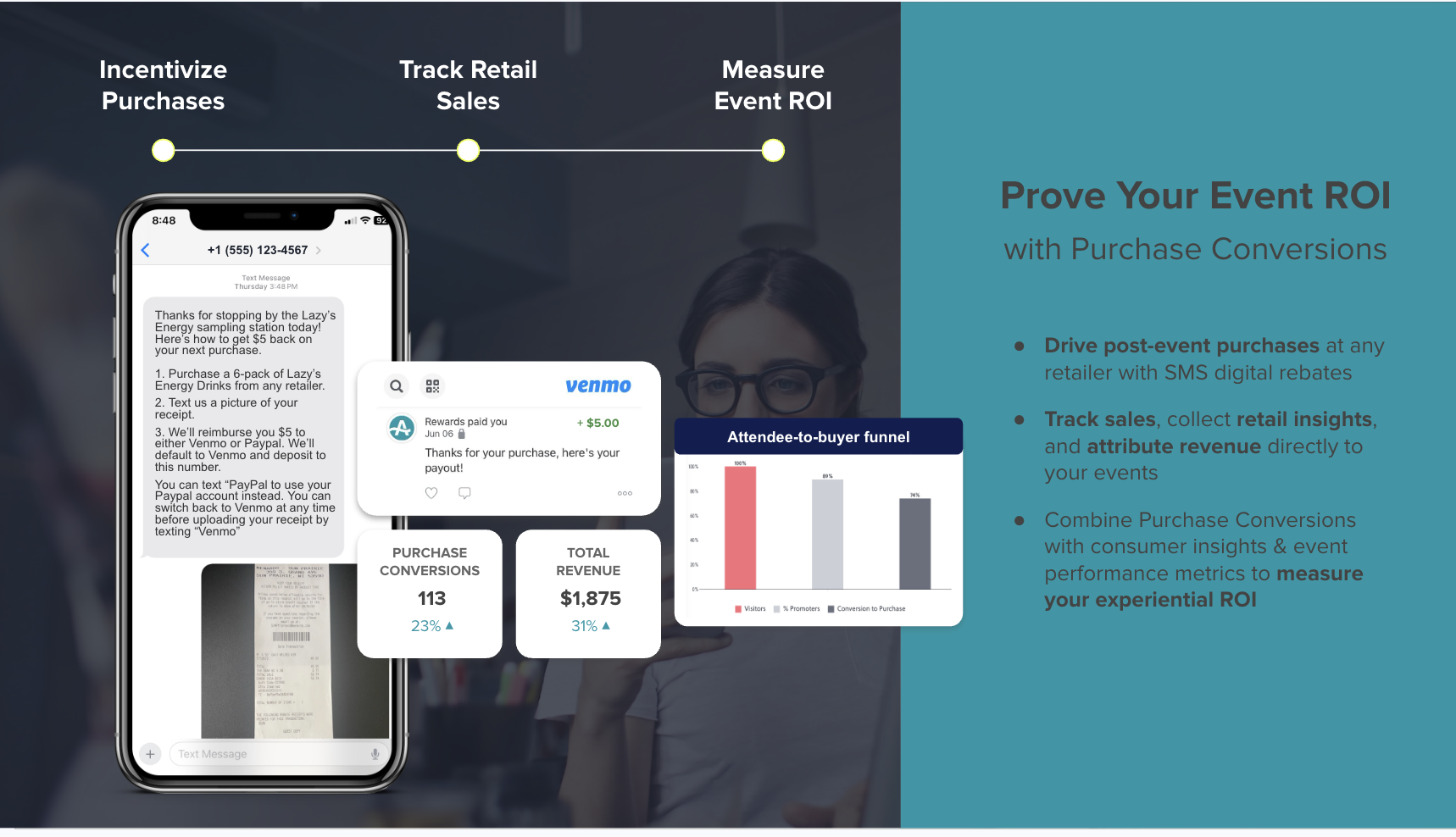
- AnyRoad cashback rebate pilot for an unnamed craft brand — Receipt-verified conversion via cashback rebate. In an early one-month ambassador tasting pilot on a small dataset, 56% of records collected converted to a bottle purchase. Source: AnyRoad. Caveat: Early pilot result with a single unnamed craft brand on a small dataset; not a platform benchmark.
Every receipt-verified mechanic produces a first-party record tied to a verified purchase, which connects experiential spend directly to retail sell-through. The sweepstakes variant uses the same data capture and SMS follow-up but offers a prize instead of a rebate, and AnyRoad manages the regulatory compliance.
Track which retail purchases your activations actually drive. Book a demo.
How to Present Activation ROI to Finance
Most activation ROI numbers presented to finance are directional because the link between the activation and the purchase is inferred rather than verified. A CFO funds incremental revenue and contribution margin, not clicks or a platform’s self-graded ROAS. Finance leaders need proof that spend generated new profit.
Three principles govern a finance-ready activation ROI presentation.
- Lead with incremental metrics: Present incremental sales the test produced, contribution margin after trade and cost of goods, and the payback window. Budget requests should include fully loaded operational costs with no omitted staff or logistics lines, contribution margin modeling, and clear break-even thresholds.
- Label every figure honestly: Distinguish agency-reported, platform-reported, and independently verified data. A team that volunteers the gap earns more trust than one that quotes the flattering number and waits to get challenged.
- Use test-and-control designs for the strongest business case: Matched-market testing uses historical sales and market characteristics to construct treatment and control groups, then compares the post-activation difference while accounting for baseline performance. This approach avoids treating all post-exposure purchases as incremental.
AnyRoad closes the gap between activation and verified purchase by capturing data at every stage of the consumer journey. FullView captures data from every attendee in a group, not just the person who booked, so the activation produces a complete first-party record. That record becomes the foundation for Purchase Conversion Tools, which verify purchase through receipt-based cashback rebates and sweepstakes without requiring POS integration.

Once a purchase is verified, Bottle Clubs convert the visit into recurring revenue with measurable lifetime value. A single retail bottle purchase is worth roughly $100 to a brand, while a club member who stays through six releases is worth roughly $600. The compounding effect is significant: a consumer who visits a distillery twice is 512% more likely to convert into a paid loyalty enrollment.

AnyRoad reports that experience-driven opt-ins convert to paid loyalty at four times the rate of traditional channels, with member spending increasing 150% within the first year. Named Lifetime Loyalty customers include Heaven Hill Distillery, Nearest Green Distillery, Lux Row Distillers, Castle & Key, Catoctin Creek Distilling, and Tarnished Truth Distilling.
Know which bottles your activation actually sold. Schedule a demo.
Comparison Table: Four Measurement Methods
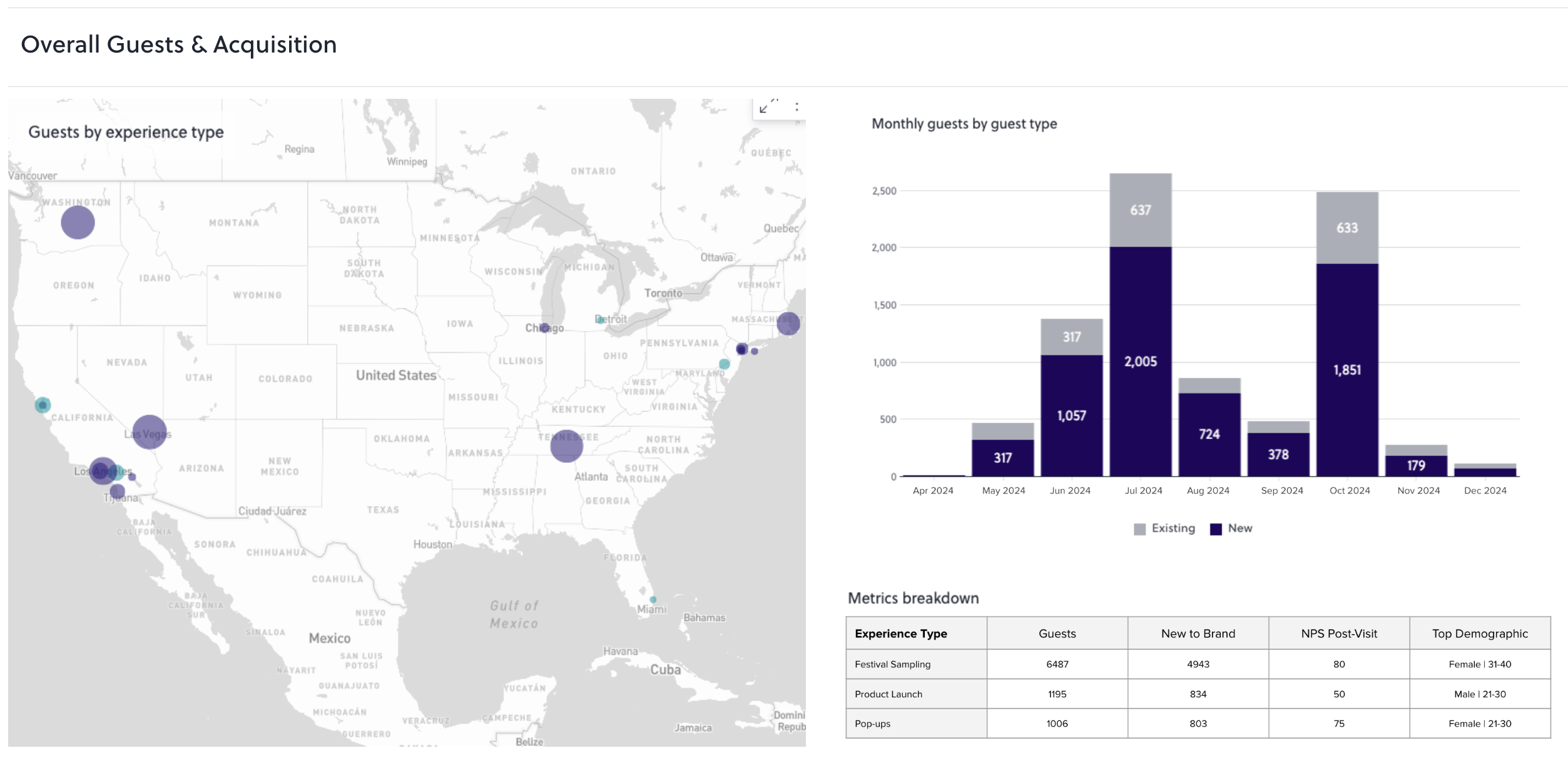
The table below compares the four measurement methods across implementation complexity, data visibility, scalability, and reporting depth. Receipt-verified conversion offers a strong mix of low implementation complexity and deep purchase-level reporting, while test-and-control delivers the strongest causal evidence at higher operational cost.
| # | Measurement Method | Implementation Complexity | Data Visibility | Scalability | Reporting Depth |
|---|---|---|---|---|---|
| 1 | Test-and-Control | High, requires matched markets and a pre-registered design | Full causal visibility that isolates incremental lift | Moderate, limited by number of matched markets | Deep reporting of incremental sales, units, and ROI with confidence intervals |
| 2 | Retailer-Linked Attribution | Moderate, requires retailer data access and loyalty match | Partial visibility within one retailer’s walled garden | High, scales across stores within a retailer | Moderate, reports attributed sales and ROAS rather than total brand demand |
| 3 | Receipt-Verified Conversion | Low, runs on receipt submission without POS integration | Full purchase visibility at SKU level without POS integration | High, deploys across any account where product is sold | Deep reporting of verified purchase rate and conversion by activation |
| 4 | Survey-Based Purchase Intent | Low, requires post-experience survey deployment | Directional visibility into stated likelihood rather than actual purchase | High, scales across any activation format | Shallow reporting of intent lift rather than incremental revenue |
Frequently Asked Questions
What Is the Difference Between ROAS and Incremental ROAS?
ROAS (return on ad spend) divides revenue attributed to a campaign by campaign spend. It measures association, not causation. Incremental ROAS (iROAS) divides only the revenue from sales that would not have happened without the campaign by campaign spend. iROAS requires a defensible counterfactual such as a randomized holdout, a matched-market test, or a modeled baseline. Because iROAS excludes purchases that would have occurred anyway, it almost always comes in lower than platform-reported ROAS. The gap is widest on branded search, where advertisers largely pay to reach demand they already own. As noted earlier, a campaign can post a 6x reported ROAS and a 2.5x incremental ROAS simultaneously, and only the incremental figure indicates whether the spend generated new revenue.
Can a CPG Brand Activation Have a High ROAS but Negative Profit ROI?
Yes. ROAS measures revenue, not margin. A campaign reporting 6x ROAS may still lose money if the contribution margin after trade spend, cost of goods, and activation costs does not cover the investment. If most of the attributed revenue would have occurred without the activation, the true incremental return may sit well below the headline figure. Finance-facing reporting should always convert incremental revenue to incremental gross profit and subtract fully loaded activation costs before presenting a profit ROI.
How Do I Present Agency-Reported Activation Data to My CFO?
As the finance section noted, label every figure explicitly as agency-reported, platform-reported, or independently verified. Present the measurement method alongside the result because a 26x ROAS from a platform dashboard and a 13.3% Circana sales lift carry different evidentiary weight. Lead with incremental sales the test produced, contribution margin after trade and cost of goods, and the payback window. Show what would be cut if the budget stayed flat so the trade-off is explicit. A team that volunteers the gap between attributed and incremental figures earns more trust than one that relies on the most flattering number.
What Is the Strongest Measurement Method for Proving Activation ROI?
Test-and-control with matched markets provides the strongest method for proving causal lift because it isolates the activation’s effect from organic demand, seasonality, and concurrent promotions. Receipt-verified conversion provides the strongest method for proving that a specific consumer actually purchased a specific SKU as a result of a specific activation, because it ties a first-party registration record to a receipt-verified transaction without requiring POS integration. The two methods answer different questions: matched-market testing proves aggregate incremental sales, while receipt-verified conversion proves individual purchase causation. For a CFO presentation, matched-market incrementality testing supplies the most defensible aggregate ROI figure, and receipt-verified conversion supplies the clearest proof that the activation drove retail sell-through.
How Does Receipt-Verified Conversion Work Without POS Integration?
The mechanic runs entirely on the consumer’s receipt. A consumer registers at an activation via QR code scan using AnyRoad Live and receives an SMS with a cashback rebate or sweepstakes entry redeemable anywhere the product is sold. The consumer buys the product, photographs the receipt, and texts it back. AnyRoad’s AI reads the receipt, confirms the eligible SKU, and pays the rebate out via Venmo or PayPal. Because the mechanic runs on the receipt rather than the retailer’s point-of-sale system, it works in any retail or on-premise account without asking the retailer or bar to integrate anything. This structure makes on-premise conversion tracking possible at scale, since a rebate tied to an identifiable SKU on a bar tab is measurable in a way a depletion report never is.
Conclusion: The Final Pitch
Most CPG brand activation ROI numbers are directional because the link between the activation and the purchase is inferred rather than verified. The same activation can report wildly different figures depending on which metric is used, as the 26x versus 2.1x gap mentioned earlier illustrates, and whether a defensible counterfactual exists. The four measurement methods, test-and-control, retailer-linked attribution, receipt-verified conversion, and survey-based purchase intent, answer different questions and carry different evidentiary standards, which means no figure should be presented to finance without a named source and a method caveat.
AnyRoad closes the gap between activation and verified purchase by capturing first-party data at the point of experience, verifying purchase through receipt-based cashback rebates, and converting visits into club memberships with measurable lifetime value. For brands that need defensible ROI numbers, AnyRoad provides the measurement infrastructure that connects experiential spend to retail sell-through and recurring revenue.
Turn your brand activations into provable retail sales. Schedule a demo.