


Written by: Bryan Grobstein, Vice President, Global Revenue, AnyRoad | Last updated: October 15, 2026
Key Takeaways
- CPG brands struggle to measure experiential marketing ROI because they rarely own the retail transaction, so attendance or purchase intent alone cannot prove sales impact.
- A test-vs-control measurement architecture built before launch, executed with disciplined data capture, and closed with receipt-verified purchases creates a defensible incremental sales lift number.
- Seven critical steps – defining objectives, establishing baselines, building matched control markets, choosing tracking mechanisms, setting attribution windows, calculating incremental gross profit, and building three-layer dashboards – produce ROI numbers that withstand finance review.
- Receipt-upload cashback rebates combined with QR registration verify purchases without retailer POS integration and solve the core attribution challenge for multi-retailer CPG campaigns.
- AnyRoad supplies the first-party data capture, receipt-verified purchase tools, and analytics infrastructure needed to run this measurement model across markets and activation formats.
Talk With AnyRoad About Your Measurement Plan
Before You Build the Measurement Model
The following inputs must be in place before you design the measurement architecture:
- A Defined Campaign Objective – what the activation will change (trial, repeat purchase, brand affinity) and what decision the result will drive (budget renewal, market expansion, staffing change).
- Access to Sales Velocity Data by Market or Retailer – weekly unit movement at the store or DMA level, sourced from distributor reporting, retailer portals, or syndicated data.
- A Baseline Period – a pre-activation window free of retailer promotions and seasonal distortion, long enough to establish a stable trend (typically eight to twelve weeks).
- A Candidate Control Market – a comparable geography or store cluster that will receive no activation support during the test window.
- A Tracking Mechanism for On-Site Data Capture – QR-code registration, SMS follow-up infrastructure, and a receipt-verification tool for purchase confirmation.
Those five inputs are the minimum. With them in place, the same measurement architecture works before, during, and after an activation and serves marketing, finance, and field operations together across sampling events, ambassador tastings, and brand-home experiences. The framework depends on clean inputs and shared ownership. A model built on incomplete baseline data or a poorly matched control market produces ROI numbers that fail scrutiny.
Review Your Inputs With an AnyRoad Specialist
Step-By-Step Measurement Architecture
Step 1: Define the Objective and the Decision It Informs
State what the activation will change. Trial, repeat purchase, and brand affinity are distinct objectives that require different measurement designs. A trial objective uses new-to-brand conversion. A repeat-purchase objective needs a longer post-event tracking window and household-level data. A brand-affinity objective needs pre- and post-experience surveys of both exposed and control consumers, as Ben & Jerry's Factory Experiences does using AnyRoad's pre- and post-experience surveys to measure brand perception, purchasing behavior, and ROI.
The objective must also specify the decision it will inform. If the result will determine whether the program scales to additional markets, the measurement must detect a statistically meaningful lift at the store or DMA level. If it will guide staffing levels, execution metrics take priority. Clear decisions defined in advance prevent the methodology from shifting after the numbers arrive.
Step 2: Establish a Baseline
Choose a pre-activation window that excludes retailer promotions, holiday distortions, and packaging changes. Historical baselines should use eight to twelve non-promoted weeks and year-over-year adjustments for equivalent seasonal periods. Document the baseline sales velocity, NPS, or opt-in rate that will serve as the comparison point. Comparing a Saturday demonstration against an average Tuesday baseline produces false-positive conclusions. True baselines compare identical days of the week across matching seasonal cycles.
Step 3: Build a Matched Control Market
Select a comparable market or retailer that does not receive the activation. A matched-store design should match on three groups of criteria: demand (historical SKU velocity over the preceding twelve to twenty-six weeks, total store weekly customer transaction volume, average basket size), structure (retailer banner and format, geographic trading environment, category share, competitive assortment density), and catchment (local demographic and income profiles within the immediate radius).
Compare treatment and control stores during the identical calendar window to strip out holidays, weather, and general market swings. Before you trust the comparison, run two checks. First, confirm the control market receives no activation support, no local media spillover, and no retailer promotions that do not also apply to the test market. Then verify parallel trends during the baseline period. If the two markets were not moving together before the activation, they cannot serve as a credible counterfactual after it.
Step 4: Choose the Tracking Mechanism
For on-site data capture, use QR-code registration and SMS follow-up. AnyRoad's Live mobile app turns an activation into a data capture point. Guests scan a QR code and register on the spot, which makes it viable for the kind of ambassador tasting that historically produced only a depletion report.

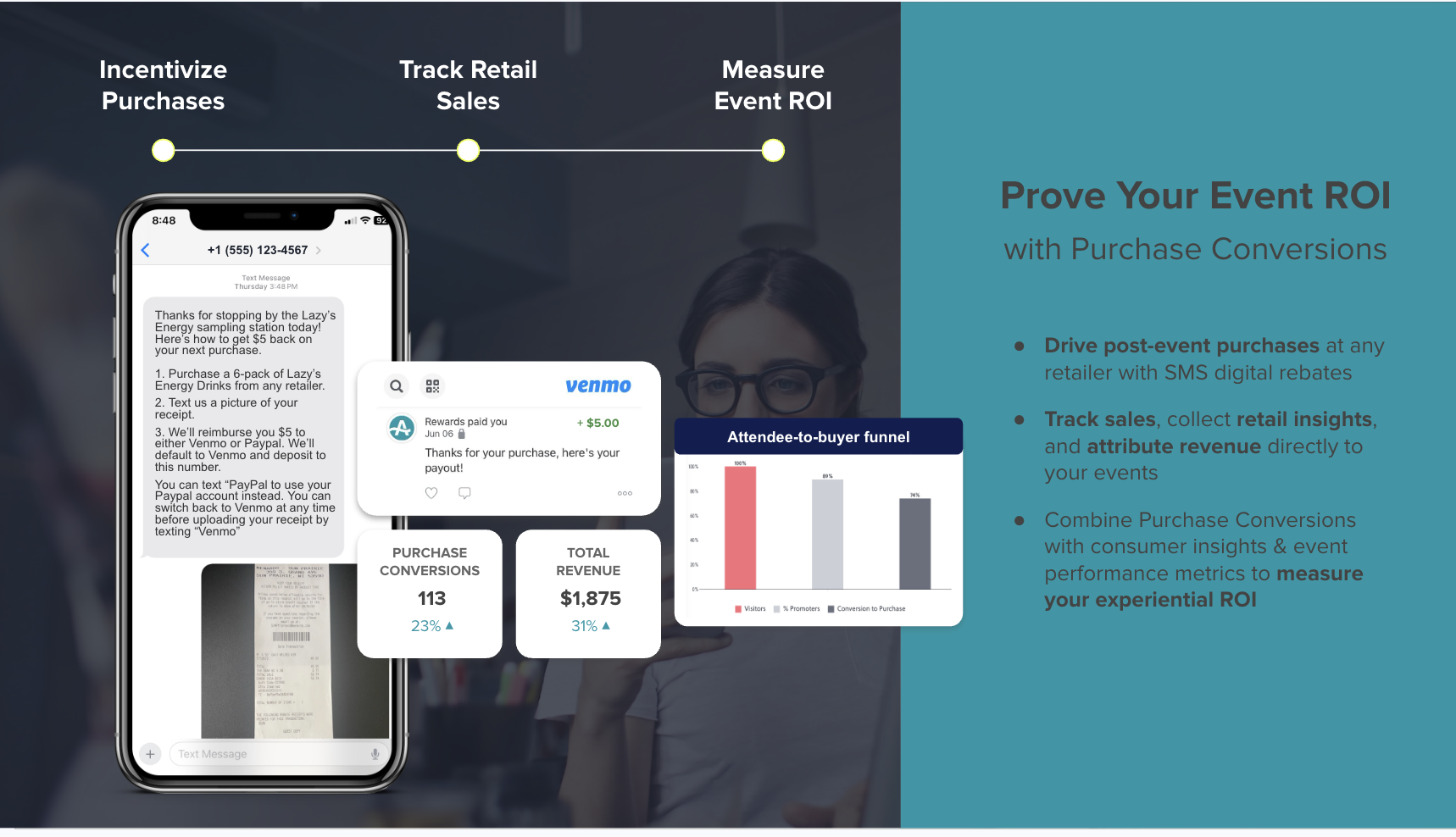
For purchase verification without POS integration, use the receipt-upload cashback rebate mechanic. After registering on-site, the consumer receives an SMS with a cashback rebate redeemable anywhere the product is sold. They buy the bottle, photograph the receipt, and text it back. AnyRoad's AI reads the receipt, confirms the eligible SKU, and pays the rebate via Venmo or PayPal. The mechanic runs on the receipt and avoids retailer or bar integration. That keeps overhead low enough to deploy across trade accounts at scale. It also makes on-premise conversion tracking possible at all because a rebate tied to an identifiable SKU on a bar tab is measurable in a way a depletion report never is.
Step 5: Set the Attribution Window
Define how long after the activation a purchase counts as associated with the program. Attribution windows should match the natural buying cycle of the product category: fast-moving consumer goods and low-cost retail products should use a fourteen to thirty-day attribution window, while high-consideration products require ninety to one-hundred-eighty-day windows. Document the window before the activation launches and hold it fixed during reporting. A window that is too short misses later purchases. A window that is too long absorbs unrelated influences and weakens the causal argument.
Step 6: Calculate Incremental Gross Profit
The formula for incremental gross profit is:
Incremental Gross Profit = (Test Market Sales − Control Market Sales) × Gross Margin − Total Program Cost
This is the number that belongs in a leadership report. ROAS and attributed revenue overstate profitability because they do not isolate incrementality and count sales that would have happened anyway. Observed volume during a promotion splits into four categories. Base sales are the volume expected without intervention. Incremental sales are the true net volume above the counterfactual baseline. Subsidized sales are purchases by existing brand buyers who would have paid full price anyway. Cannibalized sales are volume gained on an activated product that reduces sales of another product within the same brand portfolio. Only the incremental portion belongs in the ROI numerator.
Step 7: Build the Three-Layer Dashboard
Structure reporting across three layers:
- Layer 1 – Execution Metrics: attendance, samples distributed, QR registrations, opt-in rate.
- Layer 2 – Consumer Impact: NPS, brand affinity shift, purchase intent. These metrics act as leading indicators that a purchase lift is coming. In festival activations run by agency POPLIFE for an artisanal mezcal brand, 85% of consumers reported post-event purchase intent. Conversate Collective's field marketing events for a CPG beauty brand showed 74% of guests were more likely to purchase the brand's products after attending.
- Layer 3 – Business Impact: incremental sales, incremental gross profit, customer lifetime value delta.
Segment every layer by activation type, retailer, market, and SKU. A dashboard that cannot be filtered to a specific account or market cannot support the decisions that field teams and finance need to make.

How Attributed Sales Differ From Incremental Sales
Attributed sales are purchases assigned to the activation by a tracking rule such as a code redemption, QR conversion, or CRM match inside the attribution window. They show association. Incremental sales are the purchases that would not have occurred without the activation, estimated by comparing the test market against a credible control. Attribution allocates credit among observed interactions and supports operational optimization. Incrementality estimates causal impact by comparing outcomes with and without exposure, so attributed sales can exceed or fall short of incremental sales.
See a Sample Three-Layer Dashboard
Proving ROI Without Owning the Retail Transaction
Retailer POS feeds are optional. A first-party record tied to a verified purchase is the requirement. The chain works as follows: on-site registration creates the consumer identity, the SMS rebate creates the reason to buy, the receipt upload creates the purchase verification, and the matched control market creates the counterfactual that isolates incrementality.
Receipt validation allows brands to verify purchases at any retailer without POS integration: shoppers submit a photo of their receipt, and the platform uses AI to read the receipt and confirm the eligible SKU, then matches it against the program's eligibility rules before releasing payment. This produces a SKU-level purchase record for every verified redemption.
Receipt-verified purchase counts do not replace a control-based analysis of incremental lift. They prove a purchase happened but do not prove the activation caused it. The counterfactual, the matched control market, converts a verified purchase count into an incremental sales estimate. Both elements are required for a defensible ROI number.
Connect Your Activations to Verified Purchases
How to Measure Sampling-to-Purchase Conversion Without POS Integration
The mechanic runs end to end as follows:
- The consumer scans a QR code at the activation and registers on-site via AnyRoad Live.
- An SMS delivers a cashback rebate offer redeemable at any retailer where the product is sold.
- The consumer purchases the product at any store.
- The consumer photographs the receipt and texts it back.
- AnyRoad's AI verifies the eligible SKU on the receipt.
- The rebate is paid via Venmo or PayPal.
This works in any account because the mechanic runs on the receipt and avoids retailer or bar integration. Over 50% of surveyed consumers in Conversate Collective's CPG beauty brand activations bought the brand's products from Walgreens and Target, which illustrates multi-retailer purchase behavior that a single POS integration could never capture.
In a one-month ambassador tasting pilot with a craft brand, 56% of the records collected converted to a bottle purchase. This was an early, small-sample pilot result and should not be treated as a platform benchmark. It shows that the mechanic produces a measurable conversion signal where a depletion report produces none.
Explore Receipt-Upload Cashback Campaigns
What Counts in Total Experiential Program Cost
Capture every cost category below before you apply the incremental gross profit formula. Missing any category makes the program look more profitable on paper than it is in practice:
- Strategy and creative development
- Fabrication and production
- Venue and permits
- Staffing and travel
- Sample inventory and freight
- Data capture tools and platform fees
- Rebate payouts
- Post-event measurement and reporting
Staff travel, sample product cost, and rebate payouts are the three categories most commonly omitted. A promotion driving $500,000 in incremental revenue that cost $450,000 to run has a 10% ROI, and measuring revenue instead of profit is the most common promotional measurement error. Total activation cost should include the complete investment across strategy, creative development and design; custom fabrication and production; venue, permits and sponsorship fees; AV, lighting and interactive technology; staffing, freight, installation and dismantling; and promotion, data capture, measurement and follow-up.
Audit Your Cost Inputs With AnyRoad
Choosing the Right Attribution Window for CPG Campaigns
Set the attribution window from the category purchase cycle. Convenience is the wrong input. A spirits brand with a monthly purchase cycle needs a different window than a snack brand with a weekly cycle. A window that is too short can miss later purchases, while one that is too long can include unrelated influences.
Document the window before the activation launches. Lock it in writing as part of the measurement plan and hold it fixed during reporting. If the window is renegotiated after the data arrives, extended because the numbers look weak or shortened because a competitor promotion inflated the control, the methodology loses credibility with finance and leadership. Treat the window as a pre-registered commitment.
Get Help Selecting an Attribution Window
Operational Considerations for Reliable Data
Execution realities that affect data quality and comparability across markets include:
- Staffing the Data-Capture Point: Brand ambassadors must treat QR registration as a primary deliverable. When staff believes in the data mission, the quality of captured leads improves. A passive ambassador handing out samples without driving registrations produces a depletion report instead of a measurement dataset.
- Timing the SMS Follow-Up: The rebate offer should arrive within seconds of registration while the consumer is still engaged. A delayed follow-up reduces conversion rates significantly.
- Handoffs Between Field Teams and Analytics: Field execution data such as registration counts, sample distribution, and QR scan rates must flow into the analytics system in real time or daily. Waiting until the tour ends to reconcile data blocks mid-campaign optimization.
- Compliance for Alcohol Sampling: Age verification is required at the point of registration. Launching an SMS-based receipt rebate without age gating creates regulatory risk. AnyRoad's platform includes integrated ID scanning for embedded age verification.
- Consistency Across Markets and Retailers: Test and control markets must receive identical execution standards. Variations in how ambassadors pitch the product, where the sampling station sits, or how the rebate offer is communicated will distort the comparison.
Early indicators such as scan rate per hour, opt-in rate, and rebate redemption velocity can guide mid-campaign adjustments to staffing, daypart, and audience targeting while the program is still running. Measurement used this way becomes a lever for live optimization instead of only a post-mortem tool.
See How AnyRoad Supports Field Execution
Common Measurement Mistakes and Fixes
- Using Attributed Sales Instead of Incremental Sales (Data): Attributed sales count every purchase associated with the activation, including purchases that would have happened anyway. The fix is a matched control market that isolates the true incremental volume.
- Failing to Strip Retailer Promotions From the Baseline (Process): A baseline that includes a retailer price promotion overstates normal velocity and understates the activation's lift. Exclude promoted weeks from the baseline window.
- Choosing a Control Market That Differs on Distribution (Process): A control market with fewer SKUs, fewer facings, or a different retailer banner is not comparable. Match on distribution depth before finalizing the control selection.
- Setting an Attribution Window That Is Misaligned With the Category (Process): A window shorter than the category purchase cycle misses legitimate conversions. A window longer than two to three purchase cycles absorbs unrelated influences. Base the window on the category purchase cycle.
- Omitting Program Costs Such as Staff Travel, Samples, and Rebate Payouts (Ownership): These three categories are the most commonly excluded from total program cost calculations and produce ROI figures that fail a finance review.
- Running Capture and Analytics in Disconnected Systems (Systems): When registration data, rebate redemption data, and sales velocity data live in separate tools with no integration, the analysis requires manual reconciliation that introduces errors and delays. A unified platform removes this failure mode.
Diagnose Your Current Measurement Gaps
Measuring Success Across Programs
Evaluate the measurement process itself against the following checkpoints before you publish the final ROI report:
- Data Completeness: What percentage of attendees completed on-site registration? A low registration rate means the receipt-verification pool is too small to support conclusions.
- Receipt-Verification Rate: Of the consumers who received the SMS rebate offer, what percentage submitted a receipt? A low verification rate may indicate friction in the submission flow or a rebate value that was not compelling enough.
- Control-Market Stability: Did the control market remain free of activation support, media spillover, and retailer promotions during the test window? If not, the counterfactual is compromised.
- Reporting Readiness: Are all cost categories captured? Is the attribution window documented and fixed? Are test and control sales data available at the same granularity and cadence?
Program-level outcomes to track include opt-in rate, receipt-verified conversion rate, incremental gross profit, and NPS change from pre- to post-experience. These serve as indicators rather than prescribed benchmarks. The relevant comparison is against the program's own stated objective and baseline.
Advanced Tips for Next-Level Optimization
Brands that have completed one or two test-vs-control cycles can refine the model with the following approaches:
- Matched-Market Pairs at Scale: Instead of a single test-and-control comparison, run multiple matched pairs across different retailer banners, geographies, and activation formats simultaneously. The variation across pairs reveals which contexts produce the highest incremental lift per dollar spent.
- Cohort Segmentation by Visit Frequency and Spend: AnyRoad's platform stratifies the consumer audience by NPS, spend, and visit frequency, allowing brands to identify which cohorts convert to verified purchases at the highest rate and target future activations accordingly. A consumer who visits a brand home twice is 512% more likely to convert to a paid loyalty enrollment, and the same segmentation logic applies to field activations.
- Integration With CRM and Retail Velocity Dashboards: First-party data captured at activations, including registration, NPS, purchase intent, and receipt-verified purchase, should flow into the brand's CRM and be matched against retail velocity data. This enables repeat-purchase tracking, lifecycle marketing, and a customer lifetime value calculation that extends the ROI horizon beyond the immediate post-event window.
- AI-Powered Feedback Analysis: AnyRoad's PinPoint feature analyzes open-text survey responses from experiential guests, identifying themes and sentiment drivers across thousands of responses in real time. Mid-campaign feedback can reveal formulation, messaging, or staffing issues before the program scales.
For brands ready to connect experiential data to retail sell-through at scale, AnyRoad provides the first-party data capture, receipt-verified purchase conversion tools, and analytics infrastructure to run this model across multiple markets and activation formats simultaneously. For a broader comparison of platforms built for this use case, see Best Event Attribution & Experiential ROI Platforms for CPG.

See How AnyRoad Scales Test-Vs-Control Programs
Frequently Asked Questions
How Do You Calculate Incremental Sales Lift for a Sampling Event?
Compare the change in test market sales against the change in a matched control market over the same window. The difference represents the incremental volume attributable to the activation. Multiply that volume by the gross margin per unit and subtract total program cost to arrive at incremental gross profit. The control market must be matched on baseline velocity, demographics, distribution, and retailer banner and must receive no activation support during the test window. Comparing identical calendar periods in both markets strips out seasonality and regional market trends.
What Counts in Total Experiential Program Cost?
Use the cost checklist above as your reference. The three most commonly omitted categories are staff travel, samples, and rebate payouts, and missing them inflates ROI. Capture every category before you apply the incremental gross profit formula.
How Do You Measure Sampling-to-Purchase Conversion Without POS Integration?
Use a receipt-upload cashback rebate mechanic as described in the step-by-step section. The key outcome is a first-party record tied to a confirmed purchase, which connects experiential spend to retail sell-through without retailer POS access.
What Attribution Window Should You Use?
Base the window on the category purchase cycle and keep it fixed once documented. Higher-consideration categories need longer windows. See Step 5 above for specific ranges and guidance.
How Do You Build a Control Market?
Match the control market to the test market on baseline sales velocity, demographics, distribution depth, retailer banner, and geographic separation that prevents shopper crossover. Keep the control free of activation support, media spillover, and unique retailer promotions throughout the test and post-event tracking periods.
How Do You Handle Seasonality?
Compare identical calendar windows in test and control markets. Avoid comparing weekend activations to weekday baselines or holiday weeks to non-holiday weeks. Exclude retailer promotions from the baseline period. Year-over-year adjustments for equivalent seasonal periods provide an additional check when the test window falls in a period with known seasonal variation.
How Do You Report ROI to Leadership?
Lead with incremental gross profit and the stated attribution window. Present the formula explicitly: test market sales minus control market sales, multiplied by gross margin, minus total program cost. Include the three-layer dashboard that shows execution metrics, consumer impact, and business impact. Document the control market selection criteria and the baseline period so the methodology can be audited.
Conclusion: Turning Experiential Into a Finance-Ready Channel
The architecture in this playbook turns experiential from a depletion report into a number finance can audit. It links on-site engagement to receipt-verified purchases and then to incremental gross profit through a clean test-vs-control design.

Structured execution, clean data, and a matched control market make the ROI credible. The receipt-upload mechanic closes the loop between an activation and a verified purchase. The three-layer dashboard connects execution, consumer impact, and business outcome in a single view that leadership can act on.
AnyRoad is built to run this model. It captures first-party data at the activation, delivers the SMS rebate and receipt-verification flow, and provides analytics, including AI-powered feedback analysis through PinPoint, to connect experiential spend to retail sell-through at scale. Experience-driven opt-ins convert to paid loyalty at four times the rate of traditional channels, with member spending increasing 150% within the first year, according to AnyRoad's own reporting. For CPG brands that need to prove experiential ROI to leadership, AnyRoad offers a practical starting point. For more on the broader measurement strategy, see How to Measure Experiential Marketing ROI.
Start Building Your Experiential ROI Framework