


Written by: Bryan Grobstein, Vice President, Global Revenue, AnyRoad
Key Takeaways for Shopper Marketing Leaders
- Shopper marketing analytics tools fall into five categories, but only Experiential & In-Store Activation Analytics captures identified first-party data at live brand interactions and links it to receipt-verified retail purchases.
- Traditional categories, including syndicated data, trade promotion, consumer insights, and retail media, leave the experiential activation layer unmeasured, which creates a blind spot for Field Marketing Directors.
- AnyRoad closes this gap by turning ambassador tastings, festival activations, and brand home visits into structured consumer records that feed descriptive, diagnostic, predictive, and prescriptive analytics.
- Alcohol brands gain built-in compliance support, including age verification, sweepstakes management, and licensed retail transaction paths, while still owning 100% of the first-party data they collect.
- Explore how AnyRoad turns in-person experiences into measurable retail sales lift with a tailored platform walkthrough.
How Shopper Marketing Analytics Tools Differ by Path-to-Purchase Layer
Shopper marketing analytics tools only work when they match the layer of the path to purchase a brand needs to measure. The four established categories each serve a distinct function, and each carries a specific blind spot when applied to physical activations.
Syndicated data platforms deliver market-level intelligence with a multi-week data lag, which supports category strategy but arrives too late for in-flight activation decisions. Trade promotion analytics measure promotional lift at the retailer level but cannot attribute that lift to a specific ambassador tasting or brand home visit. Consumer insights platforms analyze loyalty card and transaction data for enrolled shoppers only, so they miss consumers encountered at a festival, tasting, or distillery. Retail media measurement is advancing rapidly. The IAB’s December 2025 framework for in-store media measurement defines a Three Ps standard, Play, Presence, and Pairing, using anonymized sensor data without facial recognition, but this framework covers screen-based advertising rather than live human activations.
The experiential layer remains the gap. Barely a third of consumer goods brands can confidently tie their experiential marketing to retail sell-through. For alcohol brands, compliance requirements compound the problem. Age verification, sweepstakes terms, and three-tier distribution rules govern how first-party data can be collected and how purchase incentives can be structured at activations.
Tools that address this gap must do three things none of the four established categories do. They must capture identified first-party records at the point of activation, deliver a compliant purchase incentive that routes the consumer to retail, and verify the resulting purchase via receipt rather than POS integration.
See how AnyRoad measures ROI from brand activations across every channel.
Four Types of Marketing Analytics Applied to Experiential Data
Marketing analytics typically falls into four types, and each type answers a different strategic question.
- Descriptive analytics explains what happened. Sales volume, attendance, scan rates, and depletion reports fall here. These metrics are the most common and the least actionable when viewed alone.
- Diagnostic analytics explains why it happened. Basket analysis, brand-switching data, and NPS trend analysis help teams understand the drivers behind a sales result.
- Predictive analytics estimates what will happen. Demand forecasting, churn modeling, and purchase-intent scoring use historical patterns to project future behavior.
- Prescriptive analytics recommends what to do next. Recommendation engines suggest trade spend allocation, activation timing, or audience targeting based on modeled outcomes.
All four types are well served by the established tool categories in digital and retail media contexts. The missing link is the data input layer for physical activations. Without identified first-party records from events, ambassador tastings, and brand home visits, descriptive analytics for experiential programs defaults to depletion reports and attendance counts. Those metrics do not support meaningful diagnostic, predictive, or prescriptive work.

Experiential & In-Store Activation Analytics fills this gap by generating structured, identified data that feeds all four analytics types. A consumer who scans a QR code at a tasting, receives an SMS rebate, and photographs a receipt creates a record that is descriptive, because a purchase occurred, diagnostic, because the activation drove it, predictive, because visit frequency informs future enrollment likelihood, and prescriptive, because high-NPS repeat visitors can be routed to bottle club enrollment.
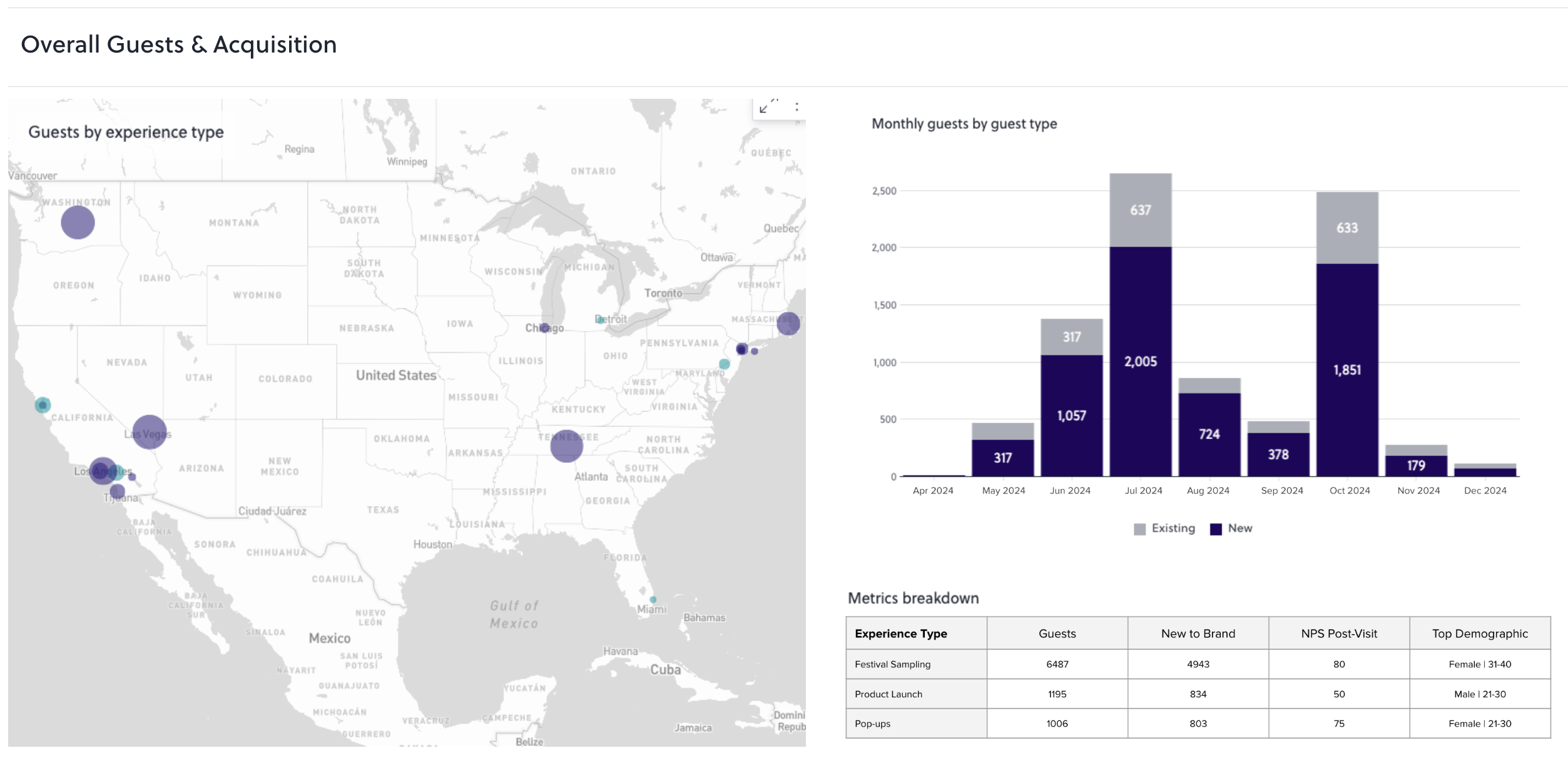
Review AnyRoad’s predictive and prescriptive analytics for experiential programs in a live session.
Comparing Shopper Marketing Analytics Categories on Core Capabilities
The table below compares the five tool categories across three capabilities that matter most to Field Marketing Directors evaluating shopper marketing analytics tools in 2026. Capabilities that cannot be compared on a shared scale are explained in prose below the table.
| Tool Category | Activation-to-Sales Attribution | First-Party Data Ownership | Alcohol Compliance Support |
|---|---|---|---|
| Syndicated Data & POS Analytics | Market-level, multi-week lag, no event linkage | None, data licensed from retailers | None native |
| Trade Promotion Analytics | Promotional lift by retailer, no activation linkage | None, retailer-supplied data | None native |
| Consumer Insights & Shopper Analytics | Loyalty-card linked, excludes non-enrolled shoppers | Shared with retailer, brand access limited | None native |
| Retail Media & In-Store Digital Measurement | Screen exposure to sales, 14% average sales lift reported for CPG in-store retail media campaigns | Anonymized, no individual record | None native |
| Experiential & In-Store Activation Analytics (AnyRoad) | Receipt-verified purchase per identified consumer, no POS integration required | Brand owns all first-party records | Age verification, sweepstakes compliance, licensed retail transaction path |
In-store path-to-purchase measurement varies too widely across categories to reduce to a single comparable metric. Syndicated platforms measure category-level foot traffic and conversion at the shelf. Retail media networks use the IAB Three Ps framework, Play, Presence, and Pairing, with anonymized sensor data to attribute screen exposure to sales. Experiential platforms measure the path from a named individual’s activation interaction to a receipt-verified purchase. These are structurally different measurement objects and should remain separate rather than forced into a single ROI figure.
Global in-store analytics market projections vary by source. One estimate projects growth from USD 5.28 billion in 2025 at a 24.1% CAGR through 2033, driven by AI-based customer behavior analytics and real-time footfall tracking. That growth concentrates in the four established categories. The experiential layer remains the least instrumented segment and the one where most brands lose roughly two-thirds of attendee records because registration data stays in spreadsheets and agency reports.
Learn how AnyRoad helps you capture and keep every attendee record from your activations.
Experiential & In-Store Activation Analytics in Practice
Experiential & In-Store Activation Analytics captures identified consumer data at live brand interactions such as tastings, ambassador demos, festival activations, and brand home visits, then connects those interactions to verified downstream purchase behavior. It is the only category that produces a first-party record tied to a named individual and a receipt-confirmed SKU.

AnyRoad delivers this category through two primary mechanics.
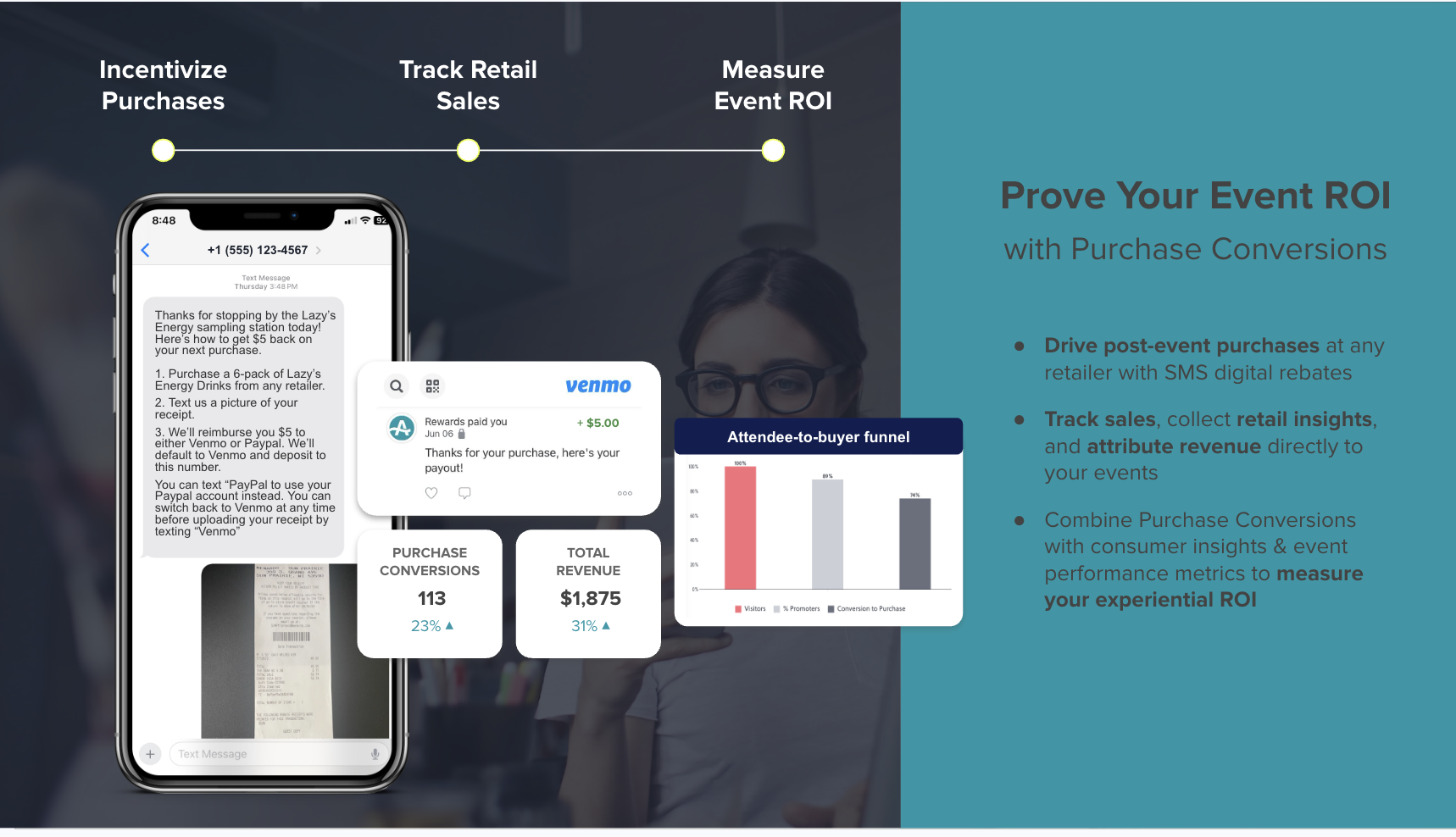
AnyRoad Live for ambassador tastings: The AnyRoad Live mobile app turns any activation into a data capture point. Consumers scan a QR code and register on the spot, which works well for ambassador tastings inside a Total Wine or on-premise account that previously produced only a depletion report. After registering, the consumer receives an SMS with a cashback rebate redeemable anywhere the product is sold. They buy the bottle, photograph the receipt, and text it back. AnyRoad’s AI reads the receipt, confirms the eligible SKU, and pays the rebate via Venmo or PayPal. No POS integration is required, so the mechanic deploys across trade accounts at scale. In a one-month ambassador tasting pilot with a single unnamed craft brand on a small dataset, 56% of records collected converted to a bottle purchase, which illustrates the mechanic’s directional potential.

Brand home and event data capture: At distillery visits, festival activations, and brand home experiences, AnyRoad captures structured first-party data from every attendee, not just the person who booked. The FullView feature collects contact information and consent from each member of a group. Campari Group’s partnership with AnyRoad enabled a 3X increase in marketing opt-in rates over a six-month period and identified 4,500 repeat visitors as brand champions. A mezcal brand’s festival activations using AnyRoad captured 45–50% more consumer data than competitors, with 85% of engaged consumers reporting post-event purchase intent.
For alcohol brands, the compliance layer is mandatory. AnyRoad’s platform includes integrated ID scanning for age verification, sweepstakes terms and conditions management, and a licensed ecommerce retail partner in the transaction path for bottle club purchases. These features keep every mechanic compliant with federal and state regulation without requiring the brand to act as a licensed retailer.
See how AnyRoad can grow your marketing opt-in database from every tasting and tour.
How AnyRoad Connects Experiential Data to Retail Sales for Alcohol Brands
Alcohol Field Marketing Directors in 2026 face a structural measurement problem. Approximately 52% of advertisers are shifting budgets to retail media networks, with 57% citing closed-loop attribution as the primary driver, yet the experiential activation layer, where brand relationships form, remains largely unmeasured. AnyRoad addresses this through four integrated capabilities.
First-party data capture at scale: Every booking, check-in, survey response, and QR scan generates a structured consumer record the brand owns outright. Diageo measured a 16-point NPS increase from pre-visit to post-visit at Johnnie Walker Princes Street using AnyRoad analytics and identified that a historically under-targeted demographic was 40% more likely to drink whisky after the visit. Absolut Home increased average revenue per guest by 36% since 2018, which required identified first-party data to uncover and track.
Cashback rebates and sweepstakes for retail conversion: Post-activation SMS incentives route consumers directly to retail purchase. The receipt-upload mechanic verifies the SKU, the retailer, and the timing, which produces the closed-loop attribution that depletion reports cannot provide. Digital coupon redemption rates are often higher than those of traditional paper coupons, and receipt-based mechanics extend that performance to spirits SKUs across any account.
Lifetime Loyalty suite for recurring revenue: A consumer who visits a distillery twice is 512% more likely to convert to a paid loyalty enrollment. AnyRoad’s Bottle Clubs move that consumer from a roughly $100 single bottle purchase to the roughly $600 a member is worth across six releases. The compliant transaction path runs through AnyRoad’s licensed ecommerce retail partner, so the brand never acts as a retailer or wholesaler. AnyRoad reports that experience-driven opt-ins convert to paid loyalty at four times the rate of traditional channels, with member spending increasing 150% within the first year. Heritage brands including Heaven Hill Distillery, Nearest Green Distillery, and Lux Row Distillers, along with craft brands such as Castle & Key, Catoctin Creek Distilling, and Tarnished Truth Distilling, have adopted the platform.
Managed CRM and white-glove service: Many alcohol brands lack in-house email marketing expertise. AnyRoad’s managed CRM services sit on top of the same first-party experiential data the platform collects, including NPS, spend, visit frequency, and club status, and are run by spirits industry operators who understand alcohol compliance and release calendars. This approach provides an alcohol-native alternative to deploying a horizontal tool like Klaviyo or Mailchimp without domain expertise. The white-glove layer extends to on-site staff coaching. Tour guides, retail managers, and mixologists receive training to make the enrollment pitch at the moment of highest conversion, during the visit itself.
Request a demo to see how AnyRoad turns tasting room visits into predictable recurring revenue.
Conclusion: Making a Confident Shopper Analytics Choice in 2026
The five categories of shopper marketing analytics tools serve distinct and largely non-overlapping functions. Syndicated data, trade promotion analytics, consumer insights platforms, and retail media measurement each address a defined layer of the path to purchase, and each leaves the experiential activation layer unmeasured.
For CPG and alcohol Field Marketing Directors, that blind spot carries the greatest impact. Global experiential marketing spending reached $138.94 billion in 2025 and is forecast to grow another 10.3% in 2026, yet most of that spend still produces only attendance counts and depletion reports. Brands that close this gap in 2026 will deploy a platform that captures identified first-party data at the point of activation, delivers a compliant purchase incentive, and verifies the resulting sale via receipt, without asking a retailer to integrate anything.
AnyRoad is built specifically to solve that problem by turning in-person experiences into measurable retail sales lift, with alcohol compliance infrastructure and white-glove service that generalist analytics tools do not provide.
Frequently Asked Questions
What makes experiential analytics different from traditional shopper marketing analytics tools?
Experiential analytics differs from traditional shopper marketing tools because it starts at the moment of live engagement rather than at the shelf or in a retailer’s system. Traditional shopper marketing analytics tools, including syndicated data platforms, trade promotion tools, consumer insights platforms, and retail media measurement systems, work from data that originates inside the retail environment, such as POS systems, loyalty cards, retailer networks, and in-store screens. They measure what happens at the shelf or in the digital ad ecosystem.
Experiential analytics works from data that originates outside the retail environment, at the moment a consumer first engages with a brand at a tasting, festival, or brand home visit. The critical difference is record ownership. Experiential platforms like AnyRoad generate first-party consumer records that belong entirely to the brand, not to a retailer or data licensor. When those records connect to receipt-verified purchases via cashback rebates or sweepstakes mechanics, they produce closed-loop attribution that other tool categories cannot match, because no other category captures the consumer before they enter the store.
How does AnyRoad attribute retail sales lift without POS integration?
AnyRoad attributes retail sales lift by using the consumer’s receipt instead of the retailer’s point-of-sale system. After a consumer registers at an activation, whether at a brand home, a festival, or an ambassador tasting inside a retail account, they receive an SMS with a cashback rebate or sweepstakes entry tied to a specific SKU. When they purchase the product, they photograph the receipt and text it back.
AnyRoad’s AI reads the receipt, confirms the eligible product, and pays the rebate via Venmo or PayPal. This process creates a first-party record that links a named individual, a specific activation event, and a verified retail purchase. The retailer, bar, or restaurant does not need to connect any system. The mechanic works in any account, which makes on-premise conversion tracking possible at scale for spirits brands.
What compliance features does AnyRoad provide for alcohol brands collecting first-party data at events?
AnyRoad provides compliance features that address both event-level requirements and broader alcohol regulations. The platform includes integrated ID scanning for age verification, sweepstakes compliance infrastructure, and licensed retail routing for bottle club transactions, as described earlier in this guide.
Beyond those core capabilities, AnyRoad’s compliance infrastructure accounts for state-by-state variations in alcohol advertising restrictions and three-tier regulation. The managed CRM team understands which product references and offers are permissible in lifecycle communications, so campaigns stay within legal boundaries. The licensed retail partner structure also ensures brands never occupy the position of acting as a retailer or wholesaler, which protects them from three-tier violations while still enabling direct-to-consumer style experiences.
How does AnyRoad’s Lifetime Loyalty suite connect experiential data to recurring revenue?
AnyRoad’s Lifetime Loyalty suite connects experiential data to recurring revenue by identifying high-intent visitors and converting them into long-term members. The suite is built on a key behavioral insight: a consumer who visits a distillery twice is 512% more likely to convert to a paid loyalty enrollment. AnyRoad’s platform captures the data that identifies those visitors, including NPS scores, visit frequency, and spend per visit, and surfaces them for targeted enrollment pitches by coached on-site staff.
Once enrolled, a bottle club member is worth roughly $600 across six releases, compared to roughly $100 for a single retail bottle purchase. The suite includes Bottle Clubs, Premium Memberships, gamified purchase conversion tools, and managed CRM services. Retention programming, including virtual cocktail classes with master distillers, addresses the primary churn driver, which is product depletion. Members who have not finished their current allocation often pause ordering, so programming that helps them enjoy what they own keeps them active for the next release. The entire stack arrives as technology plus white-glove service, which replaces the fragmented mix of ecommerce platforms, subscription billing software, and non-specialized agencies that many alcohol brands currently use.
Which CPG and alcohol brands have used AnyRoad to measure experiential marketing ROI?
AnyRoad serves a range of CPG and alcohol brands across heritage and craft segments. Diageo used AnyRoad at Johnnie Walker Princes Street to manage registrations, personalize experiences, and measure a 16-point NPS increase from pre-visit to post-visit. Absolut’s brand home in Åhus, Sweden, achieved a 36% increase in average revenue per guest using AnyRoad’s platform.
Campari Group’s results, including the 3X opt-in increase and 4,500 brand champions identified, came alongside a 25% increase in average spend per customer since 2020. For the Lifetime Loyalty suite specifically, Heaven Hill Distillery, Nearest Green Distillery, Lux Row Distillers, Castle & Key, Catoctin Creek Distilling, and Tarnished Truth Distilling have adopted Bottle Clubs and Premium Memberships as part of their recurring revenue strategy.