


Written by: Bryan Grobstein, Vice President, Global Revenue, AnyRoad
Key Takeaways
- Traditional depletion reports cannot tie ambassador tastings to actual purchases, so brands lack measurable conversion data.
- A structured SMS funnel with opt-in, timed follow-up, cashback offer, and receipt verification turns tastings into trackable acquisition events.
- Receipt-verified attribution links every verified purchase directly to the specific ambassador, tasting, and consumer without POS integration.
- Key performance metrics focus on opt-in rate, receipt-verified conversion rate, revenue per ambassador, revenue per attendee, and cost per acquired customer.
- AnyRoad enables brands to prove real ROI from ambassador tastings; see how receipt-verified attribution works.
Why Depletion Reports Miss Tasting Conversion
A depletion report shows what left the shelf during a window. It cannot be tied to a specific ambassador, a specific tasting, or a specific consumer. A bottle that depleted on Saturday could have been purchased by someone who never attended the tasting, someone who was already a loyal buyer, or someone who saw a shelf talker and grabbed it on instinct. The depletion report has no way to distinguish between those scenarios.
This gap makes ambassador tasting conversion unmeasurable for most brands today. Field marketing managers must justify next quarter's tasting budget against a metric that does not answer leadership's real question: did the activation cause a purchase? Without a system that connects the consumer who tasted to the consumer who bought, the answer will always be a guess dressed up as a number.
Know which bottles your activation actually sold.
How To Run An SMS Ambassador Tasting Funnel
This six-step sequence turns an ambassador tasting into a measurable acquisition funnel.
- Capture the opt-in on the floor using a QR code or keyword. The value exchange must give the consumer a reason to scan mid-tasting, because without that scan the follow-up has no one to reach.
- Send a timed follow-up SMS within one to two hours of the tasting. This window matters because purchase intent is still high and the consumer may still be near the account.
- Deliver the offer, such as a cashback rebate or sweepstakes entry, redeemable at any retailer where the product is sold. The mechanic runs without POS integration.
- Verify the purchase by having the consumer photograph their receipt and text it back. AI reads the receipt and confirms the eligible SKU.
- Attribute the verified purchase back to the specific ambassador and tasting event that generated the opt-in. This link turns a receipt into an activation result.
- Report revenue per ambassador, revenue per tasting attendee, and cost per acquired customer from tastings to leadership. These metrics show whether the program deserves more budget.
Collecting SMS Opt-Ins On The Tasting Floor
Generic advice about QR codes misses the operational reality of a tasting floor. A consumer holding a sample glass has three seconds of attention. The value exchange has to be immediate and tangible. Tasting notes for the flight they just tried, a recipe card, early access to a limited release, or a same-day cashback offer on the bottle they are considering all give the consumer a reason to scan before the glass is empty.
AnyRoad Live is the mobile app that makes this operationally viable. Guests scan a QR code and register on the spot, turning the activation into a data capture point rather than a depletion-report-only event. The ambassador does not need to collect paper forms or manually enter contact information. The registration happens in the consumer's hands, and the opt-in record is tied to the tasting, the ambassador, and the timestamp.

SMS Compliance Basics For Alcohol Brands
Alcohol falls under the SHAFT content category (Sex, Hate, Alcohol, Firearms, Tobacco) enforced by the CTIA and major carriers. Key requirements include:
- A full date-of-birth age gate (MM/DD/YYYY) before opt-in. A yes/no checkbox does not meet the carrier standard.
- Explicit opt-in language identifying the brand and the regulated nature of the program.
- STOP, HELP, and unsubscribe keyword support, honored immediately upon receipt.
- 10DLC campaign registration through The Campaign Registry (TCR) with the alcohol category and age-verification process documented.
For a full treatment of opt-in mechanics and compliance requirements, see AnyRoad's SMS Marketing for Tasting Rooms coverage and Ambassador Tasting Purchase Conversion resources.
The Follow-Up Cadence
Once the opt-in is captured and compliant, the next variable is when you send. Timing is the one most brands underestimate. Automated SMS flows convert at 8–18%, compared to 2–5% for email automation, and the gap widens when the send is triggered by a specific behavioral moment rather than a scheduled broadcast. Three sends structure the post-tasting window.
The first send goes out one to two hours after the tasting. The consumer is often still near the account or still deciding. This is the highest-intent window, and it is where the cashback offer or sweepstakes entry lands. Ninety percent of SMS messages are read within three minutes of delivery, so a well-timed send reaches the consumer while the tasting is still a sensory memory.
The second send goes out the next day, targeted at consumers who showed high intent during the tasting, such as those who asked about club membership, requested a second pour, or lingered at the table. This is the club or membership push, and it benefits from the specificity of what was tasted.
The third send goes out within 24 hours to everyone who opted in but did not redeem the first offer. A non-purchaser follow-up with a slightly different angle, such as a recipe, a pairing suggestion, or a reminder that the offer is still active, recovers a portion of the audience that was interested but not yet ready to act.
Cashback Rebate Vs. Text-To-Buy For Tastings
The choice between a cashback rebate and a text-to-buy link is an operational decision. Text-to-buy works when the brand controls the purchase path, such as a direct-to-consumer site, a brand-owned tasting room, or a platform with a compliant checkout.
The cashback rebate is the only option that works across trade accounts at scale. Here is how AnyRoad's mechanic runs: after registering via AnyRoad Live, the consumer receives an SMS with a cashback rebate redeemable anywhere the product is sold. They buy the bottle, photograph the receipt, and text it back. AnyRoad's AI reads the receipt, confirms the eligible SKU, and pays the rebate via Venmo or PayPal. No POS integration is required because the entire mechanic runs on the receipt. That structure makes it deployable across Total Wine, independent liquor stores, and on-premise bar tabs alike.
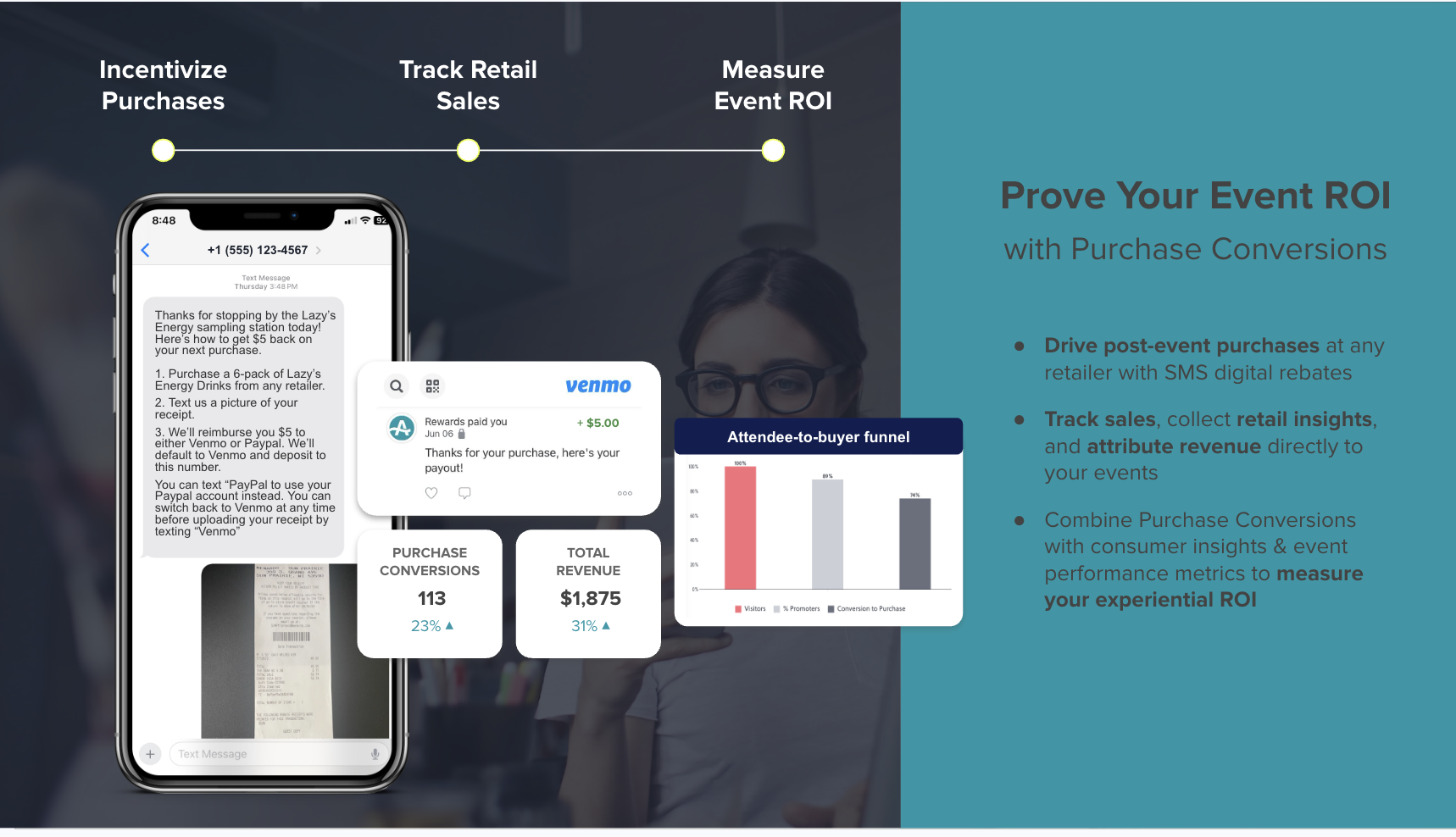
The sweepstakes variant runs the same data capture and SMS follow-up with a prize, such as Coachella tickets, a distillery experience, or a limited-release allocation, instead of cash back. AnyRoad handles the regulatory compliance around it, including terms and conditions and privacy policies, which matters because TCPA statutory damages for unauthorized automated texts start at $500 per message and reach $1,500 for willful violations.
In a one-month ambassador tasting pilot with a single unnamed craft brand, 56% of records collected converted to a bottle purchase. This was an early, small-sample pilot and should not be read as a platform benchmark. It illustrates what the funnel can achieve when the opt-in, the offer, and the timing are structured correctly.
The table below compares three attribution options on the dimensions that decide deployability and data quality.
| Mechanic | Attribution Method | Deployability At Retail | POS Integration Required |
|---|---|---|---|
| Cashback Rebate | Receipt-verified purchase tied to opt-in record, SKU, retailer, date, and ambassador, producing a clean, auditable, SKU-level transaction dataset | Can run at any retailer where the product is sold via receipt upload, including chains and independents | No, because receipt upload substitutes for retailer data-sharing |
| Text-To-Buy Link | Click-to-purchase tracked through brand-controlled checkout, so attribution is direct but limited to owned purchase paths | Can run where the brand controls checkout or issues a rebate, but not as a universal in-aisle mechanic | Depends on checkout architecture and is not applicable at most third-party retail |
| Depletion Report | Aggregate shelf movement during a window that cannot be tied to a specific ambassador, tasting, or consumer | Covers third-party retail broadly but produces no individual-level attribution | No, but it also produces no actionable conversion data |
How To Attribute An SMS Purchase To A Tasting
Attribution works through a four-link chain. The ambassador generates the opt-in at the tasting. The opt-in record is timestamped and tied to that ambassador and event. The SMS follow-up delivers the cashback offer. When the consumer submits a receipt, the verified purchase is matched back to the original opt-in record.
This process creates a clean line from pour to purchase, from ambassador to tasting to opt-in to receipt-verified sale. Retailers do not need to share POS data because the receipt provides the proof of purchase.
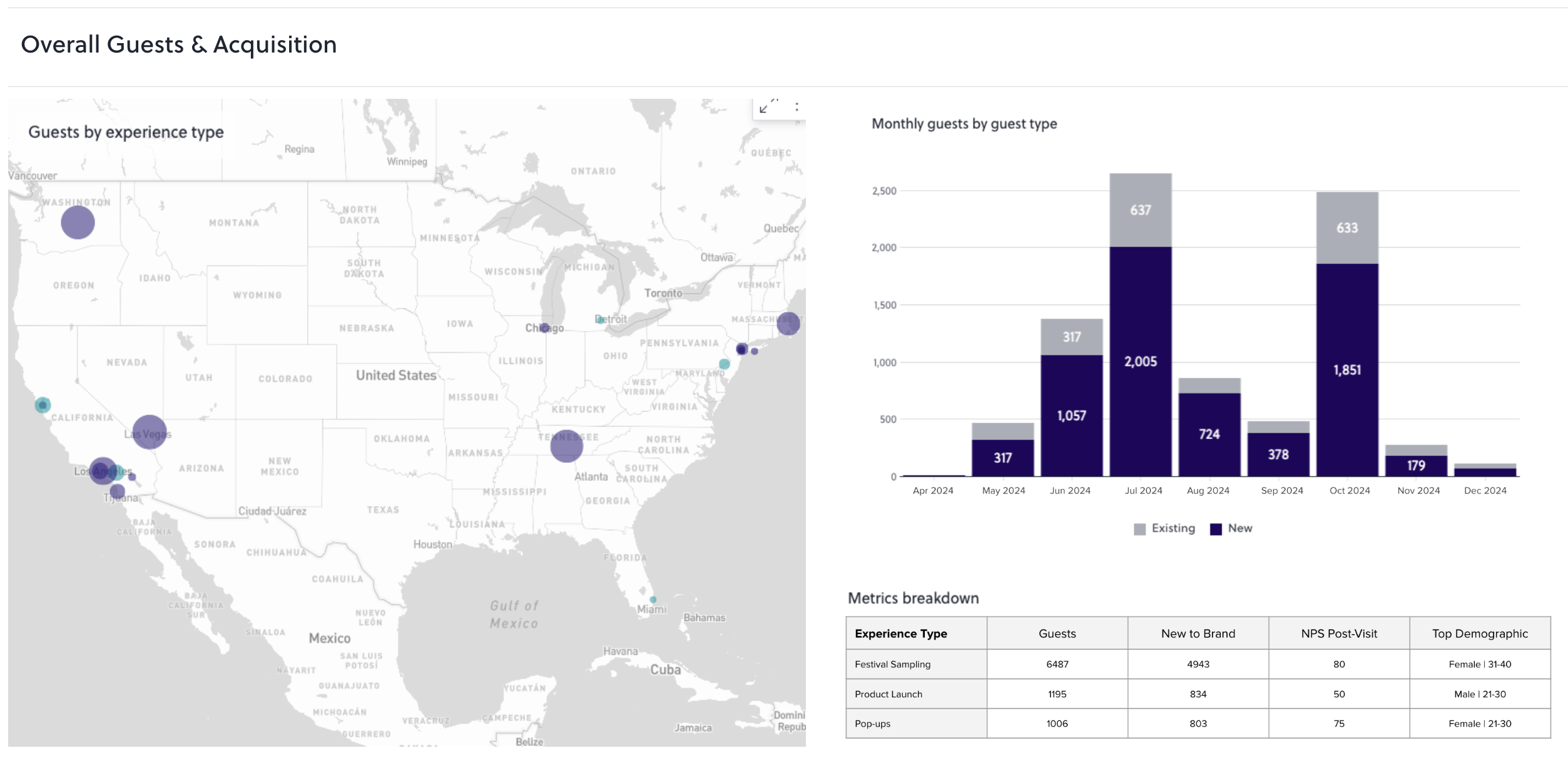
The metrics that follow from that chain are the ones leadership can act on: revenue per ambassador, revenue per tasting attendee, and cost per acquired customer from tastings. AnyRoad's Atlas Insights reporting makes this chain visible. The platform's customer view lets brands stratify by NPS, spend, and visit frequency to see which guests convert, so the analysis covers total revenue and the consumer profiles, ambassadors, and account types that drive the highest return. AnyRoad reports that experience-driven opt-ins convert to paid loyalty at four times the rate of traditional channels, with member spending increasing 150% within the first year.

Prove future retail sales impact from your experiences.
SMS Compliance For Alcohol Tastings
Alcohol SMS programs operate under two overlapping compliance frameworks. The TCPA requires prior express written consent for marketing messages, with fines starting at $500 per violation and reaching $1,500 for willful violations, calculated per text and per recipient. The CTIA's SHAFT framework adds carrier-level requirements specific to age-restricted content, including a full date-of-birth age gate in MM/DD/YYYY format, explicit opt-in language identifying the regulated nature of the program, and HELP and STOP instructions sent at least once a month within marketing messages.
10DLC registration became mandatory for all U.S. businesses sending A2P SMS as of February 2025, with unregistered numbers blocked outright by carriers. For alcohol brands, the campaign registration must document the age-verification process and consent flow. Carriers conduct ongoing audits of SHAFT-category senders, and an opt-out rate above 3% can trigger a review. Compliance functions as an ongoing operational discipline that runs alongside every send.
Coaching The Ambassador
The funnel only works if the ambassador makes the ask. The script is short: "We'd love to send you the tasting notes and a thank-you offer. Just scan this code and it takes about ten seconds." The ask happens after the second or third sample, when the consumer has formed an opinion and is most likely to want to remember what they tried. It should not wait until the end of the conversation when the consumer is already moving toward the door.
The manager's coaching note is equally simple. The QR code represents a value exchange. The consumer gets something useful, such as tasting notes, a recipe, or a same-day offer, and the brand gets a first-party record tied to a verified purchase. Ambassadors who frame it as a benefit rather than a form see materially higher scan rates.
AnyRoad's white-glove service is delivered by spirits industry operators who have built and run large-scale spirits programs and understand the floor dynamics of a retail tasting. They work directly with brand teams on site, coaching ambassadors, retail managers, and mixologists on how and when to make the opt-in ask, and how to hand off to the SMS flow without breaking the conversation. That coaching layer turns a funnel that exists on paper into one that produces a revenue-per-ambassador number worth reporting.
Measuring Success For SMS Tastings
The checkpoints for an SMS ambassador tasting program focus on a small set of metrics.
- Opt-In Rate Per Tasting: the percentage of tasting attendees who scan and register. This is the ambassador's primary floor metric.
- Receipt-Verified Conversion Rate: the percentage of opt-ins who submit a qualifying receipt. This is the funnel's core output.
- Revenue Per Ambassador: total verified purchase revenue attributed to each ambassador's opt-in records over a defined period.
- Revenue Per Tasting Attendee: total verified revenue divided by total attendees across all tastings in the period.
- Cost Per Acquired Customer From Tastings: total program cost divided by the number of consumers who completed a verified purchase.
The lifetime value math gives these metrics their strategic weight. A single retail bottle purchase is worth roughly $100 to a brand. A club member who stays through six releases is worth roughly $600. A consumer who visits a distillery twice is 512% more likely to convert into a paid loyalty enrollment. The ambassador tasting is the top of a funnel that, with the right follow-up, leads to recurring revenue. AnyRoad's reporting shows member spending increasing 150% within the first year of enrollment.
Advanced Tips For Scaling Tasting Conversion
Once the core funnel is running, segmentation by what was tasted unlocks the next layer of performance. A consumer who tried the single malt and asked about aging receives a different follow-up than one who tried the flavored expression and asked about cocktail recipes. The SMS content, the offer, and the club pitch all sharpen when they reflect what the consumer actually experienced.
Cross-channel follow-up, pairing the SMS cadence with a targeted email sequence for consumers who opted into both, extends the conversion window without increasing SMS frequency beyond the four-messages-per-month threshold above which opt-out rates spike. Multi-location standardization means every ambassador in every market runs the same QR code, the same opt-in flow, and the same follow-up cadence. That consistency makes the revenue-per-ambassador metric comparable across markets rather than a product of inconsistent execution. Integration with AnyRoad's Atlas Insights and managed CRM services sends tasting data directly into the brand's broader segmentation and lifecycle marketing without a manual export step.
Frequently Asked Questions
How Do You Know The Tasting Caused The Purchase?
The attribution chain runs from the opt-in record to the verified receipt. When a consumer scans the QR code at the tasting, that record is timestamped and tied to the specific ambassador and event. When they later submit a receipt showing the eligible SKU, the verified purchase is matched back to that original opt-in. The tasting serves as the source of the opt-in, and the receipt provides the proof of purchase. The chain between them creates the attribution. Retailers do not need to integrate POS systems because the receipt substitutes for retailer data-sharing.
What If The Retailer Will Not Integrate A POS?
The cashback rebate mechanic does not require any retailer to integrate anything. The consumer buys the bottle at whatever retailer they choose, photographs the receipt, and texts it back. The AI reads the receipt and confirms the eligible SKU. The retailer is not involved in the verification process at all. This structure makes the mechanic deployable across Total Wine, independent liquor stores, and on-premise bar tabs without negotiating data agreements with each account.
How Soon Should The First Text Go Out?
The first text should go out within one to two hours of the tasting. The consumer is often still near the account or still deciding in that window. Waiting until the next day means competing with a full day of other inputs and a fading sensory memory of what they tasted. The first send is the highest-intent moment in the entire cadence, and timing it to the tasting rather than to a scheduled broadcast separates a triggered flow from a generic campaign.
Who Owns The Opt-In Data?
The brand owns the opt-in data. AnyRoad captures first-party consumer records on behalf of the brand, and those records, including the opt-in timestamp, the tasting event, the ambassador, and the verified purchase, belong to the brand. They are not shared with third parties for marketing purposes, and they feed directly into the brand's own CRM, segmentation, and lifecycle marketing workflows.
How Do You Report Revenue Per Ambassador?
Revenue per ambassador is calculated by summing the verified purchase revenue attributed to each ambassador's opt-in records over a defined period and dividing by the number of active ambassadors. Because every opt-in is tied to a specific ambassador at the point of capture, and every verified receipt is matched back to that opt-in, the attribution remains clean at the individual level. AnyRoad's Atlas Insights reporting makes this chain visible, so the comparison across ambassadors, markets, and account types is available without manual aggregation.
Conclusion: The Receipt Is The Conversion Event
The SMS ambassador tasting funnel is a six-step operational system. It captures the opt-in on the floor, sends the timed follow-up, delivers the offer, verifies the purchase, attributes it to the ambassador and tasting, and reports the revenue. Each step produces a data point. Together, they produce the number that justifies the budget: revenue per ambassador, verified against a receipt and traceable to a specific pour at a specific account on a specific day.
The depletion report will always show what left the shelf, but it will never show why. The receipt, verified by AI, matched to an opt-in, and attributed to an ambassador, answers the question leadership is actually asking. AnyRoad makes that chain possible using only the receipt, so no retailer has to share POS data or sign a data agreement.
Find out how you are measuring ROI from brand activations.