


Written by: Bryan Grobstein, Vice President, Global Revenue, AnyRoad
Key Takeaways for CPG and Alcohol SMS
- SMS delivers 93–98% open rates within three minutes, so it becomes the most effective post-experience revenue channel once first-party data is captured at tastings and events.
- Experiential opt-ins captured on-site during peak brand affinity convert to paid loyalty at four times the rate of traditional channels when paired with compliant TCPA/CTIA consent language and documented records.
- Depletion-aware replenishment timing, triggered at 70–80% of estimated consumption, prevents churn and moves members from a $100 single-bottle purchase to a $600 six-release lifetime value.
- Receipt-verified cashback mechanics close the experiential-to-retail measurement gap and feed first-party purchase data back into SMS segmentation without retailer POS integrations.
- See how AnyRoad turns tasting-room visits into compliant, revenue-driving SMS programs.
Executive Overview: How SMS Fits the CPG Revenue Stack
SMS marketing for consumer packaged goods means sending permission-based text messages to consumers who have opted in at a brand experience, retail activation, or digital touchpoint to drive repeat purchase, loyalty enrollment, and lifetime value. Unlike email, SMS runs on a carrier-regulated network governed by the TCPA and CTIA Messaging Principles, which require prior express written consent, documented opt-in records, and campaign registration through The Campaign Registry (TCR) before any message goes out.
Inside a first-party data strategy, SMS sits at the activation layer. A brand experience generates the consent record and the behavioral signal such as visit frequency, NPS score, or spend level. SMS then converts that signal into a timed, personalized message that drives the next action like a bottle purchase, a club enrollment, or a release-day reorder. The opt-in mechanic forms the foundation. Without a compliant, documented consent record tied to a specific program description and message frequency disclosure, the entire downstream lifecycle remains legally exposed.
2026 Vendor Landscape and the Alcohol-Native Gap
Once the compliance requirements are clear, the next decision is which SMS platform can actually support them for alcohol and CPG brands. The dominant SMS platforms in 2026, such as Attentive, Klaviyo, Postscript, and Sakari, operate as horizontal tools built for ecommerce replenishment and promotional blasts. They handle consent flows, A/B testing, and Shopify integrations well. They do not address the specific intersection of experiential first-party data, alcohol compliance, and depletion-aware retention that defines the CPG alcohol lifecycle.
Klaviyo’s benchmarks define strong SMS performance for ecommerce campaigns, with top flows performing higher. Those numbers assume a Shopify-native data model where purchase history drives triggers. An alcohol brand’s data model works differently. The trigger is a tasting-room visit, the compliance layer is CTIA’s SHAFT restriction on alcohol content, and the retention problem centers on product depletion rather than cart abandonment.
CTIA guidelines restrict alcohol-related SMS content under the SHAFT standard, which can result in program termination by carriers. Alcohol-promotional SMS is permitted in the US when accompanied by 21+ age verification, yet a generic Postscript or Attentive campaign that skips that verification layer faces a carrier-block risk. Legacy coupon blasts sent without age gating, without TCR-registered alcohol campaign descriptions, and without depletion-aware timing do more than underperform. They create regulatory exposure that can shut down an entire SMS program.
Pillar 1: Turning Experiential Opt-Ins into SMS Revenue
The highest-converting SMS opt-in channel for alcohol brands is an on-site enrollment during a tasting-room visit or brand activation, delivered by a coached staff member at the moment of peak brand affinity. Website pop-ups and checkout checkboxes rarely match this performance.
AnyRoad’s data shows that a consumer who visits a distillery twice is 512% more likely to convert into a paid loyalty enrollment. The first visit creates the relationship. The second visit signals that the guest is ready to be asked. An SMS opt-in captured at that moment, tied to a specific program with documented consent language, is worth multiples of a list-purchased contact.
The consent record must meet the strictest multi-state standard: an unchecked checkbox separate from other agreements, the brand name, “marketing text messages” or “promotional texts” language, message frequency and rates disclosures, STOP instructions, and “consent is not a condition of purchase.” That single form satisfies federal TCPA, CTIA, and all 12 state mini-TCPA laws. The record itself, including timestamp in UTC, IP address, exact disclosure text, and source URL, must stay on file for at least five years.
The POPLIFE agency’s festival activations for an artisanal mezcal brand at III Points and Portola show what compliant experiential opt-ins produce at scale: 42% of attendees opted into future marketing communications, and 85% reported post-event purchase intent. Campari Group’s partnership with AnyRoad produced a 3× increase in marketing opt-in rates from brand-home registrations.
On-site enrollment mechanics that consistently perform include QR-code registration at check-in, tablet-based sign-up at the retail counter, and keyword opt-in promoted verbally by tour guides. AnyRoad’s AnyRoad Live mobile app turns any ambassador tasting into a data-capture point using the same QR-code mechanic, which extends the opt-in channel into third-party retail accounts where no POS integration exists.

Pillar 2: Timing Replenishment and Launch Messages
Alcohol brands need depletion-aware timing instead of generic calendar-based replenishment. Messages should arrive when a member is likely to have finished their current allocation, not when a monthly batch job runs.
The lifetime value math makes the stakes clear. A single retail bottle purchase is worth roughly $100 to a brand. A club member who stays through six releases is worth roughly $600. The SMS cadence between enrollment and the sixth release exists to prevent the churn that concentrates at that inflection point. Members who have not depleted what they already own start skipping and pausing, and a replenishment SMS sent before depletion finishes accelerates that behavior instead of preventing it.
Depletion-aware timing starts with per-SKU consumption estimates. A 750ml bottle consumed at two drinks per week depletes in roughly three to four weeks. The replenishment trigger fires at 70–80% of that cycle, before the customer runs out and before a competitor fills the gap. After the second release, observed reorder behavior from the member’s own history replaces the estimate.
Release-calendar triggers then layer on top of replenishment timing. A new expression drops, and members who are at or near depletion of their previous allocation receive an SMS announcing the release with a one-tap reorder link. Members who are not yet depleted receive a cocktail recipe or education piece that moves them through their current bottle. That programming supports retention instead of pushing a transaction the member is not ready for.
Pillar 3: Using Two-Way SMS to Segment and Elevate VIPs
SMS for alcohol brands works as a segmentation engine rather than a simple broadcast channel. Every reply, every NPS response, and every purchase signal narrows the audience for the next message and surfaces the guests most likely to convert to VIP status.
AnyRoad’s platform stratifies visitors by NPS score, spend level, and visit frequency. Staff can then direct the club enrollment pitch at the guests the data identifies as highest-probability converters instead of pitching everyone equally. The same segmentation logic applies to SMS. A guest with a high NPS score and two visits receives a different message than a first-time visitor with an average spend.
Two-way SMS mechanics such as reply-based surveys, keyword-triggered preference captures, and feedback requests sent within 24 hours of a visit generate the behavioral data that makes segmentation meaningful. Switching a post-visit survey from SMS back to email caused survey completions to drop by more than 90%, which confirms that SMS is the correct channel for immediate post-experience feedback capture.

VIP identification then follows from that data. A member who replies to three consecutive SMS surveys, maintains a high NPS, and reorders within the first depletion window becomes a VIP candidate for early access, exclusive expressions, and on-site master distiller events. That programming keeps members engaged through the six-release retention window.
Pillar 4: Tracking Conversions with Receipt-Verified Rebates
Experiential marketing often struggles to connect an activation to a bottle leaving a shelf. Depletion reports show how much product moved through a distributor. They do not show whether a specific tasting drove a specific purchase.
AnyRoad’s cashback rebate mechanic closes that gap without requiring any retailer or bar to integrate a POS system. A consumer registers at an ambassador tasting via QR code, receives an SMS with a cashback rebate redeemable anywhere the product is sold, purchases the bottle, photographs the receipt, and texts it back. AnyRoad’s AI reads the receipt, confirms the eligible SKU, and pays the rebate via Venmo or PayPal. The result is a first-party record tied to a receipt-verified purchase, which becomes the only data point that directly connects experiential spend to retail sell-through.
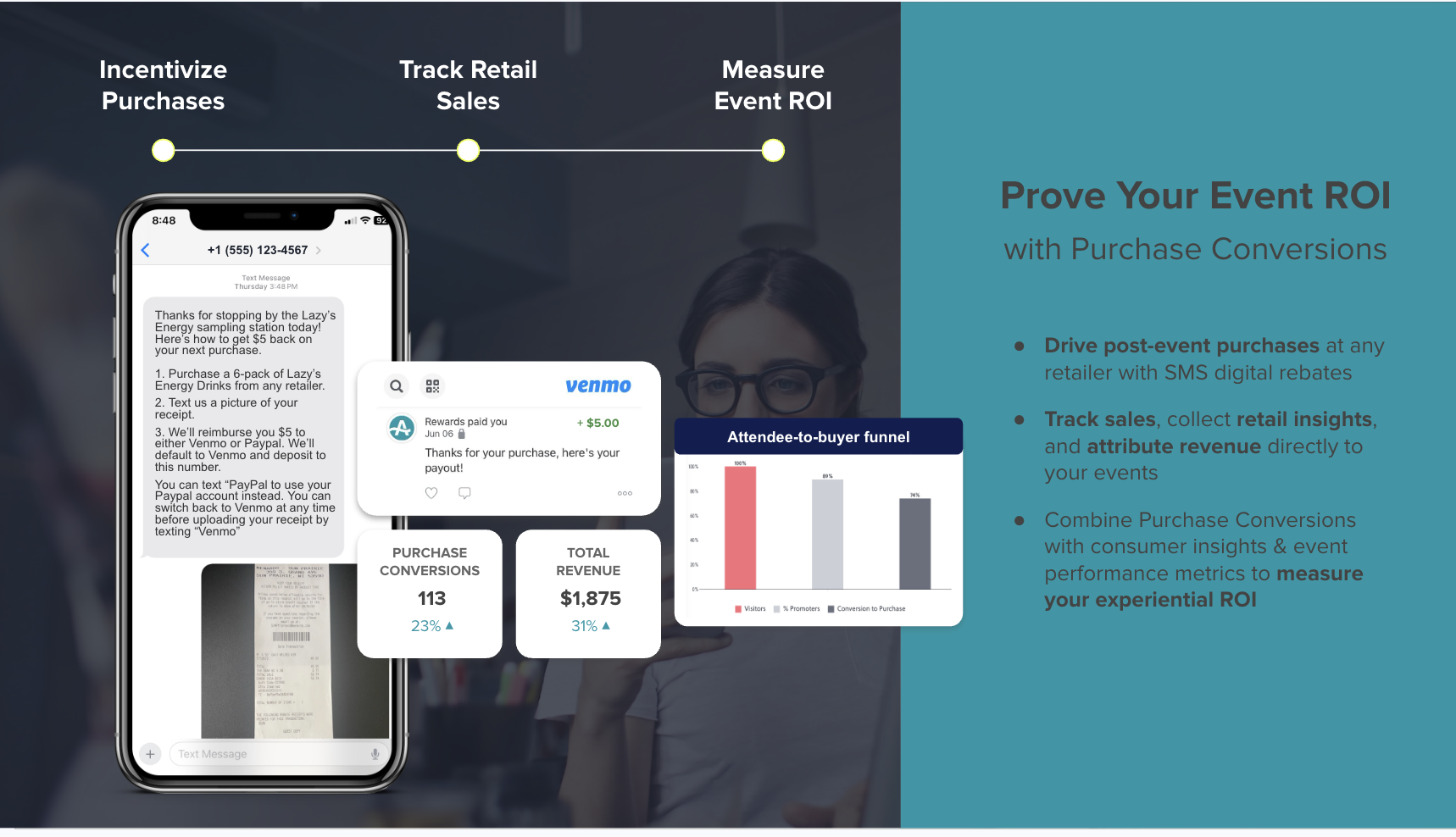
In a one-month ambassador tasting pilot with a single unnamed craft brand on a small dataset, 56% of the records collected converted to a bottle purchase. The sweepstakes variant runs the same mechanic with a prize entry instead of cash back, and AnyRoad handles the regulatory compliance around terms, conditions, and privacy policies.
Every receipt-verified conversion feeds back into the SMS segmentation model. A consumer who purchased within 48 hours of a tasting receives a different follow-up sequence than one who registered but did not convert, which enables a win-back flow timed to the 25–30-day window when a typical first-purchase supply is running low.

Strategic Choices: Resourcing, Integrations, and Measurement
The in-house versus managed-service decision for alcohol SMS programs depends on two factors. The first is whether the brand has a lifecycle marketer who understands alcohol compliance and release calendars. The second is whether it has the data infrastructure to connect experiential opt-ins to SMS triggers without a manual export step.
Most mid-size alcohol brands lack both. The managed CRM services model, where the SMS and email program is run by a team that already holds the experiential data, understands CTIA SHAFT restrictions, and knows the rhythm of a spirits release calendar, replaces a fragmented stack of Klaviyo licenses, agency retainers, and internal headcount with a single relationship. AnyRoad’s managed CRM sits on top of the same first-party data the platform collects, including NPS, spend, visit frequency, and club status, so segmentation does not require manual exports.

Integration requirements for brands building in-house include CRM or CDP connections such as HubSpot or Salesforce, marketing automation like Klaviyo, and payment rails for cashback payouts through Venmo or PayPal. AnyRoad connects to all of these via Webhooks, Zapier, Workato, and direct API. Bottle club transactions run through a Shopify-integrated experience operated by AnyRoad’s licensed ecommerce retail partner, which keeps the compliant transactional path intact without requiring the brand to become a licensed retailer.
Measurement needs to shift from open rates to revenue-per-subscriber and retention-through-six-releases. Automated lifecycle flows achieve higher conversion rates than broadcast blasts, and that gap only appears when measurement moves beyond opens to placed orders and attributed revenue. The six-release retention window is the correct long-term metric for bottle club SMS programs. Retaining a member through all six releases captures the full $600 value established earlier, while early churn at release two leaves $400 on the table.
Implementation: Phased Readiness Checklist
- Audit all existing consent language across tasting-room registration forms, festival sign-ups, and digital opt-ins against the TCPA/CTIA multi-state standard: unchecked checkbox, brand name, program description, frequency disclosure, rates disclosure, STOP instructions, and “consent is not a condition of purchase.” This audit establishes your compliance baseline before you build any new flows.
- Once consent language is solid, map every visit-to-SMS trigger. Examples include first visit opt-in leading to a welcome SMS within 24 hours, second visit leading to a club enrollment pitch SMS, post-purchase receipt leading to a rebate confirmation SMS, depletion window leading to a replenishment SMS, and release day leading to a launch announcement SMS. This mapping defines what messages you will actually send.
- With triggers mapped, register a Brand and Campaign through The Campaign Registry (TCR) with an alcohol-specific campaign description that includes 21+ age verification documentation. Failure to meet CTIA-based TCR requirements can result in campaign rejection, lower trust scores, and message filtering by carriers.
- Build quiet-hour guardrails into every automated journey. Use 8 AM–9 PM in the recipient’s local time zone federally, 8 AM–8 PM in Florida and Oklahoma, and Sunday restrictions in Texas under SB 140 effective September 1, 2025.
- Implement 21+ age verification at the SMS opt-in point for any program that will send alcohol-promotional content.
- Pilot with a single experience such as one tasting-room enrollment flow, one depletion-aware replenishment trigger, and one receipt-verified rebate before scaling to the full release calendar.
- Retain consent records for a minimum of five years in tamper-proof storage with timestamps, IP addresses, and exact disclosure text.
Walk through the compliance checklist and pilot setup with AnyRoad’s alcohol-native team.
Five Common Pitfalls to Avoid
- Generic blast fatigue. Many consumers unsubscribe from SMS lists because they receive too many messages, and 28% stop buying from a brand entirely because of unhelpful texts. Behavioral triggers that respond to visits, purchases, and feedback consistently outperform scheduled blasts on every conversion metric and support the lifecycle pillars described above.
- Ignoring depletion timing. A replenishment SMS sent before a member has finished their current allocation accelerates skip and pause behavior. Depletion-aware timing becomes the retention lever that discounting cannot replace and directly supports the six-release value target.
- Missing TCPA/CTIA consent language. TCPA statutory damages run $500–$1,500 per message, and Texas SB 140 adds up to $5,000 per violating text with a private right of action. A single missing disclosure in an opt-in form creates class-action exposure across every message sent to that list.
- Measuring only opens. Open rate shows delivery, not revenue. Revenue-per-subscriber and retention-through-six-releases align with the experiential, depletion-aware lifecycle and reveal whether SMS is actually driving paid loyalty.
- Stitching non-alcohol-native tools. A Klaviyo flow built on ecommerce purchase history does not understand release calendars, SHAFT restrictions, or the depletion-churn relationship. The compliance and data gaps compound with every release cycle and undermine the lifecycle design.
Generalized Use-Case Patterns for Alcohol SMS
- Tasting-room enrollment. Guest checks in via QR code, opts into SMS at registration, and receives a welcome text within 24 hours with a club enrollment link and a same-day discount offer. A coached tour guide reinforces the pitch at the end of the tasting. Diageo’s Johnnie Walker Princes Street experience shows how post-visit follow-up creates lifelong brand relationships from a single immersive visit.
- Ambassador tasting cashback. Consumer registers at a Total Wine activation via AnyRoad Live, receives an SMS rebate offer, purchases the bottle, texts back the receipt, and receives Venmo payment within 48 hours. The receipt record then feeds a follow-up replenishment sequence timed to the depletion window.
- Club launch announcement. An existing tasting-room opt-in list receives an SMS announcing a new bottle club with a club-only expression and an enrollment deadline. Segmentation surfaces the highest-NPS, highest-spend visitors for a personalized VIP invitation variant.
- VIP replenishment. A member’s depletion clock reaches 75% of the estimated cycle. SMS fires with a one-tap reorder link and a cocktail recipe using the current allocation, which moves the member through their bottle and primes them for the next release.
- Event feedback-to-SMS nurture. A post-event survey goes out via SMS within two hours of the visit. High-NPS responders enter a VIP nurture sequence, while low-NPS responders trigger a service-recovery flow. Campari Group’s AnyRoad data showed 48% of visitors converted to brand promoters after their experiences, which provides a segmentation signal that directly informs which subscribers receive VIP versus standard nurture messaging.
Map these use cases to your tasting-room and event calendar with our experiential SMS specialists.
Visitor-to-VIP Lifecycle Table
| Stage | Visitor Status | Data Signal | SMS Trigger | Message Goal | Success Metric |
|---|---|---|---|---|---|
| 1. First Visit | Anonymous visitor → identified opt-in | QR-code registration, consent record | Welcome SMS within 24 hours of visit | Confirm opt-in value, introduce brand story | Opt-in confirmation rate |
| 2. Second Visit | Identified opt-in → enrollment candidate | Second check-in event (the 512% lift signal mentioned earlier) | Club enrollment pitch SMS with same-day discount | Convert visit momentum into paid enrollment | Club enrollment rate |
| 3. New Member | Enrollment candidate → active member | Enrollment confirmation, first release shipped | Onboarding SMS series: welcome, education, cocktail recipe | Drive depletion of first allocation, reduce early churn | First-release depletion rate |
| 4. Active Member | Active member → repeat purchaser | Depletion clock at 75%, release calendar trigger | Depletion-aware replenishment SMS with one-tap reorder | Drive reorder before competitor fills the gap | Release-to-release retention rate |
| 5. At-Risk Member | Active member → skip/pause risk | Missed replenishment window, skip or pause signal | Re-engagement SMS: master distiller class invite or exclusive content | Move member through current allocation, prevent churn | Skip/pause reversal rate |
| 6. VIP Member | Retained member → brand advocate | High NPS, above-average spend, six-release retention | VIP early-access SMS for limited expressions and on-site events | Maximize LTV, activate advocacy and referral | Revenue per subscriber, referral rate |
Frequently Asked Questions
What is SMS marketing for consumer packaged goods, and how does it differ from email marketing?
SMS marketing for consumer packaged goods is a permission-based channel where brands send text messages to consumers who have explicitly opted in, typically at a brand experience, retail activation, or digital touchpoint. The core difference from email is immediacy and attention. SMS messages are read within minutes of delivery at rates that email cannot match, which makes SMS the right channel for time-sensitive triggers like depletion reminders, release-day announcements, and post-visit feedback requests. For alcohol and CPG brands, SMS also operates under a stricter compliance framework, including TCPA, CTIA Messaging Principles, and carrier-level content screening, which requires alcohol-specific consent language and age verification that generic email programs do not need.
How do alcohol brands stay compliant when sending promotional SMS messages?
Alcohol-promotional SMS is permitted in the US under CTIA guidelines when the program includes 21+ age verification at opt-in, a registered campaign through The Campaign Registry (TCR) with an alcohol-specific campaign description, and consent language that meets the TCPA prior express written consent standard. Every message must include a clear opt-out mechanism, and opt-out requests must be honored within 10 business days. Quiet-hour rules apply at the federal level from 8 AM to 9 PM local time and are stricter in Florida, Oklahoma, and Texas. Consent records, including the exact disclosure text shown at opt-in, timestamp, IP address, and source URL, must be retained for a minimum of five years. Brands that skip TCR registration or omit age verification risk carrier-level program termination, which CTIA classifies as a Level 0 SHAFT violation.
What metrics should alcohol and CPG brands use to measure SMS program performance?
Open rate functions as a delivery metric and should not serve as the primary scoreboard for an alcohol SMS program. The correct metrics include revenue per subscriber, release-to-release retention rate, club enrollment rate from SMS-triggered flows, receipt-verified conversion rate from cashback rebate campaigns, and opt-out rate, where a healthy program stays below 1%. For bottle club programs specifically, retention through six releases is the long-term metric that shows whether the SMS lifecycle is actually moving members from a roughly $100 single-bottle value to the roughly $600 six-release member value. Automated lifecycle flows consistently outperform broadcast blasts on all of these metrics because they align with behavioral signals rather than calendar schedules.
How does AnyRoad connect tasting-room visit data to SMS triggers without manual exports?
AnyRoad’s platform captures guest data such as NPS score, spend level, visit frequency, club status, and opt-in consent records at the point of experience through QR-code registration, the Front Desk app, and the AnyRoad Live mobile app for off-site activations. That data lives in the same platform as the SMS and managed CRM layer, so segmentation and trigger logic do not require a manual export to a separate email service provider or SMS tool. A second check-in event automatically surfaces the guest as an enrollment candidate. A depletion clock reaching 75% automatically queues a replenishment SMS. A high-NPS survey response automatically routes the guest into a VIP nurture sequence. For brands with existing CRM or CDP infrastructure, AnyRoad connects via Webhooks, Zapier, Workato, HubSpot, Salesforce, and direct API.
What is the difference between running a bottle club SMS program in-house versus using AnyRoad’s managed service?
An in-house bottle club SMS program requires assembling an ecommerce platform, subscription billing software, a compliant fulfillment path through a licensed retailer, an SMS tool with alcohol-compliant campaign registration, and internal headcount to operate all of it, often without alcohol-native expertise attached to any component. AnyRoad’s managed service delivers the technology, the compliant transactional path through its licensed ecommerce retail partner, the SMS and CRM execution, and a team of spirits industry operators who coach on-site staff, manage release-calendar communications, and handle quarterly club maintenance as a single relationship. For brands without a dedicated lifecycle marketer who understands CTIA SHAFT restrictions and spirits release cadences, the managed service often determines whether the channel runs or the license goes unused.
Conclusion: Turning Every Tasting-Room Visit into Recurring Revenue
The experiential-to-SMS lifecycle already functions as the most reliable post-experience revenue path available to alcohol and CPG brands in a privacy-first, cookie-free environment. First-party data captured at a tasting room or festival activation, converted into a compliant SMS opt-in, and activated through a depletion-aware lifecycle framework moves a $100 single-bottle buyer toward the $600 six-release member relationship that defines long-term brand value.
The brands that will win the next five years of CPG loyalty are building that infrastructure now with alcohol-native compliance, coached on-site enrollment, and measurement anchored to revenue per subscriber rather than open rates. AnyRoad’s Lifetime Loyalty platform, already adopted by Heaven Hill Distillery, Nearest Green Distillery, Lux Row Distillers, Castle & Key, Catoctin Creek Distilling, and Tarnished Truth Distilling, is the only end-to-end solution that connects the tasting-room visit to the SMS trigger to the receipt-verified bottle sale without requiring brands to assemble or maintain the stack themselves.
Schedule a walkthrough to see the compliant, depletion-aware SMS lifecycle in action.