


Written by: Bryan Grobstein, Vice President, Global Revenue, AnyRoad | Last updated: October 14, 2026
Key Takeaways
- Experiential marketing drives growth through a six-stage amplification chain: experience, sharing, organic reach, consideration, conversion, and long-term growth. Each stage produces measurable signals.
- Hands-on participation nearly doubles purchase intent, and 85% of highly engaged attendees report being more likely to purchase after live events.
- Peer-to-peer social sharing generates 69% consumer trust versus 38% for direct brand messaging, so attendee-generated content carries more credibility than paid media.
- Brands that capture first-party data at activations can connect shares to second visits and recurring revenue. Visitors who return twice are 512% more likely to enroll in paid loyalty programs.
- AnyRoad provides the technology and expertise to capture first-party data, measure brand affinity and purchase intent, and connect experiences to retail sales through its Purchase Conversion Tools.
The Amplification Chain Behind Experiential Growth
The mechanism operates as a six-stage sequence. Each stage produces a distinct, measurable signal.
- Experience. A consumer participates hands-on at the activation, such as a distillery tour, a festival tasting, or a brand-home class. Spiro's EMIR found that attendees who interact with a brand, have meaningful conversations, or get hands-on are far more likely to purchase, recommend, and remain open to future engagement. That finding shows that participation depth is the variable that matters at this stage.
- Sharing. Attendees post content from the experience to their personal social channels. 44% of attendees shared because the experience was surprising, striking, or emotionally resonant, and 41% shared because it felt personally or professionally relevant. Two barriers suppress sharing: 28% said it was not top of mind, and 21% said there was no easy way to share.
- Organic Reach. Attendee-generated content reaches followers who were never at the event and whom the brand never paid to reach. Matter Communications (2023) found that 69% of consumers trust a recommendation from a friend, family member, or influencer, compared with 38% who trust the same message coming directly from a brand. Peer-to-peer posts carry structural credibility that paid placements cannot replicate.
- Consideration. Exposed non-attendees shift on brand affinity and purchase intent. Spiro's EMIR found that the share of attendees reporting high purchase intent was 264% higher among those who felt increased brand trust after a live event than among those whose trust did not increase. This association points to trust as the mechanism that links a share to a sale.
- Conversion. Consideration becomes a first purchase, a retail redemption, or an enrollment. Connecting this stage to the activation requires first-party identifiers such as UTM parameters, QR codes, unique promotional codes, or post-event follow-up that bridge the gap between a social impression and a transaction.
- Long-Term Growth. A converted customer who returns becomes exponentially more valuable. AnyRoad's data shows that a consumer who visits a distillery twice is 512% more likely to convert into a paid loyalty enrollment. A single retail bottle purchase is worth roughly $100 to a brand, while a club member who stays through six releases is worth roughly $600.
Primary Research That Supports the Amplification Chain
Spiro's EMIR: The Deeper Dive surveyed 2,000 live event attendees, split evenly between B2B and B2C, in partnership with Qualtrics. The dataset adds two findings that extend the chain above: hands-on participation nearly doubled purchase intent versus passive attendance, and 85% of highly engaged attendees said they were more likely to purchase.

These relationships are associations, not proof of causation. Spiro's methodology does not isolate sharing as the sole driver of intent. Other variables such as prior brand affinity, product category, and event design move at the same time. The measurement framework in the next section gives practitioners a way to isolate impact within a specific activation.
Broader word-of-mouth research reinforces this direction. A 2026 review in the Journal of the Academy of Marketing Science (Pauwels et al.) synthesizes 15 years of research. It concludes that word-of-mouth matters more for experience products than for search products, and that a measurement chain from event to conversation to online sharing to store traffic and sales is empirically supported. Bazaarvoice's Shopper Experience Index (2022) found that shoppers who engage with user-generated content generate 162% more revenue per visitor and about 13% higher average order value than those who do not. This figure covers digital UGC broadly, so each brand still needs its own baseline comparison for live activations.
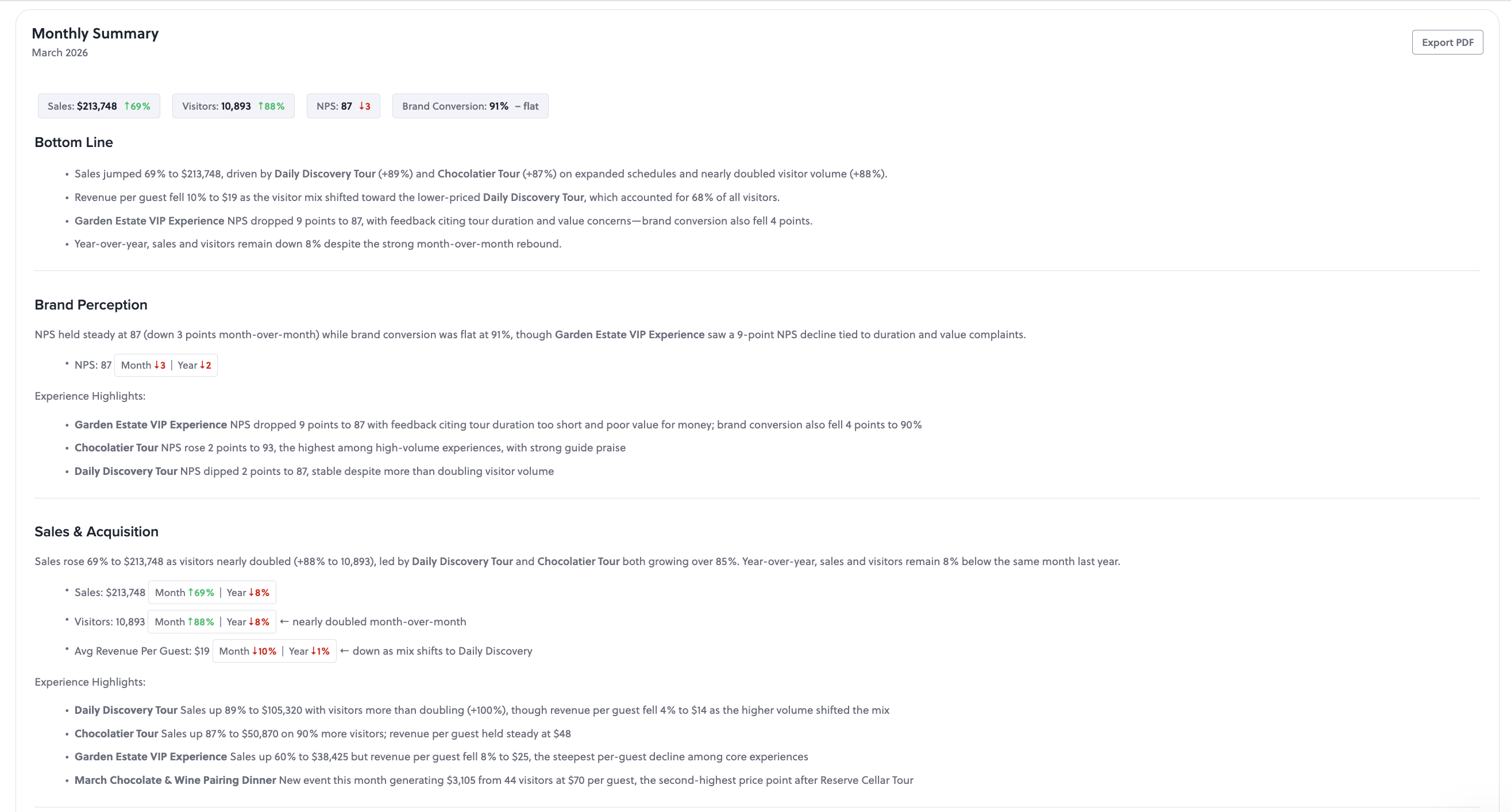
AnyRoad's customer data shows how this plays out at the brand-home level. Festival activations run by agency POPLIFE for an artisanal mezcal brand at III Points and Portola in 2023 produced 85% post-event purchase intent. Conversate Collective's field marketing events for a CPG beauty brand showed that 74% of guests were more likely to purchase after attending, and over 50% of surveyed consumers bought the brand's products from Walgreens and Target. These results all depend on attendees choosing to share, so the design of shareable experiences becomes the next lever.
Design Principles That Make Experiences Shareable
Spiro's EMIR identifies two structural barriers to sharing: 28% of attendees said sharing was not top of mind, and 21% said there was no easy way to share. These barriers come from design choices rather than audience motivation. Four principles address them directly.
- Visual Distinctiveness. Environments with a strong, photogenic identity give attendees a natural reason to document. A generic tasting table produces no shareable moment. A barrel-room setting with branded lighting does.
- Frictionless Content Creation. QR codes linking to pre-formatted share prompts, on-site photo stations integrated with platforms like Smilebooth, and SMS-delivered content reduce the effort required to post from minutes to seconds.
- Creator and Community Activation. Seeding micro-influencers or brand ambassadors within the activation normalizes sharing behavior for general attendees and extends reach to audiences that already trust those voices.
- A Clear Value Exchange. 77% of consumers are open to submitting UGC if they receive a reward such as a discount, a chance to be featured, or early access to new products. A cashback rebate delivered via SMS after a share acts as both an incentive and a first-party data capture point.
Measurement Framework for Social Amplification
Likes, views, and impressions diagnose reach but do not prove growth. A stage-by-stage measurement framework connects each activation phase to a trackable signal.
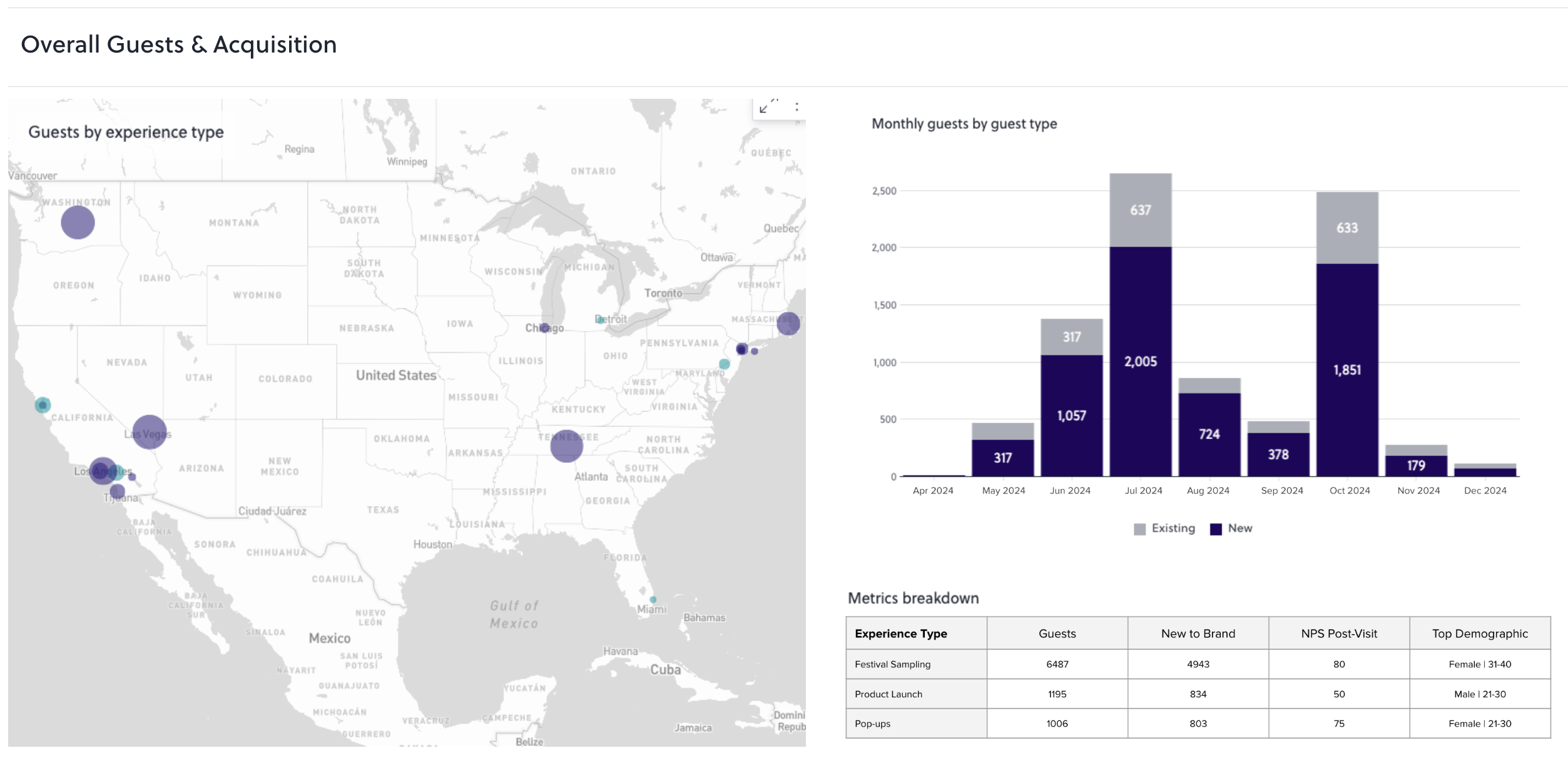
- Experience. Track attendance, participation depth, and first-party opt-ins captured at the point of engagement. Campari Group's partnership with AnyRoad enabled a 3X increase in marketing opt-in rates from brand-home registrations and identified 4,500 brand champions, alongside a 25% increase in average spend per customer since 2020.
- Amplification. Measure social amplification rate, tagged mentions, UGC volume, and earned reach. Inspira Marketing recommends monitoring event hashtags and brand tags in real time to measure social amplification rate, defined as the percentage of attendees who share the activation on their own social channels.
- Consideration. Measure brand affinity, NPS, and purchase-intent shift before and after the event using a consistent survey instrument. AnyRoad analytics at Johnnie Walker Princes Street showed that an important under-targeted demographic was 40% more likely to drink whisky after visiting, and the experience produced a 16-point NPS increase.
- Conversion. Track redemptions, enrollments, and first purchases attributable to the activation. EventTrack 2026 research by Event Marketer found that 61% of consumers say they are more inclined to purchase after attending a brand event. Conversion tracking turns that intent figure into a revenue figure.
- Long-Term. Track repeat visits, membership retention, and lifetime value. The 512% loyalty conversion figure cited earlier explains why the second visit matters. A member who stays through six releases is worth roughly $600 versus roughly $100 for a single bottle purchase.
Connecting Social Activity to Conversion
Reach becomes attributable revenue only when a first-party identifier links the social touchpoint to a downstream transaction. QR codes placed on event assets can route attendees to event-specific landing pages with embedded tracking parameters, bridging physical presence and digital capture, although QR scans demonstrate digital follow-through rather than purchase causality. UTM parameters standardized by source, medium, campaign, and content enable creative-level reporting across channels.
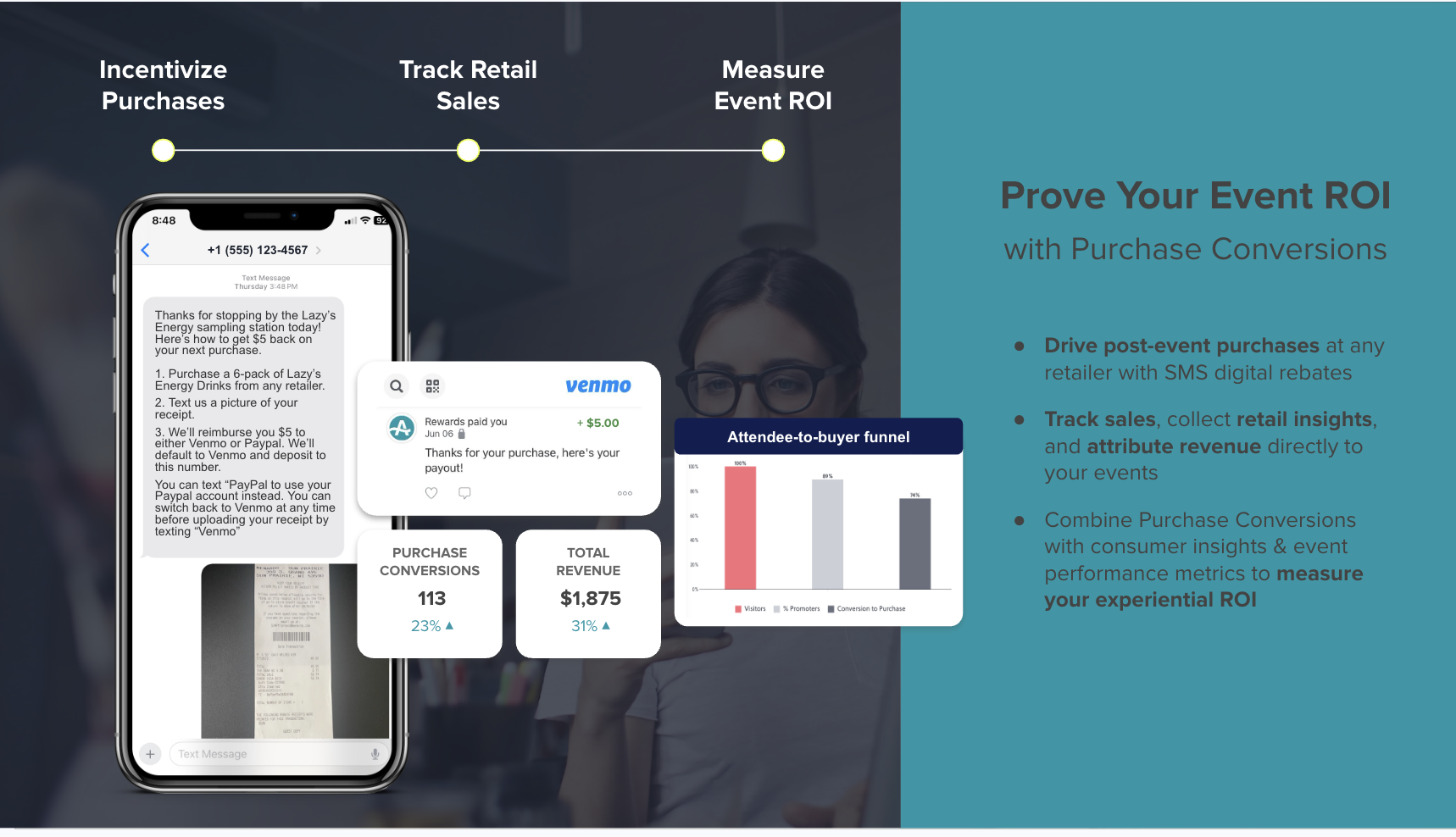
Unique promotional codes provide a fallback when links are stripped in in-app browsing and allow redemption tracking at retail. Post-event follow-up surveys with a question asking how the consumer heard about the brand close the gap that last-click attribution leaves open. Attribution windows, performance baselines, and data capture rules must be established before an activation begins to eliminate post-campaign reporting bias.
Prove future retail sales impact from your experiences. Schedule a demo.
How Social Sharing Influences Purchase Intent
The 61% purchase-intent lift among sharers and the 264% trust figure cited earlier both come from the same 2,000-person Spiro survey. These figures represent associations rather than controlled experiments that isolate sharing as the only cause. The practical takeaway is that sharing and trust move together. The act of sharing can reinforce the sharer's own commitment to the brand, while the content itself shifts intent among the exposed audience through peer credibility.
The 2026 Journal of the Academy of Marketing Science review by Pauwels et al. reports that offline word-of-mouth is driven mostly by emotional factors, online word-of-mouth by social factors, and both by functional factors. This pattern aligns with Spiro's observation that emotional resonance is the primary driver of sharing from live experiences. Stackla/Nosto found that 79% of people say user-generated content highly impacts their purchasing decisions, which reinforces the downstream effect of attendee-generated posts on non-attendee audiences.
The measurement framework above gives practitioners a way to turn these associations into activation-specific numbers. Pre- and post-event purchase-intent surveys, matched control groups, and conversion tracking by first-party identifier convert directional findings into defensible results.
Applying the Amplification Chain to Alcohol and CPG Brand Homes
The brand-home and tasting-room context makes the amplification chain directly measurable because the visit, the share, and the subsequent purchase can all be connected through first-party data. Absolut's brand home in Åhus, Sweden, increased average revenue per guest by 36% since 2018 and maintained an 85% brand conversion score post-event. This performance shows that a structured visit experience produces measurable revenue outcomes and not just brand impressions.
The recurring-revenue math strengthens the case for owning the data behind each share. A single visit is a transaction. A second visit changes the math: that consumer is 512% more likely to convert to a paid loyalty enrollment. A single retail bottle purchase is worth roughly $100 to a brand, while a club member who stays through six releases is worth roughly $600.
Churn concentrates around the six-release mark, and the underlying cause is typically depletion. Members who have not finished what they own hesitate to buy more. Programming such as virtual cocktail classes with master distillers addresses retention more effectively than discounting because it increases usage and engagement.
AnyRoad's reporting from its February 20, 2025 press release shows that experience-driven opt-ins convert to paid loyalty at four times the rate of traditional channels, with member spending increasing 150% within the first year. That performance is why distilleries including Heaven Hill, Nearest Green, Lux Row, Castle & Key, Catoctin Creek, and Tarnished Truth have adopted the platform.
Social amplification produces reach, and reach becomes growth when the brand owns the first-party data behind it and can connect a share to a second visit and a purchase. AnyRoad captures first-party consumer data across online and in-person experiences, measures brand affinity, NPS, and purchase intent through Atlas Insights, and connects experiences to retail sales through its Purchase Conversion Tools. Cashback rebates and sweepstakes delivered via SMS track receipt-verified purchases without requiring POS integration at the retailer.
The alternatives brands typically weigh fall into two categories. Booking and ticketing tools such as FareHarbor, Xola, Peek Pro, Tock, Splash, and Eventbrite focus on demand generation or booking management rather than deep first-party data capture and post-experience revenue attribution. A DIY stack that combines an ecommerce provider, subscription billing software, a fulfillment partner, and internal headcount creates a program the brand must maintain indefinitely, with no alcohol-specific expertise attached to any component. AnyRoad supplies the technology, the domain expertise, and the operating team as one relationship. The table below compares three capabilities that determine whether an experience can be tied to revenue: primary focus, data ownership, and post-experience revenue connection.
| Capability | AnyRoad | Eventbrite / FareHarbor / Tock |
|---|---|---|
| Primary Focus | First-party data capture and post-experience revenue for brand-owned experiences | Demand generation, booking management, or reservations |
| Data Ownership | Brand owns the full consumer record, with no third-party co-ownership | Eventbrite co-owns data and markets other events to your customers; FareHarbor and Tock retain booking data within their platforms |
| Post-Experience Revenue Connection | Purchase Conversion Tools, Bottle Clubs, Memberships, and managed CRM connect visits to retail sales and recurring revenue | No native post-experience purchase conversion or loyalty enrollment tools |
Experiential Marketing Compared With Traditional Advertising
Traditional advertising operates on a passive, interruptive model in which the brand pays to place a message in front of an audience that did not request it. Experiential marketing operates on a participatory model in which the audience opts into the interaction and, when the experience is well-designed, generates the distribution itself. Katz and Lazarsfeld (1955) reported that word-of-mouth was seven times more effective than print advertising in influencing consumers to switch brands. This finding predates social media but describes the same trust differential that makes attendee-generated posts more persuasive than corporate ads. The structural advantage of experiential programs is that the audience's own content carries credibility that paid media cannot manufacture.
Frequently Asked Questions
Does the Approach Differ for a Local Pop-Up Versus a Digital-Hybrid Event?
The amplification chain stays the same, while the data capture mechanics change. A local pop-up relies on on-site QR codes, mobile registration, and SMS follow-up to build the first-party record. A digital-hybrid event can capture attendee data at registration and use platform analytics to track content sharing and downstream engagement.

In both cases, the measurement framework of participation depth, amplification rate, intent shift, conversion, and lifetime value applies without modification. The primary difference is that digital-hybrid events produce a more complete click-stream, while in-person activations require deliberate data capture design to avoid losing most attendees as anonymous visitors.
How Does This Apply by Industry or Product Type?
The amplification chain is strongest for experience products, where consumption is social, sensory, or identity-expressive. Alcohol, spirits, CPG food and beverage, beauty, and travel all show high social-sharing propensity because the experience carries social currency. For utilitarian or privately consumed categories, offline word-of-mouth often outperforms online sharing, and the measurement emphasis shifts toward NPS, repeat purchase, and referral tracking rather than UGC volume.
The brand-home and tasting-room context suits this approach particularly well because the visit is inherently shareable and the recurring-revenue path through club enrollment is structurally available.
How Long After an Event Should You Measure Conversion?
Purchase intent captured immediately after a positive experience often runs high. A 30-day post-event survey with a matched control group provides a more reliable intent signal. Observed purchase behavior should be tracked at 60 to 90 days post-event for most CPG and spirits activations, given depletion reporting lag and the time required for a consumer to return to retail.
Long-term brand equity impacts such as repeat visit rates, club enrollment, and lifetime value require six months to a year of tracking to fully materialize. Attribution windows must be defined before the activation begins, because expanding them retroactively to capture background purchases undermines the measurement.
What Is a Good Social Amplification Rate?
There is no universal benchmark, and vendor-reported figures vary widely by category, event format, and audience. Inspira Marketing identifies strong nationwide experiential programs as those achieving first-party data opt-in rates above 30%, which provides a directional proxy for engagement depth. For social amplification specifically, the relevant comparison is the brand's own baseline across activations.
A rate that improves quarter over quarter, controlled for event size and format, offers a more defensible signal than a cross-industry average. Tracking the metric consistently using a standardized definition, such as unique posts divided by total attendees within a defined window, is the prerequisite for any meaningful benchmark.
Can You Measure Amplification Without a Large Budget?
The minimum viable measurement stack for a single activation includes a unique event hashtag monitored through native platform search, a QR code linking to a landing page with UTM parameters, a post-event survey sent to the first-party contact list captured at registration, and a comparison of purchase or redemption data in the activation market against a prior period or a comparable non-activation market. This approach does not require a dedicated analytics platform or a large team.
The main constraint is discipline. Data capture rules, attribution windows, and survey questions must be defined before the activation and not reconstructed afterward. That discipline is what turns the amplification chain from a concept into a revenue case.
See how AnyRoad measures amplification for your brand
Conclusion: Turn Amplification Into Attributable Revenue
The amplification chain of experience, sharing, organic reach, consideration, conversion, and long-term growth forms a measurable sequence rather than a theory. Each stage produces a trackable signal, and brands that connect those signals through first-party data can defend their experiential budgets with revenue numbers. Structured execution, clean first-party data capture, and a stage-by-stage measurement framework separate an activation that generates social noise from one that generates attributable growth.
Experiential marketing's business case is strongest when the brand owns the data behind every share and can trace it forward to a second visit, an enrollment, and a recurring revenue relationship.
Own the guest journey, own your guest data. Schedule a demo.