


Written by: Bryan Grobstein, Vice President, Global Revenue, AnyRoad | Last updated: October 15, 2026
Key Takeaways
- Experiential marketing for CPG brands works when activation formats align with specific objectives like trial, awareness, or retail lift instead of creative preference.
- Sampling drives trial with strong conversion rates, while immersive pop-ups and culture-led events excel at first-party data capture and earned reach respectively.
- Operational execution, including trained ambassadors, on-site data capture, and QR registration, determines whether audience engagement turns into measurable commercial outcomes.
- Receipt-verified purchase mechanics using SMS rebates and AI receipt validation connect activations to actual bottles sold without retailer POS integration.
- AnyRoad unifies booking, scheduling, data capture, and purchase tracking so CPG brands can see which activations drive real retail sales.
See how AnyRoad connects activations to retail sales. Book a demo.
Why CPG Experiential Marketing Now Centers On Audience Engagement
Experiential marketing for CPG brands now operates as a revenue discipline. Rising customer acquisition costs, the collapse of third-party data, and retailer pressure to justify shelf space push brand managers to treat activations as accountable programs with clear commercial outcomes. The focus has shifted from proving that experiential marketing works to proving which bottles it actually sold. Brands meet that bar by matching activation format to objective, running the operational layer that converts engagement, and closing the loop with receipt-verified purchase mechanics.
Ready to prove your experiential ROI? Schedule a demo.
Match Each Experiential Activation To A Clear CPG Objective
The most common failure in CPG experiential planning is choosing an activation format before defining the objective. Each format supports a different commercial outcome. When brands mismatch format and goal, they spend heavily and see weak returns.
Sampling And Ambassador Tastings serve trial. The objective is to get the product into a consumer's mouth and convert that moment into a purchase. In-store product demonstrations typically deliver average sales lifts of 150% to 300% for featured items during the promotion period, and well-run programs achieve strong immediate trial-to-purchase conversion. The primary KPIs are cost per trial and trial-to-purchase conversion rate.
Immersive Pop-Ups serve awareness and first-party data capture. The objective is to create a brand environment that earns an opt-in from every attendee. The primary KPIs are opt-in rate and data captured per attendee. Campari Group's partnership with AnyRoad enabled a 3X increase in marketing opt-ins and identified 4,500 brand champions.
Culture-Led Events serve relevance and earned reach. The objective is to associate the brand with a cultural moment that the target audience already cares about. The primary KPIs are share of voice and sentiment.
Retailtainment And In-Store Activations serve retail lift. The objective is to move product off a specific shelf in a specific account. The primary KPIs are receipt-verified purchase and sell-through velocity. A Kraft Heinz omnichannel campaign across Empire's Sobeys and Safeway banners generated a reported 1.08% incremental sales lift and approximately $159,000 in incremental sales above the media mix control stores received.
Mobile Tours serve geographic expansion. The objective is to build trial volume across markets where the brand lacks retail presence or awareness. The primary KPIs are markets reached and repeat visits per market.
Creator Activations serve audience engagement and trust transfer. The objective is to reach an existing community through a trusted voice and convert that engagement into a brand registration. The primary KPI is engagement-to-registration rate.
The table below summarizes how each activation format maps to its objective and primary KPI so teams can match format to goal before committing budget.
| Activation Type | Best For | Primary KPI |
|---|---|---|
| Sampling and ambassador tastings | Trial | Cost per trial, trial-to-purchase conversion |
| Immersive pop-ups | Awareness and first-party data capture | Opt-in rate, data captured per attendee |
| Culture-led events | Relevance and earned reach | Share of voice, sentiment |
| Retailtainment and in-store activations | Retail lift | Receipt-verified purchase, sell-through |
| Mobile tours | Geographic expansion | Markets reached, repeat visits |
| Creator activations | Audience engagement and trust transfer | Engagement-to-registration rate |
Own the guest journey and your guest data. Schedule a demo.
Named, Dated CPG Experiential Marketing Examples
OREO Space Dunk At Walmart (2024): Mondelēz International used a limited-edition retail activation format to reach lapsed buyers. Between 15% and 17% of shoppers who bought the Oreo Space Dunk edition at grocery stores had not purchased any Oreo at those locations in more than two years. This result shows that retailtainment-adjacent limited-edition activations can reactivate lapsed buyers that core product marketing does not reach. The activation type was retailtainment and limited-edition retail. The objective was trial and lapsed-buyer reactivation. The KPI was new-to-brand and lapsed-buyer purchase rate.
Aveeno Oat Oasis At SXSW: Aveeno's immersive pop-up at SXSW positioned the brand inside a culture-led event to reach a health-conscious, digitally engaged audience. The activation type was an immersive pop-up inside a culture-led event. The objective was awareness and first-party data capture among a high-value demographic. The KPIs were opt-in rate and brand sentiment among attendees.
Graza's Community Refill Activation (2024): Graza introduced nitrogen-sealed aluminum refill cans in May 2024 designed to support repeat household use of its squeeze-bottle olive oils. The activation type was a community and DTC engagement mechanic. The objective was repeat purchase and household retention. The KPI was refill subscription conversion and repeat purchase rate. No independently verified event-specific sales figures have been publicly reported for the refill activation itself.
Kerrygold's Chicago Irish Village Market Activation: Kerrygold used a culture-led event tied to Irish heritage to drive brand relevance and trial in a high-affinity consumer environment. The activation type was a culture-led event with sampling. The objective was relevance, earned reach, and trial among premium grocery buyers. The KPIs were share of voice and trial-to-purchase conversion at adjacent retail accounts.
The Operational Reality Of CPG Brand Activations
These examples show what strong activations look like on paper. The difference between success and failure usually appears in execution. The operational layer determines whether audience engagement converts. Most activations fail on execution. Staffing gaps, untrained ambassadors, and missing data capture mechanics are where commercial return disappears.
Running a CPG experiential activation across markets requires four operational capabilities. Staffing and scheduling coordination keep every stop covered. Ambassador coaching ensures the pitch happens consistently. On-site data capture at the point of engagement turns interactions into usable records. QR registration that works for walk-ins as well as pre-booked guests keeps the data flowing beyond the guest list. Staffing is not a commodity, and hiring brand ambassadors based solely on availability or cost often leads to ambassadors who lack enthusiasm, product knowledge, or the interpersonal skills needed to build genuine connections. Trained brand ambassadors consistently produce 20–40% lifts in conversion rates versus unstaffed periods at the same retail location.
AnyRoad is the platform that unifies booking, scheduling, on-site check-in, and data capture for CPG and alcohol brands. Its white-glove service model deploys spirits industry operators, rather than generalist account managers, to coach on-site staff, structure the enrollment experience, and handle the operational lift brands would otherwise have to staff internally. AnyRoad supplies both the expertise and the operating team alongside the software.

See how AnyRoad supports activation operations. Schedule a demo.
How CPG Brands Capture First-Party Data At Activations
First-party data is the core asset of experiential marketing for CPG brands. An activation that produces impressions but no consumer records leaves the brand with nothing to act on after the event ends. Strong operations create the conditions for that data capture.
AnyRoad captures data from every attendee through configurable pre-, during-, and post-experience questions. Its FullView capability captures data from every member of a group, which closes the gap most platforms leave open. Campari Group's partnership with AnyRoad has streamlined event management and integrated systems, contributing to stronger customer engagement.
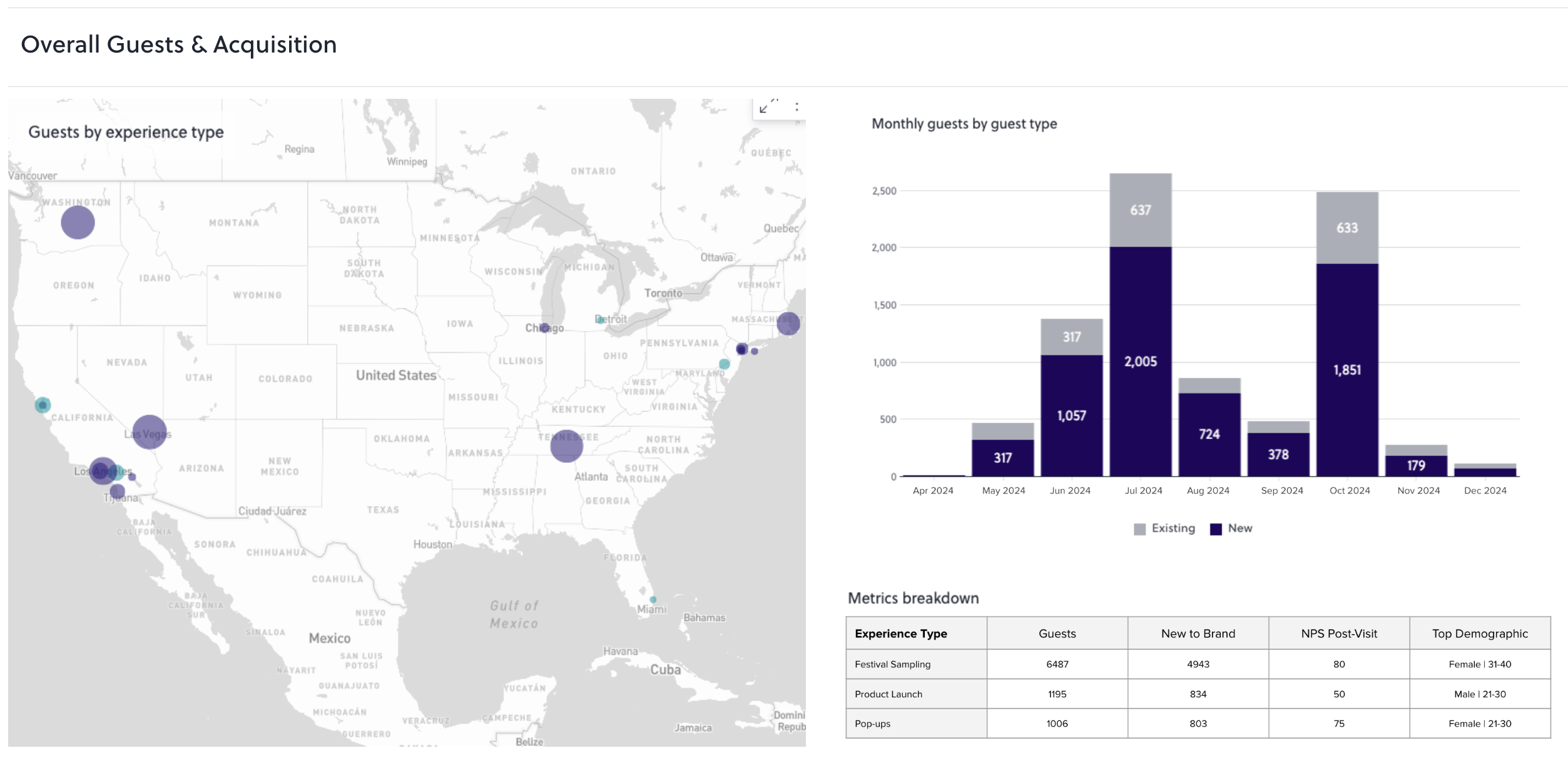
The Proximo Spirits case illustrates the scale of the problem. Proximo Spirits realized it was missing contact information for over 66% of its guests. After implementing AnyRoad's FullView feature, the brand immediately began collecting 69% more guest data and 34% more NPS responses.
For field marketing events, QR registration at the point of engagement makes data capture viable at ambassador tastings and walk-in activations. Conversate Collective used AnyRoad at field marketing events for a CPG beauty brand, where over 50% of surveyed consumers bought the brand's products from Walgreens and Target, and 74% of guests were more likely to purchase the brand's products after attending.

Festival activations show the same pattern at scale. Agency POPLIFE captured 45–50% more consumer data using AnyRoad compared to competitors during festival activations for an artisanal mezcal brand, with 42% of attendees opting into future marketing communications and 85% of consumers reporting intent to purchase post-event.
How To Measure Whether A CPG Activation Drove Purchase
Measurement must answer whether the activation sold product. Reach and impressions alone do not answer that question. QR registration, SMS follow-up, and receipt-verified rebates provide the mechanics that connect engagement to purchase.
The flow works as follows. A consumer scans a QR code at the activation and registers on the spot. After the event, they receive an SMS with a cashback rebate redeemable anywhere the product is sold. They buy the bottle, photograph the receipt, and text it back. AnyRoad's AI reads the receipt, confirms the eligible SKU, and pays the rebate via Venmo or PayPal. Receipt-based rebates create a purchase record tied to a specific retailer, product, date, and transaction, giving brands purchase-level data on every consumer who redeems, without relying on any retailer data-sharing arrangement.
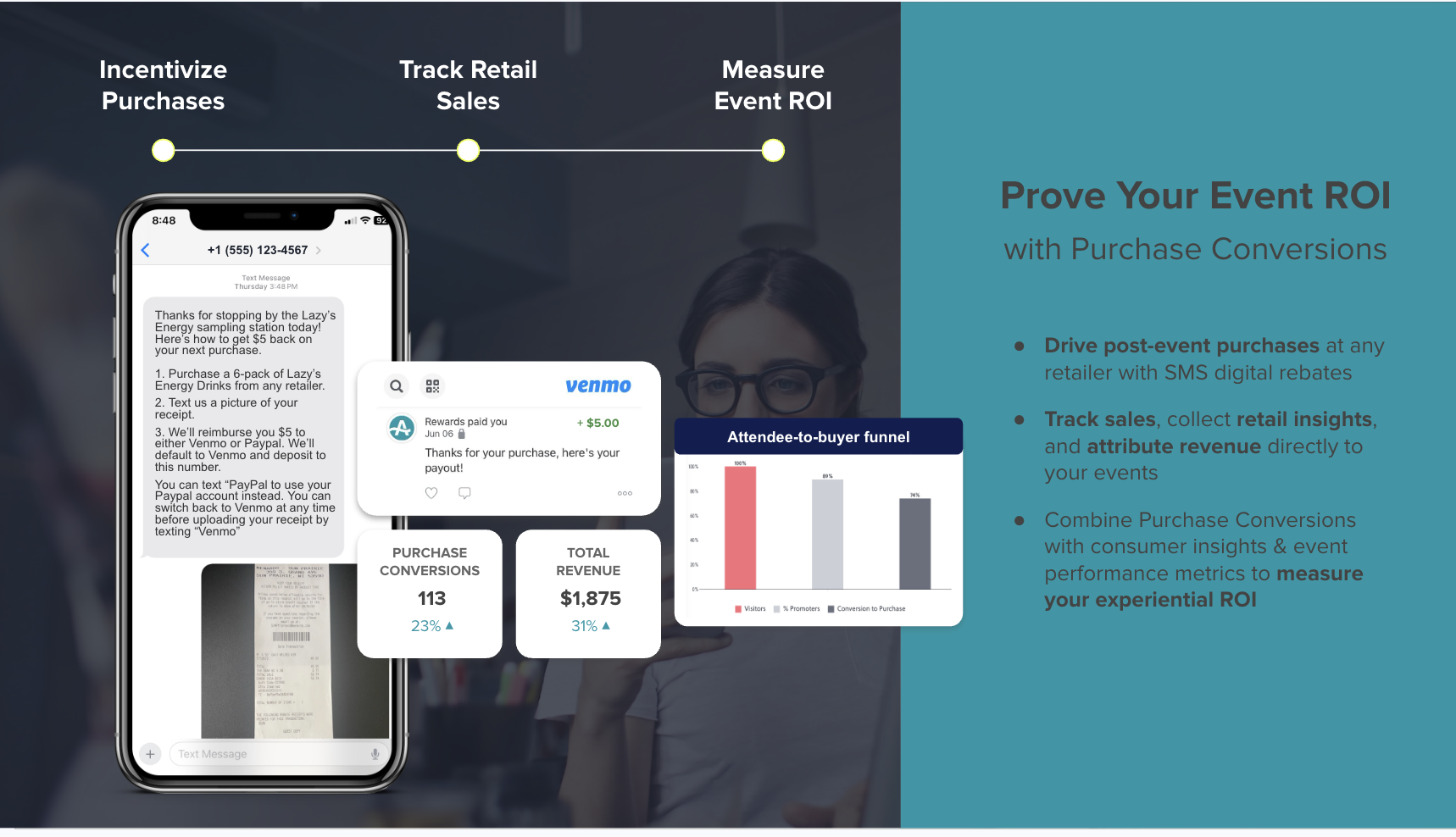
This mechanic requires no POS integration, which makes it deployable across trade accounts at scale. It works in any account, including a Total Wine ambassador tasting, an on-premise bar, or a festival activation, because the proof of purchase is the receipt rather than a retailer data feed.
AnyRoad's Purchase Conversion Tools, including cashback rebates, punch card experiences, and sweepstakes entries, connect an activation to a bottle sold. In a one-month ambassador tasting pilot with a single unnamed craft brand on a small dataset, 56% of the records collected converted to a bottle purchase. This was an early pilot result and should not be read as a platform benchmark.
The durable data points that frame the commercial case are these. A consumer who visits a brand experience twice is 512% more likely to convert into a paid loyalty enrollment. A single retail bottle purchase is worth roughly $100 to a brand. A club member who stays through six releases is worth roughly $600. AnyRoad reports that experience-driven opt-ins convert to paid loyalty at four times the rate of traditional channels. Member spending increases 150% within the first year.

Know which bottles your activation actually sold. Schedule a demo.
What Retailtainment Means For CPG Brands
Retailtainment is the deliberate blending of shopping and entertainment inside a physical retail space, using ambience, emotion, sound, and activity to interest customers in merchandise and put them in a mood to buy, a term coined by sociologist George Ritzer in his 1999 book. For CPG brands, retailtainment most commonly appears as ambassador tastings inside third-party retailers and on-premise accounts.
These activations have historically produced only a depletion report that shows units moved during the demo period, with no line connecting the activation to a specific consumer or a verified purchase. The receipt-verified mechanic described earlier closes that gap. The brand ends up with a first-party record tied to a real transaction at any retailer, without asking the retailer to share POS data.
CPG brands should use retailtainment when the objective is retail lift measured through sell-through velocity and when the brand has distribution in the accounts where the activation runs. The matching framework from the earlier section applies directly. Retailtainment serves retail lift, and the KPI is receipt-verified purchase and sell-through.
For more on connecting retail activations to measurable outcomes, see How To Measure Experiential Marketing ROI For CPG Brands and Best Experiential Marketing Software For CPG Brands.
How To Brief Your Next CPG Experiential Activation
This checklist turns the framework above into a briefing structure a brand manager can hand to an agency or internal team.
- Define the objective first, such as trial, awareness and data capture, relevance, retail lift, geographic expansion, or trust transfer.
- Choose the activation type that matches that objective using the comparison table above.
- Name the primary KPI before the activation runs and document how the team will measure it.
- Plan on-site data capture and QR registration for every attendee, including walk-ins.
- Brief and coach on-site staff on the product pitch, data capture process, and escalation protocol so execution stays consistent.
- Set up the post-activation SMS follow-up and receipt-verified purchase mechanic before the activation launches.
Frequently Asked Questions
How Do You Measure Experiential Marketing ROI For CPG Brands?
The most defensible measurement mechanic connects an activation to a receipt-verified purchase without requiring POS integration. The flow uses QR registration at the activation to capture a first-party consumer record, then SMS follow-up to deliver a cashback rebate to registrants. The consumer buys the product at any retailer, photographs the receipt, and submits it. AI validates the qualifying SKU and pays the rebate via Venmo or PayPal. Every validated submission becomes a purchase record tied to a specific consumer, retailer, product, and date. This produces incrementality data that reach-and-impressions reporting cannot provide. Matched-market analysis, which compares activated markets against control markets that did not receive the activation, offers a strong method for estimating total sales lift beyond tracked redemptions.
What Is The Difference Between Sampling And An Immersive Activation?
Sampling serves trial. The objective is to get the product into a consumer's hands and convert that moment into an immediate or near-term purchase. The KPIs are cost per trial and trial-to-purchase conversion rate. Immersive activations serve awareness and first-party data capture. The objective is to create a brand environment that earns an opt-in and builds brand affinity among a defined audience. The KPIs are opt-in rate and data captured per attendee. Teams should choose between them based on the marketing objective rather than creative preference or budget size.
How Do CPG Brands Use Pop-Ups To Drive Retail Sales?
Pop-ups capture first-party data and drive opt-ins that fuel post-activation follow-up. The activation itself rarely serves as the main retail sales moment. It serves as the starting point for the consumer relationship. After the pop-up, brands use the data captured to send SMS follow-up with cashback rebates, which drives the consumer to purchase at any retail account. The same receipt-verified rebate mechanic described earlier connects the pop-up to a bottle sold at retail, even when the pop-up sits outside a retail store.
What Is Retailtainment?
Retailtainment blends shopping and entertainment inside a physical retail space so CPG brands can hold shopper attention and influence purchase decisions at the point of sale. For CPG brands, it most commonly appears as ambassador tastings and in-store brand events inside third-party retail accounts. The objective is retail lift, measured through receipt-verified purchase and sell-through velocity. Retailtainment works best when the brand has strong distribution in the activated accounts and uses QR registration with receipt-verified rebates to connect the tasting to the transaction.
How Do CPG Brands Capture First-Party Data At Activations?
CPG brands capture first-party data at activations through configurable pre-, during-, and post-experience questions delivered via QR registration that works for walk-ins as well as pre-booked guests. Platforms like AnyRoad extend this to every member of a group through capabilities like FullView, which captures contact information and survey responses from all attendees. At festival and field marketing activations, the value exchange typically includes branded swag, a cashback rebate, or a sweepstakes entry in return for registration. The data captured at the activation then supports post-activation SMS follow-up and receipt-verified purchase tracking.
Conclusion: A Three-Part System For CPG Experiential Marketing
Experiential marketing strategies for CPG brands succeed when three things happen in sequence. First, the activation format matches the objective it serves instead of creative preference or budget convenience. Second, the operational layer runs consistently, with trained ambassadors, on-site data capture, and QR registration that works for every attendee. Third, receipt-verified purchase mechanics connect the activation to a bottle sold at retail without POS integration and without relying solely on a depletion report.
Audience engagement is the input. Purchase is the output. Brands that can prove the connection between the two will defend their experiential budgets and grow them.
For a deeper look at how CPG brands are building this system, see CPG Brand Activation Examples That Drive Engagement.
Build a measurable experiential system with AnyRoad. Schedule a demo.