


Written by: Bryan Grobstein, Vice President, Global Revenue, AnyRoad | Last updated: October 13, 2026
Key Takeaways
- Cvent excels at large-scale enterprise events with complex registration, venue sourcing, and governance needs, and is overbuilt for most consumer-facing programs.
- Brand-owned experiences such as tasting rooms, distillery tours, and field activations require first-party data capture, AI feedback analysis, and post-experience revenue tools that Cvent does not provide.
- Overbuying Cvent leads to hidden costs from per-registrant fees, unused modules, and lengthy onboarding, and as detailed below, first-year costs can exceed $90,000.
- The real decision is whether your program is an operations problem or a consumer engagement problem, because each category needs a different type of platform.
- AnyRoad is purpose-built for brand-owned experience programs that need white-labeled booking, compliance, loyalty conversion, and measurable revenue impact.
See how AnyRoad captures first-party data at every touchpoint. Book a demo.
What Cvent Actually Does And What It Is Built For
To understand where Cvent fits, start with what it actually is. Cvent is a global meetings, events, and hospitality technology provider with more than 5,500 employees and approximately 30,000 customers worldwide, and Cvent reports that more than 60% of the Fortune 500 are customers. Blackstone completed its acquisition of Cvent in a $4.6 billion transaction that closed June 2023, taking the company private.
Cvent's core strengths are well-documented. Its Supplier Network features nearly 340,000 hotels, resorts, and special event venues and recorded more than $20 billion in group-business sourcing activity during 2025. The platform covers the full enterprise event lifecycle. It handles multi-track conference registration, conditional registration logic, group hierarchies, and approval workflows. It also supports onsite badging and check-in via OnArrival, exhibitor and sponsor management, virtual and hybrid delivery, and integrations with Salesforce, Marketo, and Eloqua. Cvent has been named a Gartner Magic Quadrant Leader for Event Marketing and Management Platforms for the third consecutive year.
That breadth makes Cvent the right answer for some programs and the wrong category of tool for others.
When Cvent Is The Right Choice For Your Event Program
Cvent is purpose-built for a specific set of conditions. It delivers genuine value when all or most of the following are true:
- You run large-scale, multi-track conferences or a global portfolio of events requiring centralized governance.
- Your registration logic is genuinely complex, with conditional paths, group hierarchies, or approval workflows.
- Venue sourcing, room blocks, and travel logistics are core to the program, not peripheral.
- You need enterprise security review, SOC 2 Type II compliance, SSO, and procurement-friendly contracting.
- You require deep integration with a corporate CRM or ERP, and have the internal Salesforce admin capacity to maintain it.
Cvent is the right choice when these conditions describe your reality. Teams that match this profile gain a powerful operations platform that centralizes logistics and governance across a demanding event portfolio.
When Cvent Is Overkill And The Hidden Costs Of Overbuying
The structural problem is compounding. A worked mid-size example totals roughly $93,000 in year one. The breakdown: a $40,000 annual license, $28,000 in per-registrant fees across five events at 800 attendees each, a $15,000 implementation, and $10,000 in add-ons. The license is often less than half the real first-year cost.
Capabilities buyers assume are included frequently are not. Commonly reported extra-cost items include OnArrival onsite check-in and badge printing, advanced integrations, premium support tiers, professional services, gamification, lead retrieval, and other specialized modules, and Capterra reviewers consistently cite these as nickel-and-diming. The per-registrant model creates a structural misalignment. A sold-out event is also the most expensive one, and a conference that doubles its audience two years running receives a roughly doubled per-registrant bill right when cash is tightest.
For brand-owned experience programs such as tasting rooms, distillery tours, brand homes, and field activations, the overbuying problem is acute. You pay for venue sourcing, room blocks, and travel modules you will never use, and then spend months learning features that do not map to your program. Cvent onboarding takes 3 to 6 months for full team proficiency even for experienced event professionals. After all that, you still lack a mechanism to capture first-party data from every attendee, analyze guest feedback with AI, or connect a distillery visit to a recurring revenue relationship.
Compare your current costs to AnyRoad's consumer engagement model. Book a demo.
The Decision Most Comparison Articles Miss: Operations Problem Vs. Consumer Engagement Problem
Most Cvent comparison content frames the decision as a question of scale and complexity. That narrow lens makes every article in the category sound the same and leaves brand-owned experience programs without a clear path to a defensible choice.
A more useful diagnostic focuses on the core job. Your event program is either primarily an operations problem or a consumer engagement problem.
An operations problem involves logistics, registration, venues, travel, and governance. Cvent is engineered for exactly that. An enterprise SaaS company running a 3,000-person user conference with multi-track sessions, hotel room blocks, and a Salesforce integration requirement has an operations problem. Cvent is the right answer.
A consumer engagement problem involves capturing first-party data from every attendee, building loyalty, analyzing guest feedback, and driving post-experience revenue. A distillery running weekend tours, a spirits brand home hosting immersive tastings, or a CPG brand activating at festivals has a consumer engagement problem. Cvent was designed for a different job, and its breadth does not replace the capabilities it lacks in this category.
Brand-owned experience programs such as distillery tours, tasting rooms, brand homes, and field activations need configurable data capture at every touchpoint, AI-powered feedback analysis, and a path from a single visit to recurring revenue. Those requirements do not appear in Cvent's core value proposition, because Cvent was built for a different buyer with a different problem.

What Brand-Owned Experience Programs Actually Need From A Platform
The platform requirements for tasting rooms, distillery tours, brand homes, and field activations differ from enterprise event operations. The capabilities that matter are:
- A fully white-labeled booking experience embedded on the brand's own website, so the brand owns the consumer journey rather than sending guests to a third-party registration page.
- First-party data capture from every attendee in a group, not just the person who booked. AnyRoad's FullView feature addresses this directly. Diageo used AnyRoad analytics to measure a 16-point NPS increase from pre-visit to post-visit at Johnnie Walker Princes Street. Campari Group's partnership with AnyRoad enabled a 3X increase in marketing opt-ins and identified brand champions through brand home registrations.
- Integrated age verification and compliance for regulated industries like alcohol, embedded in the booking flow.
- AI-powered analysis of open-text guest feedback. AnyRoad's PinPoint feature automatically analyzes thousands of survey responses to surface sentiment drivers and actionable themes in real time.
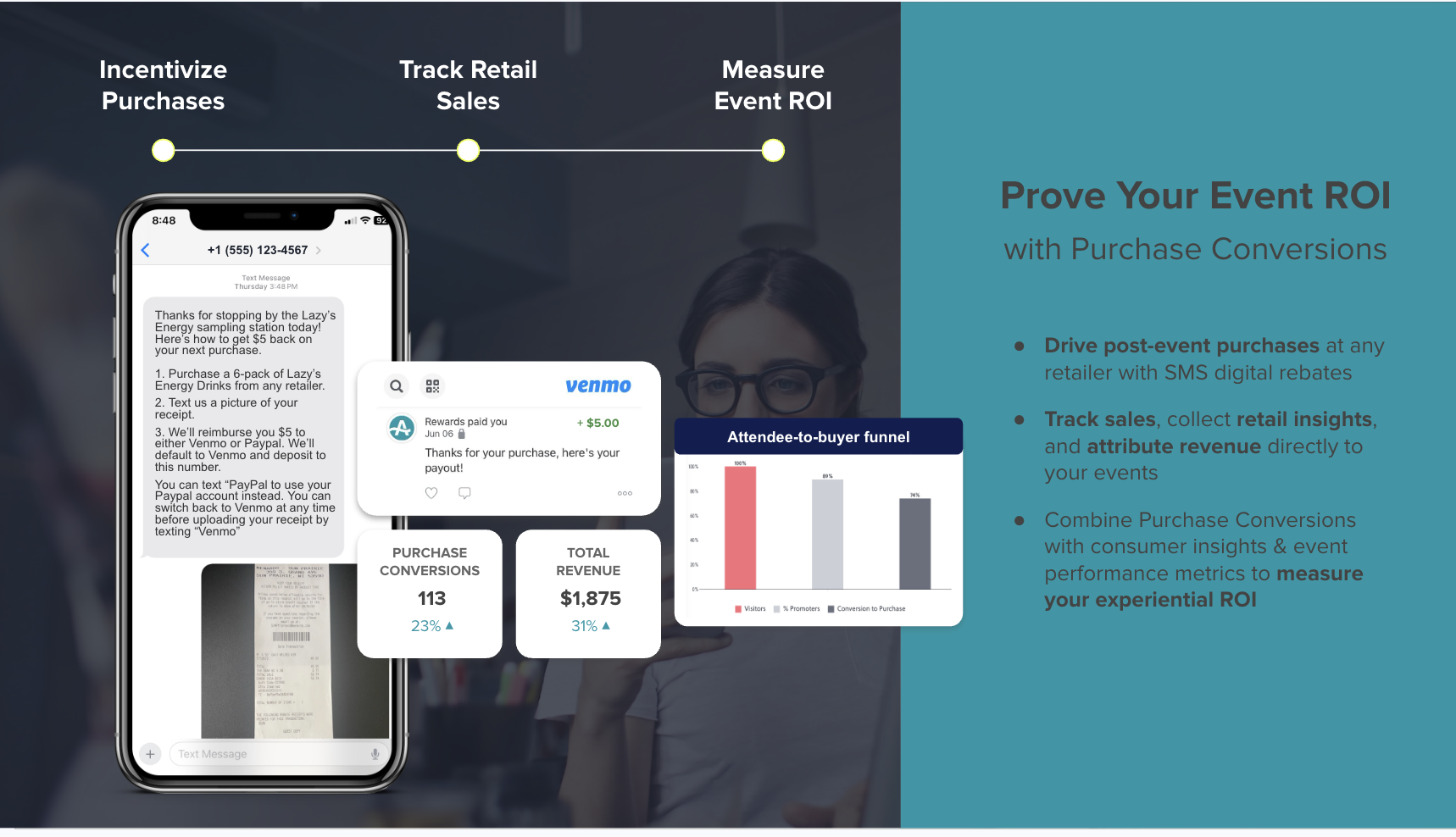
- A mechanism that connects the experience to retail purchase and recurring revenue.
AnyRoad is the AI-powered consumer engagement platform built for this job. Its platform spanning Experience Manager, Guest Experience, Atlas Insights, and the Lifetime Loyalty suite is designed specifically for brand-owned experience programs in alcohol, CPG, and adjacent industries.


The Lifetime Loyalty suite addresses the gap between a visit and recurring revenue directly. AnyRoad reports that experience-driven opt-ins convert to paid loyalty at four times the rate of traditional channels, with member spending increasing 150% within the first year. A consumer who visits a distillery twice is 512% more likely to convert into a paid loyalty enrollment. A single retail bottle purchase is worth roughly $100 to a brand, and a club member who stays through six releases is worth roughly $600. Lifetime Loyalty customers include Heaven Hill Distillery, Nearest Green Distillery, Lux Row Distillers, Castle & Key, Catoctin Creek Distilling, and Tarnished Truth Distilling.
Absolut Home increased average revenue per guest by 36% since 2018 using AnyRoad's platform. Leiper's Fork Distillery increased average tour price by 33% and achieved a 97 post-event NPS using AnyRoad's automated surveys.

Turn tasting room visits into recurring revenue. Schedule a demo.
A Practical Diagnostic: Five Questions To Ask Before You Sign
Before committing to any event platform, answer these five questions honestly:
- Are my events corporate-facing or consumer-facing? Corporate-facing programs with internal stakeholders and procurement requirements point toward Cvent. Consumer-facing programs such as tours, tastings, brand homes, and field activations point toward a platform built for consumer engagement.
- Is my hardest problem logistics or data? If the hardest problem is venue sourcing, room blocks, and registration complexity, Cvent is designed for that. If the hardest problem is knowing who attended, what they thought, and whether they bought again, a consumer engagement platform is the right fit.
- Do I need venue sourcing and room blocks, or do I need first-party data capture? These capabilities serve different programs. Paying for one when you need the other creates overbuying and wasted budget.
- What is my post-event revenue goal, and does the platform connect experiences to it? If the goal is recurring revenue from visitors such as bottle clubs, memberships, or retail conversion, the platform must have a mechanism to close that loop. Cvent does not offer that connection.
- What is actually included in the contract, and what is an add-on? As noted earlier, Cvent's extra-cost items include onsite check-in, advanced reporting, and premium support. Get every included feature named in writing before signing.
Where Cvent Fits Vs. Where A Brand Experience Platform Fits
The distinction between Cvent and a platform like AnyRoad is a job-to-be-done comparison rather than a simple feature checklist. Cvent is built for enterprise event operations and logistics. AnyRoad is built for consumer engagement, first-party data, and post-experience revenue.
Cvent's venue sourcing network, multi-track session management, and enterprise governance make it the right choice for large organizations running portfolios of corporate conferences, trade shows, and internal events. Cvent is built for enterprise event programs running 30 or more events per year with dedicated event operations headcount of two to five people, complex registration workflows, large attendee volumes, and budget for $100,000 to $250,000 or more per year in platform costs.
Brand marketing teams often evaluate Cvent alternatives such as Eventbrite or Bizzabo. The relevant question is whether the alternative was built for the consumer engagement job. Most alternatives in the enterprise event category still solve the operations problem with a different interface. AnyRoad is the platform built specifically for the consumer engagement problem that brand-owned experience programs actually have, including capturing first-party data from every guest, analyzing feedback with AI, and converting a visit into a loyalty relationship.
That difference shows up in measurable outcomes. At festival activations, POPLIFE captured 45 to 50% more consumer data using AnyRoad compared to competitors, with 85% of engaged consumers reporting intent to purchase post-event. That is the kind of result a brand experience platform is designed to produce, and it has no equivalent in Cvent's feature set.
Conclusion: Choosing The Right Platform For Your Program
The Cvent decision comes down to whether your event program is an operations problem or a consumer engagement problem. Cvent is the right answer for the first category. Brand-owned experience programs such as tasting rooms, distillery tours, brand homes, and field activations fall into the second category and need a platform built for first-party data capture, AI-powered feedback analysis, and a direct path from a guest visit to recurring revenue.
Consumer-facing programs that prioritize data, loyalty, and revenue benefit from a brand experience platform like AnyRoad. When your goal is to turn every visit into a measurable relationship, AnyRoad is built for that job.
See how AnyRoad turns experiences into loyalty and revenue. Schedule a demo.