


Written by: Bryan Grobstein, Vice President, Global Revenue, AnyRoad
Key Takeaways
- Ambassador tastings represent a major budget line item, yet most brands lack reliable methods to connect a specific tasting to a specific bottle sale.
- Traditional depletion reports cannot prove causality because activation, inventory, and checkout data live in separate systems across the three-tier structure.
- Accurate ROI measurement requires capturing first-party consumer data at the event and tracking repeat purchases over a 60–90 day window, beyond day-of sales.
- Control-group comparisons and receipt-verified attribution tools like cashback rebates deliver a clear picture of four-week velocity lift and long-term customer value.
- Ready to prove the ROI of your ambassador tastings? Book a demo with AnyRoad today.
Why Traditional ROI Measurement Fails in the Three-Tier System
The three-tier system is the structural reason attribution is hard. Suppliers, distributors, and retailers each operate under distinct licensing requirements, and each tier maintains its own data. Activation data lives with the brand. Inventory movement data lives with the distributor. Checkout data lives with the retailer. None of these systems talk to each other by default, and retailers have no obligation to share point-of-sale data with suppliers.
A depletion report only confirms that a case moved from the distributor’s warehouse to a retail account. It cannot reveal whether an ambassador’s sample influenced the consumer’s choice. Only 15% of brands report strong confidence in their field marketing ROI measurement, a figure that reflects exactly this structural problem. Without a mechanism that connects a specific consumer interaction to a specific purchase event, the depletion report offers correlation at best.
The Full Cost of an Ambassador Tasting: What You’re Really Spending
Accurate ROI calculation starts with an accurate cost baseline. Most brands undercount because they focus on ambassador pay and product cost while ignoring logistics and administrative overhead.
| Cost Component | Typical Range | Notes |
|---|---|---|
| Ambassador Pay | $20–$30/hour (standard), $30–$50/hour (premium/certified) | ZipRecruiter average: $20.21/hour, Indeed average: $21.95/hour, certified alcohol roles command higher rates |
| Product Cost | Wholesale cost of open bottles | Varies by category and price point; often absorbed by distributor for priority accounts |
| Logistics & Supplies | Variable | Tablecloths, ice buckets, signage, branded materials, travel; frequently omitted from budget models |
| Administrative Overhead | 15–25% premium for agency bookings | Agency rates run $25–$75/hour before fees; rush bookings inside two weeks carry an additional 15–25% premium |
The formula for total event cost is: Total Event Cost = (Ambassador Hours × Hourly Rate) + Product Cost + Logistics + Administrative Overhead.
Indeed’s August 2026 data puts the national average brand ambassador rate at $21.95/hour, while ZipRecruiter reports $20.21/hour for wine and spirits roles specifically. Premium alcohol-specific roles requiring certifications or specialized product knowledge command $30–$50/hour, with agency rates running $25–$75/hour before fees. A four-hour tasting in a major market, staffed through an agency, can easily exceed $400 in labor alone before a single bottle is opened.
With a realistic cost baseline in hand, the next step is understanding what those dollars return in measurable sales lift.
Measuring Immediate Sales Lift Beyond Day-of Numbers
Bevology reports an average 16x sales lift on the day of an in-store tasting, with conversion rates ranging from 30% to 60% depending on location, engagement style, and product. Those numbers are directionally useful, but day-of spikes often mask whether the tasting created new buyers or simply accelerated purchases from consumers who already planned to buy.
A control group comparison provides a more reliable method. GetKard advises withholding 10–20% of target accounts as a control group, then comparing sales velocity in activated stores against that matched control set over a 2–4 week post-event window.
The formula: Sales Lift = (Activated Store Sales − Control Store Sales) ÷ Control Store Sales × 100.
Immediate sales lift is only part of the story. While control groups capture the short-term spike, the deepest gains from experiential marketing typically manifest 6–12 months post-activation, characterized by higher repeat purchase rates and larger basket sizes. A brand that measures only day-of performance captures the smallest fraction of the value its tastings generate.
Tracking Repeat Purchases and Long-Term Value
A one-time buyer who purchases a bottle after a tasting is worth roughly $100 to the brand. In contrast, a consumer who becomes a club member and stays through six releases is worth roughly $600. That gap forms the business case for tracking repeat purchase behavior, which many field marketing programs ignore.
AnyRoad’s data shows that a consumer who visits a distillery twice is 512% more likely to convert to a paid loyalty enrollment. The second visit signals that a guest is ready to be asked. The same principle applies to ambassador tastings in third-party retail. A consumer who buys once after a tasting and then buys again unprompted behaves very differently from a one-time trial buyer, and the two groups require different follow-up strategies.
To act on that difference, you need a way to identify repeat buyers. Methods for tracking repeat purchases include loyalty program enrollment, QR code registration with email or SMS capture, unique promo codes, and cashback rebates that require receipt verification. Churn in bottle clubs concentrates around the six-release mark, driven by product depletion rather than dissatisfaction, because members who have not finished what they own do not want more. Brands that track repeat purchase behavior, rather than enrollment counts alone, can see this pattern clearly.
Attribution Methods That Go Beyond the Depletion Report
Wildfire Beverage Group recommends measuring tastings by basket attach rate and post-event four-week velocity lift rather than day-of sales alone. That framework moves the measurement window from a single afternoon to a month-long behavioral signal, which better predicts whether the tasting created durable demand.
Additional attribution approaches include:
- Comparing sales velocity in activated versus non-activated stores over a defined post-event window
- Using unique promo codes or QR codes that tie a specific consumer interaction to a specific purchase event
- Tracking basket attach rates to understand whether tasting participants added the product to an existing basket or made a standalone purchase
- Monitoring coupon or rebate redemption rates as a direct measure of tasting-to-purchase conversion
Digital coupon redemption rates reached 5.92% in 2025 — roughly 10 times the rate of traditional paper alternatives, making digital mechanics a highly reliable attribution tool for field marketers operating within the three-tier system. The goal is connecting the tasting to a specific, trackable purchase event, something a depletion report structurally cannot do.
Technology Solutions: Closing the Loop with Cashback Rebates
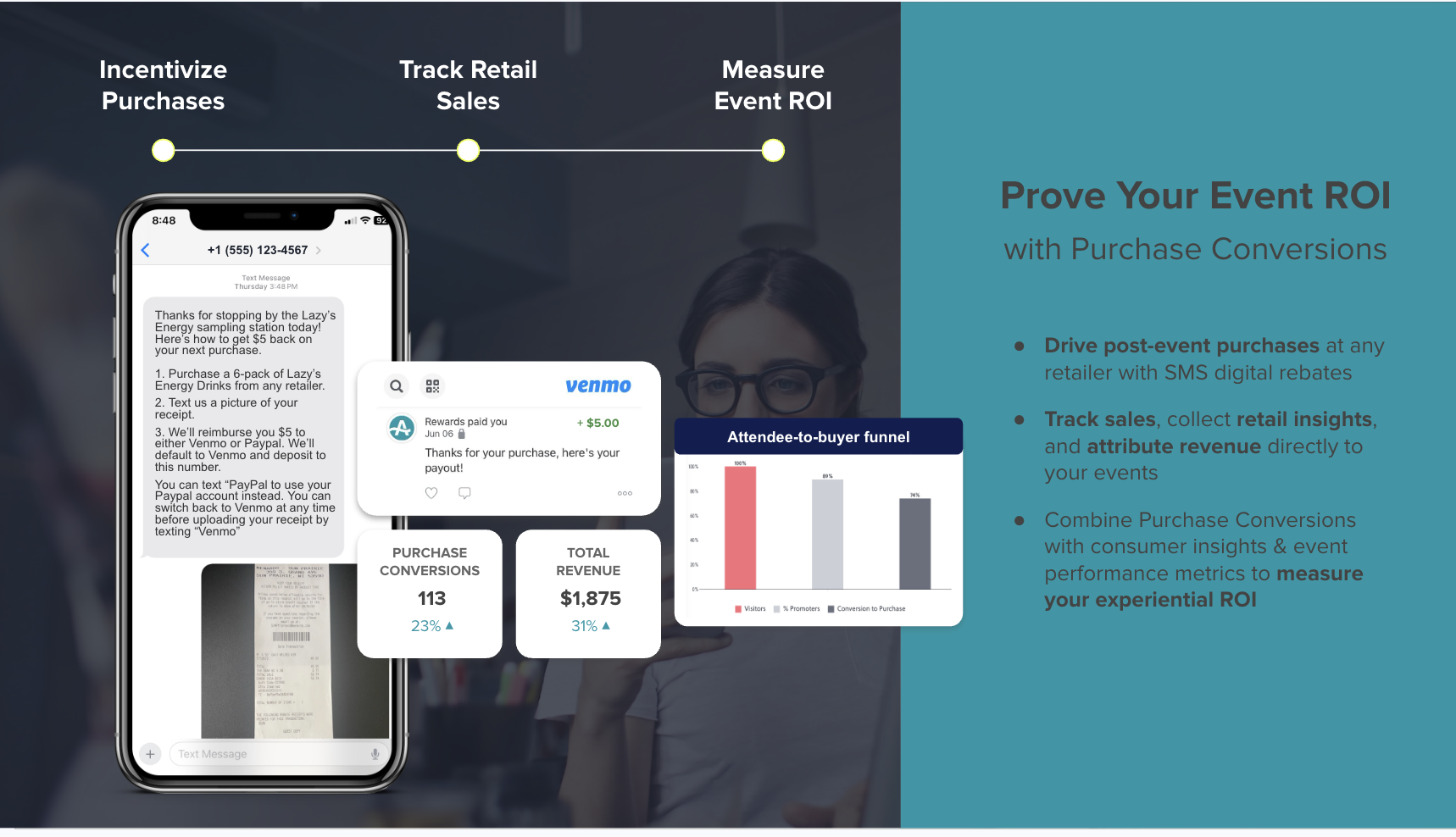
AnyRoad’s cashback rebate mechanic directly addresses the attribution problem that the three-tier system creates. It requires no POS integration from the retailer, so it works in any retail or on-premise account at scale.

The mechanic works as follows:
- A guest at an ambassador tasting scans a QR code via the AnyRoad Live mobile app and registers on the spot, capturing first-party consumer data at the point of activation.
- The consumer receives an SMS with a cashback rebate redeemable anywhere the product is sold.
- They purchase the bottle, photograph the receipt, and text it back.
- AnyRoad’s AI reads the receipt, confirms the eligible SKU, and pays the rebate via Venmo or PayPal.
Every redemption produces a first-party record tied to a receipt-verified purchase. That record is what connects experiential spend to retail sell-through. In a one-month ambassador tasting pilot with a craft brand, 56% of the records collected converted to a bottle purchase. This was an early, small-sample result and should not be treated as a platform benchmark, but it illustrates the kind of attribution signal the mechanic produces.

For brands with compliance considerations around cash incentives, AnyRoad also runs a sweepstakes variant, which offers an entry to win a prize rather than a direct rebate. This variant uses the same data capture, SMS follow-up, and regulatory compliance handling, including terms and conditions and privacy policies.
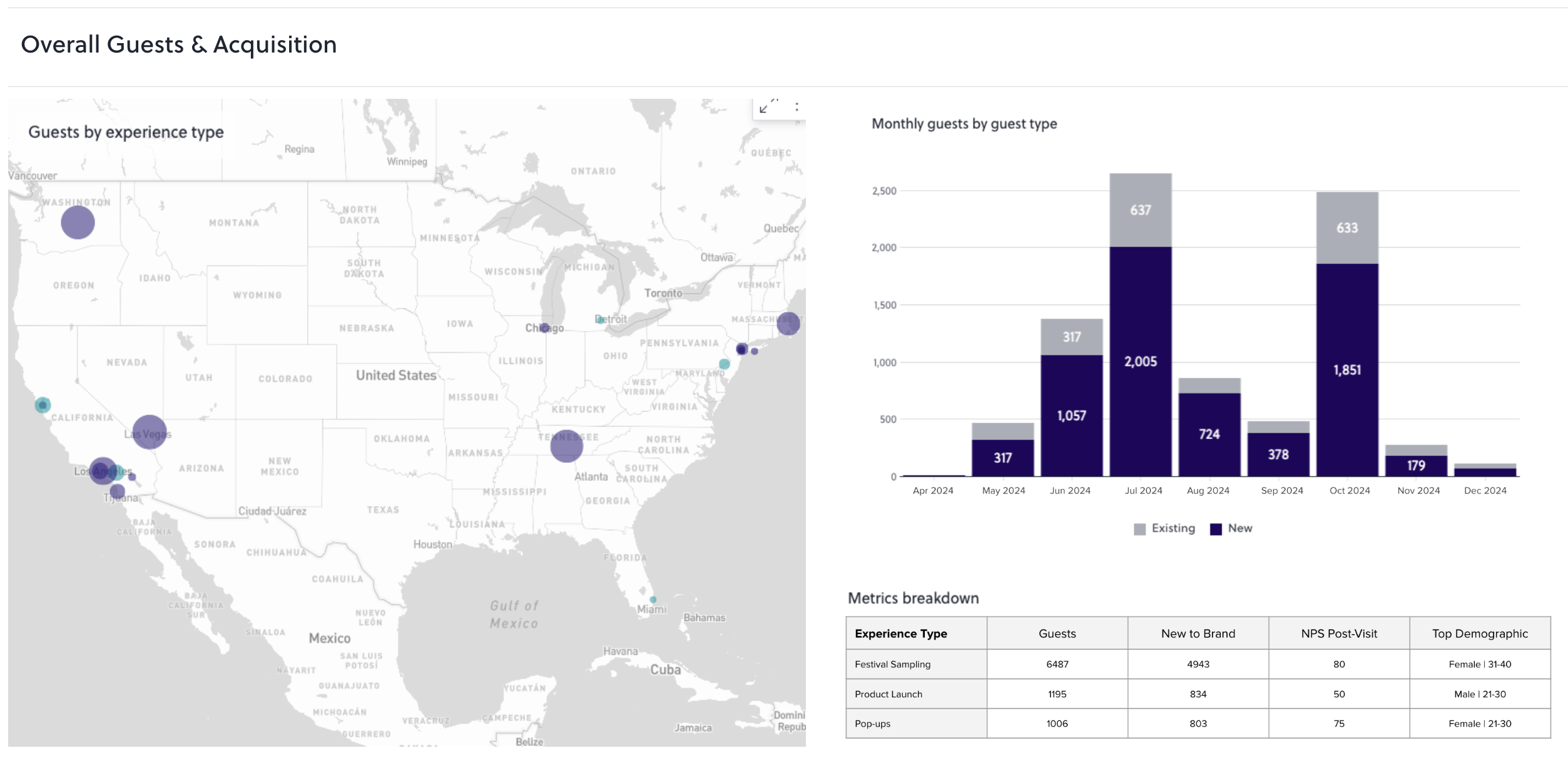
The POPLIFE agency used AnyRoad’s platform to run festival activations for an artisanal mezcal brand, generating 85% post-event purchase intent among engaged consumers, with detailed event reports produced in approximately 20 minutes using AnyRoad’s automated reporting. Similarly, Conversate Collective’s field marketing events for a CPG brand showed that 74% of guests were more likely to purchase after attending, a downstream signal that depletion reports cannot surface.
Know which bottles your activation actually sold. Schedule a demo.
KPIs and Benchmarks for Ambassador Tasting Performance
To turn attribution data into a decision-making tool, you need a consistent set of metrics. The KPIs below separate immediate signals from lagging indicators so you can see both the short-term spike and the durable demand a tasting creates.

- Conversion Rate: Percentage of tasting participants who purchase. The directional range above and typical 15–35% trial-to-purchase conversion for sensory-driven products provide useful context; AnyRoad’s early pilot conversion result sits within that broader range but remains illustrative only.
- Cost per Interaction: Total event cost ÷ number of consumer interactions at the activation.
- Cases per Hour: Cases sold ÷ tasting hours, useful for comparing ambassador performance across accounts.
- Repeat Purchase Rate: Percentage of tasting participants who repurchase within 60–90 days, tracked via rebate redemption or promo code reuse.
- Cost per Acquired Customer: Total program cost ÷ verified new-to-brand buyers, the metric that connects field marketing spend to actual customer acquisition.
- Four-Week Velocity Lift: Sales velocity in activated accounts versus control accounts in the four weeks following the event.
Ninety percent of campaigns drove measurable sales lift, with an average incremental increase of 19%. Causal sales lift, not cost per sample, should sit at the center of your evaluation.
Common Pitfalls in Measuring Ambassador Tasting ROI
Several recurring mistakes undermine ROI measurement for ambassador tasting programs. Addressing these issues strengthens every subsequent activation.
- Ignoring repeat purchases: Day-of spikes capture only a fraction of the value a tasting generates. Programs that measure only same-day sales systematically undervalue their activations.
- Failing to capture consumer data at the event: A tasting without data capture functions as a sampling event rather than a marketing program. Without a registration mechanism, there is no consumer record to connect to a future purchase, which compounds the problem of ignoring repeat buyers.
- Not using control groups: Without a matched set of non-activated accounts, you cannot isolate the tasting’s contribution from seasonal trends, display placement, or price promotions running simultaneously.
- Neglecting compliance requirements: All staff serving alcoholic beverages at activations must hold appropriate certifications such as TIPS, ServSafe, or state-equivalent responsible service training, and activations require age verification procedures that vary by state and municipality.
- Treating all retail accounts as equal: Whole Foods generates higher average dollar sales per demo than other chains, so account selection materially affects program ROI.
- Focusing on cost per sample as the primary metric: Causal sales lift provides a more accurate measure of program effectiveness than how cheaply a sample was distributed.
Frequently Asked Questions
How much does a brand ambassador get paid for an alcohol tasting?
Based on 2026 data, the average hourly rate for wine and spirits brand ambassadors in the United States ranges from $20.21 to $21.95, depending on the source. Premium roles requiring certifications, specialized product knowledge, or compliance credentials command $30–$50 per hour, with agency rates running $25–$75 per hour before fees. Rush bookings requested inside two weeks typically carry an additional 15–25% premium. Rates also vary significantly by market, with major metro areas like New York and Miami paying above the national average.
How do you track repeat purchases from ambassador tastings?
The most reliable methods tie the tasting registration to a specific, trackable purchase event. Cashback rebates require the consumer to photograph a receipt showing the eligible SKU, creating a verified first-party purchase record. Unique promo codes and QR code registrations with SMS or email capture allow brands to follow up and track whether tasting participants repurchase within a defined window, typically 60–90 days. Loyalty program enrollment at the point of activation offers another option, though it requires the consumer to take an additional step. The key is capturing consumer data at the tasting itself, because without registration there is no record to connect to a future purchase.
What is a good conversion rate for an in-store alcohol tasting?
Industry sources report a broad conversion range for in-store tastings, with well-run sampling programs for sensory-driven products achieving 15–35% trial-to-purchase conversion. Performance varies by product category, price point, location, ambassador quality, and time of day, and Saturday midday often delivers the strongest results. AnyRoad’s early ambassador tasting pilot produced a 56% conversion result, though this came from a small, one-month program and should not be treated as a universal benchmark. For most programs, four-week velocity lift in activated accounts versus a control set offers a more meaningful metric because it captures delayed purchases that same-day conversion rates miss.
Why can’t I just use depletion reports to measure tasting ROI?
As discussed earlier, depletion reports lack causality because the three-tier system separates activation, inventory, and checkout data across different entities. A depletion spike in the week of a tasting could reflect the tasting’s impact, a coincident display placement, a price promotion, or seasonal demand. Without a control group and a consumer-level tracking mechanism, you cannot isolate the tasting’s contribution. Depletion reports serve as a useful lagging indicator but remain an insufficient attribution tool on their own.
What compliance considerations apply to cashback rebates for alcohol brands?
Many states restrict or prohibit traditional alcohol couponing, which is why cashback rebates have become a standard tool for compliant beer, wine, and spirits promotions. The rebate mechanic, where the consumer purchases the product and submits a receipt for reimbursement, is structured differently from a point-of-sale discount and navigates most state restrictions. Sweepstakes mechanics, where the consumer enters to win a prize rather than receiving direct cash back, offer an alternative with similar data capture and attribution capabilities. Both mechanics require careful terms and conditions, privacy policies, and age verification procedures that vary by state. AnyRoad handles the regulatory compliance for both mechanics as part of its platform offering.
Stop Guessing, Start Measuring
Ambassador tastings function as a sales activation tool and deserve to be measured like one. Depletion reports cannot establish causality, and day-of conversion rates capture only the smallest fraction of the value a tasting generates. Brands that win on field marketing treat every activation as a data capture opportunity, registering consumers at the pour, tracking the purchase via receipt verification, and following up with the repeat buyers who represent the real lifetime value of the program.
The technology to do this already exists, works without POS integration from retail partners, and operates within the three-tier system. As the sections above show, the gap between a tasting and a measurable bottle sale is a data infrastructure problem that cashback rebates and first-party data capture are designed to solve.
See how AnyRoad connects tastings to bottle sales — schedule a demo.