


Written by: Bryan Grobstein, Vice President, Global Revenue, AnyRoad
Key Takeaways
- SMS delivers up to 98% open rates versus 20% for email, giving CPG brands a reliable direct channel when retailers own the customer relationship.
- Building compliant opt-in lists depends on packaging QR codes, in-store displays, and high-intent experiential events where consumers already engage with the brand.
- Segmentation by purchase behavior, product category, engagement level, and experiential data reduces opt-outs and drives significantly more revenue than generic blasts.
- Connecting SMS to retail sales relies on store-locator links, retailer-specific promo codes, and gamified receipt-verification mechanics that prove incremental revenue without POS integration.
- AnyRoad bridges brand experiences, SMS subscribers, and measurable retail revenue from one platform, turning every activation into a first-party growth engine. Book a demo today to see it in action.
How to Run an SMS Campaign for CPG in 7 Steps
- Set goals and KPIs. Before sending a single message, define what success looks like, such as opt-in rate, click-through rate, incremental retail revenue, or repeat purchase rate. This clarity guides every decision that follows.
- Choose a compliant SMS platform. Select a provider registered for A2P 10DLC that handles consent tracking, opt-out automation, and quiet-hour suppression so campaigns stay deliverable and compliant.
- Build your subscriber list via packaging, QR codes, and events. Turn every product label, in-store display, and brand activation into a clear, compliant opt-in opportunity.
- Segment your audience. Group subscribers by purchase behavior, product category, engagement level, and channel so each message feels relevant and timely.
- Craft lifecycle campaigns. Create welcome series, replenishment reminders, and win-back flows that nurture subscribers from first opt-in to loyal repeat buyer.
- Integrate with retail. Use store locator links, retailer-specific promotions, and unique promo codes to drive in-store traffic and track impact.
- Measure and refine. Track incremental revenue with A/B testing and holdout groups, then adjust targeting, timing, and offers based on results.
Building Your SMS Subscriber List for CPG
The subscriber list is the foundation of every CPG SMS program. Ecommerce brands collect numbers at digital checkout, while CPG marketers rely on physical touchpoints, with packaging as the most scalable asset.
On-pack QR codes and text-to-join keywords turn every unit sold into a potential opt-in channel. A beverage brand might print a QR code on its label that links to a mobile opt-in page with a discount on the next purchase. A beauty brand could use a text-to-join keyword such as “Text GLOW to 12345 for exclusive offers” on its outer carton. A compliant opt-in must clearly state: who is texting the subscriber, what type of messages they will receive, how often, that message and data rates may apply, and how to unsubscribe. Brands can communicate this on a small label insert or a mobile landing page.
In-store displays and digital pop-ups expand the opt-in surface. Point-of-purchase displays can feature QR codes or short codes that shoppers scan while standing in the aisle. Digital ads and social media can drive to two-step web sign-up forms with an immediate incentive.
Experiential events act as the highest-intent opt-in channel for CPG brands. Tastings, samplings, festivals, and brand activations attract consumers who already care enough to attend. These guests opt in at higher rates and convert more often. At festival activations using AnyRoad, POPLIFE captured 45–50% more consumer data than competitors. AnyRoad’s platform captures SMS opt-ins directly during events and syncs that data with a brand’s CRM, turning a festival booth into a measurable list-building channel.

Segmentation Strategies for CPG Subscribers
Relevant messaging keeps subscribers engaged and reduces opt-outs. 2025 Emarsys research found that 73% of consumers unsubscribe from brands that send irrelevant or too-frequent messages, and SMS opt-outs are permanent.
Segment by purchase behavior. Group subscribers by what they buy, how often, and how recently. A coffee brand might separate daily drinkers who need monthly replenishment reminders from occasional buyers who benefit from education and trial offers.
Segment by product category. Brands with multiple product lines should send snack offers only to snack buyers and beverage offers only to beverage buyers. Category-specific messaging respects demonstrated interests.
Segment by engagement level. New subscribers, active customers, and lapsed customers require different approaches. New subscribers in their first 30 days need onboarding and education. Active customers from the last 90 days respond well to cross-sells and loyalty rewards. Lapsed customers beyond 90 days need re-engagement and stronger incentives.
Segment by channel and experiential data. Consumers who discovered a brand at a tasting event have different needs than DTC buyers. At field marketing events for a CPG beauty brand, Conversate Collective used AnyRoad to collect consumer data and enrich profiles with demographic information. That same data revealed that over 50% of surveyed consumers bought the brand’s products from Walgreens and Target, which directly shaped which retail-focused SMS messages to send and to whom.
Campaign Types and Lifecycle Flows for CPG
A segmented list allows lifecycle campaigns to guide subscribers from first contact to loyal repeat purchase. The essential flows for CPG brands include several core programs.
- Welcome series. Greet new subscribers instantly with a brand introduction and their sign-up reward. Set expectations for frequency and content from the first message.
- Post-purchase follow-up. After a DTC purchase or a redeemed retail offer, send a message asking for feedback, offering usage tips, or suggesting complementary products.
- Replenishment reminders. Track purchase cycles and text subscribers when they are likely running low. “Time to restock your coffee, enjoy 15% off your next bag this week only.”
- Win-back offers. Re-engage lapsed subscribers with a compelling incentive. “We miss you. Here’s 20% off your next purchase to welcome you back.”
- New product launches and promotions. Announce launches to the most engaged segments first to create a sense of exclusivity.
Salesforce’s SMS best practices guide recommends limiting promotional sends to two to four times per month to avoid fatigue. Triggered messages sent in response to specific behaviors outperform scheduled blasts because they align with high-intent moments. Keep every message focused on one idea and one action. A standard SMS supports 160 characters, and longer messages get split into multiple segments, which increases costs and can reduce deliverability.
Connecting SMS to Retail: Driving Store Traffic and Measuring Impact
CPG SMS marketing must connect messages to retail sales that the brand does not directly process. Three mechanics bridge that gap, each addressing a different step from message to verified purchase.
Drive store traffic with store locator links. Include a store locator link in SMS so subscribers can find nearby retailers that carry the product. A message such as “Your favorite snack is waiting, find it at a store near you” with a tap-to-navigate link provides a simple, trackable nudge.
Use retailer-specific promotions and unique promo codes. Partner with specific retailers to offer exclusive in-store promotions, then issue unique codes redeemable only at those locations. Redemption rates provide a direct measure of campaign impact.
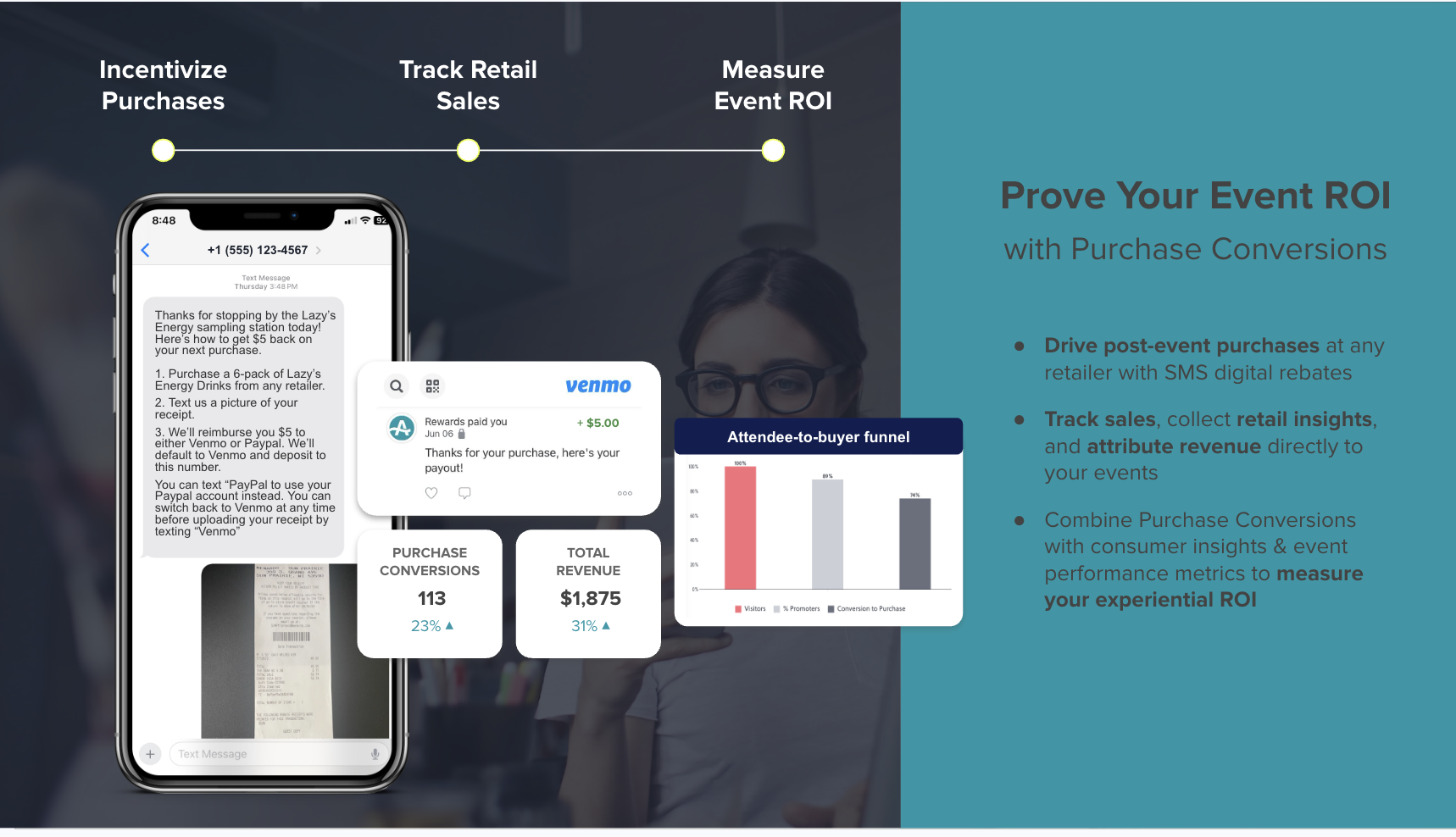
Close the loop with gamified purchase conversion. AnyRoad’s cashback rebate mechanic sends consumers an SMS after a brand activation and incentivizes them to buy the product at any retailer. Shoppers text back their receipt for payment via Venmo or PayPal. AnyRoad’s AI reads the receipt, confirms the eligible SKU, and processes the rebate. No POS integration is required. At field marketing events for a CPG beauty brand, 74% of guests reported being more likely to purchase the brand’s products after attending, and AnyRoad’s receipt-verification mechanic turns that intent into measurable transactions. In a one-month ambassador tasting pilot with a craft brand, 56% of collected records converted to a bottle purchase, illustrating the potential of connecting SMS to verified retail transactions.
Compliance and Best Practices for CPG SMS
SMS compliance carries real financial risk for CPG brands. A 5,000-name list of non-consenting recipients can generate $2.5 million to $7.5 million in statutory damages if a class action forms, which matches the 2025 Zales Jewelers settlement. The following checklist summarizes 2026 requirements.
A2P 10DLC registration is mandatory. Since February 1, 2025, U.S. wireless carriers have blocked all unregistered A2P traffic sent over 10-digit long codes. Every brand must register both a brand record and a campaign record through The Campaign Registry before sending messages. Content must match the registered campaign, and mismatched sample messages are the leading cause of campaign rejection.
Secure prior express written consent. Under the TCPA, consent must be in writing, clear and conspicuous, not pre-checked, specific about sender and message types, and not required as a condition of purchase. A phone number collected at checkout or an event does not count as SMS consent unless SMS marketing was specifically mentioned and agreed to. Bundling SMS consent with email consent in a single checkbox also fails this standard.
Address CPG-specific consent considerations. When collecting numbers via packaging QR codes or at events, consent language must state who is texting, what subscribers will receive, how often, and how to opt out. The CTIA’s SHAFT guidelines restrict messaging content involving alcohol, tobacco, and cannabis, even where state-legal, and carriers actively scan campaign sample messages for these categories. Food, beverage, and personal care brands should review sample messages carefully before submission.
Honor opt-outs immediately and across channels. As of April 11, 2025, the FCC requires businesses to honor opt-out requests within 10 business days and to accept revocations through any reasonable method, such as email, phone calls, website forms, and in-person requests. When someone texts STOP, send a single confirmation and suppress that number across every campaign.
Respect quiet hours and state-level rules. Federal rules prohibit texts before 8 AM or after 9 PM in the recipient’s local time zone. Florida’s FTSA and Oklahoma’s OTSA tighten this to 8 PM, and Oklahoma also limits senders to no more than three messages per 24-hour period even with valid consent. Active state-level mini-TCPA jurisdictions currently include Florida, Texas, Oklahoma, Washington, and Maryland.
Keep consent records for at least four years. Consent records should include timestamp, source, IP address, and the exact wording shown at opt-in, and must be kept for at least four years after the last message sent under that consent. If consent records cannot be produced within 30 days of a discovery request, every text sent to that person is presumed unauthorized.
Measuring Success: Metrics That Matter for CPG
Open rates provide little insight for SMS because nearly everyone opens a text. Reporting a “97% open rate” says nothing about business impact. CPG brands should focus on metrics that tie directly to outcomes.
- Opt-in rate. The percentage of people who subscribe when presented with the opportunity, which reflects how effectively packaging, events, and digital campaigns build the list.
- Click-through rate. Industry average is 19–20% for well-run campaigns.
- Conversion rate. Strong SMS programs see 21–32% conversion rates post-click.
- Incremental revenue. Revenue directly attributable to SMS campaigns, measured using holdout groups that do not receive messages and serve as a comparison.
- Repeat purchase rate. The percentage of SMS subscribers who make a second purchase, which shows whether SMS drives retention instead of one-time discounts.
- Opt-out rate. A warning sign if it exceeds 1–2% per campaign, since rising opt-outs signal problems with frequency or relevance.
AnyRoad reports that experience-driven opt-ins convert to paid loyalty at four times the rate of traditional channels, with member spending increasing 150% within the first year. AnyRoad’s analytics connect SMS campaigns to experiential data and verified retail sales, so CPG brands can prove ROI across both DTC and retail channels from a single platform.

Common Pitfalls to Avoid
- Buying lists. Purchased or scraped phone numbers are non-consensual and prohibited by CTIA and the FCC, and carriers flag such patterns within hours.
- Ignoring compliance. As Lasse Pettersen, founder of FixyFlow, notes, “Email is soft enforcement: a bad send hurts sender reputation. SMS is hard: a bad send gets your number killed in 24 hours.”
- Over-sending. Bombarding users with daily texts causes opt-outs to spike, according to Salesforce’s SMS best practices guide. Stick to two to four promotional messages per month.
- Failing to segment. Sending the same message to an entire contact list without segmentation leads to low engagement, increased opt-outs, and weak sales performance.
- Writing SMS like email. Long copy, multiple CTAs, and HTML-style language break the implicit contract of SMS as an intimate, high-trust channel. One message should carry one idea and one action.
- Using generic link shorteners. Carriers frequently filter and block generic public link shorteners due to spam concerns. Use branded short links instead.
Why AnyRoad Is the Ideal Partner for CPG SMS Campaigns
AnyRoad connects SMS to the experiences where CPG brands actually build relationships with consumers. Three capabilities distinguish it from generic SMS platforms.

Experiential data capture at the highest-intent opt-in channel. AnyRoad captures SMS opt-ins directly during events, tastings, and brand activations using the AnyRoad Live mobile app. As noted earlier, POPLIFE captured 45–50% more consumer data than competitors when using AnyRoad at festivals.
Micro-segmentation powered by first-party experiential data. Guest data, NPS scores, spend, visit frequency, and club status all live in one platform. Brands can target high-value cohorts, such as repeat visitors with high NPS and above-average spend, without stitching together multiple tools. For a CPG beauty brand, Conversate Collective used AnyRoad to build complete consumer profiles and surface the Walgreens and Target insight mentioned earlier, which enabled SMS campaigns tailored to the right consumers with the right retail message.
Gamified purchase conversion that closes the retail loop. AnyRoad’s cashback rebate and sweepstakes mechanics send consumers an SMS after an activation, encourage a retail purchase at any store, and verify the transaction via receipt photo. This process produces a first-party record tied to a confirmed sale. No POS integration is required, so brands can deploy the mechanic across any retail account at scale.
For brands without in-house SMS and email expertise, AnyRoad’s managed CRM services sit on top of the same first-party experiential data. These services are run by specialists who understand CPG compliance and product launch calendars, giving brands a category-native partner for lifecycle marketing.
Frequently Asked Questions
What is the best SMS marketing platform for CPG brands?
The strongest SMS platforms for CPG brands solve three structural challenges. They capture opt-ins from packaging and events instead of relying on digital checkout. They connect SMS engagement to retail sales that the brand does not control. They maintain compliance when consent is collected offline. Horizontal platforms like Klaviyo or Mailchimp require a brand to supply both the subscriber data and the in-house expertise to run campaigns. AnyRoad differentiates by sitting on top of first-party experiential data, including NPS scores, spend, visit frequency, and purchase intent captured directly at tastings, samplings, and brand activations. Its gamified purchase conversion tools, including cashback rebates verified by receipt photo, connect SMS campaigns to confirmed retail transactions without POS integration. For brands without in-house lifecycle marketing capability, AnyRoad also offers managed CRM services run by people who understand CPG compliance and the rhythm of product launch calendars.
Is SMS marketing legal in the USA for CPG brands?
SMS marketing is legal in the USA when brands follow TCPA regulations, CTIA Messaging Principles, and A2P 10DLC registration requirements. Key requirements include obtaining prior express written consent that is specific to SMS marketing, registering brand and campaign records through The Campaign Registry before sending messages, honoring opt-out requests within 10 business days through any reasonable channel, and respecting quiet hours of 8 AM to 9 PM in the recipient’s local time zone. CPG brands collecting consent via packaging QR codes or at events face additional scrutiny because the consent must explicitly mention SMS marketing. A phone number collected at a tasting event does not automatically authorize marketing texts. TCPA violations carry statutory damages of $500 to $1,500 per message with no cap on class-action damages. Several states, including Florida, Texas, Oklahoma, Washington, and Maryland, have enacted mini-TCPA laws with their own penalties and stricter quiet-hour rules that layer on top of federal requirements.
How do CPG brands build an SMS subscriber list without a digital checkout?
CPG brands have four primary opt-in channels that do not require a digital checkout. First, on-pack QR codes and text-to-join keywords turn every unit sold into a potential opt-in. A QR code on a label links to a mobile opt-in page, and a keyword such as “Text SNACK to 12345” gives shoppers an immediate action. Second, in-store point-of-purchase displays can feature QR codes or short codes that shoppers scan in the aisle. Third, digital ads and social media can drive to two-step web sign-up forms with an explicit incentive. Fourth, experiential events such as tastings, samplings, festivals, and brand activations attract consumers who are already engaged with the brand, making them the highest-intent opt-in channel available. In a POPLIFE case study for an artisanal mezcal brand using AnyRoad at festivals like III Points and Portola, 42% of attendees opted into future marketing communications, and POPLIFE captured 45–50% more consumer data than competitors using traditional methods. All opt-in flows must include clear disclosure of who is texting, what subscribers will receive, how often, and how to opt out, and consent records must be stored with timestamps, source URLs, and the exact disclosure text shown.
What SMS metrics should CPG brands track?
CPG brands should track metrics that reflect business outcomes rather than vanity numbers. Key metrics include opt-in rate, click-through rate, conversion rate post-click, opt-out rate per campaign, and incremental revenue measured using holdout groups. For CPG brands, store locator engagement via SMS campaigns, measured by clicks on store locator links and their correlation with in-store visits, serves as a useful proxy for retail impact. BlendJet’s Christmas 2023 campaign sent 325,000 SMS messages linking to a store locator, achieved a 2.2% click-through rate, and drove seven figures in incremental retail sales. The most defensible measure of SMS ROI is incremental lift. Randomly exclude a segment from receiving a campaign, then compare their purchase behavior to the group that received it. AnyRoad’s receipt-verification mechanic enables this even for retail sales the brand does not directly process.
How do I stay compliant with A2P 10DLC when collecting SMS consent at events and via QR codes?
A2P 10DLC registration and TCPA consent operate as two separate requirements that both must be satisfied. For registration, every brand sending automated marketing texts over a 10-digit long code must register a brand record and at least one campaign record through The Campaign Registry before sending messages. Since February 2025, carriers have blocked unregistered traffic. For consent, collecting a phone number at an event or via a packaging QR code does not automatically create SMS consent. The opt-in flow, whether a mobile landing page, a tablet form at an event, or a text-to-join keyword, must explicitly state that the consumer agrees to receive SMS marketing messages, identify the brand sending them, describe the message types and frequency, and provide opt-out instructions. Consent records must capture the timestamp, IP address or device identifier, source URL or event location, and the exact disclosure text shown. These records must be retained for at least four years. For CPG brands in alcohol, tobacco, or cannabis categories, CTIA’s SHAFT guidelines add carrier-level content restrictions that apply regardless of state legality, so campaign sample messages submitted to TCR must be reviewed against those guidelines before registration.